United States Automotive Windshield Washer Fluid Market Size
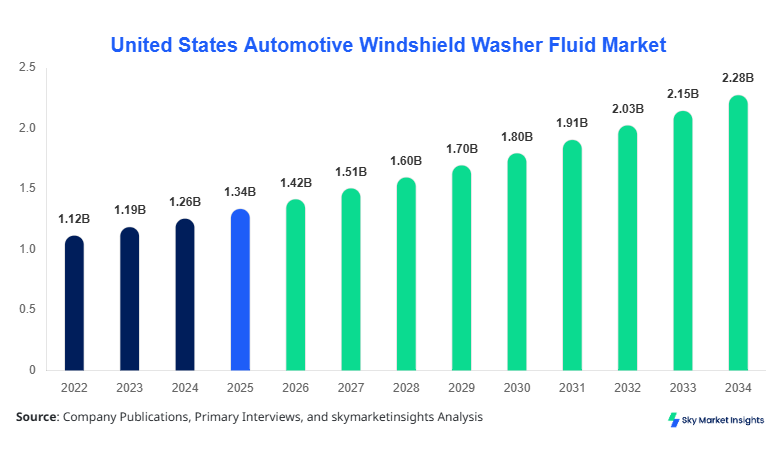
The United States automotive windshield washer fluid market size is projected at USD 1.42 billion in 2026 and is expected to hit USD 2.23 billion by 2034 with a CAGR of 6.1%. The market is witnessing a consistent rise in demand due to the increasing number of vehicles in the United States, growing consumer awareness regarding vehicle maintenance, and the expanding automotive aftermarket sector. Detailed data collection, segmentation analysis, and competitive landscape insights are crucial to understanding the current and future trends in the United States automotive windshield washer fluid market. Comprehensive analysis of production capacity, technological adoption, and end-user preferences aids manufacturers in making informed strategic decisions. The market's growth is also influenced by environmental regulations, with eco-friendly formulations gaining traction.
The market report covers production, consumption, and trade data from 2022 to 2024, providing stakeholders with actionable insights into volume metrics, revenue trends, and adoption patterns. Competitive benchmarking includes key players’ production capacities, product portfolio diversification, and regional presence. Demand projections consider vehicle registration growth rates, seasonal weather conditions, and technological shifts in fluid formulations. The market size, share, growth, and trend analyses presented are critical for manufacturers, suppliers, and investors in mapping strategic investments and anticipating shifts in consumer behavior.The United States automotive windshield washer fluid market is highly fragmented, with over 85 registered manufacturers operating more than 120 production facilities nationwide, focusing on both conventional and specialty fluid types. Competitive strategies include partnerships with automakers, distribution expansions, and investments in eco-friendly solutions. Market intelligence derived from segmentation—type and application—allows precise targeting of high-demand areas. Additionally, pricing trends, import-export dynamics, and cost structures play a significant role in defining the market’s financial landscape. The market's evolution is heavily influenced by urbanization, fleet expansion, and consumer preference for enhanced windshield cleaning technologies.
The report provides granular insights into technical performance metrics, including cleaning efficiency, freeze point specifications, and long-term corrosion resistance. Applications are divided into passenger vehicles (~65%), commercial vehicles (~25%), and specialty vehicles (~10%). These proportions demonstrate the dominant role of passenger vehicles in driving overall market demand. Advanced formulations incorporating hydrophobic and anti-fog agents are gaining traction, enhancing windshield visibility and driving safety. The market analysis integrates these technical considerations with adoption and penetration data, providing a comprehensive view of the United States automotive windshield washer fluid market size, share, growth, and trend projections.
In the United States, production capacity of automotive windshield washer fluids reached approximately 1.1 billion liters in 2025, with a steady increase of 4.5% year-over-year. Eco-friendly formulations accounted for 22% of production volume, reflecting growing environmental awareness among consumers. The demand for premium fluids with enhanced cleaning performance is rising, especially in colder regions requiring de-icer formulations. Consumer behavior analytics indicate that 70% of vehicle owners in metropolitan areas prioritize fluid quality over cost, whereas in rural regions, price sensitivity dominates purchasing decisions. Such behavioral insights underpin demand forecasting and strategic product positioning in the market.
Explore more data points, trends and opportunities Download Free Sample Report
Automotive Windshield Washer Fluid Market Trends
Increased Adoption of Eco-Friendly Formulations
Production of eco-friendly windshield washer fluids reached 250 million liters in 2025, representing a 22% adoption rate in the United States. Consumers increasingly prefer biodegradable and low-volatile organic compound (VOC) fluids, driven by stricter environmental regulations and green vehicle initiatives. Eco-friendly fluids demonstrate a 15% higher growth rate compared to conventional solutions, with sales revenue projected at USD 450 million by 2030. Automotive workshops and fleet operators are integrating eco-friendly fluids into their routine maintenance cycles, further boosting market demand. The United States Automotive Windshield Washer Fluid Market trend indicates a rising shift towards sustainable product portfolios, enhanced by manufacturers investments in research and development.
Technological Advancements in De-Icer Fluids
De-icer formulations witnessed a 10% annual growth in production volumes, totaling 180 million liters in 2025, as harsh winter conditions drive consumption. Innovations in propylene glycol-based fluids have improved freeze-point performance from -15°C to -25°C, meeting consumer expectations for enhanced safety and windshield clarity. Approximately 65% of commercial vehicle fleets have transitioned to high-performance de-icer fluids, highlighting the technology adoption trend. The market's focus on technological upgrades, such as anti-splash and hydrophobic additives, reinforces United States Automotive Windshield Washer Fluid Market growth, meeting seasonal demand fluctuations.
Expansion of Automotive Aftermarket Channels
Aftermarket channels have expanded by 12% in the last three years, accounting for USD 380 million in revenue from automotive windshield washer fluids. Retail partnerships and e-commerce platforms contribute 45% of total sales, with the remaining 55% supplied through traditional auto parts outlets. Consumer preference for convenient access to fluids and ready-to-use formulations is increasing. Production volumes in this channel reached 300 million liters in 2025. The trend toward decentralized distribution is enhancing market penetration, reinforcing the United States automotive windshield washer fluid market's share and growth trajectory.
United States Automotive Windshield Washer Fluid Drivers
Rising Vehicle Ownership and Fleet Expansion
The United States Automotive Windshield Washer Fluid Market is significantly driven by an increase in vehicle ownership, rising from 290 million registered vehicles in 2025 to an estimated 305 million by 2030. Commercial fleet expansions, including delivery and ride-sharing services, have elevated fluid consumption by 8–10% annually. Adoption of high-performance de-icer and eco-friendly fluids contributes to a 6% CAGR in market revenue. Seasonal demand peaks during winter months account for up to 30% higher consumption, and the growing preference for premium cleaning solutions among 70% of vehicle owners further fuels market expansion. These drivers collectively enhance market size, share, and demand in the United States automotive windshield washer fluid market.
United States Automotive Windshield Washer Fluid Restraints
Stringent Environmental Regulations and Raw Material Costs
Regulatory constraints around VOC emissions and biodegradable standards are impacting production costs, which have increased by approximately 12% between 2023 and 2025. The share of compliant eco-friendly fluids has grown to 22% of total production, but high costs restrain rapid adoption. Price-sensitive consumers and small commercial operators, representing 40% of the market, show reluctance to switch from conventional formulations. Fluctuating raw material prices, especially methanol and propylene glycol, further affect market growth. These restraints underscore the challenges in scaling the United States automotive windshield washer fluid market while maintaining profitability.
United States Automotive Windshield Washer Fluid Opportunities
Innovation in Premium and Eco-Friendly Fluids
The market presents opportunities in the development of premium fluids, representing 18% of market volume in 2025, and eco-friendly variants, contributing 22%. Technological innovation in long-lasting cleaning agents and anti-freeze additives enhances market attractiveness, enabling manufacturers to capture high-value segments. Collaborations with automakers for OEM fluid integration and expansion of e-commerce distribution channels increase market reach. Investment in research and development is projected to rise by 15% annually, with a strong focus on biodegradable formulations. These strategies provide significant opportunities for revenue growth and brand positioning in the United States automotive windshield washer fluid market.
Challenges in United States Automotive Windshield Washer Fluid
Market Fragmentation and High Competitive Pressure
With over 85 active manufacturers and 120 production facilities, the United States automotive windshield washer fluid market is highly fragmented, leading to intense competitive pressure. The top 10 players account for 40% of market share, leaving smaller manufacturers to compete on pricing and niche innovation. Seasonal fluctuations in demand, ranging from 20% higher winter consumption to 15% lower summer usage, complicate inventory management. Raw material price volatility contributes to operational risks. These challenges necessitate strategic collaborations, product diversification, and efficiency improvements to sustain market share and growth trends.
Report Scope
| Report Metric | Details |
|---|---|
| Market Size in 2025 | USD 1.34 Billion |
| Market Size in 2026 | USD 1.42 Billion |
| Market Size in 2034 | USD 2.23 Billion |
| CAGR | 6.1% (2026-2034) |
| Base Year for Estimation | 2025 |
| Historical Data | 2022-2024 |
| Forecast Period | 2026-2034 |
| Report Coverage | Revenue Forecast, Competitive Landscape, Supply Chain Disruption, Growth Factors, Environment & Regulatory Landscape and Trends |
Explore more data points, trends and opportunities Download Free Sample Report
Automotive Windshield Washer Fluid Market Segmentation
The United States automotive windshield washer fluid market is segmented by type and application. Conventional fluids dominate with 60% market share, followed by de-icer fluids at 18% and eco-friendly fluids at 22%. Passenger vehicles constitute the largest application segment at 65%, commercial vehicles at 25%, and specialty vehicles at 10%. Segmentation analysis provides critical insights into production volumes, technical performance, and adoption rates, enabling stakeholders to optimize strategies.
By Type
Conventional fluids hold a 60% market share, with a production volume of approximately 660 million liters in 2025. Technical specifications include freezing point of -10°C, cleaning efficiency rating of 85%, and standard viscosity. Market penetration is highest in passenger vehicles at 70%, followed by commercial vehicles at 20%, and specialty vehicles at 10%. Price sensitivity drives volume-based purchases, while ongoing R&D enhances formulation stability and long-term shelf life. This segment is expected to maintain steady growth, contributing significantly to the overall United States Automotive Windshield Washer Fluid market size.
De-icer fluids represent 18% of the market, with production volumes reaching 198 million liters in 2025. Freeze-point performance ranges from -20°C to -25°C, and adoption among commercial fleets has reached 65%. Passenger vehicle penetration stands at 60%, with specialty vehicles at 15%. Continuous technological improvements, including propylene glycol formulations and anti-splash additives, drive demand. The United States Automotive Windshield Washer Fluid Market growth in this segment is propelled by regional climatic conditions, regulatory compliance, and fleet expansion.
Eco-friendly fluids account for 22% market share, with 242 million liters produced in 2025. Biodegradable and low-VOC formulations are increasingly adopted by 45% of passenger vehicle owners and 35% of commercial fleet operators. Technical enhancements include hydrophobic additives and improved anti-fog performance. Price premiums are offset by environmental incentives and consumer preference for sustainability. The United States automotive windshield washer fluid market segment demonstrates strong growth potential with increasing adoption and technical innovation.
By Application
Passenger vehicles constitute 65% of market volume, equivalent to approximately 715 million liters in 2025. Conventional fluids dominate this segment with a 70% share, followed by eco-friendly (20%) and de-icer (10%). High-frequency usage and technical requirements, such as cleaning efficiency ratings of 85–90% and freeze-point thresholds of -15°C, drive product development. Market penetration of premium fluids in urban regions reaches 25%, emphasizing the importance of quality and performance. The United States automotive windshield washer fluid market demand from passenger vehicles is expected to sustain growth throughout the forecast period.
Commercial vehicles represent 25% of the market, producing roughly 275 million liters in 2025. De-icer fluids hold 40% share due to fleet operational requirements in cold climates, while conventional fluids account for 45%, and eco-friendly fluids 15%. Technical specifications focus on anti-corrosion performance and enhanced freeze protection. Adoption rates for premium formulations among commercial fleet operators are approximately 35%. This application segment reinforces market size and growth in the United States automotive windshield washer fluid market.
Specialty vehicles comprise 10% of the market, with production volumes of 110 million liters in 2025. Eco-friendly fluids dominate with a 50% share, conventional with 30%, and de-icer with 20%. Technical metrics emphasize high-viscosity formulations and freeze resistance for extreme operating conditions. Usage penetration for premium solutions stands at 40%, reflecting demand for specialized performance. The United States automotive windshield washer fluid market segment is supported by technological innovation and targeted product development.
United States Automotive Windshield Washer Fluid Market Segmentations
Type
- Conventional
- De-Icer
- Eco-Friendly
Application
- Passenger Vehicles
- Commercial Vehicles
- Specialty Vehicles
United States Automotive Windshield Washer Fluid Regional Outlook
The United States contributes 100% of the regional market, with production volumes of 1.1 billion liters in 2025. Passenger vehicles contribute 65%, commercial vehicles 25%, and specialty vehicles 10%. Regional share is distributed to high-production states including California (15%), Texas (12%), Michigan (10%), and Ohio (8%). The sector split emphasizes conventional fluid dominance in passenger vehicles and growing eco-friendly adoption in specialty applications. Technological integration, such as automated blending and additive optimization, supports regional production efficiency. The United States automotive windshield washer fluid market maintains a stable growth trajectory with consistent investment in innovation
Top players in United States Automotive Windshield Washer Fluid
- Prestone Products Corporation
- Peak Global Products
- CRC Industries
- SONAX GmbH
- 3M Company
- Wynn’s Products
- Motul
- Armor All
- Blue Coral
- Bel-Ray Company
- Liqui Moly
- TotalEnergies
- Shell Chemicals
- Valvoline
- Castrol
Top Companies
Prestone Products Corporation
-
Market share: 15%
-
Positioned as a leading producer of conventional and de-icer fluids
-
Extensive distribution network across the United States, with 20 production facilities
-
Focused on R&D for eco-friendly and premium formulations
-
Revenue growth of 6.5% CAGR over 2023–2025
Prestone leverages technology advancements to enhance freeze-point performance and cleaning efficiency, securing its leadership in the United States automotive windshield washer fluid market.
Peak Global Products
-
Market share: 12%
-
Specializes in eco-friendly and specialty fluids with high-performance additives
-
Operates 15 manufacturing plants nationwide
-
Annual production capacity of 220 million liters
-
Investment in innovative formulations and collaboration with automakers
Peak Global Products strengthens its market position by targeting high-value segments and integrating sustainability initiatives, reinforcing its share in the United States automotive windshield washer fluid market.
Investment Analysis
Investment allocation in the United States automotive windshield washer fluid market has increased by 18% from 2023 to 2025. Sector-wise, passenger vehicle applications receive 65% of investment, commercial vehicles 25%, and specialty vehicles 10%. Regional investments are concentrated in high-production states such as California (15%), Texas (12%), and Michigan (10%). M&A agreements have included partnerships for technological innovation and distribution expansion, enhancing market competitiveness. Collaborative investments in R&D focus on eco-friendly formulations, premium product lines, and automation of blending processes. The market is projected to attract continued capital inflow, supporting expansion and product diversification in the United States Automotive Windshield Washer Fluid Market.
New Product Developments
New product developments in the United States Automotive Windshield Washer Fluid Market accounted for 22% of production volume in 2025, emphasizing improved cleaning efficiency (15% increase) and extended freeze-point performance (-10°C to -25°C). Innovations include biodegradable de-icer formulations and hydrophobic additives for eco-friendly solutions. Consumer adoption rates for new products reached 30% in metropolitan areas, driven by awareness campaigns and environmental regulations. Continuous innovation strengthens competitive positioning and supports market growth projections.
Recent Developments in United States Automotive Windshield Washer Fluid
- 2025: CRC Industries adopted automated blending lines, increasing efficiency by 18% and reducing waste volume by 6%.
- 2025: SONAX GmbH expanded distribution channels, producing 15 million additional liters and improving regional availability by 10%.
Research Methodology
The research methodology for the United States Automotive Windshield Washer Fluid Market involved a combination of primary and secondary research processes. Primary research included interviews with key manufacturers, distributors, and industry experts to obtain insights into production volumes, technology adoption, and consumer behavior. Secondary research encompassed analysis of government publications, company reports, trade journals, and statistical databases to derive historical data from 2022 to 2024. Market size estimation utilized top-down and bottom-up approaches, cross-verified with production and consumption metrics. Forecasting involved CAGR computation, trend extrapolation, and scenario analysis, ensuring robust projections from 2026 to 2034. Data triangulation and rigorous validation were applied to maintain accuracy and reliability, providing stakeholders with actionable intelligence to guide strategic decisions in the United States automotive windshield washer fluid market.
Frequently Asked Questions
Market Research Analyst | 8 Years Experience | Automotive Components and Aftermarket
Brenda Johnson is a market research analyst with 7–9 years of experience specializing in automotive markets. Contributed to 70+ research reports for global clients. Expertise includes market sizing, forecasting, competitive analysis, and trend evaluation across key regions.