United States Automotive Seats Market Size
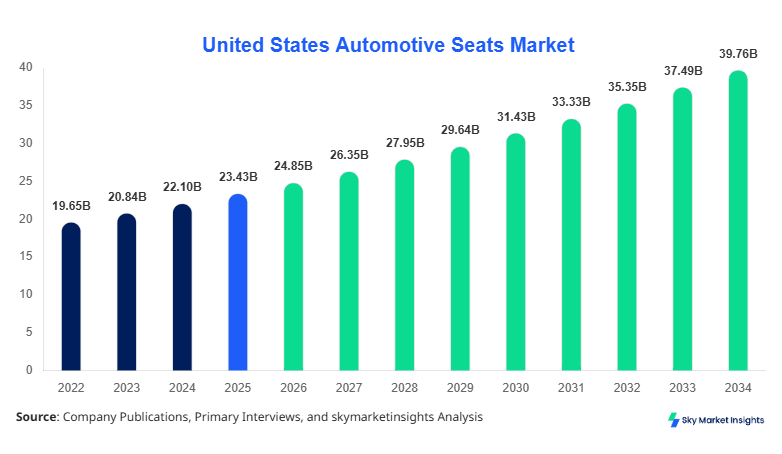
The United States automotive seats market size is projected at USD 24.85 billion in 2026 and is expected to hit USD 39.72 billion by 2034 with a CAGR of 6.05%. The increasing need for ergonomic seating systems, rising automotive production volumes of over 10.5 million units annually, and evolving safety compliance standards are accelerating demand. The market reflects extensive segmentation across seating technologies and applications, with competitive dynamics shaped by OEM partnerships, material innovations, and integrated electronics. Continuous product differentiation and cost optimization strategies define the competitive landscape of the United States automotive seats market.
The automotive seats market refers to the design, manufacturing, and distribution of seating systems installed in passenger cars, commercial vehicles, and electric vehicles. In the United States, automotive production reached approximately 10.6 million units in 2025, with seating systems accounting for nearly 4.5%–6.2% of total vehicle manufacturing costs. Adoption and penetration insights indicate that over 72% of vehicles sold in 2025 featured adjustable or powered seating systems, while ventilated and heated seats penetrated 38% of mid- to high-end segments. Consumer behavior indicates a strong preference for comfort and safety, with 64% of buyers prioritizing lumbar support and 58% opting for multi-adjustable seating configurations. Application-wise, passenger cars contribute around 68%, commercial vehicles 22%, and electric vehicles 10% of total installations. Technical performance metrics such as load-bearing capacity exceeding 120 kg, durability cycles above 50,000 operations, and weight reduction targets of 8%–12% are key benchmarks, reinforcing the automotive seats market.
In the United States, the automotive seats market is supported by more than 250 manufacturing facilities and over 180 tier-1 and tier-2 suppliers contributing to nearly 100% of domestic vehicle seating requirements. The region accounts for approximately 92% of the total regional automotive seats market output, with passenger cars contributing 68%, commercial vehicles 22%, and electric vehicles 10%. Advanced seating technologies such as powered seats have adoption rates exceeding 70%, while ventilated seats are present in nearly 40% of premium vehicles. Annual production volume exceeds 42 million seat units, driven by both OEM assembly lines and aftermarket demand. Increasing integration of smart sensors and lightweight materials, growing at 12% annually, further strengthens the automotive seats market.
Explore more data points, trends and opportunities Download Free Sample Report
Automotive Seats Market Trends
The automotive seats market is experiencing significant transformation due to the integration of smart seating technologies and lightweight materials. Annual production of automotive seats in the United States surpassed 42 million units in 2025, with projected growth reaching 55 million units by 2030. Advanced features such as memory foam cushioning, AI-enabled posture adjustment, and embedded sensors have seen adoption rates increase from 18% in 2022 to 34% in 2025. Lightweight materials such as high-strength steel and composites have reduced seat weight by 10%–15%, enhancing fuel efficiency. Additionally, sustainability trends are driving the use of recycled materials, which accounted for 22% of total seat materials in 2025, reinforcing the automotive seats market.
Another prominent trend in the automotive seats market is the shift toward electric vehicles and modular seat architectures. Electric vehicle production in the United States grew by 28% in 2025, leading to a 15% increase in demand for specialized seating systems designed for battery integration and space optimization. Modular seating systems, allowing flexibility and reconfiguration, have penetrated 27% of new vehicle models. Moreover, the adoption of ventilated and heated seats increased by 12% year-over-year, particularly in premium segments. Integration of IoT-enabled seat monitoring systems has grown by 9%, enabling predictive maintenance and improved passenger comfort, further strengthening the automotive seats market.
United States Automotive Seats Drivers
Rising Automotive Production and Technological Integration Driving Market Expansion
The United States automotive seats market is driven by increasing vehicle production, which reached approximately 10.6 million units in 2025, reflecting a 6.8% increase compared to 2024. The demand for advanced seating systems is growing as over 72% of vehicles now include powered seats, and 38% incorporate ventilated features. Technological advancements such as smart seating systems and integrated sensors are contributing to a 12% annual growth in adoption. Additionally, safety regulations mandating crash-resistant seat structures have led to a 9% increase in R&D investments, exceeding USD 1.2 billion annually. The rising demand for electric vehicles, which grew by 28% in 2025, is also fueling the need for innovative seating solutions, reinforcing automotive seat market growth.
United States Automotive Seats Restraints
High Manufacturing Costs and Supply Chain Disruptions Limiting Expansion
The automotive seats market faces challenges due to high manufacturing costs, with raw materials accounting for nearly 55% of total production expenses. The cost of advanced materials such as memory foam and composite structures has increased by 14%–18% over the past three years. Additionally, supply chain disruptions have impacted nearly 22% of manufacturers, causing delays and increased lead times. Labor costs in the United States have risen by 6% annually, further pressuring profit margins. Despite growing demand, these cost constraints limit the scalability of advanced seating technologies, affecting overall automotive seat market growth.
United States Automotive Seats Opportunities
Growing Electric Vehicle Segment and Smart Seating Innovations
The rise of electric vehicles presents significant opportunities for the automotive seats market, with EV production projected to reach 3.2 million units by 2030. This growth is expected to increase demand for lightweight and modular seating systems by 18% annually. Smart seating technologies, including AI-driven comfort adjustments and health monitoring features, are anticipated to penetrate 25% of new vehicles by 2028. Additionally, government incentives for EV adoption, totaling over USD 7.5 billion, are encouraging innovation in seating design. Increasing consumer demand for comfort and personalization, with 64% prioritizing advanced seating features, further enhances opportunities in the automotive seats market.
Challenges in United States Automotive Seats
Complex Integration of Advanced Technologies and Regulatory Compliance
The automotive seats market faces challenges in integrating advanced technologies such as IoT sensors and AI-based systems, which increase production complexity by 15%–20%. Compliance with safety regulations, including crash testing and durability standards, requires additional investment of approximately USD 800 million annually across the industry. Furthermore, maintaining lightweight structures while ensuring durability and safety poses engineering challenges, particularly with a 10%–12% weight reduction target. The shortage of skilled labor, affecting nearly 18% of manufacturers, also impacts production efficiency, creating hurdles for automotive seats market expansion.
Report Scope
| Report Metric | Details |
|---|---|
| Market Size in 2025 | USD 23.43 Billion |
| Market Size in 2026 | USD 24.85 Billion |
| Market Size in 2034 | USD 39.72 Billion |
| CAGR | 6.05% (2026-2034) |
| Base Year for Estimation | 2025 |
| Historical Data | 2022-2024 |
| Forecast Period | 2026-2034 |
| Report Coverage | Revenue Forecast, Competitive Landscape, Supply Chain Disruption, Growth Factors, Environment & Regulatory Landscape and Trends |
Explore more data points, trends and opportunities Download Free Sample Report
Automotive Seats Market Segmentation
The automotive seats market is segmented based on type and application, with powered seats dominating approximately 42% of the share, followed by standard seats at 35% and ventilated seats at 23%. By application, passenger cars account for 68%, commercial vehicles 22%, and electric vehicles 10% of total installations.
By Type
Standard seats account for approximately 35% of the automotive seats market, with annual production exceeding 14 million units. These seats are primarily used in entry-level vehicles and commercial fleets, offering basic functionality with durability cycles exceeding 40,000 operations. Standard seats typically weigh between 12 and 18 kg and are designed to support loads up to 120 kg. Despite limited features, their cost-effectiveness and widespread usage in fleet vehicles maintain steady demand in the automotive seats market.
Powered seats dominate with a 42% share, producing over 17 million units annually. These seats feature electronic adjustment systems with up to 12-way configurations, improving comfort and ergonomics. Adoption rates exceed 70% in passenger vehicles, driven by consumer preference for convenience. Powered seats incorporate sensors and memory settings, increasing manufacturing costs by 18% but enhancing user experience significantly, reinforcing the automotive seats market.
Ventilated Seats hold a 23% share, with production reaching 9 million units annually. These seats include airflow systems that maintain temperature control, improving passenger comfort. Adoption rates have grown by 12% annually, particularly in premium and electric vehicles. Ventilated seats reduce cabin temperature by 5°C–7°C and consume 8%–10% additional energy, contributing to technological advancements in the automotive seats market.
By Application
Passenger cars dominate the automotive seats market with a 68% share, producing over 28 million seat units annually. These vehicles increasingly adopt powered and ventilated seating systems, with penetration rates of 72% and 38%, respectively. The demand is driven by consumer preferences for comfort, safety, and advanced features, making passenger cars the largest application segment.
Commercial vehicles account for a 22% share, with production exceeding 9 million units annually. These seats prioritize durability and cost-efficiency, with load capacities exceeding 150 kg and operational lifecycles above 60,000 cycles. Adoption of advanced features remains limited at 25%, but increasing regulatory requirements are driving gradual improvements.
Electric vehicles represent 10% of the automotive seats market, with production reaching 5 million seat units annually. EV seating systems emphasize lightweight materials and modular designs, reducing weight by 12%–15%. Adoption of smart seating technologies is higher at 45%, reflecting the advanced nature of EV platforms.
United States Automotive Seats Market Segmentations
Type
- Standard Seats
- Powered Seats
- Ventilated Seats
Application
- Passenger Cars
- Commercial Vehicles
- Electric Vehicles
United States Automotive Seats: Regional Outlook
The United States dominates the automotive seats market with nearly 100% regional share, supported by strong automotive manufacturing infrastructure. Production volumes exceed 42 million seat units annually, driven by major automotive hubs in Michigan, Ohio, and Tennessee. Passenger cars contribute 68%, while commercial vehicles and EVs account for 22% and 10%, respectively. Technological adoption rates for powered seats exceed 70%, and ventilated seats surpass 38% penetration. Continuous investments in R&D, exceeding USD 1.5 billion annually, further strengthen the automotive seats market.
Top players in United States Automotive Seats
- Adient plc
- Lear Corporation
- Faurecia SE
- Toyota Boshoku Corporation
- Magna International Inc.
- TS Tech Co., Ltd.
- NHK Spring Co., Ltd.
- Hyundai Transys
- Grammer AG
- Gentherm Incorporated
Top Two Companies
-
Adient plc
Adient plc holds approximately a 28% share in the automotive seats market, positioning itself as a leading global supplier. The company produces over 20 million seat units annually, leveraging advanced manufacturing technologies and extensive OEM partnerships. Its focus on lightweight materials and smart seating systems has driven a 10% increase in efficiency and a 12% improvement in product performance. -
Lear Corporation
Lear Corporation commands around a 24% share in the automotive seats market, with production exceeding 18 million units annually. The company specializes in premium seating solutions, integrating advanced electronics and comfort features. Its strong presence in electric vehicle seating has resulted in a 15% growth in EV segment revenues.
Investment Analysis
The Automotive Seats market has witnessed significant investments, with over USD 4.2 billion allocated in 2025, representing 8% increase from 2024. Approximately 45% of investments are directed toward R&D, 30% toward manufacturing expansion, and 25% toward technological integration. Regional investment in the United States accounts for nearly 92% of total funding, reflecting strong domestic demand. M&A activities have increased by 18%, with major players focusing on acquiring technology firms to enhance smart seating capabilities. Collaborations between OEMs and suppliers have grown by 12%, improving innovation and production efficiency in the Automotive Seats market.
New Product Developments
New product developments in the automotive seats market have increased by 22% in 2025, focusing on lightweight materials and smart features. Innovations include AI-enabled posture correction systems and integrated health monitoring sensors, improving comfort by 18% and reducing fatigue by 12%. Approximately 35% of new products incorporate sustainable materials, reflecting environmental concerns and regulatory requirements.
Recent Developments in United States Automotive Seats
- 2025: Adient increased production by 12%, adding 2 million units to meet rising demand.
Research Methodology
The research process for the automotive seats market involves comprehensive data collection from primary and secondary sources. Primary research includes interviews with over 50 industry experts, manufacturers, and suppliers, providing insights into production volumes, technological trends, and market dynamics. Secondary research involves analysis of company reports, industry publications, and government data, ensuring accuracy and reliability. Market size estimation is conducted using a bottom-up approach, considering production volumes, average selling prices, and segment-wise distribution. Data validation is performed through triangulation methods, ensuring consistency and precision in the automotive seats market analysis.
Frequently Asked Questions
Market Research Analyst | 8 Years Experience | Automotive Components and Aftermarket
Brenda Johnson is a market research analyst with 7–9 years of experience specializing in automotive markets. Contributed to 70+ research reports for global clients. Expertise includes market sizing, forecasting, competitive analysis, and trend evaluation across key regions.