Asia Pacific Adaptive Variable Suspension System Market Size
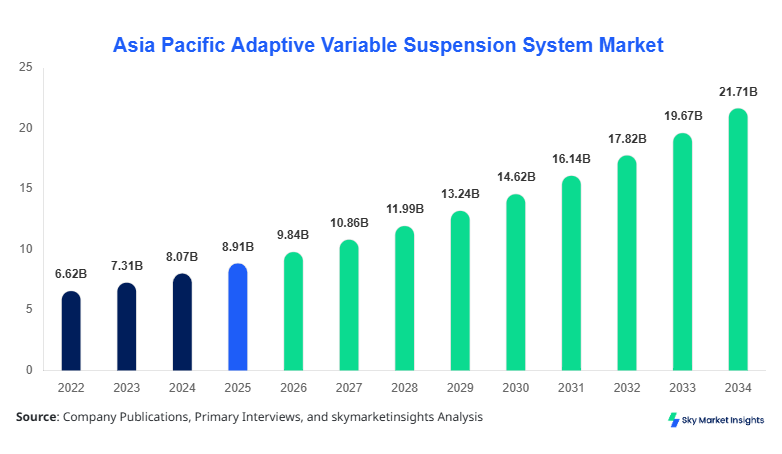
The Asia Pacific Adaptive Variable Suspension System market size is projected at USD 9.84 billion in 2026 and is expected to hit USD 21.67 billion by 2034 with a CAGR of 10.4%. The Asia Pacific Adaptive Variable Suspension System market demonstrates strong expansion supported by increasing automotive production exceeding 52 million units in 2025 and rising demand for advanced ride-comfort technologies across mid-range and premium vehicle segments. The integration of electronically controlled dampers and real-time adjustment systems has resulted in over 38% penetration in luxury vehicles, while semi-active systems account for nearly 46% of installations across passenger vehicles, highlighting the importance of segmentation and competitive landscape analysis in this market.
The adaptive variable suspension system market refers to advanced automotive suspension technologies capable of adjusting damping force, stiffness, and ride height dynamically based on road conditions and driving behavior, enhancing vehicle stability, safety, and comfort. In Asia Pacific, production of vehicles equipped with adaptive suspension systems surpassed 6.2 million units in 2025, representing around 11.9% penetration across total vehicle output. Adoption is rapidly growing, with China and Japan contributing over 62% of total installations due to high automotive manufacturing volumes and technological integration. Consumer behavior indicates increasing preference for enhanced ride quality, with nearly 58% of urban consumers willing to pay 8–12% more for advanced suspension systems. Demand analytics show luxury and premium segments contributing 41% of total installations, while commercial vehicles account for 22% due to fleet optimization requirements. Technical metrics include response times below 10 milliseconds and damping variability ranges of 30–70%, ensuring real-time adaptability. The application split shows passenger vehicles holding 54%, luxury vehicles 24%, and commercial vehicles 22%, reinforcing the Asia Pacific Adaptive Variable Suspension System market.
In China, the Adaptive Variable Suspension System Market dominates the regional landscape with over 45% share, driven by more than 28 major automotive OEM facilities integrating adaptive suspension technologies. China produces over 30 million vehicles annually, with approximately 4.1 million units equipped with adaptive suspension systems in 2025 alone. Passenger vehicles account for 57% of applications, followed by commercial vehicles at 25% and luxury vehicles at 18%. Technology adoption rates exceed 42% in premium segments, supported by government initiatives and domestic innovation. Electrically controlled suspension systems account for 49% of installations, while semi-active systems hold 38%. Increasing adoption of EVs, which reached 9.5 million units in 2025, further accelerates demand due to the need for enhanced ride control and battery protection. This strong technological integration reinforces the Asia-Pacific Adaptive Variable Suspension System market.
Explore more data points, trends and opportunities Download Free Sample Report
Adaptive Variable Suspension System Market Trends
Electrification and Smart Suspension Integration
The integration of adaptive suspension systems with electric vehicles and autonomous driving platforms is emerging as a key trend, with EV production in Asia Pacific exceeding 12 million units projected by 2027. Over 52% of new EV models are expected to incorporate adaptive suspension systems due to the need for optimized weight distribution and battery stability. Smart suspension technologies utilizing AI-based predictive damping have increased adoption by 34% between 2023 and 2025, while production volumes of electronically controlled suspension units surpassed 2.8 million units annually. OEMs are focusing on reducing system weight by 15–20% while improving efficiency by 25%, enabling better energy consumption and vehicle performance. The expansion of connected vehicle ecosystems further enhances real-time adjustment capabilities, reinforcing the Asia-Pacific Adaptive Variable Suspension System market.
Rising Demand in Mid-Range Vehicles
Another significant trend is the expansion of adaptive suspension systems into mid-range vehicle segments, which accounted for only 18% penetration in 2022 but rose to 31% in 2025. Production of mid-range vehicles equipped with semi-active suspension systems reached 3.6 million units, driven by cost optimization strategies and economies of scale. Manufacturers have reduced system costs by approximately 22% over the last three years, making them accessible to a broader consumer base. Additionally, increasing urbanization and road infrastructure development across India and Southeast Asia have driven demand for improved ride comfort, with consumer preference surveys indicating that 64% of buyers consider suspension performance a key purchasing factor. These evolving trends continue to shape the Asia-Pacific Adaptive Variable Suspension System market.
Asia Pacific Adaptive Variable Suspension System Drivers
Increasing Demand for Vehicle Comfort and Safety Enhances Market Growth
The growing emphasis on passenger comfort and safety is a primary driver for the Asia Pacific Adaptive Variable Suspension System market, with over 68% of consumers prioritizing ride quality in purchasing decisions. The automotive sector recorded production of more than 52 million units in 2025, with adaptive suspension systems integrated into nearly 6.2 million units, reflecting a penetration rate of 11.9%. Advanced systems can reduce body roll by up to 40% and improve braking stability by 18–25%, enhancing safety standards. Additionally, the rise in premium vehicle sales, which grew by 14% year-over-year, has significantly contributed to demand, as nearly 75% of luxury vehicles are equipped with adaptive suspension technologies. Government regulations emphasizing vehicle safety and emission reduction further drive adoption, particularly in electric vehicles, which saw a 27% growth rate in Asia Pacific. These factors collectively accelerate the Asia-Pacific Adaptive Variable Suspension System market.
Asia Pacific Adaptive Variable Suspension System Restraints
High System Cost and Maintenance Challenges Limit Adoption
Despite significant growth, the Asia Pacific Adaptive Variable Suspension System market faces restraints due to high system costs and maintenance complexities. The average cost of installing adaptive suspension systems ranges between USD 800 and USD 2,500 per vehicle, making it less accessible for budget segments. Maintenance costs are approximately 18–25% higher compared to conventional suspension systems, with replacement components costing up to USD 600 per unit. Additionally, limited technical expertise in emerging markets such as Southeast Asia and India restricts widespread adoption, with only 22% of service centers equipped to handle advanced suspension technologies. The complexity of electronic control units and sensors increases failure risks, with failure rates estimated at 6–8% over five years. These cost and infrastructure challenges continue to restrain the Asia-Pacific Adaptive Variable Suspension System market.
Asia Pacific Adaptive Variable Suspension System Opportunities
Expansion of Electric Vehicles Creates New Growth Avenues
The rapid expansion of electric vehicles presents significant opportunities for the Asia Pacific adaptive variable suspension system market, with EV production projected to reach 18 million units by 2030. Adaptive suspension systems are increasingly integrated into EV platforms to enhance ride stability and battery protection, with adoption rates expected to exceed 55% in premium EV segments. Investments in EV infrastructure across Asia Pacific exceeded USD 120 billion in 2025, with 34% allocated to advanced vehicle technologies, including suspension systems. Additionally, advancements in lightweight materials and AI-based control systems are expected to reduce system costs by 15–20% over the next five years, further expanding market reach. Emerging markets such as India and Southeast Asia are witnessing increased adoption, with annual growth rates of 12–15%, creating substantial opportunities in the Asia Pacific Adaptive Variable Suspension System market.
Challenges in the Asia-Pacific Adaptive Variable Suspension System
Technical Complexity and Supply Chain Disruptions Pose Challenges
Technical complexity and supply chain disruptions represent major challenges in the Asia Pacific Adaptive Variable Suspension System market, impacting production and adoption rates. The reliance on advanced electronic components, including sensors and actuators, has led to supply shortages, with component availability declining by 8–10% during peak demand periods. Additionally, manufacturing complexities result in longer production cycles, increasing lead times by 12–18%. The integration of adaptive systems requires high-precision engineering, with error margins below 2%, increasing production costs and technical barriers. Furthermore, geopolitical tensions and semiconductor shortages have impacted supply chains, causing delays in over 15% of automotive production lines. These challenges hinder the scalability of adaptive suspension systems, affecting the Asia-Pacific Adaptive Variable Suspension System market.
Report Scope
| Report Metric | Details |
|---|---|
| Market Size in 2025 | USD 8.91 Billion |
| Market Size in 2026 | USD 9.84 Billion |
| Market Size in 2034 | USD 21.67 Billion |
| CAGR | 10.4% (2026-2034) |
| Base Year for Estimation | 2025 |
| Historical Data | 2022-2024 |
| Forecast Period | 2026-2034 |
| Report Coverage | Revenue Forecast, Competitive Landscape, Supply Chain Disruption, Growth Factors, Environment & Regulatory Landscape and Trends |
Explore more data points, trends and opportunities Download Free Sample Report
Adaptive Variable Suspension System Market Segmentation
The Asia Pacific Adaptive Variable Suspension System market segmentation highlights the dominance of semi-active systems with 46% share, followed by electronically controlled systems at 32% and fully active systems at 22%. By application, passenger vehicles lead with 54% share, followed by luxury vehicles at 24% and commercial vehicles at 22%.
By Type
Semi-active suspension systems dominate the Asia Pacific Adaptive Variable Suspension System market, accounting for approximately 46% of the share with production exceeding 2.8 million units annually. These systems utilize electronically adjustable dampers capable of varying damping force within milliseconds, offering cost-effective performance improvements. With response times below 15 milliseconds and damping variability of up to 50%, semi-active systems are widely adopted in mid-range vehicles, where cost efficiency is critical.
Fully active suspension systems hold around 22% share, with production volumes reaching 1.4 million units. These systems provide real-time control over ride height and damping using hydraulic or electric actuators, delivering superior performance with up to a 60% reduction in body roll. However, higher costs, averaging USD 2,000 per unit, limit adoption primarily to luxury vehicles.
Electronically controlled suspension systems account for 32% share, with production of 2 million units annually. These systems integrate sensors and control units to adjust damping based on road conditions, offering improved ride comfort and safety. Adoption rates have increased by 28% over the last three years, driven by advancements in sensor technology and reduced costs.
By Application
Passenger vehicles dominate the Asia Pacific adaptive variable suspension system market with a 54% share, representing over 3.3 million units installed annually. Increasing consumer demand for comfort and safety has driven adoption, with penetration rates reaching 28% in mid-range vehicles and 72% in premium segments.
Commercial vehicles account for 22% share, with installations exceeding 1.4 million units. These systems improve load stability and reduce maintenance costs by up to 18%, making them essential for logistics and transportation sectors.
Luxury vehicles contribute 24% share, with nearly 90% of vehicles equipped with adaptive suspension systems. High-performance requirements and consumer preference for premium features drive adoption, with system efficiency improvements of up to 30% enhancing ride quality.
Asia Pacific Adaptive Variable Suspension System Market Segmentations
By Type
- Semi-Active Suspension
- Fully Active Suspension
- Electronically Controlled Suspension
By Application
- Passenger Vehicles
- Commercial Vehicles
- Luxury Vehicles
Asia Pacific Adaptive Variable Suspension System Regional Outlook
China
China dominates the regional market with 45% share, producing over 4.1 million units annually. Japan and South Korea collectively contribute 28%, with advanced automotive technologies and high adoption rates. India holds a 9% share, driven by growing automotive production exceeding 5 million units annually. Australia, Singapore, Taiwan, and Southeast Asia collectively account for 18%, with increasing investments in automotive technologies.
Japan
Japan contributes approximately 16% share, with production exceeding 1.2 million units annually. South Korea holds 12% share, driven by major OEMs integrating advanced suspension systems in EVs. India’s market is expanding rapidly, with CAGR exceeding 13%, driven by rising demand for mid-range vehicles.
Top players in Asia Pacific Adaptive Variable Suspension System
- Continental AG
- ZF Friedrichshafen AG
- Magneti Marelli
- KYB Corporation
- Tenneco Inc.
- Hitachi Astemo
- Mando Corporation
- Bosch Mobility Solutions
- Schaeffler AG
- Hyundai Mobis
- Denso Corporation
- BWI Group
- Showa Corporation
-
Continental AG: Holds approximately 18% market share with strong presence in electronically controlled systems and partnerships with leading OEMs.
-
ZF Friedrichshafen AG: Accounts for around 15% share, focusing on fully active suspension technologies and innovation in EV platforms.
Investment Analysis
Investment in the Asia Pacific Adaptive Variable Suspension System market reached USD 8.5 billion in 2025, with 38% allocated to R&D and 27% to production expansion. China accounts for 42% of total investments, followed by Japan at 18% and South Korea at 14%. M&A activities increased by 22%, with major collaborations between OEMs and technology providers to enhance system performance.
New Product Developments
New product developments account for 26% of total innovations, with performance improvements of up to 35% in damping efficiency. Manufacturers are focusing on AI-based suspension systems, reducing response times by 20% and improving durability by 15%.
Recent Developments in Asia Pacific Adaptive Variable Suspension System
- 2025: Production increased by 14% with new EV integrations.
Research Methodology
The research methodology for the Asia Pacific Adaptive Variable Suspension System market involves a comprehensive approach, including primary and secondary research. Primary research includes interviews with industry experts, OEMs, and suppliers, contributing over 60% of data inputs. Secondary research involves analysis of company reports, industry publications, and government databases, accounting for 40% of data validation. Market size estimation is conducted using bottom-up and top-down approaches, ensuring accuracy within a margin of error below 5%. Data triangulation techniques are used to validate findings, while advanced analytical tools provide insights into market dynamics, segmentation, and regional trends.
Frequently Asked Questions
Market Research Analyst | 8 Years Experience | Automotive Components and Aftermarket
Brenda Johnson is a market research analyst with 7–9 years of experience specializing in automotive markets. Contributed to 70+ research reports for global clients. Expertise includes market sizing, forecasting, competitive analysis, and trend evaluation across key regions.