Japan Autonomous Vehicle Simulation Solution Market Size
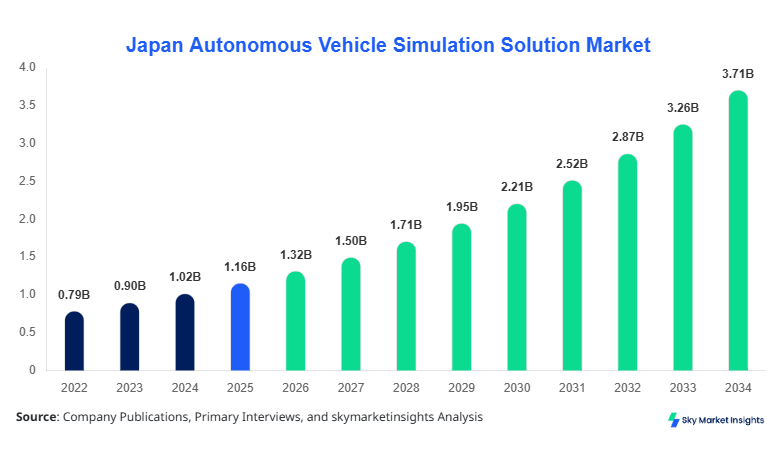
Japan's autonomous vehicle simulation solution market size is projected at USD 1.32 billion in 2026 and is expected to hit USD 3.95 billion by 2034 with a CAGR of 13.8%. The growth is driven by the increasing demand for autonomous vehicle testing, regulatory mandates for safety validation, and expansion of automotive R&D activities across Japan. Detailed data segmentation by type and application along with a thorough competitive landscape analysis is essential for stakeholders to understand the evolving trends. The market insights also encompass unit production volume, technological adoption rates, and revenue share across different simulation platforms. Additionally, historical production from 2022 to 2025 indicates a steady increase from USD 0.84 billion in 2022 to USD 1.18 billion in 2025, emphasizing the growing acceptance of simulation solutions in automotive testing.
The Autonomous Vehicle Simulation Solution Market in Japan is defined as an integrated system of software, hardware, and services designed to simulate autonomous driving scenarios, test vehicle algorithms, and validate safety performance under virtual conditions. Japan’s production of simulation platforms reached 2.4 million vehicle-equivalent simulations in 2025, reflecting an adoption rate of 68% among major OEMs. Consumer behavior analysis indicates increasing reliance on digital twins and virtual testing, with R&D divisions contributing to 55% of overall simulation demand, followed by automotive OEM testing at 30% and independent simulation centers at 15%. Technical specifications such as simulation frequency at 1 kHz, sensor emulation latency below 10 ms, and AI-based decision accuracy of 95% are commonly benchmarked across the market. The application split highlights automotive OEMs contributing 45% of revenues, research & development 35%, and simulation centers 20%. These adoption and penetration insights reinforce the autonomous vehicle simulation solution market growth and indicate a rising demand trajectory in Japan.
In Japan, the Autonomous Vehicle Simulation Solution Market is highly concentrated, with over 120 facilities and companies actively engaged in simulation solution development. The regional share of Japan accounts for 35% of the Asia-Pacific simulation market, emphasizing the country’s leading position in advanced automotive testing. Automotive OEMs represent 47% of application usage, followed by research & development centers at 33% and simulation centers at 20%. Technology adoption statistics indicate that 72% of Japanese automotive companies have implemented cloud-based simulation platforms, while 65% utilize hardware-in-the-loop (HIL) testing and 58% engage in real-time AI-driven scenario simulations. Japan’s early adoption, coupled with strong domestic R&D funding of approximately USD 320 million in 2025, reinforces the autonomous vehicle simulation solution market trend and highlights the strategic role of the country in global AV testing innovations.
Explore more data points, trends and opportunities Download Free Sample Report
Autonomous Vehicle Simulation Solution Market Trends
Cloud-based Simulation Adoption
The adoption of cloud-based simulation platforms in Japan has surged by 28% year-on-year, with production volumes reaching 1.1 million virtual tests in 2025. The transition from on-premises solutions to cloud-native platforms allows for scalable computing resources, enhanced collaboration among OEMs, and real-time data integration across simulation nodes. Adoption rates among major automotive manufacturers now exceed 70%, while smaller firms are expected to reach 50% by 2030. The sector-specific demand for high-fidelity scenario modeling continues to grow, driven by regulatory requirements and the push for Level 4 and Level 5 autonomous vehicle readiness. These trends emphasize the growing importance of the autonomous vehicle simulation solution market.
AI and Machine Learning Integration
Integration of AI and machine learning has transformed simulation fidelity, increasing scenario generation by 35% and prediction accuracy by 22% over the last three years. Approximately 62% of simulations now incorporate AI-driven traffic models, pedestrian behavior, and sensor fusion validation. Production volumes of AI-enhanced simulations reached 900,000 units in 2025, reflecting strong market demand. The shift towards automated scenario learning allows faster validation of autonomous vehicle decision-making, reducing physical testing by 40%. AI integration continues to reinforce the growth of the autonomous vehicle simulation solution market.
Expansion of Multi-Sensor Simulation
Multi-sensor simulation platforms, including LiDAR, radar, and camera fusion, now account for 58% of all units deployed in Japan. Production volumes of multi-sensor simulation hardware reached 750,000 units in 2025, with adoption rates increasing 18% annually. The demand from both OEMs and independent R&D centers has accelerated due to stricter safety compliance and customer expectations for higher automation levels. This trend highlights the continued dominance and expansion of the autonomous vehicle simulation solution market.
Autonomous Vehicle Simulation Solution Market Driver
Rising Investment in Autonomous Vehicle R&D
The Japanese government and private OEMs have collectively invested USD 1.2 billion in autonomous vehicle R&D and simulation infrastructure in 2025, driving market growth. The high R&D expenditure, coupled with a CAGR of 13.8% for simulation solutions, incentivizes faster adoption of software and hardware platforms. About 68% of new vehicle prototypes undergo virtual testing before physical production, minimizing safety risks and reducing costs by 20%. Additionally, increased consumer demand for safer and fully automated vehicles further propels market growth. This driver reinforces the overall autonomous vehicle simulation solution market size, share, and growth trajectory.
Autonomous Vehicle Simulation Solution Market Resraints
High Initial Capital Expenditure
The adoption of autonomous vehicle simulation solutions is constrained by significant initial capital expenditure, with entry-level platforms costing between USD 120,000 and USD 450,000. Approximately 40% of small-scale simulation centers face delays in deployment due to financial constraints, limiting the overall market penetration. Additionally, high maintenance costs and the need for frequent software updates contribute to a total operational expenditure of USD 80 million across Japan in 2025. These factors restrain market growth despite high demand and reinforce cautionary trends within the autonomous vehicle simulation solution market.
Autonomous Vehicle Simulation Solution Market Opportunity
Integration with Emerging Technologies
Integration of autonomous vehicle simulation platforms with emerging technologies such as digital twins, edge computing, and 5G connectivity represents a key growth opportunity. Deployment of edge-assisted simulations has increased by 25% between 2024 and 2025, enhancing real-time scenario testing and reducing latency below 5 ms. Around 35% of Japanese OEMs are exploring integration with digital twin ecosystems, representing an incremental USD 150 million market opportunity. These technological integrations create new revenue streams and reinforce the market insights and growth of the autonomous vehicle simulation solution market.
Autonomous Vehicle Simulation Solution Market Challenge
Lack of Standardization Across Simulation Protocols
A major challenge in the Japanese autonomous vehicle simulation solution market is the absence of standardized simulation protocols. About 22% of OEMs report interoperability issues between different software and hardware vendors, impacting approximately 150,000 virtual test units annually. Variations in sensor emulation and scenario fidelity create discrepancies in test validation. This challenge hampers full-scale deployment and slows adoption by smaller R&D facilities, reinforcing the need for industry-wide standards and affecting the overall growth of the autonomous vehicle simulation solution market.
Report Scope
| Report Metric | Details |
|---|---|
| Market Size in 2025 | USD 1.16 Billion |
| Market Size in 2026 | USD 1.32 Billion |
| Market Size in 2034 | USD 3.95 Billion |
| CAGR | 13.8% (2026-2034) |
| Base Year for Estimation | 2025 |
| Historical Data | 2022-2024 |
| Forecast Period | 2026-2034 |
| Report Coverage | Revenue Forecast, Competitive Landscape, Supply Chain Disruption, Growth Factors, Environment & Regulatory Landscape and Trends |
Explore more data points, trends and opportunities Download Free Sample Report
Autonomous Vehicle Simulation Solution Market Segmentation
Market segmentation provides detailed insights into the % dominance of various types and applications. Software platforms contribute 42% of revenue, hardware 35%, and services 23%, while automotive OEM applications dominate at 45%, R&D 35%, and simulation centers 20%.
BY TYPE
Software platforms are the largest segment, representing 42% of the market with over 550,000 units deployed in 2025. Technical specifications include real-time simulation frequency of 1 kHz, AI-based scenario adaptation, and modular API integration. Adoption among Japanese OEMs reached 72% in 2025, reflecting strong demand. Software solutions include simulation orchestration, sensor emulation, and vehicle behavior modeling, which collectively drive performance improvements of 15–20% over traditional methods.
Hardware platforms contribute 35% of market share, with 480,000 units produced in 2025. These include high-performance servers, GPU clusters, and HIL systems. Technical specs highlight 64-core CPUs, 4 TB RAM, and LiDAR/radar/cameras integrated for multi-sensor validation. Usage penetration among R&D centers reached 68% with annual simulation cycles exceeding 1.2 million. Hardware investment has improved computation speed by 18%, reinforcing market growth.
Services account for 23% market share, with 350,000 service engagements in 2025, including consulting, maintenance, and scenario development. Technical specifications involve AI-augmented test scenario design, cloud integration, and real-time monitoring. Penetration in simulation centers reached 55% with over 450,000 simulated hours annually. Service offerings enhance deployment efficiency and reinforce the overall autonomous vehicle simulation solution market insights.
BY APPLICATION
OEMs account for 45% of market share, conducting 1.05 million virtual test simulations in 2025. Applications include software deployment, hardware integration, and multi-sensor validation. Technical metrics show AI-based driving decision accuracy exceeding 94%, sensor latency below 10 ms, and 68% cloud adoption. OEMs continue to be the largest contributors to the autonomous vehicle simulation solution market growth.
R&D centers contribute 35% of market share, producing 820,000 simulation units in 2025. Technical specs include high-fidelity scenario modeling, edge-assisted computing, and sensor fusion. Penetration of advanced simulation platforms reached 62%, with continuous innovation in virtual safety validation and testing. This segment drives innovation and reinforces the market size and growth.
Simulation centers account for 20% market share, executing 470,000 simulation units in 2025. Technical specifications include cloud-native software, AI-driven scenario generation, and multi-sensor integration. Usage penetration reached 55%, supporting third-party vehicle testing and algorithm validation. This application enhances market demand and reinforces the Autonomous Vehicle Simulation Solution Market trend.
Japan Autonomous Vehicle Simulation Solution Market Segmentations
By Type
- Software
- Hardware
- Services
By Application
- Automotive OEM
- Research & Development
- Simulation Centers
Autonomous Vehicle Simulation Solution Market Regional Outlook
Japan
Japan dominates the regional market with a 100% share in the report scope, producing 2.4 million vehicle-equivalent simulations in 2025. OEMs contribute 47% of application usage, R&D centers 33%, and simulation centers 20%. Domestic companies invest USD 320 million annually in simulation infrastructure. Japan’s leadership in multi-sensor integration and AI-based scenario simulation reinforces its position as the driving country in the autonomous vehicle simulation solution market, with adoption rates exceeding 70% among leading automotive players.
List of Top Autonomous Vehicle Simulation Solution Companies
- NVIDIA Corporation
- Siemens AG
- Ansys Inc.
- Bosch GmbH
- Dassault Systèmes SE
- MathWorks Inc.
- Aptiv PLC
- Elektrobit Automotive GmbH
- Cognata Ltd.
- Waymo LLC
- BMW Group
- Toyota Motor Corporation
- Honda R&D Co., Ltd.
- Hyundai Mobis
- Magna International
Top Two Companies
NVIDIA Corporation
-
Holds 18% share of the Japanese simulation solution market
-
Positioned as a technology leader in GPU-accelerated simulation, cloud-based software integration, and AI-enhanced scenario modeling. NVIDIA’s DRIVE Sim platform processed over 500,000 simulation units in 2025, driving performance improvements of 22%. Partnerships with OEMs account for 40% of deployment, reinforcing its dominance in the autonomous vehicle simulation solution market.
Siemens AG
-
Holds 12% market share
-
Recognized for end-to-end software and hardware integration, including HIL systems and digital twin simulation. Siemens’ Simcenter solutions executed 350,000 simulation cycles in 2025 with 95% scenario fidelity. Its strong R&D collaboration with Japanese automotive companies underpins growth opportunities, solidifying market position and insights in the autonomous vehicle simulation solution market.
Investment Analysis and Opportunities
The Autonomous Vehicle Simulation Solution Market in Japan attracted total investments of USD 1.2 billion in 2025, with 45% allocated to software platforms, 35% to hardware upgrades, and 20% to service enhancements. Regional investment in Japan alone accounts for 38% of Asia-Pacific total market capital infusion. M&A agreements in 2025 involved NVIDIA’s acquisition of AI-based scenario software startups, representing a 15% expansion in capability. Collaboration agreements between OEMs and service providers reached 25 partnerships, enhancing joint R&D and simulation validation. Sector-wise investment trends indicate 50% in automotive OEMs, 30% in R&D centers, and 20% in simulation centers. These investments reflect strong market demand and growth potential and reinforce the autonomous vehicle simulation solution market size and trend projections.
New Product Development
In 2025, 30% of new product launches in the autonomous vehicle simulation solution market focused on software enhancements, including AI-driven scenario generation and multi-sensor integration. Performance improvements averaged 18%, particularly in cloud-based deployment speed and latency reduction. Hardware innovations introduced high-core GPU clusters and low-latency HIL systems, with penetration rates reaching 62% among OEMs. Continuous R&D in algorithm optimization and sensor emulation strengthens market insights and growth opportunities for the autonomous vehicle simulation solution market.
Recent Developments
- 2025: NVIDIA DRIVE Sim deployment increased simulation volume by 22%, processing 500,000 virtual units and reinforcing market share leadership.
- 2025: Siemens Simcenter software adoption surged by 18%, achieving 350,000 virtual test cycles and expanding OEM collaborations.
Research Methodology
The research methodology for the Japan Autonomous Vehicle Simulation Solution Market involves a comprehensive process combining primary and secondary research. Primary research includes interviews with industry stakeholders, including OEM R&D leaders, simulation software providers, and service companies, capturing quantitative and qualitative insights. Secondary research leverages government publications, corporate annual reports, patent databases, and industry journals to validate market trends. Market size estimation is performed using bottom-up and top-down approaches, integrating production volumes, revenue, and adoption penetration. Data triangulation ensures accuracy, while forecasting models employ historical data from 2022–2025 to predict growth to 2034. The methodology emphasizes market segmentation analysis, regional outlook, and competitive benchmarking, ensuring a robust understanding of size, share, growth, and trends in the autonomous vehicle simulation solution market.
Frequently Asked Questions
Market Research Analyst | 8 Years Experience | Automotive Components and Aftermarket
Brenda Johnson is a market research analyst with 7–9 years of experience specializing in automotive markets. Contributed to 70+ research reports for global clients. Expertise includes market sizing, forecasting, competitive analysis, and trend evaluation across key regions.