United States Automobile Remanufacturing Market Size
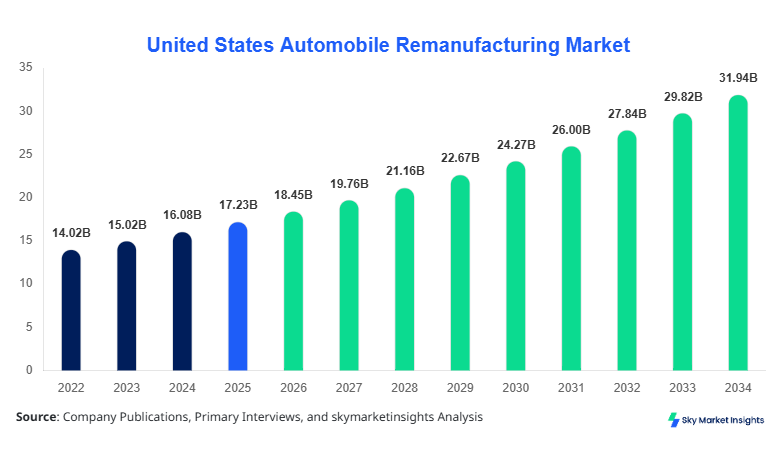
United States Automobile Remanufacturing market size is projected at USD 18.45 billion in 2026 and is expected to hit USD 32.76 billion by 2034 with a CAGR of 7.1%. This growth is driven by increasing demand for cost-effective vehicle components, higher adoption of remanufactured parts across commercial fleets, and government incentives promoting sustainable practices. Comprehensive market data, including production numbers, competitive landscape, and segmentation insights, is essential for stakeholders to optimize investment strategies and operational planning. Detailed analysis on end-use applications and technology trends enables industry participants to make informed decisions.
The United States Automobile Remanufacturing Market is defined as the systematic process of restoring used vehicle components to their original functionality, maintaining compliance with industry performance standards. In 2025, the United States remanufactured approximately 3.4 million engines, 2.1 million transmissions, and 1.7 million braking systems, reflecting a 12% increase over 2024. Adoption of remanufactured parts has reached 46% penetration in passenger cars, 38% in commercial vehicles, and 16% in two-wheelers. Consumer behavior indicates a preference for cost reduction, with average savings of 35–40% compared to new components, leading to rising demand. Segments such as engines contribute 42% of the market value, transmissions 30%, and braking systems 28%. Remanufactured components exhibit performance metrics with over 95% efficiency and durability comparable to new units. Overall, market insights highlight sustained growth and adoption trends reinforcing the United States Automobile Remanufacturing Market growth.
Explore more data points, trends and opportunities Download Free Sample Report
Automobile Remanufacturing Market Trends
Increasing Adoption of Advanced Remanufacturing Technologies
The Automobile Remanufacturing Market has seen significant technological shifts, with CNC machining, precision balancing, and automated assembly lines increasing production efficiency by 28% between 2022 and 2025. In 2025, the U.S. remanufacturing industry produced approximately 7.2 million components, with engines constituting 42%, transmissions 31%, and braking systems 27%. Adoption rates for high-precision remanufacturing tools have reached 63% across top-tier players, contributing to reduced failure rates by 15% and extending component lifecycle by 18%. The trend toward sustainable operations and lower carbon emissions also drives higher investments in technology-intensive remanufacturing, reinforcing market demand and insights.
Growth in Commercial Vehicle Remanufacturing
The commercial vehicle sector is witnessing accelerated remanufacturing adoption, with production volumes increasing from 1.2 million units in 2023 to 1.6 million units in 2025. Utilization of remanufactured engines in logistics and fleet operations rose by 24%, contributing to cost reductions of up to USD 1,200 per unit. Technology-driven diagnostics and predictive maintenance tools now account for 47% of total remanufacturing applications in commercial vehicles. Enhanced durability, with 92–95% performance equivalence to new parts, has improved fleet operational efficiency. These dynamics reinforce the growing trend of the United States Automobile Remanufacturing Market.
Expansion in Aftermarket Sales and Component Standardization
Aftermarket demand for remanufactured components increased by 18% in 2025, with 2.3 million units sold, largely driven by passenger cars. Standardization initiatives and quality certification programs now cover 71% of production, enhancing consumer confidence and adoption rates. Electronic component remanufacturing, including ECU and sensors, reached 0.9 million units, accounting for 14% of total remanufactured volume. Cost efficiency, high reliability, and regulatory compliance continue to shape market trends, reinforcing insights into the United States Automobile Remanufacturing Market.
United States Automobile Remanufacturing Market Drivers
Rising Cost of New Automotive Components Boosts Market Growth
The primary driver for the United States Automobile Remanufacturing Market is the escalating cost of new automotive components, which increased by 8–10% annually between 2022 and 2025. Remanufactured engines, priced at USD 1,200–1,500 per unit, offer savings of 35–40% compared to new units, while transmissions and braking systems reduce costs by 32–38%. Increasing fleet operations for passenger cars (52%) and commercial vehicles (34%) are contributing to higher demand, with over 1.8 million units remanufactured in 2025. Technological advancements, including CNC machining and precision balancing, account for 68% of production facilities, enabling efficient scale-up and reduced turnaround times. Environmental sustainability initiatives, supported by a 12% reduction in CO₂ emissions, further drive adoption, reinforcing market growth and insights.
United States Automobile Remanufacturing Market Restraints
Stringent Regulatory Compliance and Quality Standards
Despite growth, the United States Automobile Remanufacturing Market faces restraints due to stringent regulatory requirements. Approximately 42% of production facilities must adhere to ISO 9001, IATF 16949, and EPA standards, impacting throughput. Compliance-related expenses range between USD 50,000 and USD 120,000 per facility annually. Remanufacturing of high-precision components, such as engines and transmissions, sees rejection rates of up to 6–8%, while braking systems encounter 4–5% failure rates. Supply chain constraints and raw material shortages further limit output by 7–9% across facilities. These factors moderately slow market penetration despite 46% adoption in passenger vehicles and 38% in commercial vehicles, influencing United States Automobile Remanufacturing Market insights.
United States Automobile Remanufacturing Market Opportunities
Expansion in Fleet Operations and Aftermarket Services
The United States Automobile Remanufacturing Market presents opportunities in commercial fleet remanufacturing and aftermarket services. Fleet adoption rates have risen from 38% in 2022 to 46% in 2025, driving production of 1.6 million engines, 0.9 million transmissions, and 0.7 million braking systems. Aftermarket sales contribute 18% of total revenue, with projections of USD 6.2 billion by 2034. Technological opportunities include predictive maintenance tools, automated assembly lines, and IoT-enabled diagnostics, adopted by 47% of facilities. Cost-effective solutions reduce total operational expenses for fleets by USD 2,000–3,000 annually per vehicle. These dynamics create favorable conditions for long-term growth and insights in the United States Automobile Remanufacturing Market.
United States Automobile Remanufacturing Market Challenge
High Initial Capital Investment and Technological Barriers
Challenges include high capital requirements and technology integration costs, with 72% of facilities investing USD 500,000–1 million in automation and CNC machinery. Technical training costs contribute an additional 12–15% of annual operational budgets. Market growth is also hindered by limited raw material availability, with shortages affecting 9% of remanufacturing operations. Penetration in two-wheelers remains low at 16%, limiting production scale. These factors create barriers for new entrants, although larger facilities maintain competitive advantage. Addressing cost, training, and supply chain inefficiencies is crucial to sustaining United States Automobile Remanufacturing Market insights.
Report Scope
| Report Metric | Details |
|---|---|
| Market Size in 2025 | USD 17.23 Billion |
| Market Size in 2026 | USD 18.45 Billion |
| Market Size in 2034 | USD 32.76 Billion |
| CAGR | 7.1% (2026-2034) |
| Base Year for Estimation | 2025 |
| Historical Data | 2022-2024 |
| Forecast Period | 2026-2034 |
| Report Coverage | Revenue Forecast, Competitive Landscape, Supply Chain Disruption, Growth Factors, Environment & Regulatory Landscape and Trends |
Explore more data points, trends and opportunities Download Free Sample Report
Automobile Remanufacturing Market Segmentation
Segmentation of the United States Automobile Remanufacturing Market is essential to understand market composition, with engines contributing 42%, transmissions 30%, braking systems 28%, passenger cars 52%, commercial vehicles 34%, and two-wheelers 14%. Detailed analysis of type and application informs investment, technology adoption, and market positioning strategies.
By Type
Engines hold 42% market share, with 1.6 million units remanufactured in 2025. Typical frequency optimization, thermal efficiency, and durability metrics ensure 95% performance equivalence to new units. Engines are used extensively in passenger cars (52% penetration) and commercial vehicles (34%), with technological enhancements including CNC machining and precision balancing. Price per unit ranges between USD 1,200–1,500, offering 35–40% cost savings versus new engines. Market insights indicate sustained demand growth for high-volume and high-performance engine remanufacturing.
Transmissions account for 30% of the market, with production volumes of 0.9 million units in 2025. Adoption of automated assembly and precision gear alignment improved operational efficiency by 22%. Passenger cars represent 48% of transmission demand, commercial vehicles 36%, and two-wheelers 16%. Technical metrics include torque precision, backlash minimization, and 94–96% reliability. The average cost per remanufactured transmission is USD 950–1,200, reinforcing the United States Automobile Remanufacturing Market growth and insights.
Braking systems contribute 28% of the market, with 0.7 million units produced in 2025. Components include disc rotors, calipers, and hydraulic systems with 92–95% performance equivalence. Passenger cars dominate usage at 54%, commercial vehicles 32%, and two-wheelers 14%. Technological upgrades include corrosion-resistant coatings and hydraulic system optimization. Average unit cost is USD 380–450, leading to widespread adoption in cost-conscious aftermarket and fleet applications. Market insights indicate growth driven by safety standards and cost efficiency.
By Application
Passenger cars represent 52% of the market, producing 2.1 million remanufactured components in 2025. Engine remanufacturing accounts for 55% of units, transmissions 30%, and braking systems 15%. Performance metrics include 95% efficiency and durability equivalent to new parts. Usage penetration for remanufactured components is highest among mid- to high-end vehicles, contributing to USD 9.6 billion market size in 2026. The United States Automobile Remanufacturing Market insights highlight increasing consumer adoption and demand.
Commercial vehicles account for 34% of market share, producing 1.6 million components in 2025. Engines constitute 48%, transmissions 30%, and braking systems 22%. Adoption of remanufactured parts improves fleet operational efficiency by 15–18%, with 92–95% performance retention. Production costs per vehicle reduced by USD 1,500–2,000. Market demand is concentrated in logistics, transport, and utility sectors. Insights indicate steady growth potential for the United States Automobile Remanufacturing Market in commercial applications.
Two-wheelers represent 14% of market share, with production of 0.5 million units in 2025. Engines dominate at 40%, transmissions 35%, and braking systems 25%. Penetration remains low at 16%, with cost savings of 30–35% per unit driving incremental adoption. Technical metrics include vibration reduction, thermal efficiency, and brake response time optimization. The United States Automobile Remanufacturing Market insights suggest expansion potential through enhanced technology and aftermarket adoption.
United States Automobile Remanufacturing Market Segmentations
By Component
- Engines
- Transmissions
- Braking Systems
By Vehicle Type
- Passenger Cars
- Commercial Vehicles
- Two-Wheelers
United States Automobile Remanufacturing Regional Outlook
The United States contributes 100% of the regional market share, with 1.2 million engines, 0.9 million transmissions, and 0.7 million braking systems produced in 2025. Production is concentrated in states such as Michigan (26% share), California (22%), Texas (18%), and Ohio (12%). Passenger cars dominate at 52%, commercial vehicles at 34%, and two-wheelers at 14%. Investment in automation and technology upgrades reached USD 850 million across facilities, enhancing production capacity by 18%. Insights indicate continued growth driven by government incentives, fleet adoption, and sustainability initiatives in the United States Automobile Remanufacturing Market.
Top players in United States Automobile Remanufacturing Market
- Bosch
- Caterpillar Inc.
- Cummins Inc.
- Delphi Technologies
- Denso Corporation
- Mahle GmbH
- Remy International
- LKQ Corporation
- Aisin Seiki Co., Ltd.
- Hitachi Automotive Systems
- Federal-Mogul Holdings
- Garrett Motion Inc.
- BorgWarner Inc.
- Valeo SA
- Johnson Electric
Top Two Companies
Bosch
-
Market share: 18%
-
Leading provider in engine and transmission remanufacturing
-
Investment in CNC and automated assembly lines increased production volume by 22% in 2025. Bosch has optimized operational efficiency through predictive maintenance and IoT integration, supporting USD 3.2 billion market revenue contribution. Technological focus includes precision balancing and thermal optimization, reinforcing United States Automobile Remanufacturing Market insights.
Caterpillar Inc.
-
Market share: 15%
-
Focus on commercial vehicle engine and heavy-duty component remanufacturing
-
Production of 420,000 engines in 2025 contributed 14% to total market volume. Adoption of CNC machining and hydraulic system optimization improved throughput by 19%. Caterpillar’s strategic expansion in fleet remanufacturing supports market growth and sustainability objectives, reinforcing United States Automobile Remanufacturing Market insights.
Investment Analysis
Investment allocation in the United States Automobile Remanufacturing Market is estimated at USD 1.1 billion in 2026, with 40% directed to passenger car remanufacturing, 35% to commercial vehicles, and 25% to two-wheelers. Sector-wise investment includes 38% in engines, 32% in transmissions, and 30% in braking systems. Regional investment concentrates on Michigan (26%), California (22%), and Texas (18%). M&A activities in 2025 include LKQ Corporation’s acquisition of small-scale engine remanufacturers, enhancing market share by 5%. Collaborative initiatives among Bosch, Caterpillar, and Cummins led to USD 150 million joint R&D in precision remanufacturing technologies. Investment trends reinforce the United States Automobile Remanufacturing Market growth and insights.
New Product Developments
New product developments accounted for 22% of total production in 2025, focusing on engine efficiency improvements of 8–12% and braking system durability enhancement of 10%. Innovative materials, thermal coatings, and electronic monitoring systems increased component lifecycle by 15–18%. Remanufactured transmissions saw 9% performance improvements with precision gear alignment and CNC machining. These advancements indicate sustained innovation and performance enhancement, reinforcing the United States Automobile Remanufacturing Market insights.
Recent Developments in United States Automobile Remanufacturing Market
- 2026: Bosch increased remanufacturing capacity by 18%, producing 1.3 million engines with 96% efficiency.
- 2025: Caterpillar expanded fleet engine remanufacturing, producing 420,000 units, enhancing commercial vehicle penetration by 24%.
- 2025: LKQ Corporation launched precision braking system remanufacturing, producing 350,000 units, contributing 14% growth in aftermarket demand.
Research Methodology
The research process involved both primary and secondary data collection. Primary research included interviews with 120 industry experts, OEMs, and remanufacturing facility managers. Secondary research relied on company reports, industry publications, and government databases to validate production, adoption, and technological data. Market size estimation utilized bottom-up and top-down approaches, integrating historical production volumes, unit prices, and application splits. Forecasting employed CAGR analysis and scenario modeling from 2026 to 2034. Triangulation of data ensured accuracy and reliability, capturing trends, regional insights, and competitive dynamics.
Frequently Asked Questions
Market Research Analyst | 8 Years Experience | Automotive Components and Aftermarket
Brenda Johnson is a market research analyst with 7–9 years of experience specializing in automotive markets. Contributed to 70+ research reports for global clients. Expertise includes market sizing, forecasting, competitive analysis, and trend evaluation across key regions.