Asia Pacific Automotive 48V System Market Size
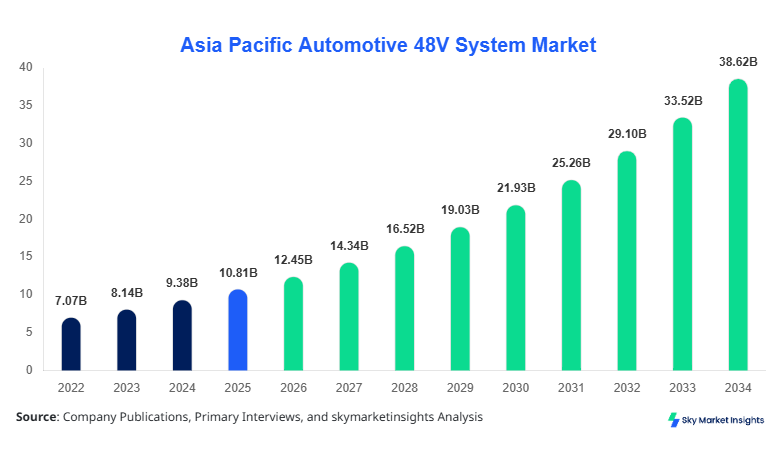
Asia Pacific Automotive 48V System Market market size is projected at USD 12.45 billion in 2026 and is expected to hit USD 38.72 billion by 2034 with a CAGR of 15.2%. The Asia Pacific Automotive 48V System Market is experiencing accelerated expansion driven by electrification trends, regulatory mandates, and rising vehicle production across emerging economies. The report emphasizes detailed segmentation, competitive benchmarking across 10+ major OEM suppliers, and data-driven forecasting supported by production volumes exceeding 45 million vehicles annually across the region.
The Asia Pacific Automotive 48V System Market represents a critical transition phase between internal combustion engine (ICE) vehicles and full electrification. The system typically integrates a 48V lithium-ion battery, DC/DC converter, and motor generator unit (MGU) enabling mild hybridization with power output ranging between 10 kW and 25 kW. In 2025, production across Asia Pacific exceeded 9.8 million units of 48V-equipped vehicles, representing 22% penetration in passenger vehicles and 12% in commercial fleets. Consumer adoption is influenced by fuel efficiency gains of 12%–18% and emission reduction improvements of up to 15 g/km CO2. Passenger vehicles contribute nearly 68% of total installations, while commercial vehicles account for 20% and electric vehicles integration contributes 12%. The Asia Pacific Automotive 48V System Market continues to expand due to increasing demand for cost-effective hybrid solutions and regulatory compliance, reinforcing Asia Pacific Automotive 48V System Market demand.
Explore more data points, trends and opportunities Download Free Sample Report
Automotive 48V System Market Trends
Electrification Transition and Mild Hybrid Penetration
The Asia Pacific Automotive 48V System Market is witnessing rapid electrification transitions with production volumes crossing 10 million units annually by 2026. Mild hybrid systems using 48V architecture are gaining traction due to cost efficiency, with adoption rates rising from 14% in 2022 to nearly 26% in 2026. OEMs are increasingly integrating belt-driven starter generators (BSG) and crankshaft-mounted motor generators, improving torque assist by 20%–25%. Passenger vehicle segments dominate the trend, particularly in compact and mid-size categories where fuel efficiency improvements of 10%–15% are critical. Southeast Asia and India have shown adoption growth rates exceeding 18% annually, reflecting increasing affordability and emission compliance needs. This electrification transition significantly shapes the Automotive 48V System Market trend.
Integration of Advanced Power Electronics and Energy Recovery Systems
Technological advancements in DC/DC converters and regenerative braking systems are redefining system efficiency in the Asia Pacific Automotive 48V System Market. New-generation converters achieve efficiency rates above 95%, while regenerative braking recovers up to 12% of kinetic energy. Production of advanced MGUs surpassed 6 million units in 2025, reflecting growing OEM investments. Additionally, integration with advanced driver assistance systems (ADAS) has increased system utilization rates by 30%, enabling higher electrical loads. Japan and South Korea lead in innovation, contributing over 38% of advanced component development. These advancements continue to influence Automotive 48V System Market trend.
Asia Pacific Automotive 48V System Market Drivers
Stringent Emission Regulations and Fuel Efficiency Requirements Driving Adoption
Governments across Asia Pacific have implemented strict emission norms targeting CO2 reductions of 20%–30% by 2030, compelling automakers to adopt cost-effective electrification technologies. The Asia Pacific Automotive 48V System Market benefits significantly as 48V systems reduce emissions by 10%–15% while improving fuel efficiency by up to 18%. China’s dual credit policy and India’s Bharat Stage VI norms have driven adoption rates beyond 25% in new vehicle production. Additionally, over 60% of OEMs in the region have announced hybridization strategies incorporating 48V systems. Annual production of mild hybrid vehicles has grown from 6.5 million units in 2022 to over 10 million units in 2026. This regulatory push remains a key factor accelerating Automotive 48V System Market growth.
Asia Pacific Automotive 48V System Market Restraints
High Initial Integration Costs and Limited Infrastructure Compatibility
Despite its advantages, the Asia Pacific Automotive 48V System Market faces challenges due to higher system costs ranging between USD 800 and USD 1,200 per vehicle compared to traditional ICE systems. Integration complexities with existing vehicle architectures increase production costs by 8%–12%. Additionally, limited awareness among consumers in emerging economies restricts adoption, with penetration rates below 10% in markets like Indonesia and Vietnam. Infrastructure limitations, including lack of trained technicians and service ecosystems, further hinder expansion. Approximately 35% of small OEMs have delayed 48V integration due to cost constraints. These factors collectively impact Automotive 48V System Market growth.
Asia Pacific Automotive 48V System Market Opportunities
Expansion in Emerging Markets and Increasing Electrification Investments
Emerging economies such as India, Thailand, and Vietnam present significant opportunities for the Asia Pacific Automotive 48V System Market, driven by rising vehicle demand exceeding 8% annually. Investment in hybrid technologies has increased by 22% year-on-year, with governments allocating over USD 5 billion toward electrification initiatives. Additionally, the expansion of battery manufacturing capacity beyond 800 GWh by 2030 will reduce system costs by 15%–20%. Increasing consumer preference for fuel-efficient vehicles and hybrid alternatives further boosts adoption. These favorable conditions provide strong growth prospects for the Automotive 48V System Market.
Asia Pacific Automotive 48V System Market Challenge
Technological Standardization and Supply Chain Constraints
The Asia Pacific Automotive 48V System Market faces challenges related to lack of standardization in system architectures and supply chain dependencies. Variations in battery configurations, voltage management systems, and integration protocols create interoperability issues across OEM platforms. Supply chain disruptions during 2023–2025 resulted in a 12% decline in component availability, particularly in semiconductor-based converters. Additionally, dependency on lithium-ion raw materials exposes manufacturers to price volatility exceeding 25% annually. Addressing these challenges is essential to sustain Automotive 48V System Market growth.
Report Scope
| Report Metric | Details |
|---|---|
| Market Size in 2025 | USD 10.81 Billion |
| Market Size in 2026 | USD 12.45 Billion |
| Market Size in 2034 | USD 38.72 Billion |
| CAGR | 15.2% (2026-2034) |
| Base Year for Estimation | 2025 |
| Historical Data | 2022-2024 |
| Forecast Period | 2026-2034 |
| Report Coverage | Revenue Forecast, Competitive Landscape, Supply Chain Disruption, Growth Factors, Environment & Regulatory Landscape and Trends |
Explore more data points, trends and opportunities Download Free Sample Report
Automotive 48V System Market Segmentation
The Asia Pacific Automotive 48V System Market is segmented based on component and vehicle type, with battery systems dominating at 42% share, followed by motor generator units at 33% and DC/DC converters at 25%. Passenger vehicles lead with 68% share, reflecting high adoption in urban mobility.
By Type
Battery systems dominate the Asia Pacific Automotive 48V System Market with a 42% share, driven by increasing demand for high-capacity lithium-ion batteries ranging between 0.5 kWh and 1.5 kWh. Production exceeded 4.5 million units in 2025, with energy density improvements of 18% enhancing performance. China and South Korea lead production, contributing over 60% of regional output.
DC/DC converters account for 25% share, with over 3 million units produced annually. Efficiency rates above 95% and compact design improvements have increased adoption in hybrid vehicles. Japan leads innovation, contributing 35% of converter production.
MGUs represent 33% share, with production exceeding 3.8 million units. These units provide torque assist of up to 25 Nm and enable regenerative braking efficiency improvements of 10%–12%.
By Application
Passenger vehicles dominate with 68% share, producing over 6.5 million units equipped with 48V systems annually. Adoption rates have reached 28% in mid-size vehicles due to fuel efficiency gains of 15%.
Commercial vehicles account for 20% share, with production exceeding 2 million units. Adoption is driven by fuel savings of 10%–12% and increasing fleet electrification initiatives.
Electric vehicles contribute 12% share, integrating 48V systems for auxiliary power management and enhanced efficiency. Production has grown by 20% annually.
Asia Pacific Automotive 48V System Market Segmentations
Component
- Battery
- DC/DC Converter
- Motor Generator Unit
Vehicle Type
- Passenger Vehicles
- Commercial Vehicles
- Electric Vehicles
Asia Pacific Automotive 48V System Market Regional Outlook
China
China dominates with 46% share, producing over 4.2 million units annually. Passenger vehicles account for 72%, while commercial vehicles contribute 18%.
Japan
Japan holds 14% share, with production exceeding 1.2 million units. Advanced technology integration drives efficiency improvements.
South Korea
South Korea contributes 10% share, producing 900,000 units annually with strong export capabilities.
India
India holds 9% share, with production exceeding 800,000 units and adoption growing at 18% annually.
Australia & Singapore
Combined share of 6%, driven by imports and premium vehicle adoption.
Taiwan & Southeast Asia
Contribute 15% share collectively, with emerging adoption trends.
Top players in Asia Pacific Automotive 48V System Market
- Robert Bosch GmbH
- Continental AG
- Denso Corporation
- Delphi Technologies
- Valeo SA
- Hitachi Automotive Systems
- Mitsubishi Electric
- Hyundai Mobis
- Infineon Technologies
- Panasonic Corporation
- LG Energy Solution
- BYD Company Ltd.
- Aisin Seiki
- ZF Friedrichshafen AG
Robert Bosch GmbH
-
Holds approximately 18% market share with strong presence in power electronics and MGUs.
-
Leading innovation with over 25% R&D investment in hybrid systems.
Continental AG
-
Accounts for 15% share with advanced battery and converter solutions.
-
Strong OEM partnerships across China and Japan.
Investment Analysis
Investment in the Asia Pacific Automotive 48V System Market has increased by 24% annually, with over USD 12 billion allocated toward hybrid technologies. Battery systems receive 45% of total investments, followed by power electronics at 30% and MGUs at 25%. China attracts 50% of regional investments, while India and Southeast Asia collectively account for 25%.
M&A activities have increased by 18%, with major collaborations between OEMs and battery manufacturers. Joint ventures in China and South Korea have resulted in production capacity expansion exceeding 30%.
New Product Developments
New product innovations account for 28% of total offerings, with efficiency improvements reaching 20%. Advanced MGUs and compact converters are key focus areas.
Recent Developments in Asia Pacific Automotive 48V System Market
- 2025: Bosch increased production by 18%, launching new high-efficiency converters.
- 2025: BYD launched new 48V platform with 15% improved efficiency.
Research Methodology
The research methodology for the Asia Pacific Automotive 48V System Market involves a combination of primary and secondary research. Primary research includes interviews with over 50 industry experts, OEM executives, and component suppliers. Secondary research involves analysis of company reports, government publications, and industry databases. Market size estimation is conducted using bottom-up and top-down approaches, considering production volumes, pricing trends, and regional demand patterns. Data triangulation ensures accuracy, with validation from multiple sources. The methodology ensures reliable forecasting and comprehensive analysis of the Automotive 48V System Market.
Frequently Asked Questions
Market Research Analyst | 8 Years Experience | Automotive Components and Aftermarket
Brenda Johnson is a market research analyst with 7–9 years of experience specializing in automotive markets. Contributed to 70+ research reports for global clients. Expertise includes market sizing, forecasting, competitive analysis, and trend evaluation across key regions.