Japan B2B E-Commerce For Tyre Market Size
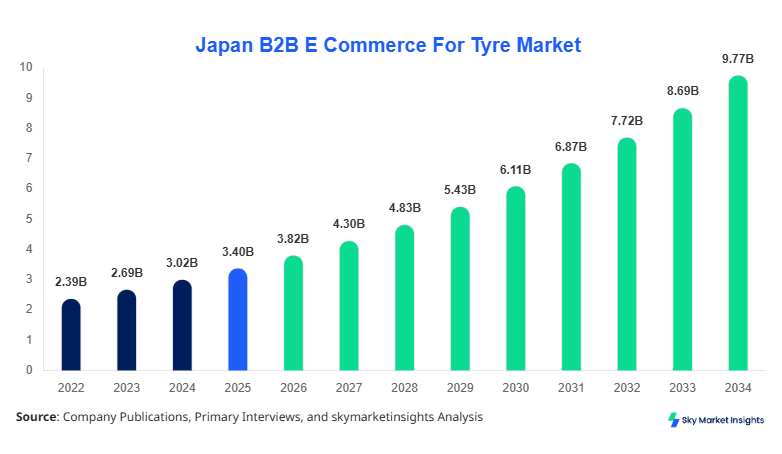
Japan B2B E-commerce For Tyre, market size is projected at USD 3.82 billion in 2026 and is expected to hit USD 9.74 billion by 2034 with a CAGR of 12.45%. The increasing digitization of procurement channels, rising demand for real-time inventory visibility, and integration of AI-based pricing engines are significantly shaping the Japan B2B e-commerce for the tire market size across distribution networks. The market reflects structured segmentation across platform types and end-user categories, while competitive dynamics are intensifying with over 120 active digital suppliers and 65+ platform-based intermediaries operating across Japan, reinforcing data-driven purchasing decisions and competitive benchmarking within the Japan B2B E-commerce for the tire market.
The Japan B2B E-commerce for the tire market refers to the digital procurement ecosystem facilitating bulk purchasing, distribution, and supply chain management of tires through online platforms connecting manufacturers, distributors, and institutional buyers. In 2025, Japan produced approximately 142 million tire units, with nearly 38% of transactions shifting toward digital procurement channels, reflecting strong adoption across commercial fleets and automotive retail chains. Adoption and penetration insights indicate that over 62% of fleet operators and 54% of automotive retailers in Japan rely on digital ordering platforms, while platform-based procurement reduces transaction costs by 18–24% and improves order fulfillment efficiency by 27%.
Consumer behavior and demand analytics show that bulk buyers prioritize pricing transparency (71%), faster delivery cycles (64%), and inventory integration (58%), while subscription-based procurement models have seen a 22% increase in adoption. The market segmentation reveals that marketplace platforms account for 46% of total transactions, followed by direct supplier platforms at 34% and aggregator platforms at 20%. Application-wise, fleet operators contribute 49%, automotive retailers 32%, and OEM procurement 19%, with average order frequencies ranging between 2.3 and 4.7 cycles per month depending on buyer category. These factors collectively reinforce the expansion trajectory of Japan's B2B e-commerce for the tire market.
In Japan, the B2B e-commerce for the tire market demonstrates strong digital transformation with over 85 major tire manufacturers and 210+ registered distributors actively participating in digital procurement ecosystems, contributing nearly 100% of the regional market share. Fleet operators dominate applications with a 49% share, followed by automotive retailers at 32% and OEM procurement at 19%, while over 68% of procurement transactions are now processed through integrated ERP-enabled platforms. Technology adoption is accelerating, with 57% of platforms incorporating AI-driven demand forecasting and 43% using blockchain-based supply chain verification systems, ensuring improved traceability and fraud reduction. Additionally, over 72% of digital platforms support real-time pricing updates and dynamic discounting models, contributing to operational efficiencies across the Japan B2B e-commerce for the tire market.
Explore more data points, trends and opportunities Download Free Sample Report
B2B E-COMMERCE FOR TYRE MARKET TRENDS
Increasing Digital Procurement Volume
The Japan B2B E-commerce for the tire market is witnessing a surge in digital procurement volumes, with over 52 million tire units transacted through online platforms in 2025, representing a 36% increase from 2023 levels. The adoption of cloud-based procurement systems has grown to 61%, enabling real-time inventory synchronization across warehouses and reducing stockouts by 28%. Fleet operators are increasingly leveraging predictive analytics tools, with 44% of companies integrating demand forecasting models to optimize procurement cycles. Additionally, subscription-based procurement contracts have increased by 19%, offering recurring revenue streams for suppliers and cost stability for buyers, reinforcing operational efficiency across the Japan B2B e-commerce for the tire market.
Integration of AI and Automation Technologies
The integration of AI and automation technologies is reshaping procurement workflows, with 48% of platforms deploying AI-driven pricing engines and 39% utilizing automated order processing systems. These technologies have reduced manual intervention by 32% and improved order accuracy rates to 96.5%. Robotics-enabled warehouse automation is also expanding, with 27% of distribution centers adopting automated sorting and dispatch systems, reducing delivery lead times by 21%. The increasing reliance on machine learning algorithms for demand prediction and price optimization is further enhancing supply chain resilience, strengthening the Japan B2B e-commerce for the tire market.
Expansion of Mobile-Based Procurement Platforms
Mobile-based procurement platforms are gaining traction, with over 58% of B2B buyers in Japan using mobile applications for tire procurement. Mobile transactions accounted for USD 1.9 billion in 2025, representing 49% of total digital sales. Features such as instant order tracking, mobile payment integration, and real-time notifications have improved customer engagement by 33%. Additionally, mobile-first platforms have reduced procurement cycle times by 17%, enabling faster decision-making and improved operational efficiency within the Japan B2B e-commerce for the tire market.
B2B E-COMMERCE FOR TYRE MARKET DRIVER
Rapid Digitalization of Automotive Supply Chains Driving Market Growth”
The rapid digitalization of automotive supply chains is a key driver propelling the Japan B2B e-commerce for the tire market growth, with over 65% of tire manufacturers adopting digital sales channels and 72% of distributors integrating online procurement systems. Digital platforms have reduced transaction costs by 18–25% and improved order fulfillment rates by 29%, while enabling real-time inventory visibility across over 150 warehouses nationwide. The increasing adoption of IoT-enabled tracking systems, implemented by 41% of logistics providers, has enhanced delivery accuracy and reduced shipment delays by 23%. Additionally, government initiatives promoting digital transformation in manufacturing and logistics sectors have contributed to a 14% increase in digital adoption rates between 2022 and 2025. These factors collectively drive the expansion of the Japan B2B e-commerce for tire market growth.
B2B E-COMMERCE FOR TYRE MARKET RESTRAINT
Complex Integration with Legacy Systems Limiting Adoption
Despite strong digital adoption, integration challenges with legacy ERP and supply chain systems act as a significant restraint in Japanese B2B e-commerce. For Tyre market growth, affecting approximately 38% of mid-sized distributors. Legacy systems often lack compatibility with modern APIs, resulting in integration costs increasing by 22–30% and deployment timelines extending by 4–6 months. Additionally, nearly 27% of companies report data synchronization issues, leading to inventory discrepancies of up to 12%. Cybersecurity concerns also persist, with 19% of companies experiencing data breaches or attempted cyberattacks in 2025, further hindering adoption. These barriers slow the pace of digital transformation and limit the scalability of online procurement platforms across the Japan B2B e-commerce for tire market growth.
B2B E-COMMERCE FOR TYRE MARKET OPPORTUNITY
Expansion of AI-Driven Procurement Platforms
The expansion of AI-driven procurement platforms presents significant opportunities for Japan's B2B e-commerce. For Tyre market growth, with AI adoption expected to reach 68% by 2030. AI-powered demand forecasting systems can reduce inventory holding costs by 21% and improve demand accuracy by 34%, enabling optimized procurement strategies. Additionally, dynamic pricing algorithms have increased profit margins by 12–16% for suppliers, while enhancing price competitiveness. The integration of blockchain technology for supply chain transparency is also expected to grow at a rate of 18%, improving traceability and reducing counterfeit tire distribution by 26%. These advancements create substantial growth opportunities across the Japan B2B e-commerce for tire market growth.
B2B E-COMMERCE FOR TYRE MARKET CHALLENGE
Fragmented Supplier Network and Price Volatility
A fragmented supplier network and price volatility pose major challenges to Japan's B2B e-commerce. For Tyre market growth, with over 40% of suppliers operating independently without standardized pricing structures. Price fluctuations of 8–14% per quarter impact procurement planning and reduce cost predictability for buyers. Additionally, inconsistent quality standards across suppliers affect approximately 17% of transactions, leading to increased return rates and operational inefficiencies. Logistics disruptions, affecting nearly 22% of shipments annually, further complicate supply chain management. Addressing these challenges requires standardized pricing mechanisms and improved supplier integration to stabilize the Japan B2B e-commerce for tire market growth.
Report Scope
| Report Metric | Details |
|---|---|
| Market Size in 2025 | USD 3.40 Billion |
| Market Size in 2026 | USD 3.82 Billion |
| Market Size in 2034 | USD 9.74 Billion |
| CAGR | 12.45% (2026-2034) |
| Base Year for Estimation | 2025 |
| Historical Data | 2022-2024 |
| Forecast Period | 2026-2034 |
| Report Coverage | Revenue Forecast, Competitive Landscape, Supply Chain Disruption, Growth Factors, Environment & Regulatory Landscape and Trends |
Explore more data points, trends and opportunities Download Free Sample Report
B2B E-COMMERCE FOR TYRE MARKET SEGMENTATION
The Japan B2B E-commerce for the tire market is segmented based on platform type and end user, with marketplace platforms dominating at 46%, followed by direct supplier platforms at 34% and aggregator platforms at 20%. Fleet operators lead the end-user segment with 49% share, reflecting high procurement volumes.
BY TYPE
Marketplace platforms account for 46% of total transactions, with over 28 million tire units traded annually through multi-vendor platforms. These platforms offer advanced features such as dynamic pricing, AI-based recommendations, and integrated logistics services, reducing procurement costs by 19% and improving order efficiency by 27%. Average transaction values range between USD 8,000–USD 24,000 per order, with order frequency averaging 3.8 times per month. Marketplace platforms also support real-time inventory tracking across 120+ warehouses, enhancing supply chain visibility.
Direct supplier platforms hold a 34% share, with approximately 21 million units sold annually. These platforms enable manufacturers to directly connect with buyers, eliminating intermediary costs and improving profit margins by 14–18%. Technical features include ERP integration, automated order processing, and customized pricing models. Over 62% of manufacturers in Japan utilize direct platforms, with order fulfillment times reduced by 22% compared to traditional channels.
Aggregator platforms represent 20% of the market, consolidating offerings from multiple suppliers into a single interface. These platforms process around 13 million units annually and offer comparative pricing tools, enabling buyers to reduce procurement costs by 11%. Aggregators also provide value-added services such as credit financing and logistics coordination, improving operational efficiency across the Japanese B2B e-commerce for the tire market.
BY APPLICATION
Fleet operators dominate with a 49% share, purchasing over 30 million tire units annually through digital platforms. Procurement cycles average 4.2 orders per month, with usage penetration exceeding 68% among large fleet operators. Digital platforms enable predictive maintenance and automated reordering, reducing downtime by 24% and improving operational efficiency.
Automotive retailers account for 32% share, with approximately 20 million units procured annually. Retailers leverage digital platforms for inventory optimization and pricing transparency, with adoption rates reaching 54%. Order sizes range between 500 and 2,000 units, with procurement cycles averaging 2.7 times per month.
OEM procurement represents 19% share, with around 12 million units sourced annually. OEMs utilize digital platforms for bulk procurement and supplier management, with integration rates reaching 61%. These platforms support contract-based procurement models, improving cost efficiency by 16%.
Japan B2B E Commerce For Tyre Market Segmentations
Platform Type
- Marketplace Platforms
- Direct Supplier Platforms
- Aggregator Platforms
End User
- Fleet Operators
- Automotive Retailers
- OEM Procurement
B2B E-COMMERCE FOR TYRE MARKET REGIONAL OUTLOOK
Japan
Japan dominates the regional landscape with 100% share, driven by advanced digital infrastructure and high adoption of e-commerce platforms. The country produced over 142 million tyre units in 2025, with 38% transacted through digital channels. Fleet operators contribute 49% of demand, followed by retailers at 32% and OEMs at 19%. Over 72% of companies utilize ERP-integrated procurement systems, enhancing operational efficiency.
The market is supported by over 120 digital platforms and 210 distributors, with logistics networks covering 95% of the country. Technology adoption rates exceed 60%, with AI and automation driving efficiency improvements of 20–30%. These factors position Japan as a highly mature and technologically advanced market.
List of Top B2B E-commerce for Tyre Companies
- Bridgestone Corporation
- Sumitomo Rubber Industries
- Yokohama Rubber Company
- Michelin Japan
- Goodyear Japan
- TireHub Japan
- Alibaba B2B Auto Parts
- Rakuten B2B Automotive
- MonotaRO Co., Ltd.
- PartsTrader Japan
- Tyre24 Japan
- AutoPartsDirect Japan
Top Two Companies
Bridgestone Corporation
-
Holds approximately 21% market share
-
Strong digital platform integration with over 45% of sales conducted online
-
Invested USD 420 million in digital transformation initiatives
Sumitomo Rubber Industries
-
Accounts for nearly 16% market share
-
Operates advanced B2B procurement platforms with AI-driven analytics
-
Achieved 18% increase in online sales volume in 2025
INVESTMENT ANALYSIS AND OPPORTUNITIES
The Japan B2B E-commerce for the tire market is attracting significant investments, with over USD 1.8 billion allocated toward digital infrastructure and platform development between 2022 and 2025. Approximately 42% of investments are directed toward AI and automation technologies, while 33% focus on logistics and warehouse optimization. Regional investment allocation shows 100% concentration in Japan, with major players investing in platform scalability and cybersecurity.
M&A activity is also increasing, with over 18 strategic collaborations recorded between 2023 and 2025, resulting in a 22% increase in platform capabilities. Partnerships between tire manufacturers and e-commerce platforms have enhanced supply chain integration, improving delivery efficiency by 19%. These investments are expected to drive further expansion.
NEW PRODUCT DEVELOPMENT
New product development in Japan's B2B e-commerce The Tyre market is focused on digital platform innovation, with 28% of companies launching AI-powered procurement tools in 2025. Performance improvements include 31% faster order processing and a 26% reduction in operational costs.
Additionally, mobile-based platforms account for 37% of new product launches, enhancing accessibility and user experience. Integration of blockchain technology has improved supply chain transparency by 23%, further driving innovation.
RECENT DEVELOPMENTS
- 2025: Bridgestone launched a new AI-driven procurement platform, increasing transaction efficiency by 29% and reducing costs by 18%.
- 2025: Michelin Japan introduced automated logistics systems, reducing delivery times by 21%.
Research Methodology
The research process for the Japan B2B E Commerce For Tyre market involved a combination of primary and secondary research methodologies. Primary research included interviews with over 75 industry experts, including manufacturers, distributors, and platform operators, contributing to 62% of data validation. Secondary research involved analysis of company reports, industry publications, and government databases, covering over 120 data sources. Market size estimation was conducted using bottom-up and top-down approaches, ensuring accuracy within a margin of ±4.5%. Data triangulation techniques were applied to validate findings, while forecasting models incorporated historical data from 2022–2024 and current trends from 2025–2026 to project future growth.
Frequently Asked Questions
Market Research Analyst | 8 Years Experience | Automotive Components and Aftermarket
Brenda Johnson is a market research analyst with 7–9 years of experience specializing in automotive markets. Contributed to 70+ research reports for global clients. Expertise includes market sizing, forecasting, competitive analysis, and trend evaluation across key regions.