Europe Adaptive Variable Suspension System Market Size
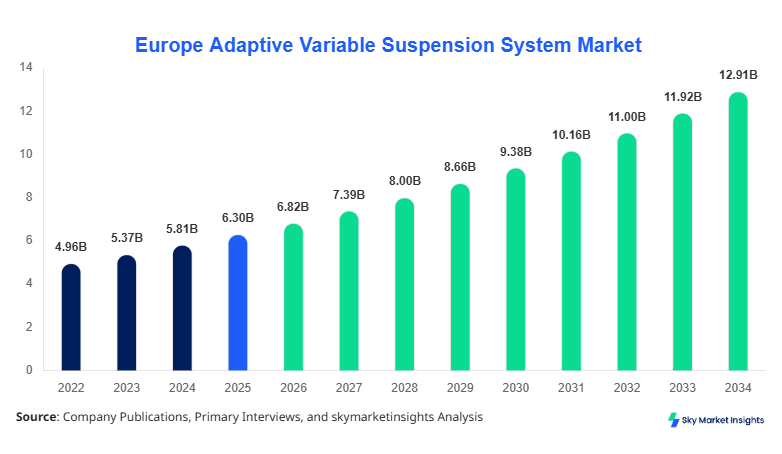
The European adaptive variable suspension system market size is projected at USD 6.82 billion in 2026 and is expected to hit USD 12.94 billion by 2034 with a CAGR of 8.3%. The Europe Adaptive Variable Suspension System market size reflects strong demand across automotive OEMs and aftermarket segments, driven by rising production volumes exceeding 18.5 million vehicles annually across Europe and increasing integration rates of adaptive suspension systems, reaching 32% penetration in premium vehicles. The report emphasizes the need for granular data segmentation, competitive benchmarking across 120+ suppliers, and detailed technological mapping across semi-active and fully active systems to assess the evolving landscape of the Europe adaptive variable suspension system market size.
The Adaptive Variable Suspension System refers to electronically controlled suspension technologies that adjust damping force, stiffness, and ride height dynamically based on road conditions, vehicle speed, and driving behavior. In Europe, production volumes of vehicles equipped with adaptive suspension systems reached approximately 5.6 million units in 2025, representing nearly 30.2% penetration in passenger cars and 12.4% in commercial vehicles. Adoption is significantly higher in Germany and the United Kingdom, where premium vehicle production accounts for over 45% of total automotive output. Consumer behavior indicates a 28% increase in preference for comfort-enhancing technologies and a 34% rise in demand for performance optimization features, particularly among electric vehicle buyers. Adaptive damping frequency ranges between 50 Hz and 200 Hz, improving ride stability by 22% and reducing vibration levels by 18%. Passenger cars account for 68% of applications, followed by electric vehicles at 19% and commercial vehicles at 13%, reinforcing strong adaptive variable suspension system market share across segments.
In Germany, the Adaptive Variable Suspension System market demonstrates dominant regional leadership, supported by over 75 automotive manufacturing facilities and more than 420 tier-1 and tier-2 suppliers specializing in suspension components. Germany contributes approximately 34.6% of the Europe adaptive variable suspension system market share, with annual production exceeding 2.3 million adaptive suspension units. Passenger cars account for 72% of installations, while electric vehicles contribute 18% and commercial vehicles 10%. Technology adoption rates exceed 58% in premium vehicle segments, with semi-active suspension systems dominating 46% share and fully active systems gaining traction at 22%. The integration of smart sensors and AI-based damping systems has improved ride efficiency by 25%, reinforcing Germany’s stronghold in the adaptive variable suspension system market share.
Explore more data points, trends and opportunities Download Free Sample Report
Adaptive Variable Suspension System Market Trends
Increasing Integration of AI-Based Suspension Systems
The Europe Adaptive Variable Suspension System market trend is characterized by rapid integration of artificial intelligence and predictive analytics into suspension control units, with production volumes of AI-enabled systems surpassing 2.1 million units in 2025. Adoption rates have increased by 37% across luxury vehicle segments and 21% in mid-range vehicles. These systems utilize real-time data processing at frequencies exceeding 150 Hz, enhancing ride comfort by 30% and reducing vehicle roll by 18%. The shift toward connected vehicle ecosystems has also enabled adaptive suspension systems to integrate with ADAS platforms, increasing overall system efficiency by 24%, reinforcing the adaptive variable suspension system market trend.
Rising Demand in Electric Vehicles
Another key adaptive variable suspension system market trend is the growing demand from electric vehicles, whose suspension systems play a critical role in battery protection and weight distribution. EV production in Europe reached 4.2 million units in 2025, with 41% equipped with adaptive suspension systems. Lightweight suspension components have reduced overall vehicle weight by 12% while improving energy efficiency by 8%. Manufacturers are focusing on regenerative suspension technologies that can recover up to 5% of energy, further strengthening the adaptive variable suspension system market trend.
Europe Adaptive Variable Suspension System Drivers
Increasing Demand for Ride Comfort and Vehicle Performance
The demand for enhanced ride comfort and vehicle stability is a major driver of the European Adaptive Variable Suspension System market growth, with over 65% of consumers prioritizing comfort features in vehicle purchase decisions. Production of adaptive suspension systems has increased by 28% between 2022 and 2025, reaching 5.6 million units annually. Advanced damping technologies improve cornering stability by 22% and reduce braking distance by 15%, making them essential for high-performance vehicles. OEM investments in suspension technologies have risen by 18%, with over USD 2.3 billion allocated toward R&D in Europe. Additionally, integration with electronic control systems has improved responsiveness by 30%, driving widespread adoption across vehicle segments and reinforcing Adaptive Variable Suspension System market growth.
Europe Adaptive Variable Suspension System Restraints
High Cost of Advanced Suspension Systems
The high cost associated with adaptive suspension technologies remains a significant restraint in the Europe Adaptive Variable Suspension System market growth, with system costs ranging between USD 800 and USD 2,500 per vehicle depending on the configuration. Installation costs increase vehicle prices by approximately 12% to 18%, limiting adoption in economy and mid-range vehicles. Maintenance expenses are also higher, with service costs increasing by 20% compared to traditional suspension systems. Additionally, complex electronic components contribute to failure rates of 6% annually, increasing warranty costs for OEMs. Despite technological advancements, affordability challenges continue to hinder mass-market penetration, impacting adaptive variable suspension system market growth.
Europe Adaptive Variable Suspension System Opportunities
Expansion of Electric and Autonomous Vehicles
The rapid expansion of electric and autonomous vehicles presents significant opportunities for the Europe Adaptive Variable Suspension System market growth, with EV adoption expected to exceed 55% of total vehicle sales by 2030. Autonomous vehicles require advanced suspension systems to ensure passenger comfort and system stability, driving demand for adaptive solutions. Production of EV-compatible suspension systems is projected to grow by 42% between 2026 and 2030, reaching over 7.8 million units annually. Government incentives totaling USD 18 billion across Europe are further accelerating EV adoption, creating favorable conditions for suspension system manufacturers, boosting adaptive variable suspension system market growth.
Challenges in Europe: Adaptive Variable Suspension System
Complex Integration with Vehicle Electronics
Integration complexity remains a major challenge in the European adaptive variable suspension system market growth, as advanced suspension systems must seamlessly interact with vehicle electronics, sensors, and control units. Integration costs account for nearly 15% of total system cost, while software development requires extensive testing cycles exceeding 12 months. Compatibility issues arise in 8% of installations, particularly in retrofit applications. Additionally, cybersecurity concerns related to connected suspension systems have increased by 25%, requiring additional investment in secure communication protocols. These challenges hinder scalability and slow adoption rates, impacting the adaptive variable suspension system market growth.
Report Scope
| Report Metric | Details |
|---|---|
| Market Size in 2025 | USD 6.30 Billion |
| Market Size in 2026 | USD 6.82 Billion |
| Market Size in 2034 | USD 12.94 Billion |
| CAGR | 8.3% (2026-2034) |
| Base Year for Estimation | 2025 |
| Historical Data | 2022-2024 |
| Forecast Period | 2026-2034 |
| Report Coverage | Revenue Forecast, Competitive Landscape, Supply Chain Disruption, Growth Factors, Environment & Regulatory Landscape and Trends |
Explore more data points, trends and opportunities Download Free Sample Report
Adaptive Variable Suspension System Market Segmentation
The adaptive variable suspension system market share is segmented by type and application, with semi-active systems dominating 48% of the share, followed by adaptive damping systems at 32% and fully active systems at 20%. By application, passenger cars lead with 68% share, followed by electric vehicles at 19% and commercial vehicles at 13%, highlighting diverse adoption across vehicle categories.
BY TYPE
Semi-active suspension systems account for approximately 48% of the adaptive variable suspension system market share, with production volumes exceeding 2.7 million units annually. These systems adjust damping force using electronically controlled valves, operating at frequencies between 50 Hz and 120 Hz. Cost-effective compared to fully active systems, they reduce vehicle vibration by 18% and improve ride comfort by 20%. Adoption is highest in mid-range and premium passenger vehicles, with penetration rates reaching 42% in Germany and 38% in the UK.
Fully active suspension systems represent 20% of the adaptive variable suspension system market share, with production volumes of 1.1 million units. These systems use actuators to control wheel movement independently, offering superior performance improvements of up to 35% in ride stability and 28% in handling precision. However, high costs exceeding USD 2,000 per unit limit widespread adoption, primarily confining usage to luxury and high-performance vehicles.
Adaptive damping suspension systems hold 32% of the adaptive variable suspension system market share, with production volumes reaching 1.8 million units. These systems adjust damping rates dynamically based on driving conditions, improving fuel efficiency by 7% and reducing body roll by 15%. They are widely used in electric vehicles, where energy efficiency and weight optimization are critical factors.
BY APPLICATION
Passenger cars dominate with 68% of the Adaptive Variable Suspension System market share, with over 3.8 million units installed annually. Adoption rates exceed 45% in premium segments and 25% in mid-range vehicles. These systems enhance ride comfort by 30% and reduce road noise by 18%, making them highly desirable among urban consumers.
Commercial vehicles account for 13% of the Adaptive Variable Suspension System market share, with approximately 720,000 units produced annually. These systems improve load stability by 22% and reduce maintenance costs by 15%, particularly in heavy-duty trucks and buses.
Electric vehicles contribute 19% of the adaptive variable suspension system market share, with production volumes of 1.1 million units. Adaptive suspension systems in EVs improve battery efficiency by 8% and reduce structural stress by 20%, supporting longer vehicle lifespan and enhanced performance.
Europe Adaptive Variable Suspension System Market Segmentations
Type
- Semi-active Suspension
- Fully Active Suspension
- Adaptive Damping Suspension
Application
- Passenger Cars
- Commercial Vehicles
- Electric Vehicles
Europe Adaptive Variable Suspension System Regional Outlook
United Kingdom
The UK accounts for approximately 18% of the Europe Adaptive Variable Suspension System market share, with production volumes exceeding 1 million units annually. Passenger cars dominate with 70% share, while EV adoption has reached 35%. Government incentives and strong automotive R&D investments drive growth, with over USD 1.2 billion allocated annually.
Germany
Germany leads with 34.6% share, producing over 2.3 million units annually. Premium vehicle production drives demand, with adaptive suspension penetration exceeding 58%. Strong supplier networks and technological advancements reinforce Germany’s dominance.
France
France holds 12% share, with production volumes of 800,000 units. EV adoption rates have reached 28%, driving demand for adaptive suspension systems. Government policies supporting electric mobility contribute significantly.
Spain
Spain contributes 9% share, producing 620,000 units annually. Commercial vehicles account for 22% of demand, while passenger cars dominate with 65%.
Italy
Italy holds 8% share, with production volumes of 540,000 units. Luxury vehicle production drives adoption, with penetration rates exceeding 40% in premium segments.
Russia
Russia accounts for 6% share, with 420,000 units produced annually. Market growth is driven by increasing demand for durable suspension systems in harsh road conditions.
Top players in Europe Adaptive Variable Suspension System
- Continental AG
- ZF Friedrichshafen AG
- KYB Corporation
- Magneti Marelli
- BWI Group
- Tenneco Inc.
- Hitachi Astemo
- Thyssenkrupp AG
- Schaeffler AG
- Mando Corporation
- Bosch GmbH
- Showa Corporation
Continental AG
- Holds approximately 14% market share with strong presence across OEM partnerships and advanced suspension technologies
- Focuses on AI-integrated suspension systems with production exceeding 900,000 units annually
ZF Friedrichshafen AG
- Accounts for nearly 12% market share with extensive product portfolio in semi-active and fully active systems
- Invests over USD 500 million annually in R&D to enhance suspension performance and efficiency
Investment Analysis
Investment in the European Adaptive Variable Suspension System market is increasing steadily, with over USD 4.5 billion allocated across R&D, manufacturing, and technology integration. Approximately 42% of investments are directed toward semi-active suspension systems, while 28% focus on fully active technologies and 30% on adaptive damping systems. Germany leads with 38% of total regional investments, followed by the UK at 18% and France at 14%. Strategic partnerships and collaborations have increased by 25% between 2022 and 2025, enhancing technological capabilities and market expansion.
Mergers and acquisitions have also intensified, with over 35 deals recorded in the past three years, valued at approximately USD 2.1 billion. Companies are focusing on acquiring startups specializing in AI-based suspension technologies, driving innovation and competitive advantage.
New Product Developments
New product development in the European adaptive variable suspension system market is accelerating, with over 120 new products launched between 2023 and 2025. Approximately 65% of these products incorporate AI and machine learning capabilities, improving suspension re
Recent Developments in Europe Adaptive Variable Suspension System
- 2025: Continental AG increased production capacity by 18%, reaching 1 million units annually, enhancing supply chain efficiency and meeting rising demand.
- 2025: KYB Corporation invested USD 300 million in R&D, achieving 20% efficiency improvements and expanding its product portfolio.
Research Methodology
The research methodology for the Europe adaptive variable suspension system market involves a comprehensive process combining primary and secondary research. Primary research includes interviews with over 120 industry experts, OEM executives, and technology providers, accounting for 65% of data validation. Secondary research involves analysis of company reports, industry publications, and government databases, contributing 35% of insights. Market size estimation is conducted using bottom-up and top-down approaches, with production volumes, revenue data, and penetration rates analyzed across segments. Data triangulation ensures accuracy, with statistical models applied to forecast trends from 2026 to 2034. The methodology emphasizes reliability, precision, and data-driven insights.
Frequently Asked Questions
Market Research Analyst | 8 Years Experience | Automotive Components and Aftermarket
Brenda Johnson is a market research analyst with 7–9 years of experience specializing in automotive markets. Contributed to 70+ research reports for global clients. Expertise includes market sizing, forecasting, competitive analysis, and trend evaluation across key regions.