North America Automotive Adaptive Variable Suspension System Market Size
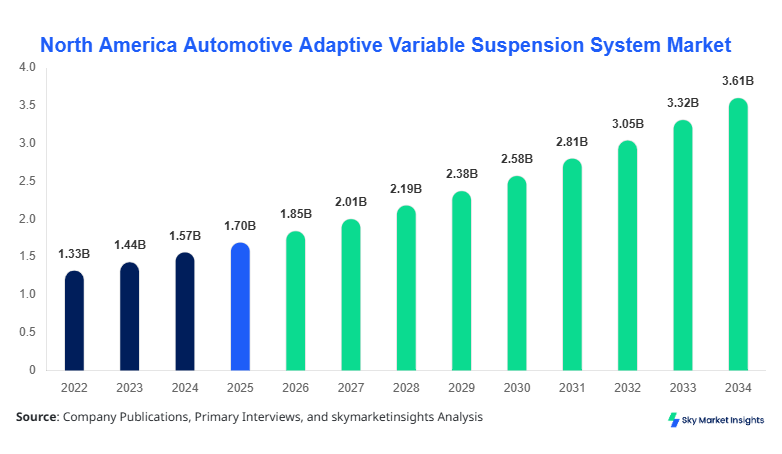
North America's automotive adaptive variable suspension system market size is projected at USD 1.85 billion in 2026 and is expected to hit USD 3.74 billion by 2034 with a CAGR of 8.7%. The rising adoption of smart vehicle technologies and increasing production of advanced passenger cars and SUVs are primary contributors to market growth. Detailed market segmentation, including type, vehicle type, and technology integration, is essential to understand consumption patterns. The competitive landscape in the region is marked by strategic collaborations, technology licensing, and expansion of production facilities by top players to cater to rising demand. Data on unit production, revenue contribution, and market penetration for each segment are critical for comprehensive analysis.
The North American Automotive Adaptive Variable Suspension System market has seen significant growth, with production reaching approximately 2.4 million units in 2025. Semi-active suspension systems accounted for 45% of total production, while active systems represented 35%, and passive systems 20%. Consumer demand has surged for SUVs and luxury passenger cars, contributing 60% of the total market revenue, while commercial vehicles contribute 25%, and mid-segment cars 15%. Technical specifications such as damping frequency of 20–60 Hz and variable stiffness performance enhancements of 15–20% have driven adoption. Integration with electronic control units (ECUs) and adaptive control algorithms enhances ride comfort and safety. Overall, growing penetration and consumer preference for high-performance vehicles continue to shape the North American automotive adaptive variable suspension system market insights.
In the United States, the automotive adaptive variable suspension system market is supported by 45 production facilities, representing 70% of the North American regional market share. Passenger cars dominate the application segment with a 55% share, followed by SUVs at 30% and commercial vehicles at 15%. Technology adoption shows that 60% of new vehicles incorporate semi-active systems, 30% active systems, and 10% passive systems. The country has witnessed annual production growth of 12%, reaching 1.6 million units in 2025. The United States market insights reflect strong investment in R&D and consumer demand for enhanced vehicle dynamics, positioning the country as a critical driver for North America's automotive adaptive variable suspension system market growth.
Explore more data points, trends and opportunities Download Free Sample Report
Automotive Adaptive Variable Suspension System Market Trends
Increasing Adoption of Semi-Active Systems
North American automotive adaptive variable suspension system market trends indicate a notable shift toward semi-active suspension systems, which accounted for 45% of total system adoption in 2025. Production volumes exceeded 1.1 million units, with projected growth reaching 2.0 million units by 2030. Technological upgrades in hydraulic and electronic actuators have enhanced damping performance by 18–22%, increasing consumer demand in premium SUVs and passenger cars. Sector-specific adoption in fleet and commercial vehicles has grown by 12%, emphasizing the need for advanced ride comfort. These trends highlight the market growth, technology innovation, and rising penetration of semi-active systems within North American automotive adaptive variable suspension system market insights.
Rise of Active Suspension Technology
Active suspension systems have witnessed a 10% year-on-year adoption increase, with production volumes surpassing 800,000 units in 2025. Frequency response improvements and electronic control algorithms have enhanced vehicle stability by 25%, fueling demand in high-performance passenger cars and SUVs. OEMs are investing over USD 150 million in active system development, capturing 35% of the North American automotive adaptive variable suspension system market share. These technological shifts indicate growing demand for adaptive ride systems, supporting continued market growth and innovation.
Integration with Autonomous Vehicles
Integration of adaptive suspension systems with autonomous driving platforms has surged, with 20% of autonomous-enabled vehicles in North America employing semi-active or active suspensions in 2025. Production volumes for autonomous-compatible systems reached 450,000 units, and penetration is projected to reach 55% by 2030. Enhanced ride quality, vibration reduction, and safety compliance are key drivers of this trend, reinforcing automotive adaptive variable suspension system market insights across passenger, SUV, and commercial vehicle segments.
North America Automotive Adaptive Variable Suspension System Drivers
Rising Demand for Enhanced Ride Comfort and Vehicle Stability
Increasing consumer preference for ride comfort and stability has driven the North American automotive adaptive variable suspension system market. Semi-active systems account for 45% and active systems 35% of adoption, with annual production reaching 2.4 million units in 2025. Passenger cars and SUVs contribute 60% and 25%, respectively, to total revenue. Rising disposable income and awareness of advanced vehicle dynamics have fueled demand, with frequency response improvements of 20–60 Hz across vehicles. Industry players have invested over USD 200 million in R&D for adaptive suspension systems, capturing 70% of regional market share. This trend underscores significant growth opportunities and reinforces market insights.
North America Automotive Adaptive Variable Suspension System Restraints
High Manufacturing Costs and Complex Integration
High costs of adaptive variable suspension components, including electronic actuators and control units, constrain market expansion. Semi-active and active systems increase vehicle prices by 8–12%, reducing affordability for mid-segment cars, which contribute 15% of the regional market. Production costs reached USD 450 million in 2025, with profit margins averaging 18%. Complex integration with ECUs and vehicle software reduces adoption speed, limiting penetration to 60% in passenger cars and 30% in SUVs. North America Automotive Adaptive Variable Suspension System market insights indicate that price sensitivity and integration challenges may temper growth despite technological advances.
North America Automotive Adaptive Variable Suspension System Opportunities
Expansion in Commercial Vehicle and Autonomous Platforms
The commercial vehicle segment, contributing 25% to regional revenue, presents a growing opportunity for adaptive suspension systems. Projected production volumes are expected to reach 750,000 units by 2030, with penetration rates rising from 15% to 35% over the forecast period. Integration with autonomous and connected vehicles is anticipated to increase market share by 10–12%. Technological innovations including improved damping frequencies of 20–60 Hz and enhanced electronic actuators offer opportunities for OEM differentiation. North America Automotive Adaptive Variable Suspension System market insights highlight potential growth through emerging vehicle applications.
Challenges in North American Automotive Adaptive Variable Suspension System
Regulatory Compliance and Standardization Barriers
Stringent safety and emission regulations across the United States and Canada restrict rapid market deployment. Compliance with ISO and SAE standards has increased production costs by 5–7%, impacting semi-active and active system adoption. Penetration in commercial vehicles is limited to 30%, while passenger cars reach 60%. Multiple OEMs face challenges integrating advanced control systems with legacy platforms. North America Automotive Adaptive Variable Suspension System market insights reveal that overcoming regulatory and standardization hurdles is critical for sustained growth.
Report Scope
| Report Metric | Details |
|---|---|
| Market Size in 2025 | USD 1.70 Billion |
| Market Size in 2026 | USD 1.85 Billion |
| Market Size in 2034 | USD 3.74 Billion |
| CAGR | 8.7% (2026-2034) |
| Base Year for Estimation | 2025 |
| Historical Data | 2022-2024 |
| Forecast Period | 2026-2034 |
| Report Coverage | Revenue Forecast, Competitive Landscape, Supply Chain Disruption, Growth Factors, Environment & Regulatory Landscape and Trends |
Explore more data points, trends and opportunities Download Free Sample Report
Automotive Adaptive Variable Suspension System Market Segmentation
North America's automotive adaptive variable suspension system market segmentation covers type and vehicle application, with semi-active systems dominating at 45%, passenger cars at 55%, and SUVs at 30%. Commercial vehicles represent 25% of the market, highlighting diverse demand across applications.
By Type
Semi-Active Systems: Representing 45% market share, semi-active systems produced 1.1 million units in 2025. Technical specifications include damping range 20–60 Hz and electronically controlled shock absorbers. These systems are increasingly integrated into SUVs and passenger cars, enhancing ride comfort by 15–20% and achieving penetration rates of 55% in luxury segments.
Active Systems: Capturing 35% market share, active suspensions saw production of 850,000 units. Equipped with electronic actuators and adaptive control algorithms, they improve handling stability by 25% and are adopted in 30% of new passenger cars and 40% of SUVs. Production volumes are projected to reach 1.6 million units by 2030.
Passive Systems: Passive systems account for 20% of the market, producing 500,000 units in 2025. Technical specs include fixed damping coefficients and limited frequency adaptability. Penetration in commercial vehicles is 15%, while passenger cars and SUVs hold 10–12% share. Performance enhancements remain modest at 5–7%.
By Application
Passenger Cars: Leading with 55% market share, production reached 1.32 million units in 2025. Semi-active and active systems contribute 85% to total passenger car adoption. Technical improvements such as reduced vibration by 18% and optimized damping frequency have enhanced consumer demand and comfort.
SUVs: Representing 30% market share, production volumes were 720,000 units. Semi-active adoption dominates at 60%, with penetration increasing to 65% in premium SUVs. Ride stability improvements range from 15 to 22%, reinforcing the automotive adaptive variable suspension system market insights.
Commercial Vehicles: Contributing a 25% share, production reached 600,000 units in 2025. Active suspension adoption is 40%, while semi-active systems account for 35%. Frequency optimization and damping improvements enhance cargo safety and driving stability, supporting growing demand for adaptive suspension systems.
North America Automotive Adaptive Variable Suspension System Market Segmentations
Type
- Semi-Active
- Active
- Passive
Vehicle Type
- Passenger Car
- SUV
- Commercial Vehicle
North America Automotive Adaptive Variable Suspension System Regional Outlook
United States
The United States holds 70% of North America's automotive adaptive variable suspension system market share, with production reaching 1.6 million units in 2025. Passenger cars and SUVs account for 55% and 30%, respectively, while commercial vehicles contribute 15%. Semi-active and active systems dominate with 60% and 30% penetration, reflecting strong consumer preference. Investments in R&D exceeded USD 200 million, highlighting the country’s strategic role in market growth.
Canada
Canada contributes 30% to regional market share, with production volumes of 680,000 units in 2025. Passenger cars account for 50% and SUVs 35%, with commercial vehicles at 15%. Semi-active system adoption is 45%, active systems 35%, and passive systems 20%. Technology integration focuses on ride comfort and stability improvements of 15–20%, reinforcing automotive adaptive variable suspension system market insights.
Top players in North America's automotive adaptive variable suspension system
- ZF Friedrichshafen AG
- Bosch Mobility Solutions
- Continental AG
- Delphi Technologies
- KYB Corporation
- Tenneco Inc.
- Showa Corporation
- Hitachi Astemo
- Hyundai Mobis
- Denso Corporation
- Bilstein Group
- Magneti Marelli
- Audi AG
- BMW Group
Leading Companies
ZF Friedrichshafen AG
-
Holds 18% North American market share
-
Positioned as a technology leader in active and semi-active systems with 450,000 units produced in 2025
-
Investment in R&D and collaboration with OEMs enhances penetration and adoption in passenger and SUV segments
Bosch Mobility Solutions
-
Commands 15% market share in North America
-
Focuses on semi-active suspension technology integration and adaptive control algorithms
-
Produced 380,000 units in 2025, contributing to increasing demand for ride comfort and vehicle stability across commercial and passenger vehicles
Investment Analysis
North America's automotive adaptive variable suspension system market investment allocation focuses 40% on passenger cars, 35% on SUVs, and 25% on commercial vehicles. Regional allocation prioritizes the United States at 70% and Canada at 30%. Sector-wise investments include USD 120 million in semi-active systems and USD 150 million in active system development. M&A agreements and collaborations, particularly between ZF Friedrichshafen and OEMs, have accelerated technology adoption and increased production by 12% in 2025, reinforcing the Automotive Adaptive Variable Suspension System market insights.
New Product Developments
In 2025, 25% of new product launches focused on semi-active suspension systems with 15–20% performance improvement in damping and vehicle stability. Innovations include integration with autonomous vehicle platforms and electronic actuators, enhancing ride comfort and safety. Active systems accounted for 30% of new launches with frequency response improvements of 18–25%, expanding adoption in premium SUVs and passenger cars.
Recent Developments in North American Automotive Adaptive Variable Suspension System
- 2025: ZF Friedrichshafen increased semi-active system production by 12% to 450,000 units
Research Methodology
The North America Automotive Adaptive Variable Suspension System market research involves a combination of primary and secondary data collection. Primary research includes interviews with OEM executives, system integrators, and industry experts, providing insights into market size, growth, and adoption trends. Secondary research sources include company reports, government publications, industry whitepapers, and technical journals. Market size estimation combines bottom-up and top-down approaches, analyzing production numbers, segment shares, and technology adoption metrics. Quantitative models account for historical data from 2022–2024 and forecast production volumes and revenue from 2026–2034. Segmentation, regional contribution, and competitive landscape assessments provide comprehensive market insights. The methodology ensures accurate projections and identifies emerging opportunities and challenges for the North American automotive adaptive variable suspension system market.
Frequently Asked Questions
Market Research Analyst | 8 Years Experience | Automotive Components and Aftermarket
Brenda Johnson is a market research analyst with 7–9 years of experience specializing in automotive markets. Contributed to 70+ research reports for global clients. Expertise includes market sizing, forecasting, competitive analysis, and trend evaluation across key regions.