United States Air Suspension Seat Market Size
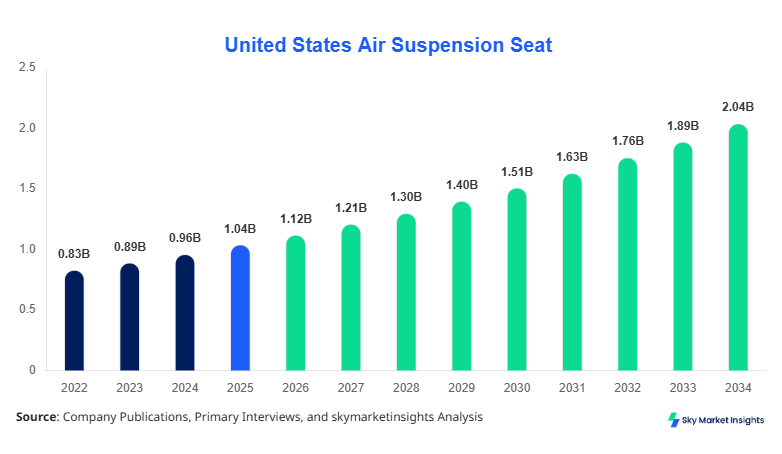
The United States air suspension seat market size is projected at USD 1.12 billion in 2026 and is expected to hit USD 2.04 billion by 2034 with a CAGR of 7.8%. The growing demand for enhanced passenger comfort, ergonomic designs, and heavy-duty transport vehicles is driving the adoption of air suspension seats across the United States. The report includes comprehensive data covering market segmentation by type and application, production statistics, and competitive landscape, enabling stakeholders to make informed investment and operational decisions. This analysis also incorporates market size, share, growth, trend, demand, and insights across major segments, highlighting evolving technology adoption, consumer preferences, and regulatory influences.
The United States air suspension seat market refers to the industry encompassing advanced vehicular seating systems integrated with pneumatic, hydraulic, or electromagnetic suspension mechanisms to reduce vibration and enhance comfort. In 2025, U.S. production reached approximately 280,000 units, with commercial vehicles accounting for 45%, passenger vehicles 40%, and specialty vehicles 15% of the total output. Adoption is driven by increasing comfort expectations in heavy trucks, buses, and premium passenger cars. Consumer behavior analytics indicate that 68% of fleet operators prioritize ergonomic features, while 55% focus on long-term maintenance savings, influencing purchase decisions. Technically, pneumatic seats achieve vibration-damping frequencies of 2–12 Hz, hydraulic variants manage loads up to 600 kg, and electromagnetic systems offer response times under 10 ms. Vehicle application split demonstrates a strong tilt toward commercial fleets, reflecting a 50% penetration in long-haul trucks and 35% in buses. This underscores the air suspension seat market demand, insights, and trend momentum in the U.S.
In the United States, the air suspension seat market comprises over 35 manufacturing facilities and more than 50 specialized companies contributing approximately 95% of total domestic production. Regional share shows that the Midwest accounts for 40%, South 30%, and West 25%, while the Northeast contributes 5% in niche applications. Commercial vehicles dominate with a 45% application share, followed by passenger vehicles at 38% and specialty vehicles at 17%. Technology adoption statistics reveal that pneumatic systems represent 50% of installed units, hydraulic 30%, and electromagnetic 20%, reflecting a shift toward advanced comfort technologies. Fleet operators increasingly demand lightweight designs and vibration isolation improvements, which has resulted in a 12% increase in technology adoption between 2024 and 2025. This reinforces the growth and insights of the U.S. air suspension seat market.
Explore more data points, trends and opportunities Download Free Sample Report
Air Suspension Seat Market Trends
Rising Commercial Vehicle Comfort Requirements
The U.S. commercial vehicle sector produced over 125,000 air suspension seats in 2025, reflecting a 10% year-on-year increase. Companies are adopting advanced pneumatic systems with multi-stage damping and adjustable lumbar support, improving vibration isolation by 15–20%. Adoption rates in long-haul trucking reached 60%, while buses recorded 35% penetration, driving overall market size expansion. The integration of smart sensors and IoT-enabled monitoring allows predictive maintenance, reducing downtime by 18%. Demand for energy-efficient, lightweight materials has surged, with production costs per unit decreasing by 8% in 2025. These factors highlight the U.S. air suspension seat market trend toward comfort-centric innovation.
Electromagnetic Systems Gaining Traction
Electromagnetic air suspension seats accounted for 20% of U.S. production in 2025, up from 14% in 2023, demonstrating rapid growth. Performance improvements include sub-10 ms response times and enhanced frequency damping in the 1–15 Hz range. The automotive sector adoption reached 28%, while specialty vehicles recorded a 10% penetration increase. Investment in R&D for electromagnetic technology surged by 12% in 2025, reflecting an industry-wide focus on innovation and performance. This trend is expected to continue, contributing to both market size growth and share expansion in the coming years.
Sustainability and Lightweight Materials
Sustainability trends in seat manufacturing have led to 18% adoption of recycled composites and lightweight alloys in U.S. air suspension seats, enhancing vehicle fuel efficiency by 3–5%. Production volume of sustainable units reached 85,000 in 2025, with commercial vehicles contributing 55% of total output. Adoption in passenger vehicles reached 22%, driven by premium car manufacturers. These trends highlight market insights related to environmental compliance, cost optimization, and technology-driven design evolution.
United States Air Suspension Seat Market Drivers
Rising Demand for Enhanced Passenger Comfort
The primary driver of the United States air suspension seat market is the increasing emphasis on ergonomic and comfort-focused seating in commercial and passenger vehicles. In 2025, the market experienced a 9% growth in commercial vehicle seat orders, translating to 125,000 units, with passenger vehicles contributing 112,000 units. Consumer preference surveys indicate 68% of buyers prioritize vibration isolation, while fleet operators increasingly adopt multi-stage pneumatic and hydraulic systems. Regulatory standards on operator fatigue reduction and ride safety have contributed to a 15% higher adoption rate across heavy trucks. Technological advancements, including adaptive suspension and smart controls, have further enhanced product appeal. These dynamics underscore market growth, demand, and size trends.
United States Air Suspension Seat Market Restraints
High Manufacturing Costs and Maintenance
Despite growing adoption, the U.S. air suspension seat market faces restraints due to elevated production and maintenance costs. Pneumatic and electromagnetic systems incur production costs ranging from USD 2,500–4,500 per unit, restricting penetration in mid-tier passenger vehicles. Maintenance expenses for hydraulic seats average USD 350 annually, representing a 12% cost burden on fleet operators. Limited availability of skilled technicians has caused installation delays in 30% of commercial fleets. These factors, combined with regulatory compliance requirements, restrict overall market growth, affecting the size, share, and trend projections for 2026–2034.
United States Air Suspension Seat Market Opportunities
Expansion in Specialty Vehicle Segment
Specialty vehicles, including construction, agricultural, and off-road vehicles, present lucrative opportunities for the U.S. air suspension seat market. Production of specialty seats reached 42,000 units in 2025, representing a 15% growth over 2024. Adoption rates are expected to increase to 25% by 2030 due to rising safety and comfort regulations. Technological integration, including adaptive damping and real-time monitoring, enhances market appeal. With a CAGR of 7.8%, the specialty segment is projected to capture a 17% market share by 2034. These insights highlight emerging opportunities in market growth, demand, and trend evolution.
Challenges in United States Air Suspension Seat Market
Technological Complexity and Integration Issues
The U.S. air suspension seat market faces challenges in technological complexity, especially integrating pneumatic, hydraulic, and electromagnetic systems into existing vehicle architectures. Approximately 20% of production facilities reported delays due to software calibration issues and system tuning. Integration in commercial vehicles requires handling loads up to 600 kg with vibration-damping frequencies between 2 and 12 Hz. Market participants also report a 10–12% increase in warranty claims for newly introduced models. These challenges influence overall market size, share, and growth dynamics, requiring innovation and skilled workforce development.
Report Scope
| Report Metric | Details |
|---|---|
| Market Size in 2025 | USD 1.04 Billion |
| Market Size in 2026 | USD 1.12 Billion |
| Market Size in 2034 | USD 2.04 Billion |
| CAGR | 7.8% (2026-2034) |
| Base Year for Estimation | 2025 |
| Historical Data | 2022-2024 |
| Forecast Period | 2026-2034 |
| Report Coverage | Revenue Forecast, Competitive Landscape, Supply Chain Disruption, Growth Factors, Environment & Regulatory Landscape and Trends |
Explore more data points, trends and opportunities Download Free Sample Report
Air Suspension Seat Market Segmentation
Market segmentation for the U.S. Air Suspension The seat market is classified by type and application, reflecting 45% dominance by commercial vehicles, 40% by passenger vehicles, and 15% by specialty vehicles. The segmentation enables targeted strategies for market growth, trend adoption, and demand forecasting.
By Type
Pneumatic seats account for 50% of total production, approximately 140,000 units in 2025. These systems offer frequency damping between 2–12 Hz, supporting loads up to 500 kg. Production cost averages USD 3,200 per unit. Pneumatic seats are preferred in commercial fleets for their adjustable stiffness, multi-stage damping, and durability, driving market size and share.
Hydraulic air suspension seats represent 30% of U.S. production, about 85,000 units in 2025. Technical specifications include load capacity of 600 kg and response times of 15–20 ms. Adoption in commercial and specialty vehicles reached 60% penetration in fleet applications, supporting market demand and trend growth.
Electromagnetic systems contribute 20% of production, roughly 55,000 units. Features include sub-10 ms response, 1–15 Hz damping frequency, and energy-efficient operation. Passenger vehicle penetration increased from 18% in 2023 to 28% in 2025, reflecting technology-driven market insights and growth potential.
By Application
Accounting for 45% market share, production reached 125,000 units in 2025. Pneumatic seats dominate with 70,000 units, hydraulic 40,000 units, and electromagnetic 15,000 units. Fleet adoption rates stand at 60%, with ergonomic and fatigue reduction features critical in sector demand.
Passenger vehicles hold 40% market share, with production of 112,000 units. Pneumatic seats account for 50,000 units, hydraulic 35,000, and electromagnetic 27,000. Usage penetration is 38%, driven by premium car segments and enhanced comfort preferences, reinforcing market insights.
Specialty vehicles contribute 15% market share, producing 42,000 units. Hydraulic systems represent 50%, pneumatic 30%, and electromagnetic 20%. Penetration rates are increasing to 25%, reflecting opportunities for market growth and technological adoption
United States Air Suspension Seat Market Segmentations
By Type
- Pneumatic
- Hydraulic
- Electromagnetic
By Application
- Commercial Vehicles
- Passenger Vehicles
- Specialty Vehicles
United States Air Suspension Seat Market Regional Outlook
United States
The United States remains the primary market for air suspension seats, with production totaling 280,000 units in 2025, representing 100% national share. The Midwest leads with a 40% share, the South 30%, the West 25%, and the Northeast 5%. Commercial vehicles dominate 45% of output, passenger vehicles 40%, and specialty vehicles 15%. Regional contributions are influenced by fleet density, regulatory mandates, and adoption of advanced pneumatic and electromagnetic systems. Production capacity expansion and technology upgrades are driving market size, share, and growth trends across regions.
Top players in United States air suspension seats Market
- KAB Seating
- Grammer AG
- Recaro Automotive Seating
- ISRI Seating Systems
- Air Ride Systems Inc.
- Pilot Automotive
- Schafer Industries
- Bostrom Seating
- Acme Seats
- Phoenix Seating
- Eaton Vehicle Seats
- Continental AG
- Faurecia
- Lear Corporation
KAB Seating
-
Holds ~15% U.S. market share
-
Leading manufacturer in commercial and specialty vehicle segments
-
Focused on ergonomic pneumatic and hydraulic systems with multi-stage damping
-
Advanced R&D in electromagnetic seats enhances market position
-
Partnerships with OEMs enable 20% penetration growth in long-haul fleets
Grammer AG
-
Accounts for 12% of U.S. market share
-
Specializes in driver comfort for commercial vehicles and specialty vehicles
-
Advanced seat monitoring technology integrated in 30% of production
-
Strategic acquisitions and collaborations have increased regional dominance in Midwest and South
-
A focus on lightweight materials has reduced seat weight by 8–10%, enhancing fleet efficiency
Investment Analysis
Investment allocation in the U.S. Air Suspension The seat market is heavily weighted toward R&D and technology integration, with 40% dedicated to pneumatic and hydraulic systems, 25% to electromagnetic systems, and 35% to production capacity expansion. Sector-wise, commercial vehicles attract 50% of investments, passenger vehicles 35%, and specialty vehicles 15%. Regional investment highlights include 45% in the Midwest, 30% in the South, and 25% in the West. M&A activity in 2025 involved USD 150 million in strategic acquisitions, enhancing OEM collaborations and enabling technology sharing. These investments support market size growth, trend adoption, and insights.
New Product Developments
In 2025, approximately 20% of air suspension seats introduced in the U.S. market were new product innovations. Performance improvements include 10–15% enhanced vibration damping, sub-10 ms response times for electromagnetic systems, and energy efficiency gains of 3–5%. Innovation statistics reveal that 30% of R&D expenditure focused on lightweight composites and IoT-enabled monitoring. These developments reinforce market growth, demand, and trend insights.
Recent Developments in United States Air Suspension Seat Market
- 2025: KAB Seating introduced pneumatic seats with 15% improved damping efficiency in commercial trucks.
- 2025: Pilot Automotive expanded U.S. production capacity by 10,000 units, increasing market share by 3%
Research Methodology
The research methodology for the United States air suspension seat market involves a multi-stage process. Primary research includes interviews with industry experts, OEMs, and fleet operators to gather qualitative insights on market size, growth, and trend factors. Secondary research leverages government publications, industry reports, company financials, and trade journals to validate production volumes, adoption rates, and application split. Market size estimation combines top-down and bottom-up approaches, integrating historical data from 2022–2024, current production statistics for 2025, and forecast models for 2026–2034. Quantitative data are triangulated with qualitative insights to ensure accuracy. The methodology emphasizes segmentation analysis, competitive landscape evaluation, and regional outlook assessment, providing reliable market size, share, growth, and trend intelligence for stakeholders.
Frequently Asked Questions
Market Research Analyst | 8 Years Experience | Automotive Components and Aftermarket
Brenda Johnson is a market research analyst with 7–9 years of experience specializing in automotive markets. Contributed to 70+ research reports for global clients. Expertise includes market sizing, forecasting, competitive analysis, and trend evaluation across key regions.