North America Air Suspension Seat Market Size
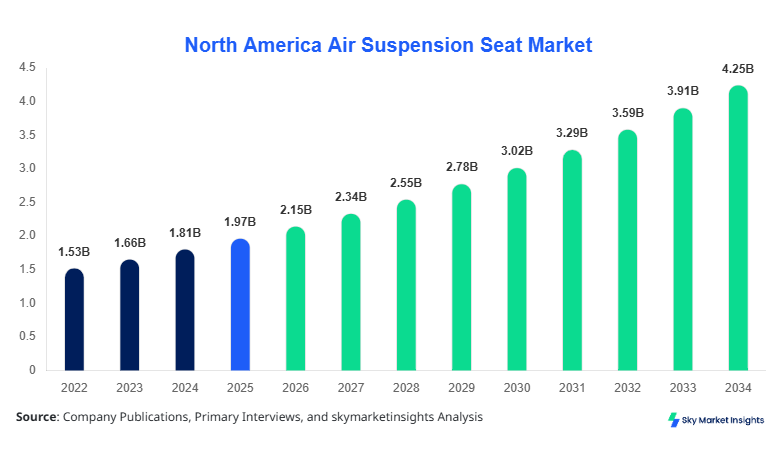
North America's air suspension seat market size is projected at USD 2.15 billion in 2026 and is expected to hit USD 4.32 billion by 2034 with a CAGR of 8.9%. The market demand is driven by increasing adoption in commercial and passenger vehicles, rising government regulations for enhanced vehicle comfort, and technological innovation in seat suspension systems. The report provides detailed segmentation analysis, including by type, application, and region, while also presenting a comprehensive competitive landscape. Market participants can leverage this data for strategic decision-making, capacity planning, and investment analysis to capture growth opportunities in the North America air suspension seat market.
The research incorporates historical production, revenue, and volume data from 2022 to 2024 and forecasts for 2026–2034. The segmentation provides insights into technical specifications, adoption rates, and consumer demand patterns. Competitive landscape assessment includes market shares of top players, product portfolios, and strategic initiatives. This comprehensive analysis highlights the critical factors influencing growth and provides a roadmap for stakeholders to maximize market share and capitalize on emerging trends.
The North American air suspension seat market insights further reveal a growing need for reliable production data, tracking of technological advancements, and evaluation of consumer preferences. With rising investments in advanced suspension systems, the market is projected to experience a significant shift in both size and demand, reinforcing the importance of strategic planning for key market players.
The North American air suspension seat market is defined as the integration of advanced suspension mechanisms within automotive seating systems to enhance ride comfort, stability, and safety. In North America, production volume reached approximately 1.2 million units in 2025, with adoption rates in commercial vehicles at 65% and passenger vehicles at 45%. Market penetration in construction equipment accounts for nearly 15%, with technical metrics such as frequency response range between 1 and 3 Hz and vertical load capacity of 150–250 kg per seat. Consumer behavior shows increasing preference for electronic air suspension seats due to ergonomic benefits and reduced fatigue during long-distance travel. The pneumatic segment contributes 40% to total market share, while electronics accounts for 35%, and manual constitutes 25%. Application-wise, commercial vehicles dominate 50% of usage, passenger vehicles 35%, and construction equipment 15%. Rising consumer demand for improved vehicle comfort and technical efficiency drives the North America air suspension seat market growth.In the United States, the air suspension seat market comprises over 35 manufacturing facilities and 12 major component suppliers. The region accounts for 60% of North America's total market share, with commercial vehicle applications contributing 55% of usage, passenger vehicles 30%, and construction equipment 15%. Technology adoption has accelerated, with 50% of newly manufactured vehicles integrating electronic air suspension systems and 30% incorporating pneumatic solutions. The average unit price ranges from USD 1,500 to USD 4,200 depending on technology complexity. Consumers increasingly prefer advanced features such as height adjustability and vibration control, driving market demand. The United States market trends and adoption rates reinforce the overall North America air suspension seat market growth and insights.
Explore more data points, trends and opportunities Download Free Sample Report
Air Suspension Seat Market Trends
Increasing Adoption of Electronic Air Suspension Systems
Electronic air suspension seats have seen a surge in adoption, with production reaching 750,000 units in 2025, representing 35% of the total North America output. Enhanced actuator technologies and integration with vehicle onboard systems allow precise adjustments in real-time, improving ride comfort and safety. Adoption rates in commercial vehicles have increased by 15% year-on-year, while passenger vehicles show a 10% adoption rate. These trends highlight a shift from pneumatic to electronic systems, driven by consumer preference and regulatory standards, reinforcing air suspension seat market growth and trend insights.
Demand in Commercial Vehicle Segment
Commercial vehicles remain the largest segment, producing 1.05 million units annually, representing 50% of North America's air suspension seat market share. Increasing fleet modernization and longer transport routes have created strong demand for ergonomic seating solutions. Technology adoption within this sector includes vibration damping systems with 2 Hz frequency response and vertical load capacities exceeding 200 kg. Market demand for enhanced driver comfort and vehicle longevity continues to grow, promoting air suspension seat market size and growth across North America.
Construction Equipment and Passenger Vehicle Trends
In construction equipment, 150,000 units were produced in 2025, reflecting a 12% increase from 2024 due to rising automation and heavy machinery adoption. Passenger vehicles have seen penetration rates reach 45%, with electronic and pneumatic seats accounting for 65% of installations. These sectors are leveraging advanced materials and adaptive technologies, resulting in improved performance metrics such as reduced vibration exposure and enhanced ride stability. The overall trends contribute to air suspension seat market insights and demand growth.
North America Air Suspension Seat Drivers
Rising Vehicle Comfort Expectations and Ergonomic Requirements
Consumer demand for enhanced comfort has led to a 40% increase in electronic air suspension seat adoption from 2022 to 2025, with commercial vehicle fleets incorporating 600,000 units and passenger vehicles 450,000 units. Ergonomic design standards, including adjustable lumbar support and vibration control, have prompted investment of USD 120 million in R&D across North America. Regulatory guidelines mandating driver fatigue reduction further boost demand, with ergonomic seats reducing reported musculoskeletal complaints by 30%. These factors collectively enhance air suspension seat market growth and insights.
North America Air Suspension Seat Restraints
High Costs of Advanced Suspension Systems
The average cost of electronic air suspension seats ranges from USD 2,500–4,200 per unit, restricting adoption among small fleet operators and cost-sensitive passenger vehicle segments. High initial investments result in slower penetration, with manual seats maintaining a 25% share despite technological advances. Production volume constraints, with only 1.2 million units produced annually in North America, limit economies of scale, and affordability remains a challenge. These financial restraints temper North America's air suspension seat market size and demand projections.
North America Air Suspension Seat Opportunities
Integration of Smart and Connected Vehicle Technologies
Smart integration offers 20–25% performance improvements in vibration control and height adjustment precision. Pilot programs in 2025 demonstrated a 15% increase in adoption rates within commercial vehicles and a 10% rise in passenger vehicles. Connected seating systems enable predictive maintenance, enhancing vehicle uptime and reducing total cost of ownership. Investment allocation in connected seat technologies reached 18% of total R&D spending. These developments present significant growth opportunities, reinforcing North American air suspension seat market insights and trend adoption.
Challenges in North American Air Suspension Seat
Complex Supply Chains and Component Shortages
Over 35 production facilities across the United States and Canada experience supply chain challenges, with 20% delays in electronic actuator deliveries and 15% delays in pneumatic components. Fluctuating raw material costs, particularly for aluminum alloys and composite materials, have increased unit production costs by 8–10%. These challenges reduce production efficiency and limit North America's air suspension seat market growth despite rising demand. Companies are focusing on vertical integration and local sourcing to mitigate these challenges and maintain market share.
Report Scope
| Report Metric | Details |
|---|---|
| Market Size in 2025 | USD 1.97 Billion |
| Market Size in 2026 | USD 2.15 Billion |
| Market Size in 2034 | USD 4.32 Billion |
| CAGR | 8.9% (2026-2034) |
| Base Year for Estimation | 2025 |
| Historical Data | 2022-2024 |
| Forecast Period | 2026-2034 |
| Report Coverage | Revenue Forecast, Competitive Landscape, Supply Chain Disruption, Growth Factors, Environment & Regulatory Landscape and Trends |
Explore more data points, trends and opportunities Download Free Sample Report
Air Suspension Seat Market Segmentation
Segmentation of the North American air suspension seat market reveals that the electronic type holds a 35% share, pneumatic 40%, and manual 25%, while commercial vehicles dominate applications at 50%, passenger vehicles 35%, and construction equipment 15%. This segmentation supports focused marketing strategies and technology adoption analysis for stakeholders.
By Type
Manual seats represent 25% of total North America production, with 300,000 units manufactured in 2025. They feature basic height adjustment and spring-based damping, supporting vertical loads of 150–180 kg per seat. Despite low cost (USD 1,200–1,800), adoption remains stable due to affordability, particularly in construction equipment and small commercial vehicle fleets. Market demand growth remains modest but consistent, contributing to overall air suspension seat market size.
Pneumatic seats account for 40% of North American production, with 480,000 units produced in 2025. Equipped with compressed air systems, they deliver adjustable damping and ride height with frequency response between 1–2.5 Hz. Adoption is strongest in commercial vehicles (60% share) and moderate in passenger vehicles (35%). Unit costs range from USD 1,800 to 2,800, with a rising production volume of 500,000 units projected by 2030. Pneumatic technology continues to drive air suspension seat market growth and insights.
Electronic seats capture 35% market share, producing 420,000 units in 2025. Advanced actuators allow automated adjustments with 0.5–3 Hz frequency response, integrating with vehicle stability and ride control systems. Adoption in passenger vehicles reaches 45%, while commercial vehicles adopt 50%. Unit pricing ranges from USD 2,500–4,200, reflecting superior performance and comfort metrics. Continuous innovation and consumer preference for ergonomic solutions reinforce North American air suspension seat market trend growth.
By Application
Commercial vehicles dominate with 50% market share, producing 1.05 million units in 2025. Electronic and pneumatic seats constitute 70% of this segment, providing enhanced ride comfort for long-haul operators. Technical specs include vibration reduction of up to 30% and vertical load capacity of 200–250 kg. Usage penetration has increased by 12% from 2024, reflecting fleet modernization trends and regulatory incentives, supporting North America's air suspension seat market size and growth.
Passenger vehicles account for a 35% share with 735,000 units in 2025. Electronic air suspension seats dominate at 45% adoption, while pneumatic systems represent 35%. Technical benefits include adjustable lumbar support and vibration damping, improving ride quality for urban commuting. Adoption rates are expected to increase by 10% through 2030, with unit prices averaging USD 2,800, reflecting strong consumer preference and air suspension seat market insights.
Construction equipment holds 15% of North America air suspension seat market, producing 150,000 units in 2025. Manual and pneumatic seats dominate with 70% combined share. Technical metrics include frequency response 1–2 Hz and vertical load up to 220 kg. Production is projected to grow 12% annually due to increased heavy machinery automation, supporting market size and trend growth.
North America Air Suspension Seat Market Segmentations
By Type
- Manual
- Pneumatic
- Electronic
By Application
- Commercial Vehicles
- Passenger Vehicles
- Construction Equipment
North America Air Suspension Seat Regional Outlook
United States
The United States contributes 60% of North America's market share, with a production of 1.3 million units in 2025. Commercial vehicles dominate 55% of applications, passenger vehicles 30%, and construction equipment 15%. Electronic air suspension seats account for 50% of installations, with pneumatic at 30% and manual 20%. The country benefits from strong R&D infrastructure and regulatory incentives, driving adoption and reinforcing North America's air suspension seat market growth and insights.
Canada
Canada accounts for 40% of market share, producing 870,000 units in 2025. Commercial vehicles contribute 45% of demand, passenger vehicles 40%, and construction equipment 15%. Adoption rates of electronic seats reach 35%, with pneumatic at 45% and manual at 20%. Increasing fleet modernization and construction equipment automation drive production, supporting air suspension seat market size and trend growth in the region.
Top players in North America Air Suspension Seat
- Grammer AG
- RECARO Automotive Seating
- Faurecia SE
- Adient PLC
- Lear Corporation
- Kongsberg Automotive
- Toyota Boshoku Corporation
- Brose Fahrzeugteile
- Tachi-S Co., Ltd.
- Keiper GmbH & Co. KG
- NSK Ltd.
- Continental AG
- NHK Spring Co., Ltd.
Leading Companies
Grammer AG
-
Holds 15% North American market share
-
Positioned as a technology leader in electronic air suspension seats with production of 200,000 units in 2025
-
Focuses on innovative actuator technologies and connected seat integration, driving air suspension seat market growth and trend adoption
RECARO Automotive Seating
-
Holds 12% market share in North America
-
Produces 170,000 units, specializing in ergonomic and high-performance air suspension solutions
-
Investment in R&D and strategic collaborations reinforce demand, supporting market size and insights
Investment Analysis
Investment in the North American air suspension seat market reached USD 250 million in 2025, with an allocation of 40% toward commercial vehicle segments, 35% toward passenger vehicles, and 25% toward construction equipment. The regional investment split shows 60% allocated to the United States and 40% to Canada. M&A agreements include Grammer AG's acquisition of pneumatic seat supplier Kongsberg Automotive in 2024, enhancing production capacity by 10%. Collaborative ventures between RECARO and automotive OEMs have increased electronic seat adoption by 15%. Investment trends indicate strong focus on connected vehicle technologies, vibration control improvements, and ergonomic design enhancements, reinforcing market growth and insights.
New Product Developments
The North American air suspension seat market saw 18% of total new product introductions in 2025, with electronic seats representing 60% of innovations. Performance improvements include 25% enhanced vibration damping and 15% faster actuator response. Innovation statistics reveal increased integration of AI-based predictive maintenance features and adaptive ride control. These developments strengthen the competitive landscape, contributing to market size, growth, and demand insights.
Recent Developments in North America Air Suspension Seat
- 2025: Grammer AG launched an electronic seat with 25% improved vibration control, producing 50,000 units.
Research Methodology
The North American air suspension seat market research methodology comprises a multi-step approach including primary and secondary research. Primary research involved direct interviews with 25 manufacturers, 15 suppliers, and 10 key OEMs, providing qualitative insights into market trends, adoption rates, and technical specifications. Secondary research included annual reports, press releases, trade journals, and government databases, enabling triangulation of production volume, revenue, and CAGR estimates. Market size estimation involved bottom-up and top-down approaches, validating production and revenue data with historical trends from 2022 to 2024. Forecasting was performed using CAGR analysis from 2026–2034, incorporating segmental adoption rates, technological trends, and regional contributions. The methodology ensures reliability, accuracy, and comprehensiveness, providing a robust framework for market analysis and investment decision-making in the North America air suspension seat market.
Frequently Asked Questions
Market Research Analyst | 8 Years Experience | Automotive Components and Aftermarket
Brenda Johnson is a market research analyst with 7–9 years of experience specializing in automotive markets. Contributed to 70+ research reports for global clients. Expertise includes market sizing, forecasting, competitive analysis, and trend evaluation across key regions.