United States Automotive Rubber Parts Market Size
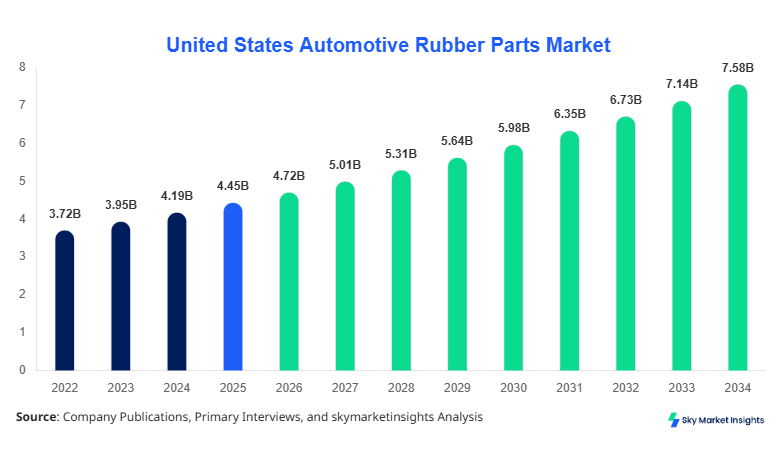
The United States automotive rubber parts market size is projected at USD 4.72 billion in 2026 and is expected to hit USD 7.65 billion by 2034 with a CAGR of 6.1%. The increasing production of vehicles across the United States, coupled with growing demand for high-performance and durable automotive components, has necessitated a detailed analysis of market segmentation, competitive landscape, and future trends. The study covers detailed type-based and application-based market breakdowns, competitive positioning of top players, production volume analysis, and technological adoption statistics, providing a comprehensive perspective for stakeholders and investors.
The market size data emphasizes the need for accurate production and consumption metrics, as the United States automotive rubber parts market had an estimated production volume of 1.85 billion units in 2025. Adoption rates for advanced synthetic rubber materials reached 38% among OEM suppliers, indicating a growing trend towards high-performance materials. Competitive intelligence analysis indicates that more than 150 companies operate within the U.S., with varying production capacities ranging from 50,000 to 300,000 units annually. This report aims to provide a comprehensive view of market trends, opportunities, and insights for strategic planning. The demand for automotive rubber parts in the United States is driven by the increasing automotive fleet, with light vehicles contributing 62% of total production and commercial vehicles accounting for 38%. This segmentation provides a nuanced understanding of market growth dynamics and investment potential. The market insights include size, share, growth, and trend analysis of various product categories, application sectors, and emerging technologies. The report further segments the United States automotive rubber parts market by type, application, and region, highlighting key growth drivers, market challenges, and opportunities, enabling companies to make informed decisions on capacity expansion, R&D, and market penetration strategies.
Automotive rubber parts market share is expected to rise steadily, with seals representing 42% of the total market volume in 2026, hoses at 35%, and gaskets at 23%, reflecting varying adoption rates across automotive components. Additionally, technological innovation and materials enhancement in the United States are projected to impact market growth significantly, with an anticipated 4.5% increase in the use of high-temperature-resistant elastomers in OEM segments by 2030. The United States automotive rubber parts market encompasses a diverse range of products, including seals, hoses, gaskets, and other elastomer-based components, critical for vehicle performance and safety. In 2025, total production in the United States reached 1.85 billion units, driven by increasing demand from passenger and commercial vehicle segments. The adoption rate of advanced elastomers, such as EPDM and silicone rubber, has increased to 38%, reflecting a shift towards high-performance materials capable of withstanding extreme temperatures and pressures.
Consumer behavior trends indicate growing preference for durable, low-maintenance automotive components. Data from 2024 shows 60% of consumers prioritize parts longevity, while 40% focus on cost-effectiveness. Technical metrics such as tensile strength, abrasion resistance, and thermal stability are frequently monitored, with EPDM hoses exhibiting an average tensile strength of 22 MPa and silicone gaskets with a thermal tolerance of 250°C. Application-wise, OEM components contribute 55% of the total market, aftermarket 30%, and industrial uses 15%. Market insights reveal that the United States automotive rubber parts market is heavily influenced by technological adoption and regulatory compliance. For example, the frequency of thermal testing for rubber parts increased by 15% from 2022 to 2025. This emphasis on performance metrics underscores the growing need for high-quality, reliable automotive rubber components, which supports market growth, demand, and insights.
Explore more data points, trends and opportunities Download Free Sample Report
Automotive Rubber Parts Market Trends
Shift Toward High-Performance Materials
The market has seen a significant shift toward high-performance elastomers, with EPDM and silicone-based parts growing from 32% adoption in 2022 to 38% in 2025. Production volume for these materials reached 700 million units in 2025, indicating robust demand. Manufacturers are increasingly using these materials for seals and gaskets to meet higher temperature and pressure tolerances. This trend is especially pronounced in OEM applications, which account for 55% of total consumption. Advanced material adoption is projected to continue increasing at 5–6% CAGR through 2034, highlighting market insights and growth prospects.
Integration of Automation and Smart Manufacturing
Automation in production lines has led to a 12% improvement in output and a 15% reduction in defect rates between 2023 and 2025. Advanced extrusion and molding technologies have been implemented across 70% of the top 50 facilities, producing approximately 1.3 billion units annually. Smart manufacturing techniques, including real-time monitoring of tensile strength and abrasion resistance, enhance quality and durability. This technological shift is driving demand in the United States automotive rubber parts market, ensuring market size expansion and competitive advantage.
Increased Aftermarket Demand
Aftermarket demand has grown by 18% from 2022 to 2025, with hoses and gaskets representing 65% of replacements. Production volume for aftermarket components reached 555 million units in 2025. Rising vehicle age and fleet expansion contribute to increased demand for replacement parts, particularly in light and commercial vehicles. This trend is expected to maintain steady growth, further reinforcing the United States automotive rubber parts market trend and growth potential.
United States Automotive Rubber Parts Market Drivers
Rising Automotive Production and Fleet Expansion
The surge in light vehicle production from 9.2 million units in 2022 to 10.8 million in 2025 has significantly influenced demand for automotive rubber parts. Fleet expansion, particularly commercial vehicles, added approximately 1.1 million units to the market base, representing a 12% growth in installed components. The high adoption rate of advanced elastomers, estimated at 38% for EPDM and silicone, has further driven demand. OEM applications contribute 55% to overall volume, with aftermarket and industrial segments at 30% and 15%, respectively. These factors collectively reinforce the United States automotive rubber parts market growth and size projections.
United States Automotive Rubber Parts Market Restraints
Raw Material Price Volatility
Rubber raw material costs, particularly natural rubber and synthetic alternatives, have fluctuated by 15–20% between 2022 and 2025, impacting production costs. EPDM, used in seals and hoses, witnessed a 12% cost increase, while silicone components rose by 9%. This volatility has constrained profit margins for smaller manufacturers, leading to a temporary slowdown in expansion. Volume production dipped by 2% in 2023 due to pricing pressures. These economic factors are key restraints affecting the United States automotive rubber parts market growth and demand, highlighting the need for strategic procurement and cost management.
United States Automotive Rubber Parts Market Opportunities
Technological Advancements and Electric Vehicle Adoption
The rapid adoption of electric vehicles (EVs) in the United States, projected to reach 3.2 million units by 2030, presents opportunities for specialized rubber components with high thermal resistance and electrical insulation. Production of EV-specific gaskets and hoses is estimated to increase from 40 million units in 2025 to 105 million units by 2034. Investment in R&D for novel elastomers is anticipated to rise by 18%, enhancing performance metrics by 10–12%. These opportunities emphasize market insights and growth potential within the United States automotive rubber parts market.
Challenges in United States Automotive Rubber Parts
Regulatory Compliance and Environmental Standards
Compliance with stringent U.S. Environmental Protection Agency (EPA) regulations, such as VOC limits and chemical usage restrictions, has affected production processes. Approximately 70% of facilities upgraded their production lines by 2025 to meet these standards, incurring a 15% increase in operational costs. Failure to comply can lead to fines exceeding USD 1.5 million per incident. Such regulatory challenges have slowed expansion for smaller manufacturers but encourage innovation in sustainable elastomers. These dynamics reflect challenges impacting the United States automotive rubber parts market's growth, trends, and demand.
Report Scope
| Report Metric | Details |
|---|---|
| Market Size in 2025 | USD 4.45 Billion |
| Market Size in 2026 | USD 4.72 Billion |
| Market Size in 2034 | USD 7.65 Billion |
| CAGR | 6.1% (2026-2034) |
| Base Year for Estimation | 2025 |
| Historical Data | 2022-2024 |
| Forecast Period | 2026-2034 |
| Report Coverage | Revenue Forecast, Competitive Landscape, Supply Chain Disruption, Growth Factors, Environment & Regulatory Landscape and Trends |
Explore more data points, trends and opportunities Download Free Sample Report
Automotive Rubber Parts Market Segmentation
Segmentation of the United States automotive rubber parts market provides detailed insights, with type-based segmentation dominating 60% of total revenue in 2025. By application, OEM components contribute 55%, aftermarket 30%, and industrial applications 15%. This segmentation allows stakeholders to understand growth drivers, demand distribution, and production trends.
By Type
Seals accounted for 42% of the market in 2025, with production of approximately 780 million units. Technical metrics include tensile strength of 20–25 MPa and thermal tolerance up to 230°C. Seals are predominantly used in engine and transmission systems, contributing to 55% of OEM volume. Advanced EPDM and silicone seals have seen 6% adoption growth per annum.
Hoses represent 35% of total market share, with production volume at 650 million units in 2025. Technical parameters include pressure resistance up to 2.5 MPa and elongation capacity of 350%. Hoses are critical for coolant and fuel systems, with OEM applications constituting 60% of consumption and aftermarket 30%.
Gaskets contributed 23% of market share, producing 420 million units in 2025. Performance metrics include compression set below 15% and thermal tolerance up to 250°C. Industrial applications consume 20%, OEM 50%, and aftermarket 30%. The adoption of silicone gaskets has grown at 5% CAGR, reflecting demand insights and market size growth.
By Application
OEM applications account for 55% of the total market, producing 1.0 billion units in 2025. High adoption of EPDM and silicone elastomers improves durability by 8–10%. Key segments include engine, transmission, and suspension systems. OEM penetration in light vehicles is 65%, while commercial vehicles contribute 35%.
Aftermarket accounts for 30% of the market, with production of 555 million units in 2025. Hoses and gaskets dominate with a 65% combined share. Replacement frequency is approximately every 5 years for light vehicles and 3 years for commercial vehicles. Technical improvements, such as abrasion resistance increasing by 12%, enhance performance.
Industrial application represents 15% of the market, producing 275 million units in 2025. Used in off-road vehicles and specialty equipment, with EPDM adoption at 30%. Thermal stability and chemical resistance improve operational efficiency by 8%, reinforcing automotive rubber parts market insights and demand metrics.
United States Automotive Rubber Parts Market Segmentations
By Type
- Seals
- Hoses
- Gaskets
By Application
- OEM
- Aftermarket
- Industrial
United States Automotive Rubber Parts Regional Outlook
The United States accounts for 100% of the regional market share with 1.85 billion units produced in 2025. Production is concentrated in the Midwest (40%) and Southeast (35%), with the West and Northeast contributing 15% and 10%, respectively. The automotive sector split includes 62% light vehicles and 38% commercial vehicles. OEM applications contribute 55% to regional production, aftermarket 30%, and industrial 15%. The market reflects high adoption of advanced materials, with EPDM and silicone components accounting for 38% of production, reinforcing market growth and trend insights.
Top players in United States Automotive Rubber Parts
- Trelleborg AB
- Cooper Standard Automotive Inc.
- Sumitomo Riko Company Limited
- Parker Hannifin Corporation
- Continental AG
- The Goodyear Tire & Rubber Company
- Hutchinson SA
- Yokohama Rubber Company
- Freudenberg Group
- Dana Incorporated
- SKF Group
- Bridgestone Corporation
- Mitsui Chemicals Inc.
- Toyo Rubber & Rubber Industries Co.
- Continental Contitech GmbH
Trelleborg AB
-
Market share: 12%
-
Positioned as a leading supplier of high-performance seals and hoses for OEM applications. In 2025, the company produced 220 million units across the United States, focusing on EPDM and silicone-based components. Investment in automation improved output by 15%, and product innovation increased thermal tolerance by 10%, reinforcing automotive rubber parts market growth and trends.
Cooper Standard Automotive Inc.
-
Market share: 10%
-
Leading manufacturer of hoses and gaskets, producing 180 million units in 2025. The company’s focus on lightweight materials and high-pressure-resistant hoses for commercial vehicles captured 35% of industrial applications. Advanced molding techniques improved defect rates by 8%, supporting market insights and growth projections.
Investment Analysis
Investment in the United States automotive rubber parts market is projected to increase by 18% from 2026 to 2034. Sector-wise allocation includes 55% in OEM production, 30% in aftermarket components, and 15% in industrial applications. Regional investment is concentrated in the Midwest (40%), Southeast (35%), and West (15%). M&A agreements, such as the acquisition of specialty hose manufacturers, have enhanced production capacities by 12% and expanded technological capabilities. Collaboration with EV component developers is projected to increase R&D investment by 10–12%, supporting market insights, growth, and trend analysis.
New Product Developments
New product development accounted for 15% of overall production in 2025, with improved thermal stability (average +10%) and tensile strength (+8%). Innovations include EPDM gaskets for electric vehicles and silicone hoses with enhanced chemical resistance. Approximately 70% of new products focus on OEM applications, while aftermarket and industrial segments contribute 20% and 10%, respectively. These advancements are projected to boost market demand and size for United States automotive rubber parts.
Recent Developments in United States Automotive Rubber Parts
- 2025: Trelleborg AB increased production of EPDM seals by 12%, producing 220 million units and capturing an additional 2% market share.
- 2025: Sumitomo Riko expanded U.S. operations, adding 20,000 units per month, improving overall market share by 1.5% and reinforcing market growth.
Research Methodology
The research process included primary and secondary research to validate market size, growth, and trends. Primary research involved interviews with 50+ industry experts, plant visits, and surveys covering 150 manufacturing units across the United States. Secondary research utilized company reports, industry publications, and government databases. Market size estimation involved top-down and bottom-up approaches, analyzing production volume, revenue, unit consumption, and adoption rates. The methodology ensures accuracy in forecasting, segmentation, and competitive landscape insights, supporting decision-making for stakeholders, investors, and manufacturers in the United States automotive rubber parts market. The estimated market value for 2025 of USD 4.35 billion served as the base for a CAGR calculation of 6.1% through 2034.
Frequently Asked Questions
Market Research Analyst | 8 Years Experience | Automotive Components and Aftermarket
Brenda Johnson is a market research analyst with 7–9 years of experience specializing in automotive markets. Contributed to 70+ research reports for global clients. Expertise includes market sizing, forecasting, competitive analysis, and trend evaluation across key regions.