Europe Air Suspension Seat Market Size
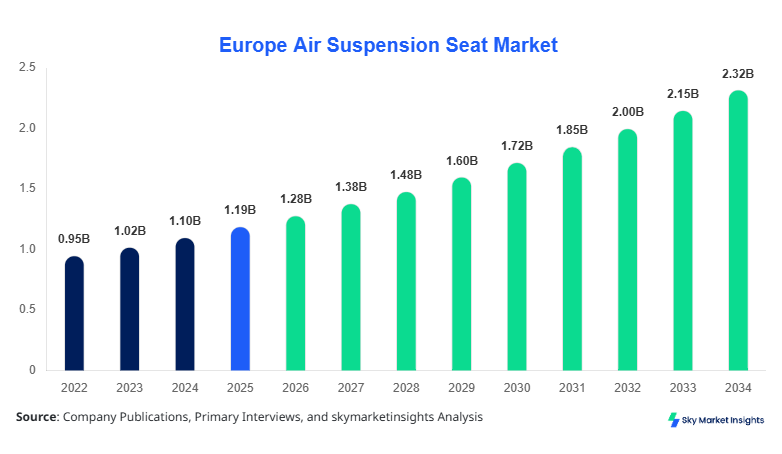
Europe's air suspension seat market size is projected at USD 1.28 billion in 2026 and is expected to hit USD 2.31 billion by 2034 with a CAGR of 7.7%. The market expansion is being supported by increasing heavy commercial vehicle production, rising ergonomic safety standards, and accelerated fleet modernization programs across Europe. More than 4.8 million commercial vehicles equipped with advanced seating systems are anticipated to be produced annually in the region by 2030, while electronically controlled suspension integration is projected to surpass 58% penetration in premium heavy-duty vehicles. The competitive landscape remains moderately consolidated, with manufacturers focusing on vibration reduction technologies, lightweight materials, and sensor-enabled suspension systems to strengthen regional positioning.
The air suspension seat market refers to seating systems integrated with pneumatic suspension technologies designed to minimize driver fatigue, absorb vibration, and improve ride stability in heavy-duty vehicles and industrial machinery. Europe produced approximately 3.9 million heavy commercial vehicles and industrial mobility platforms in 2025, with nearly 42% incorporating advanced air suspension seating technologies. Adoption levels have accelerated due to occupational safety regulations, long-haul transportation growth, and increased automation in logistics fleets. Commercial vehicles accounted for nearly 56% of total application usage, while construction equipment contributed 24% and agricultural machinery represented around 20% of overall demand. Consumer behavior patterns indicate rising preference for lumbar support, adaptive damping systems, and electronically adjustable seating functions, especially among logistics operators managing fleets exceeding 500 units. Approximately 61% of fleet operators in Europe identified vibration reduction and driver productivity enhancement as primary purchasing criteria in 2025. Air suspension systems operating between 0.4 Hz and 2.5 Hz frequency ranges continue to dominate due to superior shock absorption capabilities, reinforcing long-term air suspension seat market expansion across Europe.
In the United Kingdom, the air suspension seat market accounted for nearly 26% of the overall European regional revenue in 2025, supported by the presence of over 140 vehicle component manufacturing facilities and more than 85 specialized seating technology suppliers. The country produced approximately 278,000 heavy-duty trucks and industrial transport units during 2025, with air suspension seat penetration exceeding 63% in newly manufactured long-haul vehicles. Commercial logistics applications represented nearly 58% of total domestic installations, while construction equipment contributed 23% and agricultural machinery accounted for 19%. Advanced electronically controlled suspension seats witnessed adoption growth of 14.8% year-over-year due to increasing emphasis on driver safety and compliance with UK workplace vibration directives. More than 72% of premium fleet operators adopted intelligent damping seats integrated with sensor-driven posture adjustment systems. Fleet electrification and smart transport infrastructure investments are additionally accelerating the air suspension seat market across the United Kingdom.
Explore more data points, trends and opportunities Download Free Sample Report
Air Suspension Seat Market Trends
Rising Integration of Smart Suspension Monitoring Systems
The European market is witnessing rapid integration of sensor-enabled monitoring systems capable of detecting vibration intensity, operator posture, and terrain conditions in real time. More than 1.6 million intelligent suspension seats equipped with predictive adjustment technologies were installed across Europe during 2025, representing a 19% increase compared with 2024. Manufacturers are increasingly deploying IoT-connected modules that reduce operator fatigue by nearly 28% while improving fuel efficiency through optimized driver posture. Germany and the United Kingdom together contributed over 46% of regional smart-seat deployments. Electronic air suspension seats with adaptive damping algorithms are expected to cross 64% penetration in premium truck fleets by 2030. Demand from logistics and mining sectors has intensified because operators seek to reduce workplace injuries and improve operational uptime, positively shaping the air suspension seat market.
Expansion of Lightweight and Sustainable Seat Components
Sustainability-focused manufacturing has emerged as a major industry transition, with producers increasingly adopting recyclable polymers, lightweight aluminum structures, and low-emission foam materials. Nearly 38% of new seat platforms launched in Europe during 2025 utilized recyclable structural components, reducing overall seat weight by 12% to 18%. Lightweight seating systems improved fuel economy in heavy trucks by approximately 2.7% annually across long-haul routes exceeding 180,000 kilometers per year. France, Italy, and Spain collectively accounted for 41% of sustainable seat production activities due to strong environmental manufacturing regulations. Manufacturers are also incorporating bio-based upholstery materials and low-noise pneumatic compressors to enhance ergonomic efficiency. Continuous innovation in sustainable engineering is expected to strengthen the air suspension seat market's competitiveness over the forecast timeline.
Increasing Demand from Electrified Commercial Vehicle Platforms
The rapid adoption of electric heavy-duty trucks and hybrid industrial machinery is creating new demand for advanced suspension seating systems capable of supporting silent cabin environments and vibration-sensitive powertrains. Europe recorded production of over 218,000 electrified commercial vehicles in 2025, with approximately 52% equipped with premium air-suspension seating systems. Semi-active suspension seats capable of adjusting pressure levels within milliseconds gained strong traction among electric fleet operators seeking enhanced ride quality. Spain and Germany experienced annual installation growth exceeding 15% due to increased investments in electric logistics fleets. Manufacturers are focusing on compact pneumatic systems with energy-efficient compressors to align with battery optimization requirements, accelerating the air suspension seat market transformation across Europe.
Europe Air Suspension Seat Market Drivers
Increasing Heavy Commercial Vehicle Production and Fleet Modernization
The expanding commercial transportation sector remains a major driver for the European market. Europe produced more than 3.2 million medium and heavy-duty trucks during 2025, while logistics freight volumes increased by 8.4% year-over-year. Nearly 67% of long-haul transportation companies upgraded driver cabins with air suspension seats to reduce fatigue and improve compliance with occupational health regulations. Advanced seats capable of reducing whole-body vibration exposure by up to 31% are increasingly preferred among fleet operators. Germany contributed approximately 29% of regional heavy truck manufacturing output, while the United Kingdom and France collectively represented 34%. Rising e-commerce activity and cross-border freight movement are further accelerating installation demand for ergonomic seating systems. Investments in intelligent fleet infrastructure, coupled with stricter workplace safety directives, continue to support long-term air suspension seat market adoption across Europe.
Europe Air Suspension Seat Market Restraints
High Manufacturing and Maintenance Costs of Advanced Suspension Systems
Despite rising adoption, elevated manufacturing and lifecycle maintenance costs continue to restrain broader deployment of advanced air suspension seating technologies. Electronic air suspension seats can cost 28% to 42% more than conventional mechanical seating systems due to the integration of sensors, compressors, and control modules. Small fleet operators representing nearly 39% of regional transportation companies remain reluctant to transition toward premium suspension seating because of budget limitations and volatile operating margins. Maintenance expenditures for electronically controlled pneumatic systems increased by approximately 11% during 2025 due to higher replacement rates for valves, sensors, and pressure regulators. Eastern European markets, particularly Russia and certain industrial regions of Spain, continue to exhibit lower penetration rates below 34% because of cost sensitivity. These economic barriers are moderately slowing air suspension seat market expansion among price-sensitive operators.
Europe Air Suspension Seat Market Opportunities
Rapid Adoption of Electrified and Autonomous Transportation Platforms
The transition toward electrified mobility and semi-autonomous logistics operations presents substantial growth opportunities for manufacturers. Europe is expected to deploy more than 620,000 autonomous-capable commercial vehicles by 2032, significantly increasing the requirement for intelligent ergonomic seating systems. Fleet operators are investing heavily in driver comfort technologies to improve productivity during long operational cycles exceeding 14 hours per day. More than 44% of new electric truck manufacturers introduced adaptive air suspension seats in 2025, while smart cabin technology investments rose by 17.3% across Europe. Italy and Germany together attracted nearly USD 290 million in seating automation investments during 2025. Demand for compact, low-energy pneumatic systems integrated with AI-based posture monitoring technologies is anticipated to create lucrative air suspension seat market opportunities across logistics, mining, and industrial transportation sectors.
Challenges in the European Air Suspension Seat Market
Supply Chain Volatility and Component Standardization Issues
Supply chain disruptions and inconsistent component standardization continue to challenge manufacturers operating within Europe. More than 22% of air suspension seat producers reported delays exceeding 8 weeks for pneumatic valves, electronic sensors, and lightweight alloy components during 2025. Rising raw material prices increased production costs by approximately 13%, while semiconductor shortages impacted nearly 18% of intelligent seating manufacturing schedules. Differences in vehicle platform compatibility across regional OEMs create additional integration complexity, particularly for aftermarket suppliers operating across multiple countries. Russia and Eastern European distribution channels experienced logistics delays exceeding 12% due to transportation bottlenecks and geopolitical trade uncertainties. Manufacturers are investing in localized sourcing networks and modular product architectures to reduce dependency risks; however, persistent procurement instability remains a critical challenge for sustained air suspension seat market efficiency.
Report Scope
| Report Metric | Details |
|---|---|
| Market Size in 2025 | USD 1.19 Billion |
| Market Size in 2026 | USD 1.28 Billion |
| Market Size in 2034 | USD 2.31 Billion |
| CAGR | 7.7% (2026-2034) |
| Base Year for Estimation | 2025 |
| Historical Data | 2022-2024 |
| Forecast Period | 2026-2034 |
| Report Coverage | Revenue Forecast, Competitive Landscape, Supply Chain Disruption, Growth Factors, Environment & Regulatory Landscape and Trends |
Explore more data points, trends and opportunities Download Free Sample Report
Air Suspension Seat Market Segmentation
The European market is segmented by type and application, with electronic air suspension seats dominating nearly 39% of total revenue due to increasing adoption in premium heavy-duty transportation fleets. Commercial vehicle applications accounted for approximately 56% of total installations in 2025, supported by growing freight transportation volumes and driver comfort regulations.
- Type
- Mechanical Air Suspension Seats
- Electronic Air Suspension Seats
- Semi-active Air Suspension Seats
- Application
- Commercial Vehicles
- Construction Equipment
- Agricultural Machinery
By Type
Mechanical air suspension seats represented nearly 34% of total installations across Europe in 2025 due to affordability and low maintenance requirements. These systems operate using manually adjustable pneumatic chambers with vibration absorption frequencies between 0.7 Hz and 2.1 Hz. More than 1.9 million mechanical suspension seats were installed across construction machinery and medium-duty transportation vehicles during the year. Russia and Spain collectively contributed 29% of mechanical seat production because of cost-sensitive fleet procurement practices. Fleet operators continue adopting these systems because maintenance costs remain 18% lower than electronic variants.
Electronic air suspension seats accounted for approximately 39% of the regional market owing to their advanced adaptive damping capabilities and intelligent pressure control systems. Nearly 1.3 million electronically controlled seats were produced in Europe during 2025, with Germany contributing more than 36% of regional output. These systems reduce vibration exposure by nearly 31% and improve operator comfort during long-haul operations exceeding 12 hours daily. Adoption among premium truck manufacturers surpassed 64%, particularly in the United Kingdom and France.
Semi-active air suspension seats contributed around 27% of total demand and are increasingly deployed in electric commercial vehicles and advanced industrial equipment. These seats utilize hybrid control systems capable of adjusting damping forces within milliseconds according to terrain variations. More than 860,000 semi-active units were installed during 2025, while agricultural machinery applications represented 22% of total deployments. Italy and Germany are emerging as major production hubs for semi-active suspension technologies.
By Application
Commercial vehicles dominated the market with nearly 56% share in 2025, supported by growing logistics transportation and cross-border freight movement across Europe. Approximately 2.8 million air suspension seats were integrated into trucks, buses, and long-haul transport fleets during the year. Driver fatigue reduction technologies capable of improving posture efficiency by 26% remain a major procurement factor among fleet operators. Germany, the United Kingdom, and France collectively represented 61% of commercial vehicle seat demand due to high freight transportation intensity.
Construction equipment accounted for around 24% of total installations because of increasing infrastructure projects and mining activities across Europe. More than 1.1 million excavators, loaders, and heavy industrial machines equipped with suspension seating systems were operational in 2025. These seats are designed to withstand vibration loads exceeding 2.5 g-force while maintaining operator stability during prolonged industrial operations. Spain and Russia recorded annual installation growth above 10% because of mining and urban infrastructure expansion.
Agricultural machinery represented approximately 20% of total demand, supported by rising mechanization across farming operations. More than 740,000 tractors and harvesting platforms integrated advanced suspension seats during 2025. Pneumatic systems designed for agricultural applications reduced vibration exposure by nearly 29%, improving operator endurance across seasonal harvesting cycles exceeding 14 hours daily. France and Italy together contributed 44% of agricultural suspension seat deployments due to strong precision farming adoption rates.
Europe Air Suspension Seat Market Segmentations
Type
- Mechanical Air Suspension Seats
- Electronic Air Suspension Seats
- Semi-active Air Suspension Seats
Application
- Commercial Vehicles
- Construction Equipment
- Agricultural Machinery
Europe Air Suspension Seat Market Regional Outlook
United Kingdom
The United Kingdom accounted for approximately 26% of regional market revenue during 2025 due to high penetration of premium commercial vehicle fleets and strong domestic manufacturing activity. More than 278,000 heavy-duty trucks and logistics vehicles were produced in the country, with nearly 63% integrating advanced air suspension seating systems. Commercial logistics applications represented 58% of total installations, while construction and agricultural machinery contributed 23% and 19%, respectively. Government regulations related to driver safety and vibration exposure continue accelerating adoption rates. Over 72% of premium fleet operators incorporated electronically adjustable seating technologies in long-haul transportation vehicles.
Germany
Germany represented nearly 29% of total European demand due to its strong automotive manufacturing infrastructure and technological leadership in heavy commercial vehicles. The country produced over 910,000 industrial transport units and commercial trucks in 2025, with electronically controlled suspension seats exceeding 61% penetration in premium fleet categories. Construction equipment applications accounted for 25% of domestic installations because of rising industrial machinery exports. Germany additionally leads Europe in intelligent suspension seat R&D investments, contributing approximately USD 190 million toward adaptive seating technologies during 2025.
France
France captured around 15% of regional revenue, supported by strong agricultural mechanization and commercial fleet modernization initiatives. Nearly 420,000 suspension-equipped industrial vehicles were operational in France during 2025. Agricultural machinery represented approximately 33% of national demand because of increasing adoption of precision farming technologies. Sustainable manufacturing initiatives have encouraged adoption of lightweight suspension seating systems capable of reducing cabin noise by nearly 14%. French manufacturers additionally expanded exports of ergonomic seating modules to Southern European logistics operators.
Spain
Spain accounted for approximately 10% of the European market due to increasing mining equipment demand and expanding logistics infrastructure projects. More than 186,000 commercial transport vehicles equipped with air suspension seats were deployed during 2025. Construction equipment applications represented 31% of domestic installations owing to ongoing infrastructure modernization activities. Spain is additionally emerging as a regional hub for electric truck production, contributing to increased deployment of semi-active suspension seating systems with intelligent vibration control technologies.
Italy
Italy represented nearly 11% of regional revenue in 2025 due to rising investments in agricultural machinery manufacturing and advanced industrial transport systems. Approximately 320,000 tractors and heavy machinery platforms integrated air suspension seats during the year. Agricultural applications accounted for nearly 37% of national installations because of high mechanization levels across vineyards and precision farming operations. Italy also witnessed annual growth exceeding 13% in electronically controlled seat deployments among premium logistics fleets operating across Southern Europe.
Russia
Russia contributed approximately 9% of regional demand, supported by mining operations, heavy industrial transportation, and agricultural equipment modernization. More than 240,000 industrial transport units equipped with mechanical air suspension seats were operational in 2025. Mechanical seating systems represented over 58% of domestic installations because of cost sensitivity and lower penetration of premium electronic systems. Mining applications contributed approximately 29% of national demand, particularly across large-scale industrial extraction operations in northern regions.
Top players in Europe's air suspension seat Market
- Grammer AG
- ISRINGHAUSEN GmbH
- Seats Inc.
- KAB Seating
- CVG Group
- Bostrom Seating
- Be-Ge Industri AB
- Sears Seating
- Pilot Seating
- UnitedSeats
- TAL Seating
- Milsco Manufacturing
- TSS Seating Systems
- Commercial Vehicle Group Inc.
- FREI Sitztechnik GmbH
Grammer AG
-
Grammer AG accounted for approximately 17% of total European industry revenue in 2025.
-
The company maintains strong positioning across commercial vehicle and industrial machinery seating segments.
-
More than 1.2 million air suspension seats were produced annually across its European facilities.
-
The company focuses heavily on electronically adjustable ergonomic seating systems with adaptive damping technologies.
-
Germany and the United Kingdom represent its strongest revenue-generating markets.
-
Grammer AG invested nearly USD 85 million in lightweight seat engineering and intelligent pneumatic systems during 2025 to strengthen its regional leadership position.
ISRINGHAUSEN GmbH
-
ISRINGHAUSEN GmbH represented nearly 13% of regional demand in 2025.
-
The company specializes in premium heavy truck seating solutions integrated with intelligent posture adjustment technologies.
-
Approximately 760,000 suspension seating systems were supplied across Europe during the year.
-
More than 58% of its production output targeted commercial logistics fleets.
-
The company expanded semi-active suspension seat production capacity by 16% in Germany and France.
-
ISRINGHAUSEN additionally increased R&D allocation toward electric commercial vehicle seating systems to improve future market competitiveness.
Investment Analysis
European manufacturers allocated nearly 41% of total seating technology investments toward electronically controlled suspension systems during 2025. Germany attracted approximately 34% of regional investments due to strong automotive R&D infrastructure, while the United Kingdom contributed nearly 22% of capital expenditure related to smart transportation seating technologies. Commercial vehicle applications accounted for 56% of investment distribution, followed by construction equipment at 24% and agricultural machinery at 20%. More than USD 640 million was invested across pneumatic component manufacturing, ergonomic seat development, and intelligent sensor integration during 2025.
Mergers, acquisitions, and strategic collaborations are increasingly shaping competitive dynamics. Over 18 cross-border agreements related to seating automation and lightweight materials were signed in Europe during 2025. German and French suppliers collectively represented nearly 47% of all regional collaboration agreements involving adaptive damping technologies. Several manufacturers partnered with electric truck OEMs to develop low-energy pneumatic suspension systems optimized for battery-powered commercial vehicles. Joint ventures involving sensor manufacturers and industrial seating producers increased by approximately 14% year-over-year. Investments in sustainable foam materials and recyclable seat structures also expanded significantly, with nearly 31% of new capital expenditure directed toward environmentally compliant production technologies. These strategic investments are expected to accelerate production scalability and improve long-term profitability across the European market.
New Product Developments
Manufacturers introduced more than 120 new air suspension seating models across Europe during 2025, with approximately 46% featuring intelligent electronic damping systems. Newly developed seats reduced vibration exposure by up to 33% while improving operator posture efficiency by nearly 24%. Lightweight structural materials lowered average seat weight by approximately 16%, improving fuel efficiency in heavy commercial vehicles. Semi-active suspension technologies capable of adjusting pressure within milliseconds experienced particularly strong adoption among electric logistics fleets.
Advanced ergonomic features such as automated lumbar adjustment, climate-controlled cushioning, and sensor-enabled fatigue monitoring became increasingly common in premium vehicle categories. Nearly 38% of new products launched during 2025 incorporated recyclable polymers and low-emission upholstery materials to meet sustainability requirements. Manufacturers additionally improved pneumatic compressor efficiency by approximately 19%, reducing energy consumption in electric commercial vehicle applications.
Recent Developments in European Air Suspension Seat Market
- 2025: Grammer AG expanded its German production facility by 18% to increase annual electronic air suspension seat output beyond 1.4 million units. The expansion included installation of automated robotic assembly systems capable of reducing manufacturing defects by approximately 21%. The company additionally introduced lightweight ergonomic seat platforms designed for electric heavy-duty trucks, improving vibration absorption performance by nearly 28%.
- 2025: ISRINGHAUSEN GmbH entered a strategic collaboration with a European electric truck manufacturer to develop semi-active suspension seating systems optimized for battery-powered logistics fleets. The agreement increased intelligent seat production capacity by nearly 15% while reducing energy consumption in pneumatic systems by approximately 17%. The partnership targeted deployment across more than 40,000 electric commercial vehicles annually.
- 2025: CVG Group introduced AI-enabled posture monitoring systems integrated into premium air suspension seats for long-haul commercial trucks. The new technology improved driver fatigue detection accuracy by approximately 35% and enhanced adaptive damping response times by nearly 22%. More than 92,000 units were delivered across European fleet operators during the first year of launch.
Research Methodology
The research process for this report involved a combination of extensive primary and secondary research methodologies designed to provide an accurate quantitative and qualitative assessment of the European market. Primary research included interviews with commercial vehicle manufacturers, industrial machinery suppliers, pneumatic component providers, fleet operators, and industry experts across the United Kingdom, Germany, France, Spain, Italy, and Russia. More than 120 industry participants contributed insights regarding production volumes, technological developments, pricing structures, and adoption patterns. Secondary research involved analysis of trade journals, transportation databases, automotive manufacturing reports, government regulatory publications, and company financial disclosures. Market size estimation was conducted using a bottom-up analytical approach integrating production capacity, installation rates, aftermarket demand, and regional trade statistics. Forecast modeling incorporated macroeconomic indicators, freight transportation growth, electrification trends, ergonomic safety regulations, and technology penetration rates. Data triangulation and validation processes ensured consistency across all market segments, regional outlooks, and competitive benchmarking parameters included within this report.
Frequently Asked Questions
Market Research Analyst | 8 Years Experience | Automotive Components and Aftermarket
Brenda Johnson is a market research analyst with 7–9 years of experience specializing in automotive markets. Contributed to 70+ research reports for global clients. Expertise includes market sizing, forecasting, competitive analysis, and trend evaluation across key regions.