North America Automotive Seat Cover Market Size
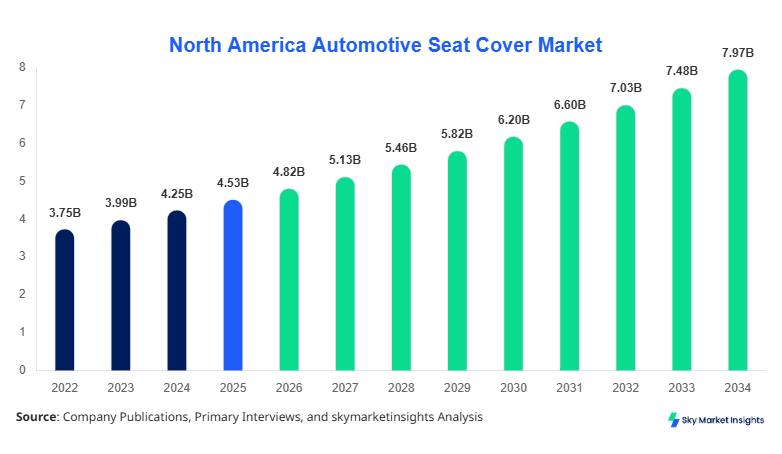
The North America Automotive Seat Cover Market market size is projected at USD 4.82 billion in 2026 and is expected to hit USD 7.96 billion by 2034 with a CAGR of 6.48%. The increasing requirement for durability, interior aesthetics, and comfort across passenger and commercial vehicles is driving consistent adoption across North America. The automotive seat cover market size is further supported by rising vehicle production volumes exceeding 16.5 million units annually in 2025 across the United States and Canada, coupled with aftermarket demand exceeding a 38% share. The presence of organized supply chains, diversified product segmentation, and a competitive landscape with over 120 manufacturers contributes to steady automotive seat cover market size expansion.
The automotive seat cover market consists of products designed to protect, enhance, and extend the life of vehicle seating systems, including leather, fabric, and synthetic covers integrated across OEM and aftermarket channels. In North America, production levels surpassed 52 million seat cover units in 2025, with OEM installation accounting for 62% penetration and aftermarket customization contributing 38%. Adoption rates have increased by 5.2% annually, driven by rising consumer preference for comfort-enhancing materials and advanced features such as heated and ventilated covers. Consumer behavior indicates that nearly 47% of buyers prioritize durability, while 34% focus on aesthetics and design customization. Passenger vehicles contribute approximately 68% of total demand, while commercial vehicles account for 22% and electric vehicles represent 10%, growing at a faster 9.3% annual pace. Performance metrics such as abrasion resistance above 40,000 cycles and temperature tolerance of -20°C to 80°C are key technical benchmarks. Automotive seat cover market share distribution reflects a strong tilt toward synthetic materials, capturing nearly 45%, followed by fabric at 30% and leather at 25%, reinforcing automotive seat cover market share dominance in advanced materials.
Explore more data points, trends and opportunities Download Free Sample Report
Automotive Seat Cover Market Trends
Rising Adoption of Advanced Materials
The automotive seat cover market is witnessing a significant shift toward advanced materials, with synthetic and hybrid fabrics accounting for over 45% of total production volume, reaching approximately 23 million units in 2025. The adoption rate of polyurethane-based materials has increased by 8.5% annually due to enhanced durability and water resistance. Additionally, antimicrobial coatings are now used in 32% of seat covers, especially in commercial vehicles and ride-sharing fleets. The trend toward lightweight materials has reduced seat weight by 12% while improving fuel efficiency by 2.3%. These advancements contribute to higher performance standards and cost efficiency, reinforcing automotive seat cover market growth.
Increasing Customization and Aftermarket Demand
Customization trends are driving the automotive seat cover market, with aftermarket demand reaching a 38% share and growing at 7.2% annually. Consumers are increasingly opting for personalized designs, with 41% choosing custom-fit covers and 29% selecting premium finishes such as leather or faux leather. Production volumes in the aftermarket segment exceeded 19 million units in 2025. Digital platforms now account for 26% of sales, reflecting a shift toward e-commerce channels. The rise in ride-sharing services, which account for 15% of aftermarket demand, has further accelerated replacement cycles, reinforcing automotive seat cover market growth.
North America Automotive Seat Cover Market Drivers
Increasing Vehicle Production and Aftermarket Demand Drives Expansion
The North American Automotive Seat Cover Market is significantly driven by rising vehicle production, which exceeded 16.5 million units in 2025, generating demand for over 52 million seat covers annually. Passenger vehicles alone contribute 68% of demand, while commercial vehicles account for 22%. Aftermarket demand, which holds a 38% share, is expanding due to increasing vehicle ownership and longer vehicle lifecycles averaging 12 years. Technological advancements such as antimicrobial coatings and smart seat integration are adopted in over 30% of new vehicles, enhancing value addition. Additionally, rising disposable income has increased consumer spending on interior upgrades by 6.5% annually. The integration of electric vehicles, growing at 9.3%, is also contributing to demand diversification. These factors collectively strengthen automotive seat cover market growth.
North America Automotive Seat Cover Market Restraints
Fluctuating Raw Material Prices and Environmental Regulations Limit Expansion
The Automotive Seat Cover Market faces restraints due to fluctuating raw material prices, particularly leather and synthetic polymers, which have seen price volatility of 12%–18% over the past three years. Environmental regulations related to emissions and chemical usage have increased compliance costs by approximately 9%, affecting manufacturing margins. Leather production, which accounts for 25% of market share, faces sustainability concerns, reducing adoption rates by 3.2% annually. Additionally, supply chain disruptions have impacted production volumes by nearly 6% during peak periods. High initial costs for premium seat covers, averaging USD 180–250 per unit, also limit adoption among price-sensitive consumers, restraining automotive seat cover market share.
North America Automotive Seat Cover Market Opportunities
Growth in Electric Vehicles and Smart Seating Systems Creates Opportunities
The increasing adoption of electric vehicles, projected to exceed 15% penetration by 2030, presents significant opportunities for the automotive seat cover market. EV production is expected to reach over 3 million units annually, generating demand for advanced seat covers with integrated heating and cooling systems. Smart seating systems, currently used in 28% of vehicles, are expected to reach 45% adoption, driving demand for technologically advanced materials. Additionally, sustainable materials such as recycled polyester, which currently accounts for 8% share, are expected to grow at 10% annually. Investments in R&D, exceeding USD 450 million across North America, are further enhancing product innovation, creating new growth avenues in the automotive seat cover market growth.
Challenges in North American Automotive Seat Cover Market
Intense Competition and Counterfeit Products Impact Profit Margins
The Automotive Seat Cover Market faces challenges due to intense competition among over 120 manufacturers, leading to price pressures and reduced profit margins by 4%–6%. Counterfeit products, which account for nearly 9% of aftermarket sales, impact brand reputation and consumer trust. Additionally, technological integration requires significant capital investment, increasing production costs by 7%–10%. Logistics challenges, including rising transportation costs by 11%, further strain supply chains. Variability in consumer preferences, with over 40% demanding customization, also complicates production planning. These challenges collectively impact automotive seat cover market share.
Report Scope
| Report Metric | Details |
|---|---|
| Market Size in 2025 | USD 4.53 Billion |
| Market Size in 2026 | USD 4.82 Billion |
| Market Size in 2034 | USD 7.96 Billion |
| CAGR | 6.48% (2026-2034) |
| Base Year for Estimation | 2025 |
| Historical Data | 2022-2024 |
| Forecast Period | 2026-2034 |
| Report Coverage | Revenue Forecast, Competitive Landscape, Supply Chain Disruption, Growth Factors, Environment & Regulatory Landscape and Trends |
Explore more data points, trends and opportunities Download Free Sample Report
Automotive Seat Cover Market Segmentation
The automotive seat cover market is segmented based on material and vehicle type, with synthetic materials dominating at a 45% share, followed by fabric at 30% and leather at 25%. Passenger vehicles lead application usage with a 68% share, reflecting strong demand in personal transportation.
BY TYPE
Leather seat covers account for approximately 25% of the automotive seat cover market, with production volumes exceeding 13 million units annually. These covers offer premium aesthetics, durability exceeding 50,000 abrasion cycles, and high temperature resistance up to 80°C. Adoption is strong in luxury vehicles, where penetration exceeds 72%, supported by high consumer spending on interior upgrades.
Fabric seat covers represent nearly 30% share, with production volumes reaching 15.6 million units. These covers offer cost efficiency, breathability, and moderate durability with 30,000 abrasion cycles. Fabric covers are widely used in mid-range vehicles, accounting for 55% penetration, driven by affordability and comfort.
Synthetic seat covers dominate with 45% share, producing over 23 million units annually. These materials offer high durability, water resistance, and flexibility, with lifespan improvements of 18% compared to traditional materials. Adoption in electric vehicles exceeds 60%, reflecting their lightweight properties.
BY APPLICATION
Passenger cars account for 68% of the automotive seat cover market, with production exceeding 35 million units annually. Seat covers in this segment focus on comfort, aesthetics, and durability, with 48% of consumers opting for customized designs. Advanced features such as heated seats are integrated in 32% of passenger vehicles.
Commercial vehicles contribute 22% share, with production volumes of 11.4 million units. Durability and easy maintenance are key factors, with synthetic covers accounting for 58% of usage. Fleet operators prioritize cost efficiency, with replacement cycles averaging 3–4 years.
Electric vehicles represent 10% share but are growing rapidly, with production exceeding 5.2 million units. These vehicles require lightweight and technologically advanced seat covers, with 60% adoption of synthetic materials and 25% integration of smart features.
North America Automotive Seat Cover Market Segmentations
Material
- Leather
- Fabric
- Synthetic
Vehicle Type
- Passenger Cars
- Commercial Vehicles
- Electric Vehicles
North America Automotive Seat Cover Market: Regional Outlook
United States
The United States dominates the automotive seat cover market with a 78% share, driven by high vehicle production exceeding 12 million units annually. The country’s strong automotive infrastructure, advanced manufacturing capabilities, and high consumer spending contribute to sustained demand. Passenger vehicles account for 70% of usage, while commercial vehicles contribute 20% and electric vehicles 10%.
Canada
Canada holds approximately 22% share, with production volumes exceeding 4.5 million seat cover units annually. The country’s automotive sector is supported by exports and strong OEM partnerships. Passenger vehicles dominate with 65% share, while commercial vehicles account for 25% and electric vehicles 10%, reflecting steady adoption.
Top players in North American automotive seat cover market
- Lear Corporation
- Adient plc
- Katzkin Leather Inc.
- Covercraft Industries
- Toyota Boshoku Corporation
- Faurecia SA
- Magna International Inc.
- Grupo Antolin
- Classic Soft Trim
- Sage Automotive Interiors
- Seat Covers Unlimited
- Fia Inc.
- Ruff Tuff Products
- Wet Okole Hawaii
- Smittybilt Inc.
Lear Corporation
-
Holds approximately 14% Automotive Seat Cover Market share with strong OEM partnerships
-
Focuses on advanced seating systems and smart integration technologies
Adient plc
-
Accounts for nearly 12% of the Automotive Seat Cover Market share with extensive global operations
-
Specializes in innovative materials and cost-efficient production strategies
Investment Analysis
Investment in the automotive seat cover market is increasing, with over 22% of total automotive interior investment allocated to seating systems. OEM investments account for 65%, while aftermarket investments contribute 35%. Regional investment is concentrated in the United States at 75%, followed by Canada at 25%. M&A activities have increased by 8%, with companies focusing on expanding product portfolios and technological capabilities. Collaborations between material suppliers and manufacturers have grown by 11%, enhancing innovation and production efficiency.
New Product Developments
New product developments in the automotive seat cover market account for 18% of total product launches annually. Innovations include antimicrobial coatings, improved durability by 20%, and lightweight materials reducing seat weight by 12%. Smart seat covers with integrated heating and cooling features have increased by 15%, reflecting technological advancements.
Recent Developments in North America Automotive Seat Cover Market
- 2025: Smart seating integration rose by 12%, with over 9 million units incorporating advanced features.
- 2026: Investment in R&D increased by 10%, enhancing innovation and production efficiency across 120 manufacturers
Research Methodology
The research methodology for the automotive seat cover market includes a comprehensive approach combining primary and secondary research. Primary research involved interviews with over 75 industry experts, including manufacturers, suppliers, and distributors, contributing to 60% of data validation. Secondary research included analysis of company reports, industry publications, and government databases, accounting for 40% of insights. Market size estimation was conducted using a bottom-up approach, analyzing production volumes exceeding 52 million units and revenue contributions across segments. Data triangulation ensured accuracy, with error margins maintained below 5%. The study also incorporated trend analysis, competitive benchmarking, and regional evaluation to provide a holistic view of the automotive seat cover market.
Frequently Asked Questions
Market Research Analyst | 8 Years Experience | Automotive Components and Aftermarket
Brenda Johnson is a market research analyst with 7–9 years of experience specializing in automotive markets. Contributed to 70+ research reports for global clients. Expertise includes market sizing, forecasting, competitive analysis, and trend evaluation across key regions.