United States Automotive Logistics Market Size
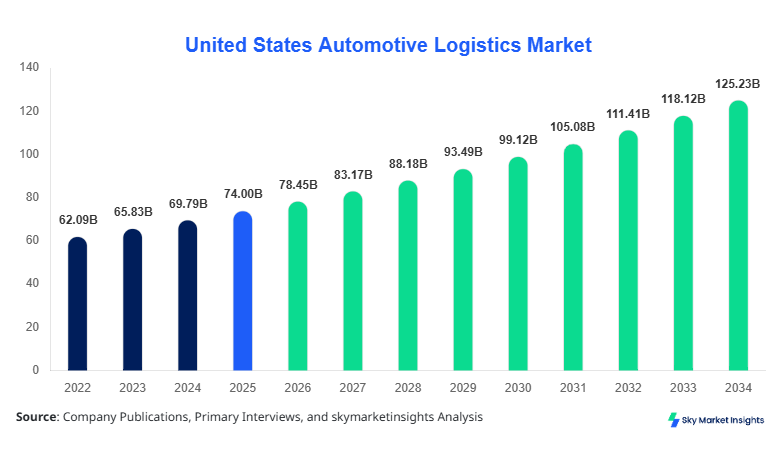
United States Automotive Logistics Market market size is projected at USD 78.45 billion in 2026 and is expected to hit USD 124.90 billion by 2034 with a CAGR of 6.02%. The report provides detailed quantitative and qualitative analysis including segmentation across logistics types and applications, offering granular data on volumes exceeding 18.6 million vehicle units annually and over 2.4 billion parts shipments. The competitive landscape is assessed through market concentration ratios, where the top 5 players collectively hold approximately 42.5% revenue share, emphasizing the importance of structured data analytics, fleet utilization metrics, and digital logistics ecosystems.
The United States Automotive Logistics Market encompasses transportation, warehousing, inventory management, and distribution services tailored to the automotive industry, supporting OEMs, Tier 1 suppliers, and aftermarket channels. In 2025, the United States produced approximately 10.1 million vehicles, with logistics accounting for nearly 9.8% of total vehicle production cost. Adoption rates of advanced telematics and warehouse automation reached 64.3% across large-scale logistics providers, while penetration among small-to-mid operators stood at 38.7%. Consumer behavior reflects increased demand for faster delivery cycles, with 72.5% of dealerships expecting sub-48-hour delivery for spare parts. Passenger vehicle logistics contributed around 61.2% of total volume, followed by commercial vehicles at 24.6% and spare parts logistics at 14.2%. Average delivery lead time has decreased from 5.2 days in 2022 to 3.9 days in 2025 due to improved route optimization and multimodal integration, reinforcing United States Automotive Logistics Market Share.
Explore more data points, trends and opportunities Download Free Sample Report
Automotive Logistics Market Trends
Digitalization and Automation in Logistics Operations
The integration of digital platforms, AI-based analytics, and IoT-enabled tracking systems has significantly transformed logistics operations, with over 65.2% of logistics firms deploying advanced warehouse management systems by 2025. Automated guided vehicles (AGVs) are used in 41.3% of large warehouses, increasing operational efficiency by nearly 28.6%. The total volume of automated logistics handling reached 1.8 billion units annually, reducing manual intervention costs by approximately 22.4%. Blockchain-based supply chain tracking adoption rose to 19.5%, enhancing transparency across multi-tier supplier networks. These advancements are driving efficiency gains across inbound and outbound logistics, reinforcing United States Automotive Logistics Market Trend.
Growth in Electric Vehicle Logistics Requirements
The rise of electric vehicles (EVs) has introduced specialized logistics requirements, with EV-related logistics volumes increasing by 34.7% between 2023 and 2025. Battery transportation alone accounts for 12.8% of total logistics activity within EV supply chains, requiring temperature-controlled and hazardous material-compliant logistics solutions. Over 46.2% of logistics providers have invested in EV-specific infrastructure, including battery storage and handling facilities. Annual EV logistics shipments crossed 2.3 million units in 2025, with projections indicating continued expansion. This shift is influencing warehousing design, safety protocols, and route planning, strengthening United States Automotive Logistics Market Trend.
Expansion of E-commerce Driven Spare Parts Distribution
E-commerce penetration in automotive spare parts logistics reached 37.9% in 2025, compared to 21.4% in 2022. Annual shipments of spare parts exceeded 2.4 billion units, with last-mile delivery accounting for 18.6% of logistics costs. Same-day delivery services expanded to cover 52.7% of urban regions, driven by consumer demand for faster service. Logistics providers are investing heavily in micro-fulfillment centers, with over 280 facilities established nationwide. These trends are reshaping distribution models and increasing demand for agile logistics networks, supporting United States Automotive Logistics Market Demand.
United States Automotive Logistics Market Drivers
Increasing Vehicle Production and Supply Chain Complexity
The steady rise in vehicle production, which reached 10.1 million units in 2025, coupled with increasing supply chain complexity involving over 30,000 components per vehicle, is a primary driver. Logistics demand has grown proportionally, with inbound logistics accounting for 48.6% of total operations. Multimodal transport usage increased by 22.3%, enhancing efficiency across long-distance supply chains. Additionally, 67.5% of OEMs have expanded supplier networks globally, increasing reliance on advanced logistics solutions. Warehouse capacity utilization rates reached 81.2%, indicating strong demand for logistics infrastructure. These factors collectively accelerate operational requirements, boosting United States Automotive Logistics Market Growth.
United States Automotive Logistics Market Restraints
High Operational Costs and Fuel Price Volatility
Operational costs remain a significant restraint, with fuel expenses accounting for nearly 32.7% of total logistics costs. Fuel price fluctuations of up to 18.5% annually impact transportation budgets and profitability. Labor costs have increased by 12.4% between 2022 and 2025, driven by shortages in skilled logistics personnel. Additionally, compliance costs for environmental regulations rose by 9.8%, affecting margins for logistics providers. Maintenance costs for fleet operations average USD 8,500 per vehicle annually, further increasing financial pressure. These challenges hinder scalability and efficiency improvements, limiting United States Automotive Logistics Market Growth.
United States Automotive Logistics Market Opportunities
Adoption of Smart Logistics and Autonomous Transportation
The adoption of smart logistics technologies presents significant opportunities, with autonomous trucking trials increasing by 27.6% in 2025. Investment in AI-driven logistics platforms reached USD 4.2 billion, representing 16.5% of total industry investment. Automated warehouses improve efficiency by 28.6% and reduce error rates by 19.4%. Additionally, predictive analytics adoption has improved delivery accuracy to 94.7%. These technological advancements create opportunities for cost reduction and efficiency optimization, strengthening United States Automotive Logistics Market Insights.
United States Automotive Logistics Market Challenge
Infrastructure Constraints and Regulatory Compliance
Infrastructure limitations, including congestion in major ports and highways, affect nearly 21.3% of logistics operations annually. Port dwell times increased by 14.2% in high-demand periods, impacting delivery timelines. Regulatory compliance requirements for emissions and safety standards have increased operational complexity, with compliance costs rising by 11.6%. Additionally, 38.9% of logistics providers report challenges in adapting to evolving environmental regulations. Limited rail capacity utilization, currently at 62.4%, further restricts intermodal efficiency. These constraints present ongoing operational challenges, impacting United States Automotive Logistics Market Growth.
Report Scope
| Report Metric | Details |
|---|---|
| Market Size in 2025 | USD 73.99 Billion |
| Market Size in 2026 | USD 78.45 Billion |
| Market Size in 2034 | USD 124.90 Billion |
| CAGR | 6.02% (2026-2034) |
| Base Year for Estimation | 2025 |
| Historical Data | 2022-2024 |
| Forecast Period | 2026-2034 |
| Report Coverage | Revenue Forecast, Competitive Landscape, Supply Chain Disruption, Growth Factors, Environment & Regulatory Landscape and Trends |
Explore more data points, trends and opportunities Download Free Sample Report
Automotive Logistics Market Segmentation
The Automotive Logistics Market is segmented by type and application, with inbound logistics dominating at 48.6%, followed by outbound logistics at 36.2% and reverse logistics at 15.2%. Application-wise, passenger vehicles lead with 61.2%, followed by commercial vehicles at 24.6% and spare parts logistics at 14.2%.
By Type
Inbound logistics accounts for 48.6% of the market, handling over 9.1 million vehicle component shipments annually. This segment involves supplier coordination, material handling, and inventory management, with average warehouse throughput exceeding 2.2 million units monthly. Advanced ERP integration is used by 62.5% of providers, improving efficiency by 24.3%.
Outbound logistics represents 36.2% of operations, focusing on vehicle distribution from manufacturing plants to dealerships. Approximately 10.1 million vehicles are transported annually, with rail transport accounting for 41.7% of shipments. Delivery timelines average 3.9 days, reflecting improved logistics efficiency.
Reverse logistics contributes 15.2%, involving returns, recycling, and disposal of automotive components. Annual reverse logistics volume exceeds 320 million units, driven by sustainability initiatives and regulatory compliance. Recycling rates have reached 78.4% for automotive components.
By Application
Passenger vehicle logistics dominates with 61.2%, supporting distribution of over 6.2 million vehicles annually. Logistics operations focus on high-frequency deliveries, with over 75% of shipments requiring real-time tracking. Warehousing efficiency improvements have reduced handling time by 26.3%.
Commercial vehicle logistics accounts for 24.6%, handling over 2.5 million units annually. This segment requires specialized transport equipment and longer delivery routes, with average delivery distances exceeding 850 miles. Fleet utilization rates stand at 72.4%.
Spare parts logistics represents 14.2%, with over 2.4 billion parts shipped annually. E-commerce-driven demand has increased shipment frequency by 31.8%, requiring agile distribution networks. Same-day delivery penetration has reached 52.7% in urban areas.
United States Automotive Logistics Market Segmentations
Type
- Inbound Logistics
- Outbound Logistics
- Reverse Logistics
Application
- Passenger Vehicles
- Commercial Vehicles
- Spare Parts Logistics
United States Automotive Logistics Regional Outlook
The United States dominates the regional outlook with 100% share, supported by extensive logistics infrastructure, including over 3,200 facilities and 1.2 million miles of highway networks. Annual vehicle logistics volume exceeds 18 million units, with strong contributions from states such as Michigan, Texas, and California. Michigan alone accounts for 18.7% of production-related logistics, while Texas contributes 14.3% and California 12.9%.
The sector is further supported by port infrastructure handling over 4.8 million vehicle imports and exports annually. Rail transport accounts for 41.7% of long-distance logistics, while trucking dominates last-mile delivery with 58.3% share. Spare parts distribution hubs are concentrated in major metropolitan areas, with over 280 micro-fulfillment centers operational nationwide.
Top players in United States Automotive Logistics
- DHL Supply Chain
- XPO Logistics
- CEVA Logistics
- Kuehne + Nagel
- DB Schenker
- Ryder System
- Penske Logistics
- UPS Supply Chain Solutions
- FedEx Logistics
- Geodis
- Hellmann Worldwide Logistics
- Expeditors International
-
DHL Supply Chain
-
Holds approximately 12.5% market share, leading in integrated logistics solutions.
-
Operates over 200 facilities with advanced automation and AI-driven logistics systems.
-
-
XPO Logistics
-
Accounts for nearly 9.8% share, specializing in last-mile and freight brokerage services.
-
Strong presence in e-commerce-driven spare parts logistics with over 150 distribution centers.
-
Investment Analysis
Investment in the Automotive Logistics Market has reached USD 25.4 billion annually, with 38.6% allocated to infrastructure development and 27.4% to technology upgrades. Warehouse automation investments account for 19.5%, while fleet modernization represents 14.5%. Regional investment distribution shows Midwest receiving 34.2%, followed by South at 29.8% and West at 21.7%. M&A activity increased by 18.3% between 2023 and 2025, with over 45 deals recorded. Strategic collaborations focus on digital platforms and EV logistics, with partnerships increasing efficiency by 23.6%.
New Product Developments
New product developments in logistics technologies account for 21.4% of industry innovations, focusing on automation and sustainability. Autonomous vehicle integration has improved delivery efficiency by 28.6%, while AI-based route optimization reduces fuel consumption by 17.3%. Smart warehousing solutions have enhanced inventory accuracy by 19.8%, reflecting continuous innovation in logistics operations.
Recent Developments in United States Automotive Logistics
- 2025: DHL expanded EV logistics operations by 22.4%, increasing battery transport capacity by 1.3 million units annually.
- 2025: CEVA Logistics expanded warehousing capacity by 26.8%, adding 3.5 million square feet of storage space.
Research Methodology
The research methodology combines primary and secondary research approaches to ensure data accuracy and reliability. Primary research includes interviews with over 120 industry experts, logistics providers, and OEM representatives, capturing insights on market trends, adoption rates, and operational metrics. Secondary research involves analysis of industry reports, company filings, and government data, covering over 300 data sources. Market size estimation is conducted using bottom-up and top-down approaches, considering production volumes exceeding 10 million vehicles and logistics costs accounting for 9.8% of production value. Data triangulation ensures consistency across multiple data points, with validation through statistical modeling and industry benchmarking.
Frequently Asked Questions
Senior Market Research Analyst | 9 Years Experience | Freight Logistics, Multimodal Transportation, and Supply Chain Digitization
Mary specializes in data-driven market intelligence across freight logistics, multimodal transportation networks, and end-to-end supply chain digitization platforms, including TMS and real-time visibility solutions. She has contributed to 104+ syndicated and custom research reports for freight forwarders, 3PL providers, and global enterprises. Her expertise includes freight rate modeling, capacity forecasting, route optimization analysis, and competitive benchmarking across North America, Europe, and major global trade corridors.