Europe Air Cargo & Freight Logistics Market Size
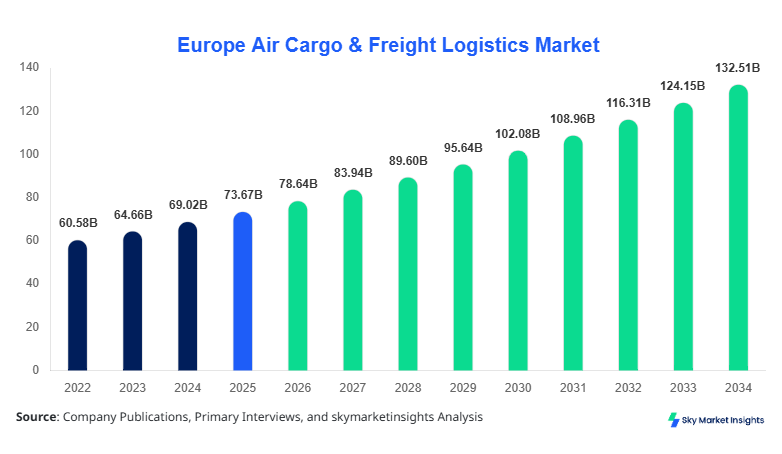
Europe's air cargo & freight logistics market size is projected at USD 78.64 billion in 2026 and isUSD 78.64 billion in 2026 and is expected to hit USD 132.57 billion by 2034 with a CAGR of 6.74% The market handled more than 18.7 million metric tons of cargo volume in 2025, supported by rising cross-border e-commerce activities, pharmaceutical transportation requirements, and increasing investments in airport logistics infrastructure across Europe. The industry is witnessing accelerated digitization with over 64% of logistics providers adopting AI-enabled route optimization and automated cargo tracking systems. Competitive benchmarking, operational efficiency analysis, and segmentation by service type and end-user industries continue to shape strategic positioning in the Europe Air Cargo & Freight Logistics Market Size landscape.
The air cargo & freight logistics industry refers to the transportation, warehousing, cargo handling, and supply chain management services delivered through air transport networks. Europe accounted for nearly 24% of global air cargo traffic in 2025, with Germany, the United Kingdom, and France contributing over 61% of total regional cargo throughput. European airports processed more than 19.3 million tons of air freight volume during 2025, supported by over 420 dedicated cargo terminals and 780 integrated logistics hubs. Adoption rates of digital freight platforms exceeded 58% among Tier-1 logistics operators, while automated sorting systems recorded processing efficiencies of 96.4% accuracy levels. E-commerce shipments represented approximately 38% of all air freight consignments, pharmaceuticals contributed 17%, and automotive spare parts accounted for 13% of shipment volumes. Consumer demand for same-day and next-day delivery services increased by 29% across major European economies between 2023 and 2025. Temperature-controlled logistics solutions witnessed 21% year-over-year expansion due to increasing biologics and vaccine transportation requirements. Cargo aircraft utilization rates averaged 79%, while average delivery turnaround time declined from 72 hours to 51 hours in major corridors. The increasing reliance on digital supply chains, express logistics, and cross-border freight transportation continues strengthening the Europe Air Cargo & Freight Logistics market share.
In Germany, the Air Cargo & Freight Logistics Market accounted for nearly 28% of the total European air freight revenue during 2025, supported by the presence of more than 140 logistics companies and 27 major cargo airports. Frankfurt Airport alone processed over 2.1 million metric tons of cargo in 2025, representing approximately 11% of Europe’s total cargo throughput. Germany’s automotive sector contributed 24% of total air cargo demand, while pharmaceutical logistics represented 18% and e-commerce distribution accounted for 32%. More than 63% of German logistics providers integrated AI-based warehouse management systems and IoT-enabled tracking technologies to improve shipment visibility and operational efficiency. The country also witnessed a 17% increase in cold chain air logistics volumes between 2023 and 2025 due to increasing biologics exports and healthcare supply requirements. Cargo aircraft fleet expansion activities rose by 12%, while automated cargo screening technologies achieved 95% adoption among top-tier airports. Germany’s strategic position as a European manufacturing and export hub continues to reinforce the Europe Air Cargo & Freight Logistics market growth.
Explore more data points, trends and opportunities Download Free Sample Report
Air Cargo & Freight Logistics Market Trends
Expansion of E-commerce Fulfillment Networks
The rapid expansion of cross-border e-commerce networks across Europe is significantly transforming air freight logistics operations. In 2025, online retail transactions in Europe exceeded USD 1.2 trillion, generating nearly 7.6 billion parcel shipments requiring rapid delivery infrastructure. Approximately 41% of high-value cross-border e-commerce orders utilized air cargo transportation due to delivery speed requirements. Logistics companies increased investments in automated fulfillment centers by 26%, while robotic cargo sorting systems improved package handling efficiency by 34%. Demand for same-day delivery services rose by 31% in Germany, France, and the United Kingdom collectively. Cargo charter operations dedicated to e-commerce shipments expanded by 19%, while express freight providers increased dedicated aircraft fleets by 14% between 2023 and 2025. More than 68% of logistics operators deployed cloud-based shipment visibility platforms to improve tracking and customer transparency. The continuous modernization of digital logistics ecosystems remains a critical air cargo & freight logistics market trend.
Adoption of Sustainable Aviation Logistics Solutions
Sustainability initiatives are becoming a major operational focus within European air cargo logistics operations. More than 52% of logistics companies operating in Europe adopted carbon-neutral freight programs during 2025. Sustainable aviation fuel utilization increased by 18%, reducing carbon emissions by approximately 12% per shipment on selected trade routes. Electric ground support equipment deployment across European cargo airports exceeded 46%, while automated energy-efficient warehouses reduced operational power consumption by 21%. Regulatory mandates under the European Green Deal accelerated investments exceeding USD 5.7 billion in green airport infrastructure and low-emission cargo handling systems. Additionally, digital route optimization technologies reduced empty cargo capacity utilization by 16%, improving fleet efficiency across integrated freight networks. Major operators introduced AI-powered cargo consolidation systems capable of increasing payload optimization rates above 91%. The integration of sustainability-driven logistics practices continues influencing air cargo & freight logistics market trend development.
Rising Pharmaceutical and Cold Chain Logistics Demand
Pharmaceutical transportation demand across Europe increased substantially due to biologics production, vaccine distribution, and personalized medicine expansion. Temperature-controlled air cargo shipments surpassed 2.8 million metric tons in 2025, representing 15% of regional air cargo volumes. More than 74% of pharmaceutical exporters preferred air freight for critical drug transportation due to strict delivery and temperature compliance requirements. Advanced cold storage infrastructure capacity increased by 22%, while IoT-enabled thermal monitoring systems achieved adoption rates above 61% across major logistics hubs. Germany, Switzerland, and France collectively contributed nearly 57% of Europe’s pharmaceutical air logistics traffic. Cargo handling systems capable of maintaining temperature ranges between -20°C and 8°C recorded 97% shipment integrity efficiency. Investments in specialized pharma logistics infrastructure exceeded USD 2.3 billion between 2023 and 2025. The increasing healthcare logistics requirements continue strengthening air cargo & freight logistics market demand.
Europe Air Cargo & Freight Logistics Drivers
Rapid Expansion of Cross-Border E-commerce Logistics
Cross-border e-commerce expansion remains one of the strongest growth drivers for the European air cargo logistics sector. Online consumer purchases increased by 27% across Europe between 2022 and 2025, generating substantial demand for rapid international freight transportation. More than 5.4 billion cross-border e-commerce parcels required air transport support during 2025, while express logistics service demand increased by 33% among retailers. Approximately 62% of consumers in Europe preferred delivery timelines under 48 hours, encouraging logistics providers to expand dedicated air freight operations. Automated sorting hubs increased processing capacities by 38%, while AI-enabled route optimization technologies reduced delivery delays by 24%. Investments exceeding USD 8.4 billion were directed toward expanding cargo terminals, smart warehouses, and integrated logistics corridors across Germany, France, and the United Kingdom. Furthermore, cargo aircraft fleet modernization activities rose by 16%, improving fuel efficiency and delivery speed. E-commerce marketplaces increasingly partnered with integrated freight operators to improve delivery reliability and reduce return logistics costs. Rising digital retail penetration and rapid fulfillment expectations continue accelerating the Europe Air Cargo & Freight Logistics market growth.
Europe Air Cargo & Freight Logistics Restraints
High Operational and Fuel Costs Impacting Profitability
Rising aviation fuel prices, labor expenses, and airport handling charges are placing substantial pressure on logistics operators across Europe. Fuel expenses accounted for nearly 31% of total air freight operational costs during 2025, compared to 24% in 2022. Cargo handling fees at major airports increased by approximately 14%, while labor costs in Germany, France, and the United Kingdom rose by 11% due to workforce shortages and inflationary pressures. Additionally, compliance costs associated with carbon emission regulations and environmental standards increased operational expenditure by nearly 9% for freight operators. Limited airport cargo capacity during peak demand periods also contributed to congestion-related delays exceeding 18% in major logistics hubs. Smaller logistics providers experienced profit margin reductions of 7% to 12% due to escalating maintenance and aircraft leasing expenses. High investment requirements for digital transformation, cybersecurity systems, and sustainable aviation technologies further intensified financial burdens across mid-sized logistics firms. These operational challenges continue constraining the Europe Air Cargo & Freight Logistics market demand.
Europe Air Cargo & Freight Logistics Opportunities
Expansion of Smart Airport and Digital Logistics Infrastructure
The increasing deployment of smart airport ecosystems and digital logistics technologies presents substantial opportunities for market expansion. More than 47% of European airports initiated smart cargo modernization projects during 2025, focusing on automated screening, AI-driven inventory systems, and blockchain-based shipment documentation. Investments exceeding USD 6.1 billion were allocated toward advanced logistics automation across Germany, Spain, France, and Italy. Cargo visibility platforms integrating IoT sensors and predictive analytics reduced shipment tracking errors by 28% and improved operational efficiency by 23%. Autonomous warehouse robotics installations increased by 34%, while automated customs clearance systems reduced cargo processing times from 18 hours to less than 7 hours in selected trade corridors. The emergence of digital freight marketplaces also improved capacity utilization by nearly 15% among integrated carriers. Pharmaceutical and semiconductor industries increasingly demanded secure, real-time monitored transportation systems capable of maintaining strict environmental conditions. Continued digital infrastructure deployment and integrated supply chain modernization are expected to create strong long-term opportunities across the Europe air cargo & freight logistics market.
Challenges in European Air Cargo & Freight Logistics
Capacity Constraints and Regulatory Complexity
Air cargo operators across Europe continue facing major capacity limitations and regulatory compliance challenges. More than 36% of European cargo airports operated near maximum handling capacity during peak seasonal demand in 2025, creating bottlenecks in freight movement and customs processing. Limited runway slots and infrastructure congestion caused shipment delays averaging 11.4 hours across major logistics hubs, including Frankfurt, Heathrow, and Charles de Gaulle airports. Additionally, over 27 different aviation and customs regulatory frameworks across Europe complicated cross-border logistics coordination and documentation processes. Compliance with EU sustainability mandates increased certification requirements and operational audits by 18% among logistics operators. Labor shortages in cargo handling, warehouse operations, and pilot availability further intensified service disruptions, with workforce gaps estimated at 14% across the sector. Cybersecurity threats targeting digital logistics networks also increased by 21% during 2025, requiring substantial investments in data protection and operational resilience systems. These structural and regulatory barriers continue creating operational challenges for the European Air Cargo & Freight Logistics Market.
Report Scope
| Report Metric | Details |
|---|---|
| Market Size in 2025 | USD 73.68 Billion |
| Market Size in 2026 | USD 78.64 Billion |
| Market Size in 2034 | USD 132.57 Billion |
| CAGR | 6.74% (2026-2034) |
| Base Year for Estimation | 2025 |
| Historical Data | 2022-2024 |
| Forecast Period | 2026-2034 |
| Report Coverage | Revenue Forecast, Competitive Landscape, Supply Chain Disruption, Growth Factors, Environment & Regulatory Landscape and Trends |
Explore more data points, trends and opportunities Download Free Sample Report
Air Cargo & Freight Logistics Market Segmentation
The Europe air cargo & freight logistics market is segmented by service type and end-user industries. Air freight forwarding accounted for nearly 44% of total market revenue during 2025, followed by express delivery at 36% and cold chain logistics at 20%. By end user, e-commerce represented 38% of cargo demand, pharmaceutical industries contributed 24%, and automotive sectors accounted for 19%. Increasing digital trade, industrial exports, and healthcare logistics requirements continue driving segment-level expansion.
By Type
Air freight forwarding remained the largest service segment in 2025, with approximately 44% market contribution and cargo volumes exceeding 8.1 million metric tons. Freight forwarding operators managed integrated transportation, customs brokerage, inventory management, and international trade compliance services across Europe. More than 58% of multinational manufacturers preferred air freight forwarding for high-value electronics, industrial machinery, and automotive components due to reduced transit times. Average shipment transit duration declined by 19% through deployment of AI-powered route optimization and predictive freight scheduling systems. Cargo consolidation efficiency improved by 23%, while digital freight documentation adoption exceeded 61% among major logistics providers. Germany and the United Kingdom collectively contributed over 46% of freight forwarding volumes within Europe. Freight forwarding companies increasingly invested in blockchain-enabled shipment visibility solutions and automated customs clearance systems to improve operational transparency and reduce delays. Integrated multimodal connectivity between airports, rail terminals, and warehouses further strengthened service efficiency within this segment.
Express delivery services accounted for nearly 36% of total market revenue in 2025, driven primarily by e-commerce and same-day delivery requirements. Parcel volumes transported through express air logistics networks exceeded 5.7 billion units during the year. More than 67% of urban consumers in Europe demanded delivery timelines below 48 hours, encouraging logistics providers to expand regional fulfillment and dedicated cargo aircraft operations. Automated package sorting systems improved throughput capacities by 29%, while AI-enabled delivery forecasting reduced failed deliveries by 17%. The United Kingdom and Germany represented approximately 43% of total express logistics demand across Europe. Dedicated express cargo fleets expanded by 13%, while drone-assisted warehouse inventory systems improved operational accuracy above 95%. Integrated mobile tracking platforms achieved adoption rates exceeding 72% among express logistics operators, significantly improving customer visibility and shipment transparency. The segment continues benefiting from rapid digital commerce growth and increasing consumer demand for premium delivery services.
Cold chain logistics represented approximately 20% of the European air cargo logistics sector during 2025, handling over 2.8 million metric tons of temperature-sensitive cargo. Pharmaceutical products accounted for nearly 54% of cold chain freight volumes, followed by food exports at 29% and biotechnology products at 17%. Temperature-controlled containers maintaining ranges between -20°C and 8°C achieved shipment compliance rates above 97%. More than 61% of logistics operators integrated IoT-enabled thermal monitoring systems and predictive temperature analytics technologies. Investments in refrigerated warehouse infrastructure increased by 24%, while pharmaceutical export corridors between Germany, Switzerland, France, and Italy experienced cargo growth above 18%. Cold chain cargo aircraft utilization rates averaged 82%, supported by increasing biologics and vaccine transportation demand. Compliance with GDP and CEIV Pharma standards accelerated adoption of specialized cargo handling systems and advanced environmental monitoring solutions across European airports.
By Application
E-commerce represented the largest application segment with approximately 38% market contribution during 2025. Cross-border online retail transactions exceeded USD 1.2 trillion across Europe, generating substantial demand for rapid air freight transportation services. More than 7.6 billion parcels required international logistics support, while same-day and next-day delivery volumes increased by 31%. Automated fulfillment centers processed over 68% of e-commerce shipments using robotics, AI-driven inventory systems, and predictive analytics. Germany, the United Kingdom, and France collectively contributed nearly 64% of Europe’s e-commerce cargo traffic. Parcel tracking systems achieved 96% visibility accuracy rates, while digital freight marketplaces improved cargo capacity utilization by 15%. Express cargo airlines expanded dedicated fleets by 14% to manage rising online retail demand. The increasing penetration of mobile commerce, digital payment systems, and omnichannel retail strategies continues accelerating air logistics utilization across Europe.
Pharmaceutical logistics accounted for nearly 24% of Europe’s air cargo demand in 2025 due to increasing biologics production and healthcare exports. Temperature-sensitive drug transportation volumes exceeded 2.3 million metric tons, while over 74% of pharmaceutical exporters preferred air freight services for time-critical deliveries. Germany, Switzerland, and France contributed approximately 57% of pharmaceutical air logistics activity across Europe. Advanced cold storage systems improved cargo integrity rates above 97%, while AI-enabled predictive monitoring reduced spoilage incidents by 18%. Specialized pharma-certified cargo terminals increased by 21% across major airports, including Frankfurt, Zurich, and Paris Charles de Gaulle. Investments in IoT-enabled thermal tracking systems exceeded USD 1.8 billion between 2023 and 2025. Compliance with international pharmaceutical transportation standards and increasing demand for personalized medicine continue strengthening logistics infrastructure investments within this application segment.
Automotive applications represented approximately 19% of total air cargo logistics demand during 2025, driven by just-in-time manufacturing requirements and spare parts distribution. Europe produced more than 15 million vehicles annually, generating high-frequency transportation demand for semiconductors, engines, electronics, and replacement components. Germany alone contributed nearly 41% of automotive-related air cargo shipments across Europe. Logistics operators reduced emergency parts delivery timelines by 26% using AI-based inventory forecasting and digital supply chain integration systems. Cargo volumes associated with electric vehicle components increased by 23% due to rising EV manufacturing investments across Germany, France, and Spain. Automated cargo handling systems improved shipment accuracy above 94%, while predictive maintenance analytics reduced logistics disruptions by 16%. The increasing complexity of automotive supply chains and accelerated electric mobility adoption continue driving specialized air logistics demand.
Europe Air Cargo & Freight Logistics Market Segmentations
Service Type
- Air Freight Forwarding
- Express Delivery
- Cold Chain Logistics
End User
- E-commerce
- Pharmaceutical
- Automotive
Europe Air Cargo & Freight Logistics: Regional Outlook
United Kingdom
The United Kingdom accounted for nearly 19% of the European air cargo logistics industry during 2025, supported by extensive e-commerce activity and advanced airport infrastructure. Heathrow Airport processed over 1.7 million metric tons of cargo volume, while East Midlands Airport handled approximately 420,000 metric tons dedicated primarily to express delivery services. E-commerce contributed nearly 43% of total UK air cargo demand, followed by pharmaceutical logistics at 18% and aerospace components at 12%. More than 66% of UK logistics operators adopted AI-powered warehouse management platforms and digital customs processing technologies to improve operational efficiency. Investments exceeding USD 2.4 billion were directed toward cargo terminal modernization, robotics deployment, and sustainable aviation logistics infrastructure. The country’s strong international trade connectivity and rapid digital retail growth continue supporting air freight expansion.
Germany
Germany remained the dominant regional contributor with approximately 28% market share in 2025. Frankfurt Airport managed over 2.1 million metric tons of cargo, while Leipzig/Halle Airport processed nearly 1.6 million metric tons due to integrated express logistics operations. Automotive exports represented 24% of Germany’s air freight demand, pharmaceuticals contributed 18%, and e-commerce generated 32% of shipment volumes. Over 63% of logistics firms deployed IoT-enabled tracking technologies and AI-powered inventory systems. Investments in green airport logistics infrastructure exceeded USD 1.9 billion between 2023 and 2025. Germany’s strong industrial base, export-oriented manufacturing sector, and advanced logistics ecosystem continue positioning the country as the leading air freight hub in Europe.
France
France contributed approximately 14% of total European air cargo logistics activity during 2025. Paris Charles de Gaulle Airport processed more than 2 million metric tons of cargo volume, while pharmaceutical and luxury goods shipments collectively represented 36% of France’s air logistics demand. E-commerce accounted for 29% of cargo volumes, followed by aerospace manufacturing at 17%. More than 58% of French logistics providers integrated automated warehouse robotics and predictive route optimization systems to reduce operational delays. Sustainable aviation logistics investments exceeded USD 1.3 billion, including electrified cargo handling fleets and energy-efficient storage facilities. France’s strong pharmaceutical and aerospace industries continue generating consistent air freight transportation requirements.
Spain
Spain accounted for approximately 9% of Europe’s air cargo logistics revenue during 2025. Madrid-Barajas Airport processed over 760,000 metric tons of cargo, while Barcelona Airport managed nearly 190,000 metric tons primarily associated with e-commerce and perishable transportation. Agricultural exports represented 22% of air cargo demand, while pharmaceutical logistics contributed 16% and fashion retail shipments accounted for 18%. More than 49% of logistics companies implemented cloud-based freight visibility systems and automated cargo sorting technologies. Investments in airport logistics infrastructure increased by 17%, supported by growing international trade and tourism-related supply chain activity. Spain’s expanding export economy and strategic geographic connectivity continue supporting regional logistics development.
Italy
Italy represented approximately 8% of Europe’s air cargo logistics market in 2025. Milan Malpensa Airport handled over 720,000 metric tons of freight volume, supported by fashion exports, pharmaceutical transportation, and automotive component shipments. E-commerce contributed nearly 27% of total cargo demand, while luxury goods represented 19% and healthcare products accounted for 15%. More than 53% of Italian logistics providers adopted digital customs documentation and AI-driven shipment tracking systems. Investments exceeding USD 780 million were directed toward cold chain expansion and automated cargo terminals. Italy’s strong export-oriented manufacturing sectors continue driving specialized air freight transportation requirements.
Russia
Russia accounted for nearly 7% of Europe’s air cargo logistics activity during 2025 despite geopolitical and operational constraints. Moscow Sheremetyevo Airport processed approximately 680,000 metric tons of cargo, while industrial equipment and energy sector components represented 31% of shipment volumes. Pharmaceutical imports contributed 14%, while e-commerce generated approximately 18% of cargo demand. Investments in domestic logistics infrastructure increased by 11%, focusing on regional connectivity and cargo fleet modernization. More than 42% of logistics providers adopted automated tracking and customs compliance technologies. Russia’s large geographic coverage and industrial transportation requirements continue sustaining domestic air cargo operations.
Top players in European air cargo & Freight Logistics
- DHL Group
- Kuehne+Nagel
- DB Schenker
- DSV A/S
- FedEx Corporation
- UPS Supply Chain Solutions
- C.H. Robinson
- CEVA Logistics
- Bolloré Logistics
- Lufthansa Cargo
- Air France KLM Martinair Cargo
- Maersk Air Freight
- Expeditors International
- Hellmann Worldwide Logistics
- Nippon Express Europe
DHL Group
-
DHL Group accounted for approximately 14% of Europe’s air cargo logistics revenue during 2025.
-
The company operated more than 280 aircraft and managed over 220 logistics hubs across Europe.
-
DHL expanded automated fulfillment infrastructure by 18% and increased sustainable aviation fuel utilization by 12%.
-
E-commerce shipments represented nearly 46% of its cargo business.
-
The company invested over USD 1.1 billion in digital logistics transformation, robotics, and AI-enabled shipment visibility platforms to strengthen operational efficiency and delivery performance.
Kuehne+Nagel
-
Kuehne + Nagel held approximately 9% share of the Europe air freight logistics sector in 2025.
-
The company processed over 2 million metric tons of air cargo annually across Europe.
-
Pharmaceutical logistics contributed nearly 28% of its freight operations, supported by extensive cold chain capabilities.
-
Digital freight booking adoption exceeded 64% among its customers.
-
The company expanded integrated multimodal logistics networks and invested heavily in carbon-neutral transportation programs and predictive analytics systems to improve supply chain transparency and operational efficiency.
Investment Analysis
The European air cargo logistics sector attracted more than USD 18.6 billion in investments between 2023 and 2025, with approximately 34% allocated toward airport cargo infrastructure modernization. Digital logistics platforms accounted for 22% of investments, while sustainable aviation logistics projects represented nearly 19%. Germany received approximately 31% of total regional logistics investments, followed by the United Kingdom at 22% and France at 17%. Automated warehouse systems, robotics deployment, and AI-enabled cargo management technologies experienced annual investment growth above 24%.
Strategic mergers, acquisitions, and collaborations increased substantially across the industry. Integrated logistics operators completed over 48 partnership agreements during 2025 focused on cold chain expansion, e-commerce fulfillment, and sustainable aviation initiatives. Joint ventures between cargo airlines and technology firms increased by 16%, supporting AI-powered route optimization and predictive cargo analytics deployment. Pharmaceutical logistics infrastructure collaborations expanded by 21%, while digital customs integration partnerships improved cargo clearance efficiency by 28%. Investments in sustainable aviation fuel supply agreements exceeded USD 2.7 billion across Europe.
Additionally, venture capital investments in freight technology startups increased by 18%, with focus areas including blockchain shipment visibility, autonomous warehouse robotics, and predictive maintenance systems. Governments across Germany, France, and Spain collectively allocated over USD 3.4 billion toward smart airport logistics ecosystems and green transportation infrastructure. These investment trends continue supporting long-term modernization and operational efficiency improvements throughout the regional logistics network.
New Product Developments
Logistics providers across Europe accelerated the introduction of AI-driven freight management platforms and automated cargo handling technologies during 2025. More than 37% of newly launched logistics solutions incorporated real-time IoT tracking capabilities and predictive analytics systems. Autonomous cargo sorting technologies improved operational throughput by 29%, while digital freight booking platforms reduced transaction processing times by 41%. Sustainable packaging and carbon-neutral freight solutions represented approximately 16% of new service launches across the sector.
Cold chain logistics innovations also expanded significantly. Advanced temperature-controlled containers improved thermal stability performance by 23%, while AI-enabled pharmaceutical shipment monitoring systems reduced spoilage risks by 18%. More than 44% of major logistics providers introduced integrated cloud-based cargo visibility systems to improve supply chain transparency and customer tracking capabilities. These technology-driven product developments continue reshaping operational efficiency across Europe’s air freight industry.
Recent Developments in European Air Cargo & Freight Logistics
- 2025: DHL expanded its Leipzig cargo hub capacity by 17%, increasing annual parcel processing capability above 150 million shipments. The project included AI-enabled automated sorting systems and sustainable energy infrastructure, reducing operational emissions by 12%.
- 2025: Lufthansa Cargo introduced sustainable aviation fuel programs across major European freight corridors, reducing carbon emissions by approximately 15% per shipment and improving fuel efficiency across long-haul cargo routes.
Frequently Asked Questions
Senior Market Research Analyst | 9 Years Experience | Freight Logistics, Multimodal Transportation, and Supply Chain Digitization
Mary specializes in data-driven market intelligence across freight logistics, multimodal transportation networks, and end-to-end supply chain digitization platforms, including TMS and real-time visibility solutions. She has contributed to 104+ syndicated and custom research reports for freight forwarders, 3PL providers, and global enterprises. Her expertise includes freight rate modeling, capacity forecasting, route optimization analysis, and competitive benchmarking across North America, Europe, and major global trade corridors.