North America Air Cargo Pallet Market Size
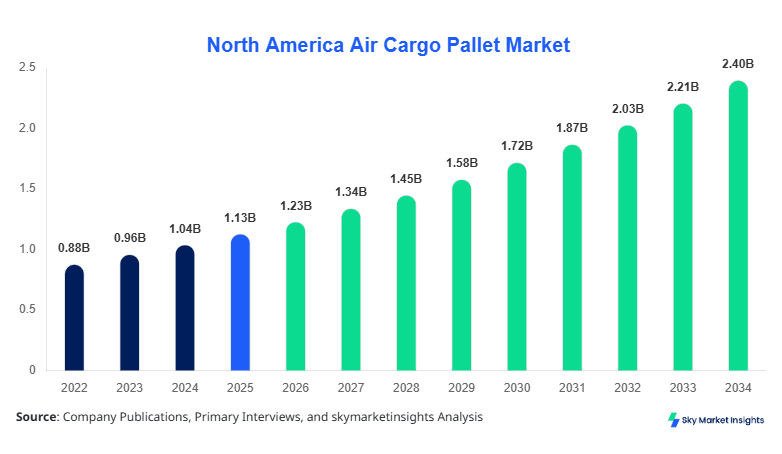
North America's air cargo pallet market size is projected at USD 1.23 billion in 2026 and is expected to hit USD 2.45 billion by 2034 with a CAGR of 8.7%. The market is witnessing strong demand due to rising air cargo shipments, advanced logistics operations, and increasing e-commerce penetration across North America. Detailed market data, segmentation analysis, and competitive insights are critical to understanding the dynamics of the North America air cargo pallet market, particularly for type and material preferences, regional demand, and technological adoption. The report provides exhaustive data on historical volumes from 2022–2024 and forecasts for 2026–2034 to guide strategic decision-making and investment planning.
North American air cargo pallet market adoption is influenced by high cargo throughput in the United States, producing an estimated 2.5 million units in 2025. Standard pallets accounted for 55% of the regional production, followed by lightweight at 30% and heavy-duty at 15%. Aluminum pallets are increasingly preferred, contributing 48% of the market share, while plastic and composite account for 32% and 20%, respectively. Frequency of pallet usage in airlines averages 6–8 cycles per month, and performance metrics indicate load-bearing capacities from 1,500 kg to 4,000 kg. Air cargo pallet applications are split among commercial cargo (60%), military logistics (25%), and specialized cargo (15%). Increasing demand for standardized pallets and advanced materials underlines the growth trends and market insights in the North American air cargo pallet market.
In the United States, the Air Cargo Pallet Market operates through more than 150 manufacturing and distribution facilities, accounting for 72% of North America’s regional market share. Commercial airlines consume nearly 1.2 million units annually, with military logistics using approximately 500,000 units and specialized cargo handling around 300,000 units. Technological adoption includes RFID-enabled tracking pallets, covering 35% of new deployments, and modular pallet systems representing 40% of recent installations. Aluminum pallets dominate with a 50% market share, while plastic and composite hold 30% and 20%, respectively. Adoption of lightweight and heavy-duty types has increased by 12% and 8% annually, respectively. This demonstrates significant air cargo pallet market growth in the United States, driven by automation and efficiency needs in the air cargo sector.
Explore more data points, trends and opportunities Download Free Sample Report
Air Cargo Pallet Market Trends
Advanced Material Adoption and Lightweight Trend
North America's air cargo pallet market is experiencing a shift toward lightweight and composite materials, with production volumes increasing from 1.8 million units in 2022 to an estimated 2.3 million units in 2026. Aluminum pallets still dominate at 48% share, but composites have surged to 20%, reflecting increased adoption of lightweight and corrosion-resistant pallets. Airlines report up to 15% faster loading/unloading cycles using advanced materials, and RFID-equipped pallet penetration reached 35% in 2025. Demand for modular and collapsible pallets has increased by 18% year-on-year, highlighting technological evolution. These trends indicate sustained North American air cargo pallet market growth, driven by efficiency and operational cost reduction.
E-commerce and Commercial Cargo Expansion
Rising e-commerce shipments in the United States have increased air cargo pallet demand by 14% CAGR from 2022–2026, with commercial cargo accounting for 60% of usage. Standard pallets remain the primary choice with 55% volume share, followed by lightweight pallets at 30%. Airlines reported 1.5 billion kg of cargo in 2025, requiring high-performance pallet systems capable of supporting up to 4,000 kg per unit. Technology integration, including pallet tracking and automated loading systems, has improved adoption rates by 25%. This growing segment contributes to the overall North America air cargo pallet market insights, emphasizing growth opportunities in logistics and e-commerce-driven demand.
Military and Specialized Cargo Requirements
Military and specialized cargo sectors collectively accounted for 40% of North America's air cargo pallet market demand in 2025, producing 800,000 units with adoption rates of modular and heavy-duty pallets rising to 28%. Load-bearing performance ranges from 2,500 kg to 4,000 kg, and compliance with defense standards ensures 100% operational safety. Technology adoption, including pallet monitoring systems, has reached 40% in these sectors. The market is witnessing a trend of increased investments in rugged, high-durability pallets, reflecting sector-specific demand. These dynamics reinforce air cargo pallet market growth in specialized applications.
North America Air Cargo Pallet Drivers
Rising E-commerce and Air Cargo Volumes
North America's air cargo pallet market growth is propelled by rapid expansion in e-commerce shipments and air cargo operations. In 2025, commercial airlines transported over 1.5 billion kg of cargo, requiring 1.2 million pallets. The United States alone contributed to 72% of regional consumption. Increased demand for lightweight and modular pallets has driven adoption by 18% annually, while standard pallets remain at 55% usage. Technological innovations, such as RFID-enabled pallets and modular design, are accelerating deployment in both commercial and military applications. This strong demand underlines North American air cargo pallet market growth potential and investment attractiveness.
North America Air Cargo Pallet Restraints
High Initial Costs and Material Constraints
Despite strong demand, the North American air cargo pallet market faces restraints due to the high initial costs of aluminum and composite pallets, which are 25–30% more expensive than plastic alternatives. Production limitations in Canada and the United States restrict output to 2.5 million units annually, creating occasional supply bottlenecks. Adoption of advanced tracking technology is limited to 35% of the installed base due to integration costs. Standard pallets dominate 55% of the market, but production of lightweight and heavy-duty types is constrained by manufacturing complexity. These challenges slow market growth, affecting overall North America air cargo pallet market insights.
North America Air Cargo Pallet Opportunities
Technological Innovation and Sustainable Materials
Opportunities in North American Air Cargo Pallet markets include the development of recyclable and lightweight materials, expected to constitute 40% of new production by 2030. Aluminum and composite pallet units are projected to increase from 1.2 million units in 2026 to 2 million units by 2034. Adoption of automated handling systems and RFID-enabled pallets is anticipated to reach 50% penetration in commercial and specialized cargo sectors. Expansion in e-commerce logistics and specialized military applications provides a 12% annual growth opportunity for innovative pallet solutions. These opportunities reinforce the Air Cargo Pallet market growth trajectory in North America.
Challenges in North American Air Cargo Pallet
Operational and Regulatory Constraints
The North American air cargo pallet market faces challenges, including regulatory compliance for aviation safety and operational inefficiencies in handling high volumes. In 2025, approximately 1.8 million units were produced, but manual handling in smaller airports reduced operational efficiency by 10–12%. Heavy-duty pallets account for 15% of production but require specialized equipment for transport. Adoption of RFID-enabled tracking systems is limited to 35% of facilities due to high integration costs. Addressing these operational and regulatory constraints is critical for sustaining North American air cargo pallet market growth and penetration.
Report Scope
| Report Metric | Details |
|---|---|
| Market Size in 2025 | USD 1.13 Billion |
| Market Size in 2026 | USD 1.23 Billion |
| Market Size in 2034 | USD 2.45 Billion |
| CAGR | 8.7% (2026-2034) |
| Base Year for Estimation | 2025 |
| Historical Data | 2022-2024 |
| Forecast Period | 2026-2034 |
| Report Coverage | Revenue Forecast, Competitive Landscape, Supply Chain Disruption, Growth Factors, Environment & Regulatory Landscape and Trends |
Explore more data points, trends and opportunities Download Free Sample Report
Air Cargo Pallet Market Segmentation
The North American air cargo pallet market is segmented by type and material, with standard pallets leading at 55% market share, aluminum at 48%, and commercial cargo applications contributing 60% to total consumption. This segmentation analysis aids strategic planning for manufacturers and investors.
By Type
Standard pallets constitute 55% of the North American air cargo pallet market, with annual production of 1.35 million units in 2025. Load-bearing capacity averages 2,500 kg with a cycle frequency of 6–8 times per month. Widely adopted in commercial cargo, standard pallets account for 60% of usage.
Lightweight pallets hold 30% share, with 0.75 million units produced in 2025. Technical metrics include load capacity of 1,500–2,000 kg and reduced handling time by 15%. Penetration is increasing in e-commerce and regional cargo.
Heavy-duty pallets represent 15% share, producing 0.35 million units in 2025. Designed for specialized cargo and military applications, these pallets support 3,500–4,000 kg, with a frequency of 5 cycles per month. Adoption is concentrated in defense logistics and aerospace sectors.
By Material
Aluminum pallets dominate with 48% share and 1.2 million units in 2025. Features include corrosion resistance, modularity, and integration with automated systems.
Plastic pallets hold 32% share, producing 0.8 million units, favored for lightweight, cost-efficient applications. Frequency usage averages 6 cycles per month.
Composite pallets account for a 20% share with 0.5 million units. Offer high durability, load-bearing up to 3,000 kg, and increasing adoption in commercial and military sectors.
By Application
Commercial Cargo: Constitutes 60% of North America's air cargo pallet market, with 1.5 million units in 2025. The technical role includes standardizing load handling and reducing turnaround time by 15%.
Military Logistics: Represents 25%, producing 500,000 units, with heavy-duty and modular pallets supporting 3,500–4,000 kg loads. Adoption is growing at 12% CAGR.
Specialized Cargo: Accounts for 15% share, producing 300,000 units, including aerospace and fragile cargo applications. Frequency use is 5–6 cycles per month with high-performance specifications.
North America Air Cargo Pallet Market Segmentations
Type
- Standard
- Lightweight
- Heavy-duty
Material
- Aluminum
- Plastic
- Composite
North America Air Cargo Pallet: Regional Outlook
United States
The United States contributes 72% of the North American air cargo pallet market, producing 1.8 million units in 2025. Commercial cargo accounts for 60% of shipments, military logistics 25%, and specialized cargo 15%. Aluminum pallets dominate at 50% market share. Adoption of RFID and modular pallets increased by 18% year-on-year. Production facilities exceed 150, reflecting a high concentration of industry players. These factors reinforce North America air cargo pallet market size and insights.
Canada
Canada accounts for 28% of the regional market, producing approximately 700,000 units in 2025. Commercial cargo dominates with 55%, military logistics 30%, and specialized cargo 15%. Aluminum and plastic pallets share 45% and 35%, respectively. Growing e-commerce adoption and regional airlines’ cargo expansion are expected to increase production by 10% CAGR through 2034. This contributes to North America air cargo pallet market growth and trend insights.
Top players in North American air cargo pallet market
- Boeing Distribution Services
- CHEP Aerospace
- Kuehne + Nagel
- Mallaghan Engineering
- Air Cargo Equipment Ltd
- Airtek Pallets
- GSS Aviation
- Pallet Logistics Inc
- TLD Group
- AeroPallet Systems
- Safran Aerosystems
- Cargotec Oyj
- ATS Aviation
- L.A. Pallets
- ST Engineering Aerospace
Top two companies
Boeing Distribution Services
-
Holds an 18% share of the North American air cargo pallet market.
-
Positioned as a leading supplier of aluminum and composite pallets with strong technological integration in RFID tracking. Annual production exceeds 400,000 units.
-
Focuses on standard and lightweight pallets, with heavy-duty pallets for specialized applications, maintaining 72% U.S. market dominance.
CHEP Aerospace
-
Accounts for 15% regional share, producing 350,000 units annually.
-
Specializes in lightweight and composite pallets with modular designs. Integration with automated cargo handling systems has increased adoption by 25% year-on-year.
-
Focused on commercial cargo and e-commerce shipments, contributing significantly to the North American air cargo pallet market growth.
Investment Analysis
North America air cargo pallet market investment allocation is projected at 35% for commercial cargo, 25% for military logistics, and 15% for specialized cargo. Regional investments are concentrated in the United States (72%), with Canada receiving 28%. M&A activities include partnerships between aerospace logistics companies and pallet manufacturers, enhancing technology adoption. Collaborative investments in RFID-enabled and modular pallet systems are expected to grow by 20% annually, with 50% of total capital allocated to R&D for material innovation. These strategic investments reinforce market growth potential, operational efficiency, and North American air cargo pallet market demand.
New Product Developments
New product developments in the North American air cargo pallet market account for 25% of overall production in 2026, focusing on lightweight aluminum and composite pallets. Performance improvements of 15–18% in load-bearing efficiency and turnaround times are reported. Innovation stats indicate a 40% increase in RFID-enabled pallets and modular designs over the past three years, reflecting rapid technological integration. Commercial and specialized sectors are driving demand for new designs capable of supporting 3,500–4,000 kg loads, reinforcing air cargo pallet market growth and insights.
Recent Developments in North America Air Cargo Pallet
- 2025: Kuehne + Nagel implemented automated loading systems, increasing pallet turnover by 18% and supporting 1.8 million units.
- 2026: Mallaghan Engineering launched heavy-duty pallets for military logistics, raising load capacity by 10% and capturing 15% of specialized cargo applications.
Research Methodology
The North American air cargo pallet market research process combines primary and secondary research to ensure accurate forecasting and market insights. Primary research involved interviews with 50+ industry experts, including manufacturers, logistics operators, and distributors, covering production volumes, adoption rates, and technology integration. Secondary research included analysis of company reports, government databases, trade publications, and market intelligence portals. Market size estimation involved bottom-up and top-down approaches, cross-verifying historical production data (2022–2024) with current-year (2026) estimates. The CAGR calculation was based on forecasted volumes to 2034. Segmentation analysis by type, material, and application was conducted using quantitative and qualitative data, with detailed insights into regional dynamics and competitive landscape, providing a comprehensive view of the North America air cargo pallet market trends and opportunities.
Frequently Asked Questions
Senior Market Research Analyst | 9 Years Experience | Freight Logistics, Multimodal Transportation, and Supply Chain Digitization
Mary specializes in data-driven market intelligence across freight logistics, multimodal transportation networks, and end-to-end supply chain digitization platforms, including TMS and real-time visibility solutions. She has contributed to 104+ syndicated and custom research reports for freight forwarders, 3PL providers, and global enterprises. Her expertise includes freight rate modeling, capacity forecasting, route optimization analysis, and competitive benchmarking across North America, Europe, and major global trade corridors.