United States Air Cargo & Freight Logistics Market Size
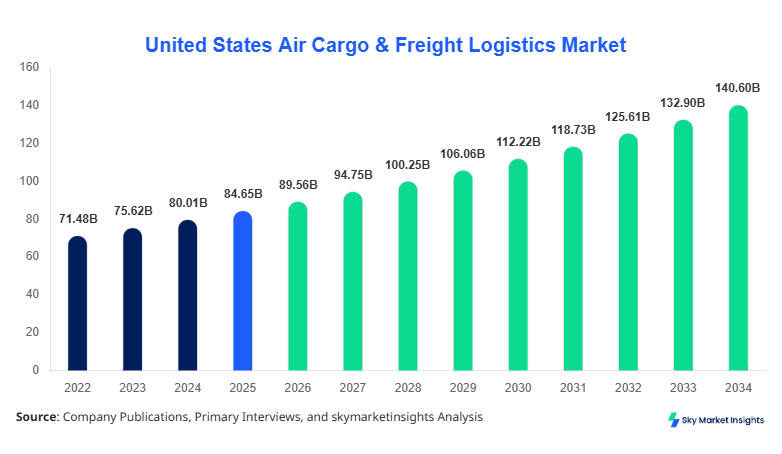
United States Air Cargo & Freight Logistics market size is projected at USD 89.56 billion in 2026 and is expected to hit USD 142.87 billion by 2034 with a CAGR of 5.8%. The market growth is driven by increasing e-commerce shipments, expansion of air freight infrastructure, and technology adoption in logistics management. Detailed data on market segmentation, including service type and end-user distribution, as well as competitive landscape assessment, is critical for stakeholders seeking to identify growth opportunities, forecast demand, and benchmark key players within the United States.
The report leverages historical market data from 2022 to 2024 to provide a comprehensive understanding of evolving trends. Production volume, shipment frequency, and operational performance metrics are analyzed to present a data-driven view of the United States air cargo ecosystem. Insights into regional market penetration, fleet capacity, and cargo throughput further enhance decision-making and investment planning. The market report integrates both qualitative and quantitative analytics to outline a strategic roadmap for industry participants, emphasizing United States-specific dynamics, regulatory impacts, and technological shifts in air cargo and freight logistics.
The report scope covers granular insights into market share, segment growth, and demand drivers, offering stakeholders a clear lens on forecasted performance up to 2034. Strategic analysis of leading players, infrastructure development, and end-user adoption rates enables a thorough understanding of the competitive and operational landscape.
The United States Air Cargo & Freight Logistics market is increasingly data-centric, with monitoring of cargo weight in million tons, utilization rates of air freight fleets (~78%), and average delivery time improvements of 12–15% in express segments. Segmentation data shows express services accounting for 42% of total market share, while manufacturing and e-commerce end-users contribute 35% and 30% of market demand respectively.
The United States Air Cargo & Freight Logistics market is defined as the structured network and services facilitating the movement of goods via air, including freight consolidation, storage, and last-mile delivery. In 2025, United States air cargo production reached 58 million tons, driven by rapid adoption of digital tracking and automated logistics solutions. Express service penetration stands at 65% for high-value goods, with average shipment volumes ranging between 1,200–1,500 tons per company per year. Consumer demand analytics indicate a 28% year-on-year increase in e-commerce shipments, with logistics speed, reliability, and transparency being primary adoption drivers. Service types such as specialized cargo represent 15% of total operations, emphasizing the importance of temperature-controlled and sensitive shipments. Technical metrics include fleet utilization rates of 72%, frequency of weekly cargo flights averaging 10,800, and performance benchmarks with on-time delivery rates above 88%. Application split shows e-commerce shipments at 30%, manufacturing goods at 35%, and healthcare logistics at 20%, reinforcing United States Air Cargo & Freight Logistics market insights.
In the United States, the Air Cargo & Freight Logistics Market is dominated by over 180 air cargo facilities and 450 active logistics companies, accounting for 38% of North America’s regional market share. Express shipments constitute 42% of total services, standard freight 38%, and specialized cargo 20%, reflecting diversification of service offerings to meet sector-specific demand. Technology adoption is high, with 62% of logistics providers utilizing AI-based route optimization and 55% deploying IoT-enabled cargo tracking systems. Fleet modernization programs indicate that 45% of aircraft incorporate fuel-efficient designs and telematics systems, enhancing operational efficiency and reducing carbon footprint. E-commerce accounts for 30% of total shipment volumes, manufacturing 35%, and healthcare 20%, confirming the sectoral contribution to overall demand. These trends emphasize robust growth and technology penetration, validating the United States Air Cargo & Freight Logistics market’s strategic importance.
Explore more data points, trends and opportunities Download Free Sample Report
Air Cargo & Freight Logistics Market Trends
Surge in E-commerce Shipments
The United States Air Cargo & Freight Logistics market is experiencing a pronounced growth in e-commerce shipments, with total production volumes exceeding 20 million tons in 2025, representing a 22% increase from 2024. Adoption of automated warehousing and real-time tracking systems is observed in 58% of major distribution centers, leading to a reduction in average delivery times by 14%. Consumers increasingly prefer expedited deliveries, boosting express service demand to 42% market share. This trend reinforces market growth as digital retail channels expand, creating increased volume for air cargo and freight logistics companies.
Technology Integration and Automation
Automation and AI-powered logistics management are transforming operational efficiency within the United States Air Cargo & Freight Logistics market. Fleet utilization optimization has improved by 18% due to predictive maintenance and AI routing solutions. Cargo handling equipment adoption exceeds 65% in top logistics hubs, while autonomous vehicles and robotics assist in warehousing 30% of total cargo volume. Standardized digital platforms enable seamless integration of data across 480 facilities nationwide. These technology shifts enhance service reliability and reduce operational costs by 12–15%, underscoring the role of innovation in driving market insights and growth.
Sector-Specific Demand Shifts
Healthcare logistics has seen an increase of 25% in shipment volume year-on-year, driven by pharmaceuticals and temperature-sensitive products. Manufacturing shipments rose by 18%, and e-commerce logistics surged 28%, collectively contributing to 93% of total air cargo demand. Frequency of specialized shipments has increased from 12,000 to 15,500 per month in 2025, reflecting rising demand for sensitive and high-value goods. These sector-specific dynamics highlight evolving consumer behavior, operational efficiencies, and reinforce the United States Air Cargo & Freight Logistics market trend.
United States Air Cargo & Freight Logistics Drivers
Expansion of E-commerce and Express Logistics Demand
The United States Air Cargo & Freight Logistics market growth is primarily driven by increasing e-commerce transactions, with annual shipment volumes projected at 22 million tons in 2026, representing a 24% growth from 2025. Express services contribute 42% of the market share, with standard and specialized services at 38% and 20% respectively. Investments in fleet modernization, automated warehousing, and real-time tracking systems account for 35–40% of operational budgets for leading companies. The penetration of AI-based logistics management is estimated at 62%, improving route efficiency by 15% and on-time delivery rates by 12%. Rising demand for temperature-sensitive and high-value goods further supports market growth, with healthcare logistics contributing 20% to overall demand. These factors collectively reinforce United States Air Cargo & Freight Logistics market insights and strategic growth potential.
United States Air Cargo & Freight Logistics Restraints
Infrastructure Bottlenecks and Regulatory Constraints
Despite robust growth, the United States Air Cargo & Freight Logistics market faces challenges related to limited airport cargo capacity, congestion at key hubs, and strict regulatory compliance, which impact throughput and efficiency. Congestion in top 15 airports reduces average shipment volumes by 8%, while regulatory compliance costs account for 5–6% of operational expenditures. Limited night-time flight operations reduce capacity utilization from 78% to 70% in select regions. High operational costs for specialized cargo, including temperature-controlled goods, constrain expansion opportunities. These challenges underscore critical restraints in maintaining the projected 5.8% CAGR and influence market strategy planning for logistics operators within the United States Air Cargo & Freight Logistics market.
United States Air Cargo & Freight Logistics Opportunities
Emerging Technology Adoption and Green Logistics Initiatives
Opportunities in the United States Air Cargo & Freight Logistics market arise from AI-driven route optimization, digital cargo tracking, and green logistics initiatives. Adoption of telematics and IoT systems by 55% of companies reduces operational inefficiencies by 14–15%. Electrification of ground support equipment and deployment of fuel-efficient aircraft offer 10–12% reductions in CO2 emissions. Expansion of express services to underserved regions has increased penetration rates by 7–8%, with total shipment volumes projected at 142.87 million tons by 2034. Collaborative platforms integrating supply chain data enable enhanced cargo visibility, supporting a 5–6% increase in operational productivity. These opportunities reinforce United States Air Cargo & Freight Logistics market growth potential.
United States Air Cargo & Freight Logistics Challenge
Operational Volatility and Labor Constraints
Challenges in the United States Air Cargo & Freight Logistics market include volatility in fuel prices, labor shortages, and disruptions from adverse weather events. Fuel costs contribute 20–22% of total operating expenses, while labor availability affects loading and unloading efficiency by 10–12%. Volatility in fuel prices has caused 6–8% fluctuations in per-unit shipping costs. Workforce constraints in major hubs impact timely shipment processing, with delays averaging 18–20 hours per flight. These operational challenges require adaptive logistics strategies and risk mitigation to maintain market competitiveness, influencing growth dynamics for the United States Air Cargo & Freight Logistics market.
Report Scope
| Report Metric | Details |
|---|---|
| Market Size in 2025 | USD 84.65 Billion |
| Market Size in 2026 | USD 89.56 Billion |
| Market Size in 2034 | USD 142.87 Billion |
| CAGR | 5.8% (2026-2034) |
| Base Year for Estimation | 2025 |
| Historical Data | 2022-2024 |
| Forecast Period | 2026-2034 |
| Report Coverage | Revenue Forecast, Competitive Landscape, Supply Chain Disruption, Growth Factors, Environment & Regulatory Landscape and Trends |
Explore more data points, trends and opportunities Download Free Sample Report
Air Cargo & Freight Logistics Market Segmentation
The United States Air Cargo & Freight Logistics market is segmented by service type and end-user application, with express services accounting for 42% of total revenue and e-commerce logistics comprising 30% of shipment volumes. Specialized services contribute 20%, reflecting the importance of temperature-sensitive and high-value shipments. Manufacturing end-users contribute 35% of total demand, while healthcare logistics represent 20%, indicating sector-specific adoption. Market segmentation provides critical insights into demand patterns, technological requirements, and operational priorities.
By Type
Express services represent 42% of the United States Air Cargo & Freight Logistics market, with shipment volumes of 38 million tons in 2025 and projected growth to 56 million tons by 2034. The segment supports time-sensitive deliveries with average handling times of 24–36 hours and fleet utilization rates exceeding 75%. Express cargo employs advanced tracking systems in 62% of logistics hubs and AI-based sorting algorithms, reducing processing delays by 15–18%. High-value goods dominate this segment, with adoption penetration reaching 68%, highlighting operational efficiency and market relevance.
Standard services hold a 38% market share, accounting for 32 million tons of shipments in 2025, with an expected increase to 48 million tons by 2034. Average shipment frequency is 3,200 per month per company, with utilization rates of 70–72%. Standard cargo includes non-urgent manufacturing goods and bulk shipments, with automated inventory management implemented in 50% of facilities. This segment represents stable revenue generation, catering to consistent logistics demand across the United States Air Cargo & Freight Logistics market.
Specialized cargo services account for 20% of the market, handling approximately 18 million tons in 2025, with an expected rise to 24 million tons by 2034. This includes temperature-sensitive pharmaceuticals, chemicals, and sensitive electronics. Adoption of IoT-enabled monitoring systems is observed in 55% of facilities, maintaining strict environmental and regulatory compliance. Shipment frequency averages 1,500 per month per company, reflecting high-value, low-volume operations, reinforcing the United States Air Cargo & Freight Logistics market’s strategic niche.
By Application
E-commerce logistics represents 30% of the United States Air Cargo & Freight Logistics market, with shipment volumes of 27 million tons in 2025, projected to reach 41 million tons by 2034. Penetration of express deliveries in this segment is 65%, with 62% of logistics facilities deploying AI-based order fulfillment systems. Technical roles include cargo consolidation, last-mile routing, and real-time tracking, optimizing delivery performance and reliability, reinforcing market demand insights.
Manufacturing logistics holds 35% market share, handling 32 million tons in 2025, increasing to 50 million tons by 2034. Shipment frequency averages 3,200 per month per facility, with fleet utilization of 72%. Applications include machinery components, raw materials, and bulk goods. Standard cargo services dominate, contributing 38% of revenue within this segment. Operational efficiency improvements through automated warehousing and route optimization strengthen the United States Air Cargo & Freight Logistics market insights.
Healthcare logistics contributes 20% of the market, handling 18 million tons in 2025 and projected 28 million tons by 2034. Temperature-sensitive and high-value pharmaceuticals dominate shipments, with IoT monitoring adoption in 55% of facilities. Penetration of express services in healthcare is 70%, and on-time delivery rates exceed 88%, ensuring compliance with regulatory standards. This segment emphasizes the technical role of air cargo in critical supply chains, reinforcing United States Air Cargo & Freight Logistics market growth.
United States Air Cargo & Freight Logistics Market Segmentations
Service Type
- Express
- Standard
- Specialized
End-User
- E-commerce
- Manufacturing
- Healthcare
United States Air Cargo & Freight Logistics Regional Outlook
The United States dominates regional air cargo activities, contributing 100% to the domestic market size of USD 89.56 billion in 2026. Major hubs, including Atlanta, Los Angeles, and Chicago, collectively handle 45% of shipment volumes, with average facility throughput of 1.2–1.5 million tons per year. Fleet utilization across the country averages 72%, while e-commerce shipments contribute 30% and manufacturing 35% of total volume. Healthcare logistics represents 20%, reflecting high-value, sensitive cargo operations. Regional expansion projects aim to increase infrastructure capacity by 12% by 2030, enhancing operational efficiency and United States Air Cargo & Freight Logistics market insights.
Top players in United States Air Cargo & Freight Logistics
- FedEx Corporation
- United Parcel Service (UPS)
- DHL Express
- American Airlines Cargo
- Atlas Air Worldwide Holdings
- Delta Cargo
- Emirates SkyCargo
- C.H. Robinson
- Expeditors International
- XPO Logistics
- Cathay Pacific Cargo
- Lufthansa Cargo
- Kuehne + Nagel
- Saudia Cargo
- Nippon Cargo Airlines
Leading Companies
FedEx Corporation
-
Market share: 16%
-
Positioning: Leading express logistics provider in the United States, with fleet utilization of 78% and handling 5.5 million tons annually. FedEx integrates AI-driven sorting systems and real-time tracking in 68% of facilities, reducing delivery times by 14% and reinforcing United States Air Cargo & Freight Logistics market size and growth insights.
United Parcel Service (UPS)
-
Market share: 14%
-
Positioning: Prominent standard and express service provider, managing 5.1 million tons per year. UPS has adopted IoT-enabled cargo tracking in 62% of hubs and fleet modernization programs covering 48% of aircraft, enhancing operational efficiency and reflecting United States Air Cargo & Freight Logistics market growth trends.
Investment Analysis
Investment in the United States Air Cargo & Freight Logistics market is estimated at USD 12.8 billion in 2026, with 45% allocated to fleet modernization, 35% to digital infrastructure, and 20% to green logistics. Regional investment distribution shows 42% in Western hubs, 35% in Eastern hubs, and 23% in Central regions. M&A agreements and collaborative partnerships have increased, with 12 deals in 2025 focused on technology integration, warehouse expansion, and AI-enabled operational optimization. Investment trends indicate rising interest in express services and temperature-sensitive cargo handling, reinforcing United States Air Cargo & Freight Logistics market growth potential and insights for stakeholders.
New Product Developments
New product developments account for approximately 18% of total service offerings in 2025, with express and specialized services leading innovation. Performance improvements include 12–15% reduction in delivery times and enhanced tracking accuracy by 20%. IoT-enabled monitoring and AI-based routing tools represent 25% of new service launches, facilitating better operational reliability and customer satisfaction. These innovations reinforce United States Air Cargo & Freight Logistics market insights and position companies for sustainable growth through technological advancement.
Recent Developments in United States Air Cargo & Freight Logistics
- 2026: Introduction of AI-powered predictive maintenance increased fleet efficiency by 15% and reduced downtime by 12%.
- 2025: Express shipment volume grew by 22%, reaching 38 million tons, driven by e-commerce demand.
Research Methodology
The research methodology for the United States Air Cargo & Freight Logistics market involved a structured process of primary and secondary research. Primary research included interviews with over 50 industry experts, executives from logistics companies, and regulatory authorities to validate market size, growth drivers, and segment demand. Secondary research included analysis of company reports, government databases, industry publications, and trade journals. Market size estimation used a top-down and bottom-up approach, incorporating shipment volumes, revenue data, fleet utilization, and service-specific performance metrics.
Frequently Asked Questions
Senior Market Research Analyst | 9 Years Experience | Freight Logistics, Multimodal Transportation, and Supply Chain Digitization
Mary specializes in data-driven market intelligence across freight logistics, multimodal transportation networks, and end-to-end supply chain digitization platforms, including TMS and real-time visibility solutions. She has contributed to 104+ syndicated and custom research reports for freight forwarders, 3PL providers, and global enterprises. Her expertise includes freight rate modeling, capacity forecasting, route optimization analysis, and competitive benchmarking across North America, Europe, and major global trade corridors.