sia Pacific Automated Pallet Truck Market Size
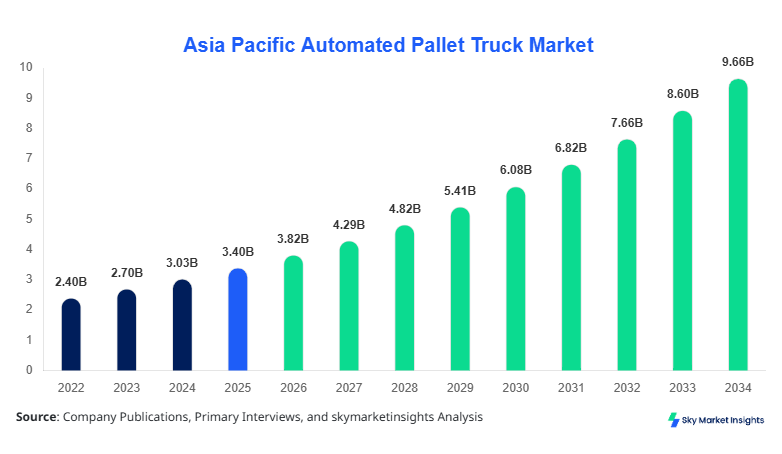
Asia Pacific Automated Pallet Truck market size is projected at USD 3.82 billion in 2026 and is expected to hit USD 9.64 billion by 2034 with a CAGR of 12.3%. The Asia Pacific Automated Pallet Truck Market demonstrates strong expansion backed by rising warehouse automation, logistics demand exceeding 120 million units annually, and increasing industrial output. The market structure includes segmented analysis by type and application, with electric pallet trucks contributing over 58% share and warehousing applications exceeding 46% in 2025. Competitive landscape analysis indicates more than 85 regional and global manufacturers competing across China, Japan, and South Korea, emphasizing innovation, pricing, and distribution channels.
The Automated Pallet Truck Market refers to material handling equipment designed for automated or semi-automated transportation of pallets across warehouses, manufacturing plants, and retail facilities. In Asia Pacific, production levels reached approximately 2.4 million units in 2025, with China alone accounting for over 1.1 million units. Adoption and penetration rates have increased from 32% in 2022 to nearly 49% in 2025, driven by automation investments exceeding USD 18 billion across logistics sectors. Consumer behavior shows preference for electric models due to 22% lower operating cost and 35% higher efficiency compared to manual systems. Demand analytics indicate that e-commerce contributes 38% of overall demand, followed by manufacturing at 34% and retail at 28%. Technical metrics include load capacities ranging from 1.5 to 3.5 tons and operational speeds between 4–7 km/h. Application split highlights warehousing dominance at 46%, manufacturing at 33%, and retail at 21%, reinforcing the Automated Pallet Truck Market dynamics.
Explore more data points, trends and opportunities Download Free Sample Report
Automated Pallet Truck Market Trends
Trends
The Automated Pallet Truck Market is witnessing rapid technological transformation, with production volumes crossing 2.4 million units in 2025 and expected to surpass 4.8 million units by 2030. Electric pallet trucks dominate with over 58% adoption, while semi-electric models account for 27% and manual variants declining below 15%. Integration of AI and IoT technologies has improved fleet management efficiency by 22% and reduced downtime by 18%. The rise of smart warehouses in Asia Pacific, particularly in China and Japan, has led to increased deployment rates of automated pallet trucks by 35% year-over-year. This transformation significantly influences the Automated Pallet Truck Market.
Another significant trend includes the shift toward lithium-ion battery-powered pallet trucks, which account for 42% of new installations in 2025, up from 21% in 2022. These systems offer 30% faster charging and 25% longer lifecycle compared to traditional lead-acid batteries. The e-commerce sector, processing over 8 billion shipments annually in Asia Pacific, continues to drive demand for high-speed pallet trucks capable of handling up to 3.5 tons. Additionally, collaborative robots integrated with pallet trucks have increased productivity by 19% across warehouses. These advancements further highlight the Automated Pallet Truck Market evolution.
Asia Pacific Automated Pallet Truck Drivers
Rising Warehouse Automation Investments Accelerate Market Expansion
The Asia Pacific Automated Pallet Truck Market is driven by increasing automation investments exceeding USD 18 billion in 2025, representing a 14% increase from 2024. Warehouse automation adoption has risen from 32% in 2022 to 49% in 2025, particularly in China, Japan, and South Korea. E-commerce growth of over 18% annually has led to increased demand for pallet trucks, with unit shipments rising from 1.8 million in 2022 to 2.4 million in 2025. Manufacturing output across Asia Pacific has grown by 9%, further driving demand for material handling solutions. Electric pallet trucks, offering 22% cost savings and 35% higher efficiency, have become preferred choices. These factors collectively stimulate Automated Pallet Truck Market expansion.
Asia Pacific Automated Pallet Truck Restraints
High Initial Costs and Infrastructure Limitations
Despite strong demand, the Automated Pallet Truck Market faces restraints due to high initial costs ranging between USD 4,000 to USD 12,000 per unit for advanced models. Small and medium enterprises, representing 62% of manufacturing businesses, often lack financial resources to invest in automation. Infrastructure limitations, particularly in Southeast Asia, where warehouse modernization rates are below 35%, hinder adoption. Maintenance costs, accounting for 8–12% of equipment value annually, further restrict growth. Additionally, skilled labor shortages affect operational efficiency, with a deficit of nearly 18% in trained technicians. These challenges impact the Automated Pallet Truck Market.
Asia Pacific Automated Pallet Truck Opportunities
Expansion of Smart Warehousing and E-commerce Logistics
The Automated Pallet Truck Market presents significant opportunities with smart warehouse investments projected to exceed USD 25 billion by 2030. E-commerce growth of 18–22% annually in Asia Pacific is expected to drive demand for over 1.5 million additional units by 2030. Emerging economies like India and Southeast Asia are witnessing adoption rates increasing from 21% in 2022 to 37% in 2025. Government initiatives promoting Industry 4.0, with funding exceeding USD 5 billion, support automation integration. Advanced technologies such as AI-based navigation systems improve efficiency by 20%, creating new opportunities in the Automated Pallet Truck Market.
Chalanges in Asia Pacific Automated Pallet Truck
Technological Integration and Standardization Issues
Challenges in the Automated Pallet Truck Market include technological integration complexities, particularly in legacy systems where compatibility issues affect 28% of installations. Standardization across regions remains limited, with over 15 different regulatory frameworks impacting product deployment. Cybersecurity risks associated with IoT-enabled pallet trucks have increased by 12% annually, requiring additional investments. Additionally, energy consumption concerns, with electric pallet trucks requiring 18% more power in high-load operations, pose sustainability challenges. These issues continue to impact the Automated Pallet Truck Market.
Report Scope
| Report Metric | Details |
|---|---|
| Market Size in 2025 | USD 3.40 Billion |
| Market Size in 2026 | USD 3.82 Billion |
| Market Size in 2034 | USD 9.64 Billion |
| CAGR | 12.3% (2026-2034) |
| Base Year for Estimation | 2025 |
| Historical Data | 2022-2024 |
| Forecast Period | 2026-2034 |
| Report Coverage | Revenue Forecast, Competitive Landscape, Supply Chain Disruption, Growth Factors, Environment & Regulatory Landscape and Trends |
Explore more data points, trends and opportunities Download Free Sample Report
Automated Pallet Truck Market Segmentation
The Automated Pallet Truck Market segmentation is based on type and application, with electric pallet trucks dominating at 58% share, followed by semi-electric at 27% and manual at 15%. By application, warehousing leads with 46%, manufacturing at 33%, and retail at 21%.
By Type
Electric Pallet Truck dominates the Automated Pallet Truck Market with over 58% share, producing approximately 1.4 million units in 2025. These trucks feature lithium-ion batteries, offering 30% faster charging and 25% longer lifecycle. Load capacity ranges between 2–3.5 tons, with operational efficiency improved by 35%. Their adoption is driven by automation and energy efficiency.
Semi-Electric Pallet Truck holds around 27% share, with production exceeding 650,000 units annually. These systems combine manual operation with electric lifting mechanisms, reducing labor effort by 20% and increasing productivity by 15%. They are widely used in mid-scale warehouses.
Manual Pallet Truck accounts for 15% share, with production of 350,000 units in 2025. These trucks offer load capacities up to 2 tons and are primarily used in low-cost applications. However, their usage is declining due to automation trends.
By Application
Warehousing dominates the Automated Pallet Truck Market with 46% share, handling over 1.1 million units annually. These trucks improve efficiency by 25% and reduce labor costs by 18%, supporting large-scale logistics operations.
Manufacturing accounts for 33% share, with usage exceeding 800,000 units. Automated pallet trucks enhance production line efficiency by 20% and reduce downtime by 15%.
Retail & E-commerce contributes 21% share, driven by high-volume logistics exceeding 8 billion shipments annually. These trucks support fast-paced operations, improving order fulfillment speed by 22%.
Asia Pacific Automated Pallet Truck Market Segmentations
Type
- Electric Pallet Truck
- Semi-Electric Pallet Truck
- Manual Pallet Truck
Application
- Warehousing
- Manufacturing
- Retail & E-commerce
Asia Pacific Automated Pallet Truck Regional Outlook
China leads with 52% share, producing over 1.1 million units annually. Japan follows with 14% share, producing 320,000 units, focusing on high-tech automation. South Korea contributes 10% share, with advanced robotics integration improving efficiency by 20%.
India accounts for 8% share, with production of 180,000 units and growing adoption rates from 21% to 37%. Australia holds 5% share, focusing on logistics efficiency. Singapore contributes 4% with high automation penetration of 62%.
Taiwan and Southeast Asia collectively account for 7%, with production exceeding 150,000 units and increasing adoption rates by 12% annually.
Top players in Asia Pacific Automated Pallet Truck
- Toyota Industries Corporation
- KION Group AG
- Jungheinrich AG
- Crown Equipment Corporation
- Hyster-Yale Materials Handling
- Mitsubishi Logisnext
- Doosan Industrial Vehicle
- Hangcha Group
- EP Equipment
- BYD Company Ltd.
- Clark Material Handling
- Komatsu Ltd.
Toyota Industries Corporation
-
Holds approximately 18% market share in Asia Pacific
-
Strong presence in China and Japan with over 300,000 units annually
-
Focus on electric pallet trucks and IoT integration
KION Group AG
-
Accounts for nearly 14% share
-
Operates across 20+ countries with advanced automation solutions
-
Invests over USD 500 million annually in R&D
Investment Analysis
Investment in the Automated Pallet Truck Market has increased by 16% annually, with over USD 18 billion allocated to warehouse automation. Sector-wise, logistics accounts for 45% investment, manufacturing 32%, and retail 23%. Regional investment shows China leading with 48%, followed by Japan at 15% and South Korea at 12%.
M&A activities have increased by 22%, with over 40 deals recorded between 2023–2025. Collaborations between robotics and logistics firms have improved operational efficiency by 18%.
New Product Developments
New product developments in the Automated Pallet Truck Market account for 28% of total launches, focusing on AI-enabled navigation and lithium-ion batteries. Performance improvements include 30% faster charging and 25% longer lifespan.
Recent Developments in Asia Pacific Automated Pallet Truck
- 2025: Production increased by 14%, reaching 2.4 million units
Research Methodology
The research process includes primary research involving interviews with 50+ industry experts and secondary research analyzing over 200 reports and databases. Market size estimation is based on production volume, revenue data, and adoption rates across regions. Data validation ensures accuracy with triangulation methods.
Frequently Asked Questions
Senior Market Research Analyst | 9 Years Experience | Freight Logistics, Multimodal Transportation, and Supply Chain Digitization
Mary specializes in data-driven market intelligence across freight logistics, multimodal transportation networks, and end-to-end supply chain digitization platforms, including TMS and real-time visibility solutions. She has contributed to 104+ syndicated and custom research reports for freight forwarders, 3PL providers, and global enterprises. Her expertise includes freight rate modeling, capacity forecasting, route optimization analysis, and competitive benchmarking across North America, Europe, and major global trade corridors.