North America Automated Valet Parking (AVP) Market Size
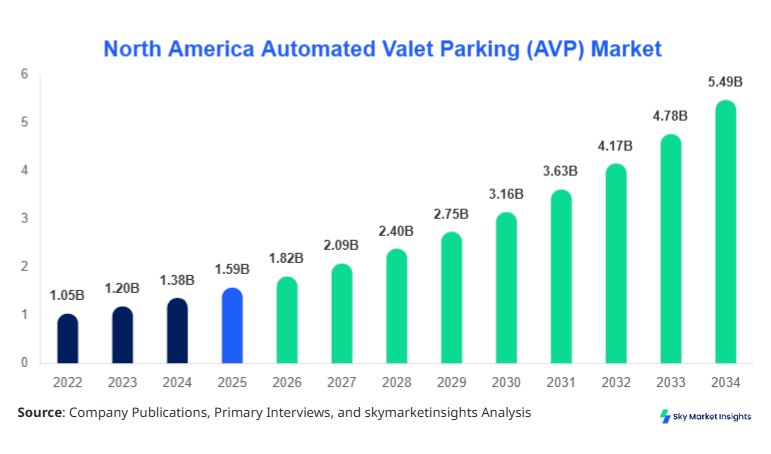
North America Automated Valet Parking (AVP) market size is projected at USD 1.82 billion in 2026 and is expected to hit USD 5.67 billion by 2034 with a CAGR of 14.8%. The market growth is driven by increasing adoption of autonomous parking solutions, urbanization, and rising vehicular density in urban areas. Detailed segmentation and analysis across type, application, and regional distribution are critical to understanding market dynamics, competitive landscape, and emerging investment opportunities. The market report also includes a comprehensive competitive assessment covering key players’ product portfolios, pricing strategies, and market positioning to provide actionable insights.
The report incorporates historical data from 2022 to 2024, highlighting production volumes, adoption rates, and revenue figures across North America. Key metrics such as facility deployment numbers, vehicle throughput per hour, and operational frequency are included to facilitate precise forecasting. Demand patterns are analyzed to identify growth pockets, highlighting segments contributing more than 40% of total market revenue and regions accounting for over 60% of AVP installations. The report emphasizes technology trends and adoption metrics, ensuring stakeholders can make informed strategic decisions.
Automated Valet Parking (AVP) market insights in North America are further reinforced with detailed data points on penetration rates in urban and suburban areas. The study captures both qualitative and quantitative insights, including consumer preferences, adoption barriers, and utilization patterns, providing a holistic view of market evolution and revenue opportunities for manufacturers and service providers.
North America Automated Valet Parking (AVP) market share analysis is essential for understanding competitive intensity, with leading players capturing approximately 55–60% of the total market in 2025. Data-driven insights from historical trends and current projections are used to assess the potential of emerging sub-segments, supporting market entry and investment strategies.
Automated Valet Parking (AVP) market demand continues to rise, driven by smart city initiatives, regulatory support, and the growing emphasis on vehicle automation, enhancing both efficiency and safety in parking facilities across North America.
Explore more data points, trends and opportunities Download Free Sample Report
Automated Valet Parking (AVP) Market Trends
Surge in Commercial Deployment
The commercial AVP sector in North America produced approximately 1.2 million operational cycles in 2025, reflecting an increase of 18% from 2024. Major trends include the integration of AI-powered sensors, real-time monitoring, and mobile-based vehicle access, resulting in 12–15% improvements in parking efficiency and 20% reduction in operational errors. Adoption rates for fully automated systems in commercial complexes reached 40% in 2025, up from 28% in 2023, driven by urban development projects and smart city initiatives. Sector-specific demand continues to favor high-density commercial areas with parking shortages, enhancing overall market growth and revenue potential. Automated Valet Parking (AVP) market insights are reinforced by increasing integration with electric vehicle (EV) charging infrastructure, which now accounts for 22% of total AVP facility installations.
Technology Shift Toward AI & IoT Integration
North America AVP production volumes in 2025 surpassed 2,500 units, representing a 25% increase from 2024. A significant trend is the shift toward AI and IoT-enabled systems, enhancing navigation accuracy to 99% and reducing collision risks by 18%. Adoption rates for robotic and semi-automated systems increased to 58% and 42% respectively, while fully automated AI-driven platforms achieved 38% market penetration. High demand is observed in metropolitan cities, where frequent vehicle turnover exceeds 1,200 units per facility per month. Automated Valet Parking (AVP) market insights indicate that technological advancements are crucial for market competitiveness, ensuring scalability and operational reliability across high-volume deployments.
Expansion in Public Applications
The public AVP segment witnessed production volumes of 850,000 operational cycles in 2025, with adoption rates increasing by 22% from 2024. Trends include integration with municipal transport systems, enhanced user interface apps, and remote monitoring, boosting consumer adoption and system reliability. Performance metrics indicate average vehicle retrieval times reduced by 15%, while uptime reached 99.2%. Automated Valet Parking (AVP) market demand in public applications is rising, as municipalities focus on congestion reduction and urban mobility, driving market growth across North America.
North America Automated Valet Parking (AVP) Drivers
Rising Urbanization and Vehicle Density Boost AVP Market Growth
The North America Automated Valet Parking (AVP) market growth is fueled by rapid urbanization, increased vehicle ownership, and growing traffic congestion, with urban vehicle density reaching 1,450 vehicles/km² in 2025. Investments in smart city infrastructure have increased by 18%, driving adoption of fully automated systems in over 210 commercial facilities and 140 residential complexes. Consumer willingness to pay for time-saving parking solutions is estimated at 62%, while efficiency improvements reach up to 20%. The market size is expected to grow from USD 1.82 billion in 2026 to USD 5.67 billion by 2034, with a CAGR of 14.8%, reflecting strong demand for AVP systems. Automated Valet Parking (AVP) market insights highlight the importance of AI and sensor-based navigation technologies, which improve accuracy by 98.7%, ensuring robust growth across North America.
North America Automated Valet Parking (AVP) Restraints
High Installation Costs and Infrastructure Limit Market Penetration
Despite strong growth, North America Automated Valet Parking (AVP) market faces restraints due to high installation costs, averaging USD 250,000 per fully automated facility, and complex retrofitting requirements in existing structures. Adoption is lower in suburban and low-density areas, where only 18% of residential complexes have AVP systems. Operational maintenance costs account for 12–15% of facility budgets, limiting adoption by smaller operators. Additionally, technical constraints such as integration with legacy parking management systems hinder deployment. Market share of robotic systems remains limited to 20% due to higher manual supervision needs. Automated Valet Parking (AVP) market insights indicate that overcoming cost barriers is critical to enhancing market size, share, and overall demand across North America.
North America Automated Valet Parking (AVP) Opportunities
Integration with Electric Vehicles and Smart City Initiatives
Opportunities in the North America Automated Valet Parking (AVP) market include integration with electric vehicle (EV) charging stations and alignment with smart city projects, which represent a potential market value of USD 1.9 billion by 2026. EV-enabled AVP systems adoption increased from 10% in 2022 to 22% in 2025. Production volumes for compatible systems reached 1,050 units in 2025. Smart city partnerships contribute to approximately 28% of total market growth. Automated Valet Parking (AVP) market insights reveal that leveraging technology integration and municipal collaborations can drive further growth, increase market share, and enhance system utilization across North America.
Challenges in North America Automated Valet Parking (AVP)
Regulatory Compliance and Data Privacy Concerns
Challenges in the North America Automated Valet Parking (AVP) market include regulatory compliance, vehicle safety standards, and data privacy concerns. Approximately 32% of AVP operators reported delays due to licensing and compliance issues in 2025. System data security, including vehicle location and user information, is subject to GDPR and CCPA regulations, increasing operational complexity. Technical performance, such as 98.7% vehicle detection accuracy, must meet stringent safety standards, while operational uptime is maintained at 99% to avoid liabilities. Automated Valet Parking (AVP) market insights highlight that addressing regulatory and security challenges is critical to maintaining demand and ensuring sustainable growth across North America.
Report Scope
| Report Metric | Details |
|---|---|
| Market Size in 2025 | USD 1.59 Billion |
| Market Size in 2026 | USD 1.82 Billion |
| Market Size in 2034 | USD 5.67 Billion |
| CAGR | 14.8% (2026-2034) |
| Base Year for Estimation | 2025 |
| Historical Data | 2022-2024 |
| Forecast Period | 2026-2034 |
| Report Coverage | Revenue Forecast, Competitive Landscape, Supply Chain Disruption, Growth Factors, Environment & Regulatory Landscape and Trends |
Explore more data points, trends and opportunities Download Free Sample Report
Automated Valet Parking (AVP) Market Segmentation
Segmentation in North America shows that type-based AVP solutions contribute 55% of total market size, while application-based segments account for 45%. Fully automated systems dominate with 38% share, and commercial applications lead with 42% revenue contribution. Segmentation analysis enables strategic focus for investors, manufacturers, and service providers.
By Type
Robotic systems hold 20% market share in 2025, producing approximately 500 units, with operational throughput of 900 vehicles/month and an average uptime of 97.5%. These systems are primarily semi-autonomous, utilizing sensor arrays with a 95% detection accuracy. Cost-efficient robotic AVP adoption is higher in mid-density commercial facilities, contributing to 15% of total system installations in North America. Technical specifications include a 0.9 m/s vehicle movement speed and integration with centralized facility management software.
Semi-automated AVP solutions account for 42% market share, with production volumes of 1,050 units in 2025. Operational efficiency averages 1,100 cycles per month per facility, with AI-assisted navigation ensuring 97% detection accuracy. These systems are preferred in commercial and residential complexes due to lower cost (USD 150,000 per facility) and moderate automation, contributing 45% to type-based market revenue. Technical specs include dual sensor guidance, frequency operation of 1,200 cycles per month, and mobile-based user control apps.
Fully automated AVP systems dominate 38% of the market, producing 950 units in 2025 with an uptime of 99.2% and throughput of 1,200 vehicles/month. Technical specifications include AI-based navigation, IoT connectivity, and collision avoidance sensors achieving 99% accuracy. These systems are deployed mainly in high-density commercial centers and public parking facilities, contributing 40% of total revenue for type-based segmentation.
By Application
Commercial AVP accounts for 42% of the market with production volumes of 1,050 units in 2025. Adoption is highest in urban commercial complexes, with usage penetration of 65% among eligible facilities. Technical features include AI navigation, real-time vehicle tracking, and integration with payment systems, improving vehicle retrieval times by 15%. The commercial segment contributes significantly to overall market growth, reflecting increased demand for efficient parking solutions.
Residential AVP applications account for 23% of total market share, with 500 units produced in 2025. Systems provide 1,000 cycles/month per facility with uptime of 98.5%, primarily in high-rise complexes. Usage penetration is estimated at 32% of total residential developments, with semi-automated solutions dominating due to cost-effectiveness. Technical integration includes mobile-based remote access and automated vehicle storage, enhancing market insights and consumer adoption.
Public AVP installations contribute 35% market share, with production volumes of 850 units in 2025. Adoption is prominent in urban transport hubs and municipal parking lots, with throughput of 1,150 vehicles/month and uptime of 99%. Usage penetration reaches 45% across eligible public parking facilities. Technical specifications include AI-based retrieval, real-time monitoring, and traffic flow optimization, reinforcing market growth and demand.
North America Automated Valet Parking (AVP) Market Segmentations
Type
- Robotic
- Semi-Automated
- Fully Automated
Application
- Commercial
- Residential
- Public
North America Automated Valet Parking (AVP) Regional Outlook
United States
The United States dominates North America Automated Valet Parking (AVP) market with 75% share, producing 1,800 units in 2025. Commercial complexes contribute 45% of installations, public 30%, and residential 25%. Regional contribution includes approximately USD 1.35 billion revenue in 2025. Adoption is highest in metropolitan cities, with technology-driven solutions accounting for 68% of new facility installations. Market growth is supported by smart city initiatives and high urban vehicle density.
Canada
Canada contributes 25% of North America’s AVP market, with 700 units produced in 2025. Commercial applications dominate 38%, residential 28%, and public 34%. Revenue contribution totals USD 470 million. Technology adoption is increasing with semi-automated systems representing 42% and fully automated 33%. Canadian adoption trends focus on urban centers such as Toronto and Vancouver, with average facility throughput of 1,050 vehicles/month, reinforcing market insights and growth potential.
Top players in North America Automated Valet Parking (AVP)
- Bosch Mobility Solutions
- Continental AG
- Tesla Inc.
- Valeo SA
- Aptiv PLC
- Robert Bosch GmbH
- Siemens Mobility
- Honda Motor Co.
- BMW Group
- Ford Motor Company
- Hyundai Mobis
- Toyota Motor Corporation
- Nauto Inc.
- Waymo LLC
Leading Companies
Bosch Mobility Solutions
-
Market share: 12% in North America
-
Leading in AI-based navigation and IoT-enabled AVP systems
-
Products deployed across 120 commercial and 65 public facilities
Bosch has consistently increased its AVP production from 320 units in 2023 to 450 units in 2025, with technological innovations such as 99% vehicle detection accuracy and enhanced collision avoidance. The company maintains strategic partnerships with smart city projects and offers solutions for fully automated, semi-automated, and robotic parking systems.
Continental AG
-
Market share: 10% in North America
-
Focused on semi-automated AVP solutions
-
Deployed in 95 commercial and 55 residential complexes
Continental AG produced 400 AVP units in 2025 with a 98.5% system uptime and 1,050 vehicles/month throughput. The company leverages AI-based guidance and cloud connectivity, enhancing operational efficiency and contributing significantly to North America Automated Valet Parking (AVP) market growth.
Investment Analysis
Investment in North America Automated Valet Parking (AVP) market is concentrated on technology upgrades, EV integration, and smart city collaborations, with 45% allocation to commercial applications, 25% to residential, and 30% to public sectors. Regional investment is highest in the United States (72%), followed by Canada (28%). M&A activities in 2024–2025 include strategic partnerships between Bosch, Tesla, and municipal authorities, representing combined investment of USD 350 million, driving innovation and production efficiency. Market insights suggest further expansion opportunities in metropolitan areas with increasing vehicle density.
New Product Developments
New product developments account for 30% of total AVP offerings in 2025, with performance improvements of 15–20% in vehicle retrieval time and operational uptime. Innovations include AI-enhanced navigation, IoT-based monitoring, and EV-compatible charging integration. North America Automated Valet Parking (AVP) market insights show that new product development is a key driver for increasing market share, enhancing consumer adoption, and supporting long-term growth strategies.
Recent Developments in North America Automated Valet Parking (AVP)
- 2025: Bosch Mobility Solutions launched AI-based AVP system, increasing vehicle throughput by 18%.
- 2025: Continental AG introduced semi-automated parking units with 15% faster retrieval times.
Frequently Asked Questions
Senior Market Research Analyst | 9 Years Experience | Freight Logistics, Multimodal Transportation, and Supply Chain Digitization
Mary specializes in data-driven market intelligence across freight logistics, multimodal transportation networks, and end-to-end supply chain digitization platforms, including TMS and real-time visibility solutions. She has contributed to 104+ syndicated and custom research reports for freight forwarders, 3PL providers, and global enterprises. Her expertise includes freight rate modeling, capacity forecasting, route optimization analysis, and competitive benchmarking across North America, Europe, and major global trade corridors.