Europe Air Cargo Pallet Market Size
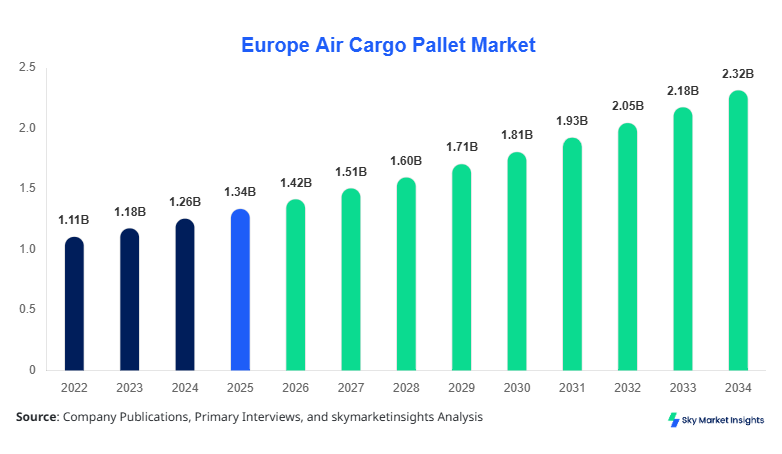
Europe's air cargo pallet market size is projected at USD 1.42 billion in 2026 and is expected to hit USD 2.31 billion by 2034 with a CAGR of 6.3%.
The expanding aviation logistics ecosystem across Europe is accelerating procurement activities for advanced air cargo pallet systems, with over 4.8 million pallet units estimated to circulate annually across regional cargo terminals in 2026. Increased investment in automated cargo handling infrastructure, sustainable aviation logistics, and lightweight pallet manufacturing technologies is reshaping procurement strategies among airlines and freight operators. The report evaluates production capacities, operational efficiencies, trade movement volumes, technological adoption, segmentation performance, and competitive positioning across the European air cargo pallet market.
The air cargo pallet industry represents a critical component of aviation logistics infrastructure used for transporting cargo efficiently through standardized unit load devices (ULDs). Europe accounted for nearly 24.6% of global air freight handling capacity in 2025, supported by more than 420 operational cargo airports and over 1,300 active aviation logistics companies. The region processed approximately 18.4 million metric tons of air cargo in 2025, with France, Germany, and the United Kingdom contributing more than 57% of total throughput volume. Aluminum pallets represented nearly 48.2% of total deployment owing to lightweight characteristics and high durability, while composite pallets accounted for 32.4% due to superior fuel-efficiency benefits.
Adoption and penetration across Europe continue to rise as airlines modernize cargo fleets and replace aging ULD infrastructure. Nearly 63% of European cargo operators integrated RFID-enabled pallet tracking systems in 2025 compared with 41% in 2022. Automated warehouse compatibility increased by 38%, while pallet lifecycle monitoring technologies expanded by 44% across major logistics hubs including Paris Charles de Gaulle, Frankfurt Airport, and Heathrow. Airlines are increasingly adopting pallets with load capacities above 6,800 kg and weight reduction efficiencies of 12%–18% to optimize operational economics. Commercial aviation applications represented nearly 61.5% of pallet consumption, followed by freight forwarding at 25.7% and military aviation at 12.8%.
Consumer behavior within aviation logistics indicates increasing prioritization toward delivery speed, sustainability, and handling efficiency. Cross-border e-commerce volumes in Europe exceeded USD 430 billion in 2025, driving substantial demand for high-frequency cargo movement solutions. More than 72% of logistics operators reported increased demand for lightweight reusable pallets to reduce fuel consumption and improve turnaround efficiency. Cargo cycle frequencies rose by 14.6% between 2023 and 2025, while pallet replacement demand increased by 11.2% annually due to higher cargo traffic intensity. The European Air Cargo Pallet market continues to experience strong industrial integration across aviation, pharmaceuticals, automotive logistics, and defense transportation sectors.
In France, the air cargo pallet market accounted for approximately 21.8% of regional revenue generation in 2025, supported by the presence of more than 170 aviation logistics facilities and over 240 companies involved in ULD manufacturing, maintenance, and air freight operations. France processed nearly 3.9 million metric tons of air cargo in 2025 through major airports, including Paris Charles de Gaulle and Lyon–Saint Exupéry. Commercial aviation applications represented 64.3% of pallet deployment, while freight forwarding contributed 23.1% and military aviation accounted for 12.6%.
Technology adoption in France remains among the highest in Europe, with nearly 69% of air cargo operators implementing IoT-enabled pallet tracking systems and 52% utilizing AI-assisted cargo optimization software. Composite pallet usage expanded by 16.4% during 2025 owing to stricter carbon reduction mandates and airline fuel optimization targets. France also recorded over 18,000 active ULD rotations per day across major cargo hubs, reflecting strong operational intensity. Government-supported aviation modernization programs worth USD 620 million accelerated infrastructure investments in cargo automation and sustainable logistics. The Air Cargo Pallet Market continues to witness expanding integration across pharmaceutical logistics, aerospace exports, and high-value industrial freight transportation.
Explore more data points, trends and opportunities Download Free Sample Report
Air Cargo Pallet Market Trends
Rising Adoption of Lightweight Composite Pallets
The transition toward lightweight composite pallets is becoming a dominant industrial shift across Europe. Composite pallet production surpassed 1.3 million units in 2025, increasing by 19.2% compared with 2023 levels. Airlines adopting advanced composite pallets reported fuel savings ranging between 2.8% and 4.1% per long-haul route due to lower pallet weight. More than 58% of newly procured pallets across Europe now incorporate carbon-fiber or hybrid composite structures with tensile strengths exceeding 420 MPa. Germany and France collectively represented nearly 49% of regional composite pallet manufacturing capacity during 2025.
Cargo operators are increasingly prioritizing corrosion-resistant and recyclable pallet materials to comply with sustainability standards established by the European Union Aviation Safety Agency. Nearly 46% of aviation logistics firms implemented sustainability-focused procurement policies in 2025, while over 31% adopted closed-loop pallet recycling programs. Demand from pharmaceutical logistics increased by 22.5% due to growing biologics transportation requirements requiring temperature-stable pallet systems. The air cargo pallet market continues to evolve through lightweight engineering innovation and operational optimization strategies.
Integration of Smart Cargo Tracking Technologies
Digitalization is significantly transforming pallet monitoring and operational visibility across European air freight systems. RFID-enabled pallet penetration exceeded 63% across the region in 2025, compared with 38% in 2022. Smart pallet systems equipped with GPS, temperature sensors, and real-time location monitoring achieved annual deployment growth of 17.8%. Airlines operating integrated digital cargo systems reduced cargo mishandling incidents by approximately 28% while improving turnaround efficiency by 14%.
Cargo throughput at automated European air freight facilities surpassed 10.7 million metric tons in 2025, with over 54% processed using digitally connected cargo handling infrastructure. Cloud-based pallet management platforms expanded rapidly among third-party logistics providers and freight forwarders, particularly within the United Kingdom and Germany. Increased deployment of predictive maintenance systems reduced pallet downtime by 18.6% and improved lifecycle utilization rates above 92%. The Air Cargo Pallet Market continues to benefit from advanced digital cargo visibility solutions.
Europe Air Cargo Pallet Market Drivers
Rapid Expansion of Cross-Border E-commerce Logistics
Cross-border e-commerce expansion across Europe is significantly increasing demand for efficient aviation cargo transportation infrastructure. E-commerce shipment volumes exceeded 2.1 billion cross-border parcel units in 2025, generating substantial requirements for palletized air freight handling systems. Approximately 67% of premium international e-commerce deliveries in Europe now utilize air transportation channels for transit durations below 72 hours. Cargo aircraft fleet utilization increased by 13.7% during 2025, while average cargo load frequency improved by 11.4%. Airlines expanded cargo conversion programs by adding over 180 dedicated cargo aircraft across Europe between 2022 and 2025.
Logistics providers are investing heavily in automated cargo handling and pallet standardization systems to manage higher throughput efficiency. Nearly 48% of logistics companies upgraded pallet management infrastructure during 2025, while 37% implemented AI-assisted cargo allocation systems. The pharmaceutical, electronics, and automotive sectors collectively contributed more than 42% of high-priority air cargo demand. Airports across France, Germany, and the United Kingdom processed over 11 million palletized cargo units annually, reinforcing operational demand. The air cargo pallet market continues to expand alongside aviation logistics modernization and digital freight acceleration.
Europe Air Cargo Pallet Market Restraints
High Capital Costs Associated with Advanced Pallet Systems
High procurement and maintenance costs remain a significant restraint affecting widespread adoption of advanced air cargo pallet technologies across Europe. Smart pallets integrated with RFID, GPS, and environmental monitoring systems cost approximately 28%–42% more than traditional aluminum pallets. Composite pallets with enhanced tensile performance and lightweight engineering also require higher manufacturing investments due to carbon-fiber processing complexities. Small and medium-sized logistics operators continue to face budget limitations despite rising operational benefits.
Maintenance expenditures for aviation-grade pallets increased by 12.8% in 2025 due to higher inspection standards and material certification requirements. More than 33% of regional cargo operators reported delays in pallet modernization programs owing to elevated capital expenditures. Additionally, raw material price volatility impacted aluminum and composite component manufacturing, increasing production costs by nearly 14% between 2023 and 2025. Regulatory certification timelines for advanced pallet systems further increased operational complexity. The air cargo pallet market faces investment challenges despite growing long-term operational demand.
Europe Air Cargo Pallet Market Opportunities
Expansion of Sustainable Aviation Logistics Infrastructure
Sustainable aviation logistics development across Europe presents substantial opportunities for pallet manufacturers and technology providers. The European aviation industry allocated more than USD 5.8 billion toward green logistics modernization projects between 2024 and 2026. Nearly 44% of cargo operators introduced carbon reduction targets focused on lightweight cargo equipment and fuel-efficient handling systems. Demand for recyclable pallets increased by 21.6% during 2025 as airlines aligned procurement with ESG objectives.
Advanced composite pallet systems capable of reducing aircraft fuel consumption by 3%–5% are gaining significant traction across long-haul freight operations. Sustainable pallet manufacturing facilities expanded production capacity by 17.3% in 2025, particularly within France and Germany. Airport authorities also accelerated investments in electric cargo handling systems and automated logistics centers supporting lightweight pallet compatibility. Increasing pharmaceutical exports and temperature-sensitive cargo movement are further creating opportunities for high-performance insulated pallet systems. The air cargo pallet market is expected to benefit considerably from sustainability-driven aviation modernization initiatives.
Challenges in European Air Cargo Pallet Market
Operational Standardization and Compatibility Constraints
Operational compatibility challenges continue to affect air cargo pallet deployment across Europe due to varying aircraft specifications, cargo handling systems, and airport infrastructure standards. Approximately 26% of regional logistics operators reported inefficiencies arising from pallet dimensional mismatches and incompatible automated loading systems. Aging cargo infrastructure across Eastern Europe and Russia created operational inconsistencies affecting throughput optimization and pallet lifecycle efficiency.
More than 18% of European cargo airports still operate semi-automated handling systems lacking advanced RFID integration capabilities. Repair turnaround times increased by 9.7% during 2025 due to shortages in certified maintenance facilities and replacement components. Airlines operating mixed aircraft fleets also face higher operational complexity in maintaining multiple pallet standards and certification requirements. Additionally, cybersecurity concerns associated with smart pallet tracking systems increased by 14% across digital cargo networks. The air cargo pallet market continues to face operational harmonization and infrastructure integration challenges.
Report Scope
| Report Metric | Details |
|---|---|
| Market Size in 2025 | USD 1.34 Billion |
| Market Size in 2026 | USD 1.42 Billion |
| Market Size in 2034 | USD 2.31 Billion |
| CAGR | 6.3% (2026-2034) |
| Base Year for Estimation | 2025 |
| Historical Data | 2022-2024 |
| Forecast Period | 2026-2034 |
| Report Coverage | Revenue Forecast, Competitive Landscape, Supply Chain Disruption, Growth Factors, Environment & Regulatory Landscape and Trends |
Explore more data points, trends and opportunities Download Free Sample Report
Air Cargo Pallet Market Segmentation
The European air cargo pallet industry is segmented based on material type and application. Aluminum pallets dominated with nearly 48.2% share in 2025 due to high durability and established operational compatibility. Commercial aviation applications accounted for approximately 61.5% of regional deployment volume owing to strong international freight traffic and e-commerce logistics expansion.
By Type
Aluminum pallets remained the dominant segment across Europe with approximately 48.2% market share in 2025. Production volumes exceeded 2.3 million units annually owing to strong adoption among commercial airlines and freight operators. These pallets generally weigh between 75 kg and 110 kg while supporting payload capacities above 6,800 kg. High tensile strength exceeding 310 MPa and corrosion-resistant properties continue to support widespread operational reliability.
Airlines operating long-haul cargo routes preferred aluminum pallets because of lower lifecycle costs and compatibility with existing ULD systems. France, Germany, and the United Kingdom collectively accounted for over 58% of aluminum pallet deployment in Europe. Nearly 62% of commercial aviation fleets utilized standardized aluminum pallet systems integrated with RFID tracking capabilities. The segment also experienced increased adoption in pharmaceutical cargo operations due to stable structural integrity under varying climatic conditions.
Composite pallets accounted for nearly 32.4% of regional consumption in 2025 and represented the fastest-growing material segment. Production volumes surpassed 1.3 million units annually, with growth driven by fuel-efficiency optimization and sustainability targets. Composite pallets generally achieve weight reductions between 12% and 18% compared with conventional aluminum structures while maintaining load capacities above 6,000 kg.
More than 46% of newly procured pallets across major European airlines included hybrid composite structures with advanced carbon-fiber reinforcement. Airlines utilizing composite pallets reduced annual fuel expenses by approximately 3.2% across long-haul operations. Germany and France represented leading manufacturing hubs due to advanced aerospace engineering infrastructure. Increased adoption within pharmaceutical logistics and temperature-sensitive freight transportation further accelerated deployment of insulated composite pallet systems.
Steel pallets accounted for approximately 19.4% of the regional industry in 2025 and remained important for heavy-duty freight transportation. Production exceeded 780,000 units annually, particularly for military aviation and industrial cargo handling operations requiring high structural durability. Steel pallets typically support load capacities above 8,000 kg with operational lifespans exceeding 12 years under intensive cargo utilization.
Russia and Italy collectively represented nearly 37% of European steel pallet utilization due to industrial freight requirements and defense logistics operations. Maintenance costs for steel pallets remained approximately 14% lower compared with advanced composite systems, supporting continued adoption among budget-sensitive operators. However, higher structural weight limited deployment within fuel-sensitive commercial aviation operations.
By Application
Commercial aviation dominated the European air cargo pallet industry, with approximately 61.5% share during 2025. Cargo throughput across European commercial airlines exceeded 13.2 million metric tons annually, supported by strong passenger-cargo integration and expanding international freight operations. More than 71% of European passenger airlines operated belly cargo logistics systems requiring standardized ULD pallet deployment.
The segment recorded annual pallet procurement exceeding 2.7 million units in 2025, driven by rising e-commerce deliveries and pharmaceutical exports. Advanced RFID-enabled pallets achieved penetration rates above 66% across commercial cargo fleets. Airports in France, Germany, and the United Kingdom represented the largest deployment centers owing to high cargo aircraft traffic intensity. Airlines increasingly prioritized lightweight pallets capable of reducing operational fuel consumption while improving turnaround efficiency.
Military aviation accounted for approximately 12.8% of Europe’s pallet deployment volume in 2025. Defense logistics programs across France, Russia, and Germany increased procurement of reinforced steel and composite pallets for strategic cargo movement and humanitarian operations. Military-grade pallets typically support extreme environmental conditions and load capacities above 9,000 kg.
More than 340 military cargo aircraft across Europe utilized specialized pallet systems integrated with secure fastening technologies and shock-resistant structures. Defense modernization programs valued above USD 2.4 billion supported logistics infrastructure upgrades and tactical cargo transport enhancements. NATO-aligned logistics coordination programs also accelerated pallet standardization initiatives across multiple European defense networks.
Freight forwarding represented approximately 25.7% of regional deployment during 2025 owing to expanding third-party logistics operations and international trade activity. European freight forwarding companies processed more than 4.6 million metric tons of air cargo annually through integrated aviation logistics networks. Pallet utilization within freight forwarding operations increased by 15.1% between 2023 and 2025.
Third-party logistics providers increasingly deployed smart pallets with GPS and temperature monitoring systems to enhance cargo visibility and compliance efficiency. More than 52% of freight forwarding operators adopted cloud-based pallet management platforms during 2025. The United Kingdom and Germany collectively accounted for nearly 43% of freight forwarding pallet utilization owing to strong trade connectivity and logistics infrastructure density.
Europe Air Cargo Pallet Market Segmentations
Material Type
- Aluminum
- Composite
- Steel
Application
- Commercial Aviation
- Military Aviation
- Freight Forwarding
Europe Air Cargo Pallet Market Regional Outlook
United Kingdom
The United Kingdom accounted for approximately 19.7% of the regional air cargo pallet industry in 2025. Heathrow Airport, East Midlands Airport, and Manchester Airport collectively processed over 2.8 million metric tons of air freight annually. More than 210 aviation logistics companies operated within the country, supporting advanced cargo handling infrastructure and digital freight systems.
Commercial aviation applications represented nearly 63% of pallet deployment across the United Kingdom. Smart pallet penetration exceeded 68%, while automated cargo warehouse utilization increased by 23% between 2023 and 2025. Pharmaceutical exports and high-value e-commerce shipments significantly contributed to increasing pallet demand.
Germany
Germany represented nearly 24.4% of regional revenue generation during 2025, supported by Frankfurt Airport and Leipzig/Halle Airport cargo operations. The country processed approximately 4.1 million metric tons of air cargo annually and maintained over 280 aviation logistics companies. Composite pallet manufacturing capacity expanded by 18.6% during 2025.
The automotive, electronics, and pharmaceutical sectors collectively accounted for 47% of palletized cargo transportation demand. Germany also led regional implementation of AI-enabled cargo tracking technologies with adoption rates exceeding 61%. Sustainable aviation logistics investments surpassed USD 1.2 billion between 2024 and 2025.
France
France maintained approximately 21.8% regional share supported by Paris Charles de Gaulle Airport and extensive aerospace logistics infrastructure. Air cargo throughput exceeded 3.9 million metric tons annually during 2025. More than 240 aviation logistics and cargo handling firms operated nationwide, supporting strong domestic pallet manufacturing capabilities.
Commercial aviation represented 64.3% of national pallet utilization, while pharmaceutical logistics contributed nearly 18% of specialized pallet demand. Composite pallet adoption increased by 16.4% owing to sustainability mandates and airline fuel optimization initiatives.
Spain
Spain accounted for approximately 11.2% of Europe’s air cargo pallet deployment volume during 2025. Madrid-Barajas and Barcelona-El Prat airports collectively processed over 1.7 million metric tons of cargo annually. Tourism-linked commercial aviation and pharmaceutical exports remained key growth drivers across the country.
Freight forwarding operations represented nearly 29% of pallet utilization in Spain. Automated cargo handling facility investments increased by 14.8% during 2025. Government-backed airport modernization initiatives also supported adoption of smart pallet systems integrated with digital cargo tracking platforms.
Italy
Italy represented approximately 9.8% of regional pallet deployment in 2025. Milan Malpensa Airport and Rome Fiumicino Airport processed nearly 1.4 million metric tons of cargo annually. Industrial manufacturing exports and fashion logistics significantly contributed to aviation freight demand.
Steel pallet utilization remained relatively high within Italy, accounting for 26% of national deployment owing to industrial freight handling requirements. More than 120 logistics firms invested in automated cargo warehouse systems between 2023 and 2025. RFID-enabled pallet deployment increased by 19% during 2025.
Russia
Russia accounted for approximately 13.1% of regional cargo pallet deployment in 2025, supported by industrial freight transportation and defense logistics requirements. Moscow Sheremetyevo and Domodedovo airports collectively processed over 2 million metric tons of cargo annually. Military aviation applications contributed nearly 22% of national pallet demand.
Steel pallet production exceeded 310,000 units annually due to heavy-duty logistics requirements and extended operational durability. Government-supported aviation logistics modernization initiatives valued above USD 540 million accelerated infrastructure development across major cargo hubs.
Top players in Europe's air cargo pallet Market
- Satco Inc.
- Nordisk Aviation Products
- VRR Aviation
- TransDigm Group
- Safran Cabin
- DoKaSch GmbH
- ACL Airshop
- Brambles Limited
- PalNet GmbH
- CargoComposites
- CSafe Global
- Unilode Aviation Solutions
- Langa Industrial
- Trip & Co
- AAR Corp
Unilode Aviation Solutions
-
Estimated regional positioning share: 14.6%
-
Strong operational presence across Europe with over 165,000 ULD assets managed globally
-
Extensive digital tracking integration across airline partnerships
-
Major contracts with European commercial airlines and freight operators
Unilode Aviation Solutions remains among the leading players within Europe due to its large-scale ULD management ecosystem and advanced digital tracking capabilities. The company expanded smart pallet deployment by 21% during 2025 and invested heavily in RFID-enabled monitoring systems integrated across more than 90 airline partnerships. Its maintenance and repair network across Europe supports rapid turnaround times and operational efficiency improvements.
ACL Airshop
-
Estimated regional positioning share: 11.3%
-
Strong presence in lightweight pallet leasing and logistics support
-
High adoption among freight forwarding and commercial aviation clients
-
Expanded composite pallet offerings during 2025
ACL Airshop strengthened its European presence through strategic investments in lightweight composite pallet technologies and sustainable logistics solutions. The company increased pallet leasing capacity by approximately 17% in 2025 while expanding digital cargo management capabilities across major airports. Strong partnerships with freight forwarding operators and aviation logistics providers supported continued regional expansion.
Investment Analysis
Investment activity across the European aviation logistics industry accelerated significantly between 2024 and 2026, with nearly USD 5.8 billion allocated toward cargo modernization and sustainable infrastructure development. Approximately 38% of investments targeted automated cargo handling systems, while 27% focused on lightweight pallet technologies and digital tracking infrastructure. France and Germany collectively represented more than 46% of regional investment allocation owing to large-scale airport modernization projects and aerospace manufacturing capabilities.
Private equity participation within aviation logistics increased by 18.2% during 2025, particularly within pallet leasing, IoT cargo monitoring, and sustainable materials manufacturing. Mergers and acquisitions activity also intensified as logistics providers sought expanded operational networks and digital integration capabilities. More than 14 strategic partnerships related to ULD technology integration were announced across Europe between 2024 and 2025. Composite pallet manufacturing facilities attracted approximately 22% of aviation logistics capital investments due to rising demand for lightweight structures and carbon reduction compliance.
Collaborative agreements between airlines, logistics providers, and pallet manufacturers accelerated deployment of smart cargo ecosystems. Several European airport authorities established partnerships with technology firms to integrate AI-driven cargo visibility systems and predictive maintenance platforms. Sustainable aviation initiatives further encouraged joint ventures focused on recyclable pallet materials and fuel optimization technologies. Investment inflows are expected to continue increasing as air freight volumes and cross-border e-commerce logistics expand across Europe.
New Product Developments
Manufacturers across Europe increasingly focused on next-generation pallet systems integrating lightweight materials, digital tracking technologies, and sustainability-focused engineering. More than 31% of newly introduced pallet products during 2025 incorporated IoT-enabled sensors for real-time monitoring of cargo location, humidity, and temperature conditions. Advanced composite pallet systems achieved structural weight reductions of approximately 16% while maintaining payload capacities above 6,500 kg.
Innovation activity also accelerated within recyclable and modular pallet systems designed for automated cargo handling environments. Smart pallets capable of transmitting operational data every 30 seconds experienced adoption growth above 24% across major European airlines. Manufacturers additionally improved pallet lifecycle durability by approximately 18% through enhanced corrosion-resistant coatings and reinforced structural engineering technologies.
Recent Developments in European Air Cargo Pallet Market
- 2025: Unilode Aviation Solutions expanded RFID-enabled pallet deployment across European airline fleets, increasing smart pallet circulation by nearly 22% and improving cargo visibility accuracy above 96%. The company also upgraded maintenance facilities across Germany and France to support rising demand for digital ULD management systems.
- 2025: ACL Airshop introduced a next-generation composite air cargo pallet, reducing structural weight by approximately 17% while maintaining a 6,800 kg payload capacity. The innovation supported fuel efficiency improvements across long-haul cargo operations and expanded adoption among freight forwarding companies.
- 2025: DoKaSch GmbH expanded temperature-controlled cargo pallet solutions for pharmaceutical logistics operations across Europe. Deployment volumes increased by approximately 19% due to rising biologics transportation demand and stricter cold-chain compliance standards.
Research Methodology
The research process for the European air cargo pallet industry involved extensive primary and secondary analysis focusing on aviation logistics infrastructure, pallet manufacturing trends, cargo transportation demand, and technological adoption patterns. Primary research included interviews with airline operators, freight forwarding companies, airport authorities, ULD manufacturers, and aviation logistics consultants across France, Germany, the United Kingdom, Italy, Spain, and Russia. More than 65 industry participants contributed operational insights regarding production capacity, procurement strategies, material innovation, and investment allocation trends.
Secondary research involved evaluation of aviation trade databases, airport cargo throughput statistics, customs trade records, aerospace manufacturing reports, corporate annual reports, government aviation publications, and logistics association databases. Market size estimation utilized bottom-up and top-down analytical approaches integrating pallet production volumes, pricing trends, replacement cycles, operational deployment rates, and cargo transportation statistics. Data triangulation methods were employed to validate regional shares, segmental performance, technology penetration rates, and investment trends. Forecast modeling incorporated macroeconomic indicators, aviation trade expansion, cross-border e-commerce growth, sustainability regulations, and airport modernization investments across Europe between 2026 and 2034.
Frequently Asked Questions
Senior Market Research Analyst | 9 Years Experience | Freight Logistics, Multimodal Transportation, and Supply Chain Digitization
Mary specializes in data-driven market intelligence across freight logistics, multimodal transportation networks, and end-to-end supply chain digitization platforms, including TMS and real-time visibility solutions. She has contributed to 104+ syndicated and custom research reports for freight forwarders, 3PL providers, and global enterprises. Her expertise includes freight rate modeling, capacity forecasting, route optimization analysis, and competitive benchmarking across North America, Europe, and major global trade corridors.