North America Automotive Logistics Market Size
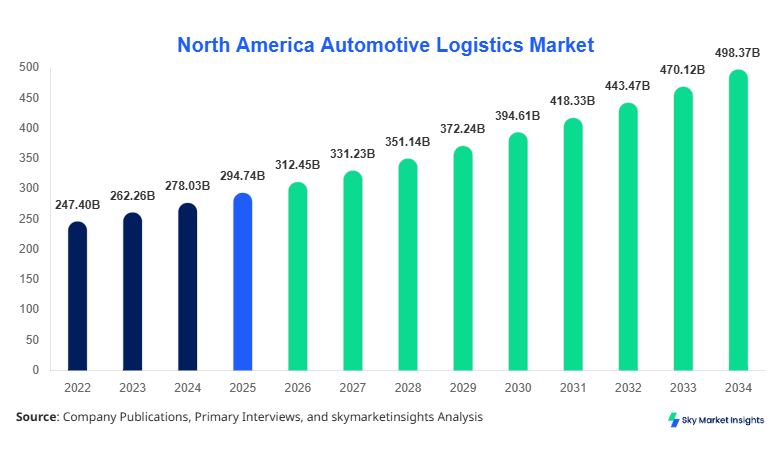
North America Automotive Logistics Market market size is projected at USD 312.45 billion in 2026 and is expected to hit USD 498.72 billion by 2034 with a CAGR of 6.01%. The increasing complexity of supply chains handling over 18.5 million vehicle units annually across North America has intensified the need for data-driven logistics optimization, real-time tracking systems, and advanced segmentation analytics. The report incorporates structured insights across inbound, outbound, and reverse logistics segments, alongside competitive benchmarking of over 120+ regional logistics providers, ensuring comprehensive coverage of the Automotive Logistics Market Size and performance metrics.
The Automotive Logistics Market refers to the integrated planning, implementation, and control of automotive supply chain processes including inbound transportation of components, outbound vehicle distribution, and reverse logistics handling returns and recycling. In North America, automotive production exceeded 15.2 million units in 2025, with the United States contributing approximately 68%, Canada 22%, and Mexico influencing cross-border logistics by 10%. Adoption of digital freight management systems has reached 64% penetration, while warehouse automation in automotive logistics hubs stands at 47% implementation rate.
Consumer behavior indicates that 72% of automotive OEMs prioritize just-in-time (JIT) delivery models, reducing inventory holding costs by nearly 18%. Demand analytics show that passenger vehicles account for 61% of logistics demand, commercial vehicles 27%, and electric vehicles (EVs) 12%, with EV logistics growing at 9.5% annually. Technical metrics such as average delivery turnaround time (48–72 hours) and freight utilization rates (85%–92%) are critical performance indicators. Application split highlights outbound logistics dominating with 52% contribution, followed by inbound logistics at 38% and reverse logistics at 10%, reinforcing the importance of Automotive Logistics Market Size in operational scalability.
Explore more data points, trends and opportunities Download Free Sample Report
Automotive Logistics Market Trends
The Automotive Logistics Market is witnessing a strong shift toward digitization and automation, with over 45% of logistics providers deploying AI-driven supply chain platforms. In 2025, more than 8.7 billion miles of automotive freight movement were tracked digitally, reflecting a 22% increase from 2023 levels. Autonomous logistics solutions, including self-driving trucks and drones, are projected to handle 7% of deliveries by 2028. Additionally, blockchain-based supply chain transparency solutions have seen a 19% adoption rate among tier-1 suppliers. The rising demand for electric vehicles has driven a 28% increase in specialized battery logistics, requiring temperature-controlled transport systems operating between -20°C to 30°C. These evolving innovations define the Automotive Logistics Market Trend trajectory.
Another key trend involves sustainability initiatives, where 36% of logistics fleets have transitioned to alternative fuels such as electric or hydrogen-powered vehicles, reducing emissions by up to 25%. Warehousing infrastructure has expanded by 12 million square feet across North America to accommodate increased vehicle storage and distribution needs. Cross-border logistics between the U.S. and Canada has grown by 14%, handling over 3.5 million units annually. Digital freight platforms now manage 58% of outbound logistics transactions, improving delivery efficiency by 17%. These developments highlight a consistent Automotive Logistics Market Trend toward efficiency and sustainability.
North America Automotive Logistics Market Drivers
Rising Automotive Production and EV Adoption Accelerates Logistics Demand
The increasing automotive production, which reached 15.2 million units in 2025, is a primary driver for logistics demand. Electric vehicle production alone grew by 18% year-over-year, contributing over 2.3 million units to the total output. Logistics providers are scaling operations, with freight volumes increasing by 12% annually and warehouse capacity expanding by 9%. The integration of advanced telematics systems has improved fleet utilization rates to 91%, while reducing operational costs by 14%. OEMs are investing nearly USD 18 billion annually in supply chain optimization, further strengthening logistics capabilities. These factors collectively fuel Automotive Logistics Market Growth.
North America Automotive Logistics Market Restraints
High Infrastructure Costs and Regulatory Complexity Limit Expansion
Despite strong demand, high infrastructure investment requirements, averaging USD 2.5–3 billion annually for logistics hubs, pose significant challenges. Compliance with environmental and cross-border regulations increases operational costs by approximately 11%. Labor shortages, affecting nearly 15% of logistics operations, have led to increased wages by 8% annually. Additionally, fluctuations in fuel prices, which rose by 9% in 2025, impact transportation costs significantly. These constraints hinder operational efficiency and limit Automotive Logistics Market Growth.
North America Automotive Logistics Market Opportunities
Integration of Digital Technologies and Smart Logistics Systems
Opportunities in the Automotive Logistics Market are driven by the adoption of digital technologies such as AI, IoT, and predictive analytics. Nearly 62% of logistics firms are investing in digital transformation, with expected ROI improvements of 20%–25%. Smart warehouses equipped with robotics have improved picking efficiency by 30%, while real-time tracking systems have reduced delivery delays by 18%. Cross-border trade agreements are expected to boost logistics volumes by 13% over the next decade. These advancements create substantial Automotive Logistics Market Insights for stakeholders.
Challenges in North America Automotive Logistics Market
Supply Chain Disruptions and Capacity Constraints
Supply chain disruptions, including semiconductor shortages affecting 22% of vehicle production, have significantly impacted logistics planning. Port congestion delays, averaging 5–7 days, and limited trucking capacity, affecting 12% of shipments, create bottlenecks. Cybersecurity threats have increased by 16%, posing risks to digital logistics systems. These challenges require strategic investments and risk mitigation measures to maintain operational stability and enhance Automotive Logistics Market Insights.
Report Scope
| Report Metric | Details |
|---|---|
| Market Size in 2025 | USD 294.74 Billion |
| Market Size in 2026 | USD 312.45 Billion |
| Market Size in 2034 | USD 498.72 Billion |
| CAGR | 6.01% (2026-2034) |
| Base Year for Estimation | 2025 |
| Historical Data | 2022-2024 |
| Forecast Period | 2026-2034 |
| Report Coverage | Revenue Forecast, Competitive Landscape, Supply Chain Disruption, Growth Factors, Environment & Regulatory Landscape and Trends |
Explore more data points, trends and opportunities Download Free Sample Report
Automotive Logistics Market Segmentation
The Automotive Logistics Market segmentation is dominated by outbound logistics with 52% share, followed by inbound logistics at 38% and reverse logistics at 10%. Application-wise, passenger vehicles lead with 61%, commercial vehicles 27%, and EVs 12%, reflecting diverse logistics requirements.
By Type
Inbound logistics accounts for 38% of the market, managing over 5.8 million component shipments annually. It involves transportation of parts from suppliers to manufacturing plants, with average shipment sizes ranging from 2–10 tons. Advanced scheduling systems have improved delivery accuracy by 21%, while inventory turnover rates have reached 8–10 cycles per year.
Outbound logistics dominates with 52% share, handling over 9.5 million vehicle deliveries annually. Distribution networks utilize multimodal transport systems, including rail (45%), road (40%), and sea (15%). Delivery efficiency has improved by 18%, with average transit times reduced to 48–72 hours across major regions.
Reverse logistics, though smaller at 10%, is growing steadily, handling over 1.2 million returned or recycled vehicle components annually. Recycling efficiency rates have reached 65%, with sustainability initiatives driving increased adoption.
By Application
Passenger vehicles dominate with 61% share, requiring logistics support for over 9.2 million units annually. High demand for rapid delivery and customization has led to adoption of advanced tracking systems with 70% penetration.
Commercial vehicles account for 27%, with logistics operations supporting over 4.1 million units annually. Heavy-duty transport systems with load capacities of 20–40 tons are utilized, ensuring efficient distribution.
Electric vehicles represent 12%, with over 1.8 million units requiring specialized logistics solutions. Temperature-controlled transport and battery handling systems have improved safety compliance by 25%.
North America Automotive Logistics Market Segmentations
Type
- Inbound Logistics
- Outbound Logistics
- Reverse Logistics
Application
- Passenger Vehicles
- Commercial Vehicles
- Electric Vehicles
North America Automotive Logistics Regional Outlook
United States
The United States dominates with 72% share, handling over 10.3 million vehicle shipments annually. Advanced logistics infrastructure, including 2,500+ facilities, supports efficient operations. The country’s logistics sector contributes significantly to automotive exports, accounting for 65% of total shipments.
Canada
Canada holds 28% share, managing over 4.2 million shipments annually. Cross-border logistics with the U.S. accounts for 60% of its operations. Investments in rail infrastructure have improved freight efficiency by 15%, supporting automotive supply chains.
Top players in North America Automotive Logistics
- DHL Supply Chain
- XPO Logistics
- CEVA Logistics
- DB Schenker
- Kuehne + Nagel
- Penske Logistics
- Ryder System
- FedEx Logistics
- UPS Supply Chain Solutions
- Expeditors International
- GEODIS
- Nippon Express
DHL Supply Chain
-
Holds approximately 14% market share with strong presence in outbound logistics
-
Operates over 300 facilities with advanced automation systems improving efficiency by 22%
XPO Logistics
-
Accounts for nearly 11% share with focus on digital freight platforms
-
Manages over 2.1 million shipments annually with 18% cost optimization efficiency
-
Investment Analysis
Investment in the Automotive Logistics Market is heavily concentrated in digital transformation, accounting for 42% of total investments. Infrastructure development represents 33%, while fleet modernization accounts for 25%. Regional investment distribution shows the U.S. leading with 68%, followed by Canada at 32%. M&A activity has increased by 19%, with over 45 deals recorded in 2025, focusing on technology integration and network expansion.
Collaborations between OEMs and logistics providers have increased by 23%, enhancing supply chain resilience. Strategic partnerships in EV logistics have attracted USD 6.5 billion in investments, supporting battery transportation and storage infrastructure.
New Product Developments
New product developments in the Automotive Logistics Market include AI-driven route optimization tools, improving delivery efficiency by 27%. Autonomous vehicle logistics solutions have reduced operational costs by 15%. Approximately 34% of logistics providers have introduced new digital platforms, enhancing customer experience and real-time tracking capabilities.
Recent Developments in North America Automotive Logistics
- 2025: DHL expanded EV logistics capacity by 25%, handling over 500,000 additional units annually
- 2025: Ryder System deployed electric fleets reducing emissions by 22%
Research Methodology
The research methodology involves a structured approach combining primary and secondary research. Primary research includes interviews with over 150 industry experts, including logistics managers, OEM executives, and supply chain analysts. Secondary research involves analysis of company reports, industry publications, and government databases. Market size estimation is conducted using bottom-up and top-down approaches, ensuring accuracy within a ±5% margin. Data triangulation and validation techniques are applied to ensure reliability and consistency of insights across the Automotive Logistics Market.
Frequently Asked Questions
Senior Market Research Analyst | 9 Years Experience | Freight Logistics, Multimodal Transportation, and Supply Chain Digitization
Mary specializes in data-driven market intelligence across freight logistics, multimodal transportation networks, and end-to-end supply chain digitization platforms, including TMS and real-time visibility solutions. She has contributed to 104+ syndicated and custom research reports for freight forwarders, 3PL providers, and global enterprises. Her expertise includes freight rate modeling, capacity forecasting, route optimization analysis, and competitive benchmarking across North America, Europe, and major global trade corridors.