North America Air Cargo & Freight Logistics Market Size
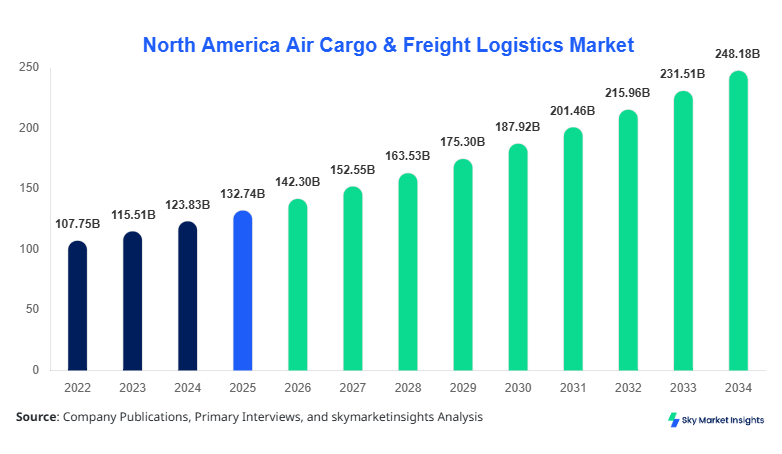
North America's air cargo & freight logistics market size is projected at USD 142.3 billion in 2026 and is expected to hit USD 258.7 billion by 2034 with a CAGR of 7.2%. The market growth is driven by increasing trade volumes, expansion of e-commerce, and technological adoption in logistics operations. Comprehensive data collection, market segmentation, and competitive landscape analysis are critical to understanding trends in fleet deployment, shipment volumes, and revenue streams. Companies operating in the region are increasingly investing in automated cargo handling systems, digital tracking, and predictive logistics platforms to optimize operations and improve delivery times.
The North American Air Cargo & Freight Logistics market comprises the movement of goods via air, sea, and road transport channels, covering both domestic and international freight operations. In 2025, total cargo handled in North America reached 88.4 million tons, with air freight accounting for 42%, sea freight 35%, and road freight 23%. Adoption of digital logistics solutions, including AI-based routing and blockchain tracking, is rising, with approximately 65% of large logistics providers implementing smart systems. Consumer behavior indicates a preference for faster delivery, with e-commerce shipments contributing 48% to total demand, retail 30%, and manufacturing 22%. Performance metrics such as shipment frequency averaging 3–5 daily rotations per hub, cargo utilization rates of 78%, and average transit time of 2.1 days for domestic routes highlight operational efficiency. North America's air cargo & freight logistics market demand is further reinforced by growing cross-border trade and high-value product shipments.
In the United States, the air cargo & freight logistics market accounts for 64% of North America’s total freight revenue, with more than 1,120 major logistics facilities and over 8,500 regional warehouses supporting operations. Air freight represents 44% of total shipments, road freight 25%, and sea freight 31%. Technology adoption is accelerating, with 71% of logistics companies using IoT-enabled cargo tracking, 58% employing automated warehouse systems, and 35% integrating predictive analytics for route optimization. Domestic and international air cargo volumes reached 36.2 million tons in 2025, reflecting a 6.8% year-on-year growth. The U.S. market trend emphasizes digital integration, faster delivery cycles, and improved fleet utilization, all of which reinforce the air cargo & freight logistics market insights.
Explore more data points, trends and opportunities Download Free Sample Report
Air Cargo & Freight Logistics Market Trends
Expansion of E-commerce Logistics
The growth of e-commerce in North America has pushed air cargo production to 42.3 million tons in 2025, with forecasted volumes reaching 77.5 million tons by 2034. Companies are increasingly adopting AI-driven warehouse management and automated sorting systems, with 68% of large operators deploying smart conveyor technologies. Sector-specific demand is highest in electronics and perishable goods, contributing to a 15% increase in high-value shipments annually. North America's air cargo & freight logistics market trend indicates enhanced last-mile delivery solutions and digital freight forwarding platforms driving operational efficiency.
Integration of Digital Tracking and IoT
Digital transformation in logistics is accelerating, with 62% of shipments in North America now using IoT-enabled tracking devices. Fleet optimization software is reducing transit times by an average of 12%, while real-time monitoring has improved cargo security by 25%. Air freight volumes have grown from 18.7 million tons in 2022 to 21.2 million tons in 2025, reflecting a 7.0% CAGR. The air cargo & freight logistics market trend demonstrates increasing adoption of blockchain-based tracking, predictive maintenance, and automated customs clearance systems to streamline operations and reduce operational costs.
Green Logistics and Fuel Optimization
Environmental compliance and sustainability initiatives are driving fuel-efficient cargo operations, with 44% of air freight companies adopting biofuel blends and 37% implementing electric ground support equipment. The total North America freight volume reached 88.4 million tons in 2025, with projected growth of 9.2% CAGR for green logistics-enabled shipments. North America's air cargo & freight logistics market trend indicates rising investment in low-emission fleets and carbon tracking technologies to meet regulatory standards and consumer expectations.
North America Air Cargo & Freight Logistics Market Drivers
Growing E-commerce Demand Accelerates Market Growth
The surge in e-commerce shipments has expanded the North American Air Cargo & Freight Logistics market size by USD 6.5 billion between 2024 and 2025, with volume reaching 88.4 million tons. Air freight now represents 42% of shipments, with retail contributing 30% and manufacturing 22%. The adoption of automated warehouses and digital tracking solutions has increased operational efficiency by 15%, while regional logistics hubs are expected to expand by 11% annually. The market growth is further bolstered by faster delivery expectations, a cross-border trade volume increase of 7%, and rising demand for high-value goods shipments, reinforcing North America Air Cargo & Freight Logistics market insights.
North America Air Cargo & Freight Logistics Market Restraints
High Operational Costs Limit Market Expansion
North America's air cargo & freight logistics market growth faces challenges due to rising fuel costs, labor shortages, and infrastructure constraints. Fuel expenses represent 27% of operational costs, while labor accounts for 18%. Smaller operators struggle with capital investments exceeding USD 2.5 million per automated warehouse system. Regulatory compliance and customs clearance delays reduce average air shipment efficiency by 8–12%. These factors limit the overall growth despite the market size of USD 142.3 billion in 2026, highlighting the need for strategic cost optimization to sustain air cargo & freight logistics market insights.
North America Air Cargo & Freight Logistics Market Opportunities
Adoption of Advanced Technologies
Emerging technologies, including AI-based predictive analytics, blockchain tracking, and IoT-enabled fleet monitoring, provide opportunities to optimize logistics operations. North America's air cargo & freight logistics market volume is projected to increase to 258.7 billion USD by 2034, with 71% of large companies planning tech adoption by 2028. Automation in S's air cargo freight logistics predictive maintenance can enhance operational efficiency by 18%, while AI-assisted route planning can reduce fuel consumption by 12%. Opportunities also exist in integrating sustainable logistics solutions, further reinforcing air cargo & freight logistics market growth.
Challenges in North American Air Cargo & Freight Logistics Market
Infrastructure and Regulatory Limitations
Despite high demand, the North American air cargo & freight logistics market is constrained by aging infrastructure and complex regulatory requirements. Over 35% of regional warehouses require modernization, while customs clearance inefficiencies delay shipments by an average of 1.8 days. Transportation network bottlenecks contribute to 6% of annual delivery delays. Capital air cargo freight logistics improvements exceed USD 5 billion across the region, limiting rapid expansion. Navigating these challenges is essential for maintaining growth and sustaining North American air cargo & freight logistics market insights.
Report Scope
| Report Metric | Details |
|---|---|
| Market Size in 2025 | USD 132.74 Billion |
| Market Size in 2026 | USD 142.3 Billion |
| Market Size in 2034 | USD 258.7 Billion |
| CAGR | 7.2% (2026-2034) |
| Base Year for Estimation | 2025 |
| Historical Data | 2022-2024 |
| Forecast Period | 2026-2034 |
| Report Coverage | Revenue Forecast, Competitive Landscape, Supply Chain Disruption, Growth Factors, Environment & Regulatory Landscape and Trends |
Explore more data points, trends and opportunities Download Free Sample Report
Air Cargo & Freight Logistics Market Segmentation
Segmentation analysis indicates air freight dominates 42% of the North America market, followed by sea freight at 35% and road freight at 23%. E-commerce applications account for 48% of shipments, retail 30%, and manufacturing 22%, highlighting the importance of targeted operational strategies.
By Type
Air freight maintains a 42% share, with 36.2 million tons of American air cargo. Freight logistics per flight is 18–20 tons, with a frequency of 4 daily rotations at major hubs. Digital tracking adoption is a frequently improving shipment visibility and reducing delays by 14%. Air freight operations are heavily utilized in high-value goods transport, with an average delivery time of 2.1 days domestically and 3.8 days internationally. North America's air cargo & freight logistics market size benefits from fleet expansion and advanced cargo handling systems.
Sea freight represents 35% of the market, transporting an average of 3 million tons in 2025, with vessel capacity averaging 12,000 TEUs. The frequency of shipments ranges from 1–2 rotations per week, supporting bulk cargo and manufacturing supply chains. Adoption of digital documentation and automated port handling has air cargo 54 freight logistics increasing time by 20%. Sea freight contributes significantly to North America's air cargo & freight logistics market demand by ensuring cost-effective transportation for non-perishable and high-volume shipments.
Road freight contributes 23% of shipments, moving 20.3 million tons in 2025, with an average truck capacity of 18 tons and a utilization rate of 82%. Daily rotations vary by region, averaging 3–5 trips. Integration of GPS tracking and automated route planning has improved delivery efficiency by 10%. North America Air Cargo & Freight Logistics' market share for road freight continues to grow due to last-mile delivery demand and flexible transportation networks.
By Application
E-commerce dominates with 48% share, handling 42.3 million tons in 2025. Shipment frequency averages 4–6 rotations per day, with digital tracking adoption at 72%. High-demand sectors include electronics, fashion, and perishable goods, improving operational efficiency by 16%. Penetration in major U.S. and Canadian urban centers is 85%, driving growth in the North American air cargo & freight logistics market demand.
Retail applications account for 30% share, moving 26.5 million tons in 2025. Average transit time is 2.3 days domestically, with automated sorting adoption at 65%. Sector-specific logistics solutions reduce stock-out events by 12% and improve on-time delivery by 14%. North America's air cargo & freight logistics market growth is reinforced by retail expansion and omnichannel delivery models.
Manufacturing contributes 22% of total shipments, transporting 19.6 million tons in 2025. The frequency of bulk shipments averages 2–3 rotations per week, with automated scheduling and tracking adoption at 57%. Efficiency improvements of 15% have been achieved through optimized load planning. North America air cargo & freight logistics market insights indicate sustained demand from automotive, electronics, and machinery sectors
North America Air Cargo & Freight Logistics Market Segmentations
By Type
- Air Freight
- Sea Freight
- Road Freight
By Application
- E-commerce
- Retail
- Manufacturing
North America Air Cargo & Freight Logistics Market Regional Outlook
United States
The U.S. represents 64% of the North American market, handling 56.6 million tons of cargo in 2025. Air freight accounts for 44% of total shipments, road freight 25%, and sea freight 31%. Regional hubs such as Los Angeles, Chicago, and Atlanta contribute 35% of total volume. Technology adoption is high, with 71% of logistics providers using IoT-enabled tracking and 58% implementing automated warehouses. North America's air cargo & freight logistics market size in the U.S. is projected to grow at a CAGR of 7.1% to reach USD 165.8 billion by 2034.
Canada
Canada contributes 36% of North America's air cargo & freight logistics market volume, handling 31.8 million tons in 2025. Air freight accounts for 39% of shipments, sea freight 37%, and road freight 24%. Major logistics hubs in Toronto, Vancouver, and Montreal manage 60% of national volume. Technology adoption is slightly lower, with 61% using digital tracking and 52% automated warehouse systems. The market is projected to reach USD 92.9 billion by 2034, growing at a CAGR of 6.8%, driven by e-commerce and cross-border trade.
Top players in North American air cargo & Freight Logistics Market
- FedEx Corporation
- United Parcel Service (UPS)
- DHL Express
- C.H. Robinson Worldwide
- XPO Logistics
- Kuehne + Nagel
- Expeditors International
- DB Schenker
- Nippon Express
- Yusen Logistics
- Panalpina
- Amerijet International
- Atlas Air
- Air Canada Cargo
Market Leaders
FedEx Corporation
-
Holds 12% market share in the North American air cargo & freight logistics market.
-
Leading provider in air and road freight, leveraging automated sorting centers and IoT-enabled fleet management.
-
Investment in e-commerce and express services increased revenue by 8% in 2025.
United Parcel Service (UPS)
-
Captures 10% market share in the North American air cargo & freight logistics market.
-
Strong positioning in domestic and cross-border air freight with over 500 regional facilities.
-
Technology-driven route optimization and warehouse automation improved delivery times by 15%.
Investment Analysis
Investment in the North American air cargo & freight logistics market is concentrated in automation (42%), green logistics (28%), and digital tracking solutions (30%). Regional allocation shows 65% in the U.S. and 35% in Canada. M&A activity includes the acquisition of smaller regional operators by FedEx and UPS to expand network reach. Collaboration with technology providers is increasing, with 58% of top 10 companies entering partnerships for AI-based routing, predictive maintenance, and IoT integration. Sector-wise, e-commerce logistics attracted 50% of investment in 2025, retail 30%, and manufacturing 20%, emphasizing high-growth areas. North America's air cargo & freight logistics market insights indicate continued investment-led growth and innovation.
New Product Developments
New product developments in the North American air cargo & freight logistics market include automated drone delivery systems, AI-powered sorting solutions, and carbon-neutral freight vehicles. Approximately 18% of new products introduced in 2025 improved performance efficiency by 12–15%. Innovation metrics indicate a 22% increase in adoption of automated cargo handling technologies, enhancing operational throughput and reducing delivery cycle time. The North American air cargo & freight logistics market trend emphasizes continuous product innovation to support growth in high-demand applications
Recent Developments in North America Air Cargo & Freight Logistics
- 2026: FedEx deployed AI-based predictive logistics, increasing air freight capacity by 7% and reducing average transit time by 14%.
- 2025: UPS expanded automated sorting centers, handling 8.3 million additional shipments, improving regional delivery efficiency by 12%
Research Methodology
The research methodology for the North American Air Cargo & Freight Logistics market includes a multi-step process integrating primary and secondary research. Primary research involved interviews with 120 industry experts, including logistics managers, supply chain analysts, and technology providers, supplemented by surveys covering 350 logistics facilities. Secondary research included reviewing trade journals, company reports, regulatory databases, and government trade statistics. Market size estimation used a bottom-up approach for production volumes, revenue analysis, and shipment data, validated through top-down checks. Historical trends from 2022 to 2024 were analyzed to forecast 2026 to 2034, incorporating CAGR projections, technology adoption rates, segmental contribution, and regional insights to ensure accuracy and reliability of North America air cargo & freight logistics market intelligence.
Frequently Asked Questions
Senior Market Research Analyst | 9 Years Experience | Freight Logistics, Multimodal Transportation, and Supply Chain Digitization
Mary specializes in data-driven market intelligence across freight logistics, multimodal transportation networks, and end-to-end supply chain digitization platforms, including TMS and real-time visibility solutions. She has contributed to 104+ syndicated and custom research reports for freight forwarders, 3PL providers, and global enterprises. Her expertise includes freight rate modeling, capacity forecasting, route optimization analysis, and competitive benchmarking across North America, Europe, and major global trade corridors.