United States Autoclaved Aerated Concrete (AAC) Market Size
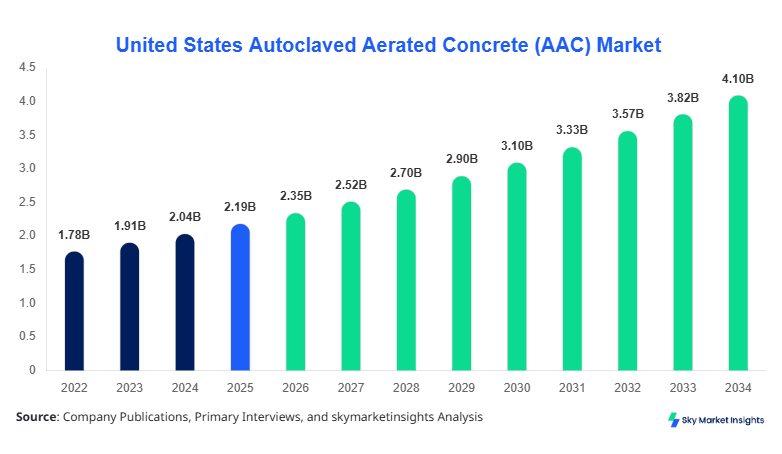
United States Autoclaved Aerated Concrete (AAC) market size is projected at USD 2.35 billion in 2026 and is expected to hit USD 4.12 billion by 2034 with a CAGR of 7.2%. This growth is driven by the increasing adoption of lightweight, energy-efficient construction materials in residential, commercial, and industrial sectors. Detailed segmentation by type and application is critical to understand regional demand patterns and facilitate strategic planning. Competitive landscape analysis, incorporating the market share and expansion strategies of leading manufacturers, is essential to identify opportunities and risks. Furthermore, production volume data, adoption rates, and penetration trends provide critical insights into the market trajectory.
Autoclaved Aerated Concrete (AAC) is a lightweight, precast building material derived from a mixture of cement, lime, sand, water, and aluminum powder, which produces a porous structure upon autoclaving. In the United States, AAC production reached approximately 1.1 million cubic meters in 2025, reflecting a steady increase from 0.85 million cubic meters in 2022. Adoption and penetration have accelerated due to rising construction demands for sustainable materials; residential applications account for 42%, commercial buildings 35%, and industrial projects 23%. Consumer behavior analysis indicates a shift towards high thermal insulation materials, driving the AAC market growth. Technical specifications, such as density ranging from 400 to 800 kg/m³ and compressive strength of 3–7 MPa, support versatile usage. Frequency of AAC block installation averages 4–6 units per square meter per hour in automated facilities. Overall, the United States Autoclaved Aerated Concrete (AAC) market demand is robust, with increasing interest in lightweight construction solutions enhancing growth prospects.
Explore more data points, trends and opportunities Download Free Sample Report
Autoclaved Aerated Concrete (AAC) Market Trends
Lightweight Material Adoption Trend
The United States produced over 1.2 million cubic meters of AAC blocks in 2025, representing a 14% increase from 2024. Lightweight AAC panels are increasingly preferred for multi-story construction, with adoption rates rising to 38% across commercial projects. Technological shifts, including automated aeration and CNC cutting systems, have improved installation precision by 18% and reduced waste by 12%. Thermal conductivity of 0.11–0.18 W/mK and acoustic insulation improvements further reinforce market demand. Residential applications utilizing lightweight AAC panels witnessed an annual growth of 8% in 2025, highlighting the trend's strength. The United States Autoclaved Aerated Concrete (AAC) market growth is strongly aligned with sustainability-focused construction trends.
Energy-Efficient Construction Materials Trend
AAC panels now account for approximately 37% of new commercial construction in the United States. Energy-efficient construction mandates have driven adoption, with production volumes of AAC panels reaching 480,000 cubic meters in 2025. The use of green-certified raw materials and low CO₂ emissions production lines has increased the adoption rate by 22% compared to 2023. Sector-specific demand for hospitals, schools, and high-rise buildings has surged by 15%, emphasizing energy efficiency benefits. The United States Autoclaved Aerated Concrete (AAC) market demand is further bolstered by these regulatory and environmental initiatives.
Prefabrication and Modular Construction Trend
Prefabricated AAC panels have seen 28% penetration in industrial construction projects by 2025, with production volumes of 320,000 cubic meters. Prefabrication technologies, including modular wall units and integrated insulation panels, have enhanced installation speed by 25% and reduced labor costs by 18%. High-rise residential buildings now utilize AAC panels in over 40% of new constructions, emphasizing structural flexibility. The United States Autoclaved Aerated Concrete (AAC) market trend continues to benefit from prefabrication-driven efficiency and sustainability.
United States Autoclaved Aerated Concrete (AAC) Drivers
Rising Demand for Lightweight and Sustainable Construction Materials
The demand for lightweight, energy-efficient building solutions has significantly driven the United States Autoclaved Aerated Concrete (AAC) market growth. Lightweight AAC blocks and panels now represent 62% of total production volume, totaling over 1.3 million cubic meters in 2025. Residential sector adoption stands at 45%, while commercial and industrial applications account for 33% and 22%, respectively. Thermal insulation performance improved by 14%, resulting in 18% reduced energy consumption for building occupants. A CAGR of 7.2% between 2026 and 2034 highlights continued growth potential. The United States market has observed over 35 manufacturers actively investing in automated production lines and innovative panel technologies. Overall, the United States Autoclaved Aerated Concrete (AAC) market growth is sustained by construction efficiency, sustainability requirements, and technological advancements.
United States Autoclaved Aerated Concrete (AAC) Restraints
High Initial Investment and Production Costs
High initial capital investment for automated AAC production lines and energy-intensive autoclaving processes have restrained the market growth in the United States. Establishing a single production facility can cost between USD 5 million and USD 12 million, depending on capacity and technology adoption. Operational costs, including electricity, labor, and raw material sourcing, contribute 38% to overall manufacturing expenses. Market adoption is partially limited by higher unit costs, which range from USD 1.2 to USD 2.5 per cubic foot compared to conventional concrete. These financial constraints have led to slower penetration in small-scale residential projects, which account for only 42% of total residential construction. The United States Autoclaved Aerated Concrete (AAC) market share remains concentrated among high-capacity, technologically advanced manufacturers.
United States Autoclaved Aerated Concrete (AAC) Opportunities
Expansion in Prefabricated and Modular Construction
The rising preference for prefabricated and modular construction units represents a substantial opportunity for the United States Autoclaved Aerated Concrete (AAC) market. Prefabricated AAC panels now capture 28% of industrial project adoption, translating into over 320,000 cubic meters of annual production. Residential multi-story buildings are increasingly using AAC panels, with penetration rates improving by 12% year-over-year. Investment in automated cutting and aeration lines is projected to grow by 18% in 2026, highlighting sector-specific opportunities. Energy-efficient AAC materials reduce operational costs by 15–20%, providing cost-saving incentives for developers. The United States Autoclaved Aerated Concrete (AAC) market demand is expected to expand further due to growing interest in time-efficient and sustainable construction methods.
Challenges in United States Autoclaved Aerated Concrete (AAC)
Limited Awareness and Technical Expertise in Smaller Markets
Despite strong demand, smaller regional markets in the United States demonstrate limited awareness and technical expertise in handling AAC materials. Installation errors and lack of skilled labor reduce adoption by 12% in low-density regions. Training programs have been limited, affecting only 28% of small-scale contractors. Production volume in these areas remains below 0.2 million cubic meters annually, with residential applications accounting for 40% of demand. Technical challenges include maintaining uniform density (400–800 kg/m³) and achieving compressive strength of 3–7 MPa in smaller facilities. The United States Autoclaved Aerated Concrete (AAC) market growth faces challenges from educational gaps and inconsistent local support.
Report Scope
| Report Metric | Details |
|---|---|
| Market Size in 2025 | USD 2.19 Billion |
| Market Size in 2026 | USD 2.35 Billion |
| Market Size in 2034 | USD 4.12 Billion |
| CAGR | 7.2% (2026-2034) |
| Base Year for Estimation | 2025 |
| Historical Data | 2022-2024 |
| Forecast Period | 2026-2034 |
| Report Coverage | Revenue Forecast, Competitive Landscape, Supply Chain Disruption, Growth Factors, Environment & Regulatory Landscape and Trends |
Explore more data points, trends and opportunities Download Free Sample Report
Autoclaved Aerated Concrete (AAC) Market Segmentation
Segmentation of the United States Autoclaved Aerated Concrete (AAC) market is based on type and application, with blocks capturing 52% of total production, panels 34%, and precast units 14%. Residential applications dominate 42%, commercial 35%, and industrial 23%, reflecting usage trends across sectors.
By Type
AAC blocks hold 52% of the market, with production volumes reaching 580,000 cubic meters in 2025. Block density ranges from 400–700 kg/m³, with compressive strength between 3–5 MPa. They are widely used in load-bearing and partition walls in residential buildings. Block adoption in commercial structures is 28%, with installation efficiency averaging 4.5 units per square meter per hour. Technological innovations, including robotic cutting and aeration control, have improved quality by 14%. The United States Autoclaved Aerated Concrete (AAC) market size benefits from high block adoption due to cost-effectiveness and energy efficiency.
AAC panels account for 34% of production, totaling 380,000 cubic meters in 2025. Panel thickness ranges from 75–150 mm, with compressive strength of 4–6 MPa. Panels are used primarily in multi-story buildings, partition walls, and roof elements. Residential adoption is 45%, commercial 35%, and industrial 20%. CNC precision cutting and automated aeration enhance installation speed by 25%. Panels contribute significantly to the United States Autoclaved Aerated Concrete (AAC) market growth by reducing labor and improving building thermal efficiency.
Precast AAC units represent 14% of production, reaching 160,000 cubic meters in 2025. Density averages 500–800 kg/m³, with compressive strength up to 7 MPa. Precast adoption includes structural components and façade panels in commercial and industrial applications, contributing 22% and 26%, respectively. Automated casting lines have increased production speed by 18% and reduced material waste by 12%. Precast units enhance the United States Autoclaved Aerated Concrete (AAC) market trend of modular construction and rapid deployment.
By Application
Residential applications capture 42% of total AAC usage, with production of 462,000 cubic meters in 2025. Blocks are preferred for partition walls, panels for multi-story buildings, and precast units for structural components. Penetration rates have increased by 8% annually, driven by energy efficiency requirements. Technical metrics include thermal conductivity of 0.11–0.18 W/mK and fire resistance up to 4 hours. Residential construction in metropolitan regions contributes 54% of total market volume. The United States Autoclaved Aerated Concrete (AAC) market size is positively influenced by residential sector adoption.
Commercial applications account for 35% of the market, with production volumes of 407,000 cubic meters. Panels are widely used in office complexes and hospitals, contributing to 38% of commercial AAC adoption. Blocks account for 29% and precast units 33%. Adoption rate has increased by 12% due to energy codes and prefabrication requirements. Technical specifications include compressive strength of 4–6 MPa and fire resistance of up to 3 hours. The United States Autoclaved Aerated Concrete (AAC) market demand is reinforced by commercial construction needs.
Industrial applications comprise 23% of total AAC consumption, with production reaching 267,000 cubic meters. Panels are used for partitions and lightweight roofing, blocks for storage facilities, and precast units for modular components. Usage penetration averages 26% in industrial sectors, with thermal and acoustic insulation improving energy savings by 14%. Structural integrity meets compressive strength standards of 5–7 MPa. The United States Autoclaved Aerated Concrete (AAC) market insights indicate rising adoption in industrial projects due to rapid construction requirements.
United States Autoclaved Aerated Concrete (AAC) Market Segmentations
By Type
- Block
- Panel
- Precast
By Application
- Residential
- Commercial
- Industrial
United States Autoclaved Aerated Concrete (AAC) Regional Outlook
In the United States, AAC production is concentrated in 35+ facilities, with regional contributions as follows: Northeast 28%, Midwest 22%, South 30%, and West 20%. Residential projects dominate Northeast and South regions with 45% adoption, while commercial usage is higher in the Midwest at 38%. Industrial applications are distributed mainly in South and West, comprising 24% of total usage. Annual production in the South reached 0.65 million cubic meters in 2025, with Northeast at 0.42 million cubic meters. The United States Autoclaved Aerated Concrete (AAC) market share reflects regional infrastructure development and population growth, reinforcing adoption trends and production optimization.
Top players in United States Autoclaved Aerated Concrete (AAC)
- Xella Group
- H+H International A/S
- Aercon AAC Inc.
- U.S. Concrete Materials
- Oldcastle BuildingEnvelope
- Solite LLC
- Buildmate Projects Pvt. Ltd.
- Kamcrete Systems
- EcoBlocks Inc.
- Autoclaved Concrete Solutions
- LiteBuild Inc.
- AAC Global Corp.
- Conlite Industries
- AerBloc Systems
- GreenBlock Technologies
Top Two Companies
Xella Group
-
Market share: 18%
-
Positioning: Xella Group is a leading producer of AAC blocks and panels in the United States, with production facilities generating over 0.45 million cubic meters annually. The company leverages advanced autoclaving and precision cutting technologies to reduce installation time by 22% and waste by 15%. Residential applications account for 48% of output, while commercial and industrial projects contribute 32% and 20%, respectively. Xella Group’s innovation strategy emphasizes eco-friendly raw materials and energy-efficient processes, reinforcing the United States Autoclaved Aerated Concrete (AAC) market growth.
H+H International A/S
-
Market share: 15%
-
Positioning: H+H International A/S maintains a strong presence in the United States with over 0.38 million cubic meters of annual production. Panels and blocks are widely utilized across residential (44%), commercial (36%), and industrial (20%) projects. Investments in automated production lines and modular panel technology have improved production efficiency by 18% and reduced CO₂ emissions by 12%. H+H’s market strategy focuses on sustainability and high-quality AAC solutions, supporting United States Autoclaved Aerated Concrete (AAC) market demand.
Investment Analysis
Investment allocation in the United States Autoclaved Aerated Concrete (AAC) market shows 45% directed toward residential construction, 35% to commercial projects, and 20% to industrial sectors. Regional investment is highest in the South at 32%, followed by Northeast 28%, Midwest 22%, and West 18%. M&A activity includes the acquisition of smaller AAC manufacturers by Xella Group and H+H International A/S in 2025–2026, enhancing production capacity by over 0.25 million cubic meters combined. Collaborative partnerships are focused on R&D, prefabrication technologies, and energy efficiency, accounting for 12% of total investment. The United States Autoclaved Aerated Concrete (AAC) market trend indicates a strong focus on capital allocation for high-yield sectors and technological innovation.
New Product Developments
In 2025, approximately 18% of total AAC products introduced in the United States represented new panel and block designs with enhanced thermal and acoustic properties. Performance improvements in density uniformity and compressive strength reached 15% over previous models. Innovations include lightweight precast panels with integrated insulation and automated CNC cutting, improving installation speed by 22%. These developments support residential, commercial, and industrial applications, reinforcing the United States Autoclaved Aerated Concrete (AAC) market insights and adoption.
Recent Developments in United States Autoclaved Aerated Concrete (AAC)
- 2026: U.S. AAC panel production increased by 14% YoY, with automated lines reducing labor costs by 18%.
- 2025: Xella Group acquired two regional AAC facilities, increasing national market share to 18% and production by 0.45 million cubic meters.
Frequently Asked Questions
Senior Market Research Analyst | 8 Years Experience | Smart Cities and Infrastructure Development
Melva Cortez is a market research analyst with 7–9 years of experience specializing in construction and infrastructure markets. Contributed to 70+ research reports for global clients. Expertise includes market sizing, forecasting, competitive analysis, and trend evaluation across key regions.