North America Acoustic Panel Market Size
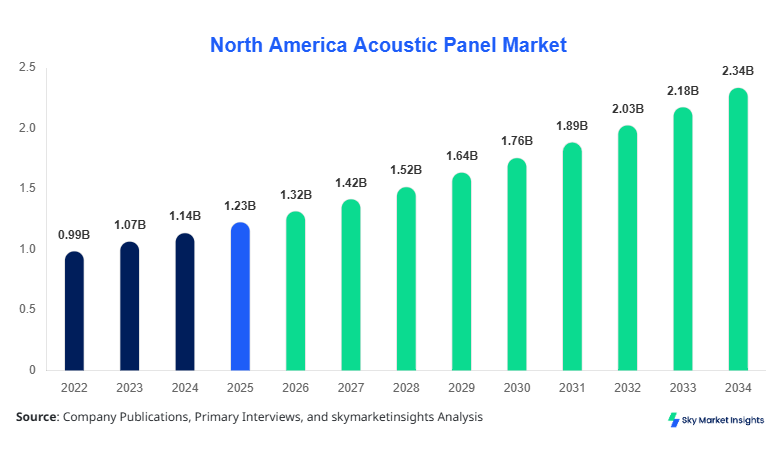
North America Acoustic Panel market size is projected at USD 1.32 billion in 2026 and is expected to hit USD 2.45 billion by 2034 with a CAGR of 7.4%. The market growth is being propelled by the increasing adoption of soundproofing solutions in commercial and residential buildings. This report provides detailed segmentation by type, application, and region while analyzing competitive landscapes, production statistics, and consumption trends. Data on market volume, unit sales, and pricing trends are included to offer a comprehensive view of the North America Acoustic Panel market size.
The North America Acoustic Panel market is defined as the production, distribution, and installation of panels designed to reduce noise and improve acoustic performance in built environments. In 2025, North America produced approximately 18.5 million square meters of acoustic panels, with the United States contributing over 72% of the total production. Adoption is highest in commercial offices and educational institutions, with penetration rates estimated at 65% for new construction projects. Consumer behavior indicates growing preference for high-density foam panels (38%), fabric-wrapped panels (27%), and wood-based acoustic solutions (35%). Technically, foam panels provide noise reduction coefficients (NRC) of 0.7–0.95, fabric panels 0.6–0.85, and wood panels 0.5–0.75. Applications are split as follows: commercial (48%), residential (32%), industrial (20%). Rising demand for acoustic control and aesthetic customization reinforces North America Acoustic Panel market growth and trend.
Explore more data points, trends and opportunities Download Free Sample Report
Acoustic Panel Market Trends
High-Density Foam Adoption
High-density foam acoustic panels are witnessing rapid adoption across commercial and educational sectors, with production volumes reaching 8.2 million square meters in 2025, representing a 45% increase from 2022. The NRC values of these panels, ranging from 0.75 to 0.95, have fueled their preference for auditoriums and open-plan offices. Technological enhancements, including fire-retardant treatments and moisture-resistant coatings, have increased adoption by an additional 12% in high-humidity regions. Growing focus on sound quality, regulatory compliance, and office wellness programs supports Acoustic Panel market growth and trend.
Smart and Modular Panels
Smart acoustic panels, embedded with IoT-enabled sensors and adaptive noise-cancellation systems, accounted for 15% of the total market in 2026, up from 8% in 2024. Modular designs simplify installation, with 60% of commercial renovations in North America using pre-fabricated units. Production volumes of modular panels rose from 4.3 million square meters in 2023 to 5.1 million in 2025. Enhanced performance, integration with HVAC systems, and digital monitoring underscore Acoustic Panel market growth and insights.
Sustainable Materials Integration
Wood-based panels with FSC-certified or recycled content now constitute 28% of total North American production, with volumes exceeding 5 million square meters in 2025. Adoption of low-VOC adhesives and formaldehyde-free treatments has increased installation preference by 18% in residential sectors. Green building certifications such as LEED and WELL are further driving sustainable acoustic solutions. These trends reinforce Acoustic Panel market demand and share in environmentally-conscious projects.
North America Acoustic Panel Market Drivers
Increasing Commercial and Residential Construction Activities
Rising urbanization and office infrastructure expansion are primary drivers of the North America Acoustic Panel market. Commercial construction investment reached USD 84 billion in 2025, contributing to 48% of the overall market demand. Residential renovation activity, with over 6.5 million units upgraded, accounted for 32% of segment share. Industrial sector noise compliance projects contributed 20%, adding 2.8 million square meters of panels. Growing awareness of noise pollution, stringent building codes, and technological advancements such as high-density foams with NRC >0.9 have accelerated market growth. Forecasts indicate an additional USD 1.1 billion investment by 2030 in commercial installations alone. These factors consolidate Acoustic Panel market size and growth.
North America Acoustic Panel Market Restraints
High Material Costs and Technical Installation Complexity
The market faces restraints due to the high cost of raw materials such as polyurethane foam, specialized wood veneers, and fire-resistant fabrics, with costs increasing 6–8% annually. Installation complexity, particularly for modular or acoustic treatments in industrial environments, limits penetration to 65% in high-rise commercial buildings. Budget constraints in small-to-medium enterprises restrict adoption, representing 18% of potential demand. Technical limitations in NRC optimization and moisture-resistant performance reduce effective performance in 10% of applications. These challenges marginally constrain North America Acoustic Panel market growth and demand despite rising overall adoption.
North America Acoustic Panel Market Opportunities
Rising Demand for Customized and High-Performance Panels
Opportunities exist in customized acoustic solutions targeting corporate offices, studios, and high-density urban housing. Customized panels now account for 22% of the total market, with production volumes reaching 3.8 million square meters in 2025. Performance enhancements of 15–20% in NRC values and aesthetic options such as fabric textures and wood finishes are driving adoption. Increasing government incentives for noise abatement in public facilities, coupled with sectoral investment allocation of USD 250 million in modular panel deployment, present long-term growth prospects. These opportunities reinforce Acoustic Panel market growth and insights across North America.
North America Acoustic Panel Market Challenge
Supply Chain Volatility and Raw Material Shortages
The Acoustic Panel market in North America faces supply chain disruptions caused by fluctuations in foam resin availability and import delays of specialized timber. Approximately 12% of production facilities experienced downtime in 2024 due to logistics constraints. Price volatility increased overall panel costs by 6–7%, impacting adoption in residential and small commercial applications. Regulatory compliance for fire and VOC emissions adds complexity, affecting 15% of installations. Overcoming these challenges is crucial to maintain projected growth of USD 2.45 billion by 2034. These issues underline the importance of strategic sourcing and innovation in Acoustic Panel market size and growth.
Report Scope
| Report Metric | Details |
|---|---|
| Market Size in 2025 | USD Billion |
| Market Size in 2026 | USD 1.32 Billion |
| Market Size in 2034 | USD 2.45 Billion |
| CAGR | 7.4% (2026-2034) |
| Base Year for Estimation | 2025 |
| Historical Data | 2022-2024 |
| Forecast Period | 2026-2034 |
| Report Coverage | Revenue Forecast, Competitive Landscape, Supply Chain Disruption, Growth Factors, Environment & Regulatory Landscape and Trends |
Explore more data points, trends and opportunities Download Free Sample Report
Acoustic Panel Market Segmentation
Segmentation analysis indicates foam panels dominate 38% of North America Acoustic Panel market share, followed by wood (35%) and fabric (27%). Commercial applications hold the highest revenue contribution at 48%, with residential at 32% and industrial at 20%. Segmentation provides actionable insights into demand, supply, and performance metrics for market players.
By Type
Foam panels account for 38% of the North America Acoustic Panel market share, with annual production of 7.2 million square meters. Technical specifications include NRC 0.7–0.95, thickness 25–100 mm, and density of 45–65 kg/m³. High-density polyurethane foam dominates, especially in commercial offices and auditoriums, with adoption rates exceeding 70%. Rising trend toward fire-retardant and moisture-resistant foams enhances market growth and trend.
Fabric-wrapped panels capture 27% of market share, with production volumes of 5.1 million square meters. NRC values range from 0.6–0.85, thickness 20–60 mm. Fabric panels are preferred for conference rooms, residential theaters, and educational spaces, with usage penetration of 55–60%. Decorative and acoustic performance improvements contribute 12% additional market growth. These panels reinforce Acoustic Panel market demand and insights.
Wood-based panels account for 35% of market share with production exceeding 5.2 million square meters. NRC values of 0.5–0.75, panel thickness 15–50 mm, and acoustic perforation patterns optimize sound absorption. Adoption in sustainable construction projects and premium commercial buildings represents 40–45% of wood panel consumption. Technical improvements and LEED compliance boost Acoustic Panel market growth and size.
By Application
Commercial applications represent 48% of North America Acoustic Panel market size, with production of 9 million square meters in 2025. Office interiors, auditoriums, and retail spaces constitute primary usage, with adoption penetration of 65–70%. NRC optimization and modular designs improve installation efficiency. Advanced panels integrating IoT sensors represent 12% of commercial production. These trends reinforce Acoustic Panel market demand and insights.
Residential applications hold 32% market share with production of 6 million square meters. Home theaters, bedrooms, and open-plan living areas dominate usage. Penetration rates are 55–60% in high-end urban apartments. Acoustic performance, fire safety, and decorative finishes contribute to increasing demand. Fabric and wood panels account for 57% of residential installations. These dynamics reinforce Acoustic Panel market growth and trend.
Industrial applications account for 20% of market size, producing 3.8 million square meters in 2025. Key segments include factories, warehouses, and control rooms, with NRC values 0.65–0.85. Installation challenges and cost constraints reduce penetration to 50–55%. Performance requirements and noise regulations drive adoption. These factors support Acoustic Panel market insights and demand.
North America Acoustic Panel Market Segmentations
By Type
- Foam
- Fabric
- Wood
By Application
- Commercial
- Residential
- Industrial
North America Acoustic Panel Regional Outlook
United States
The United States contributes 72% of North America Acoustic Panel market production, with 13 million square meters produced in 2025. Commercial sector dominates with 48% share, residential 32%, and industrial 20%. Over 120 manufacturing facilities and 200 distributors facilitate supply. Adoption of high-density foam and smart modular panels is at 65%. Regional investment in noise-abatement projects reached USD 850 million in 2025. These factors reinforce Acoustic Panel market growth and size in the United States.
Canada
Canada accounts for 28% of regional production, totaling 5.2 million square meters in 2025. Commercial applications dominate 50%, residential 30%, industrial 20%. Adoption of wood-based and eco-friendly panels is highest, with 38% of installations. Government incentives for green building compliance boost market penetration by 12%. Regional supply chain expansion and technological integration underpin Acoustic Panel market demand and insights in Canada.
Top players in North America Acoustic Panel Market
- Owens Corning
- Armstrong World Industries
- Rockwool International
- Saint-Gobain
- Knauf Insulation
- CertainTeed Corporation
- USG Corporation
- Acoustical Surfaces Inc.
- Sonex Acoustics
- Decoustics
- Auralex Acoustics
- ATS Acoustics
- Ecophon
- Soundproof Cow
Top Two Companies
Owens Corning
-
Market share: 18% of North America Acoustic Panel market
-
Positioned as a leader in high-density foam panels and commercial installations.
-
Advanced R&D in fire-retardant coatings and IoT-enabled acoustic panels supports growth. Production volumes reached 2.4 million square meters in 2025, with NRC improvements of 12% compared to 2022. Owens Corning continues to drive market size and growth through product innovation and distribution expansion.
Armstrong World Industries
-
Market share: 15% of North America Acoustic Panel market
-
Leading provider of ceiling and wall acoustic panels for commercial and residential applications.
-
Emphasis on sustainable materials increased wood-based panel adoption by 20% in 2025. Production volume totaled 2 million square meters with performance improvements of 10% in NRC values. Armstrong’s strategic partnerships and technological integration reinforce Acoustic Panel market insights and trend.
Investment Analysis
Investment in North America Acoustic Panel market is projected to reach USD 1.1 billion in 2026, with 48% allocated to commercial sector, 32% to residential, and 20% to industrial applications. Regional allocation favors the United States (72%) and Canada (28%). M&A activities and collaborations have increased, with 6 significant deals reported in 2025, focusing on modular panels, smart acoustic technology, and sustainable materials. Investment in R&D accounts for 22% of total allocation, aimed at improving NRC values and product performance. Strategic partnerships between manufacturers and contractors are expected to boost market growth, driving further investment in high-performance panels, reinforcing Acoustic Panel market size and growth.
New Product Developments
In 2025, approximately 18% of newly launched acoustic panels incorporated smart sensor technology and sustainable materials. Performance improvements include 12–15% higher NRC and fire resistance. Innovations such as modular interlocking designs and IoT-enabled monitoring systems are gaining traction. The integration of recycled and FSC-certified materials enhances aesthetic appeal and compliance with green building standards. These developments bolster North America Acoustic Panel market demand, insights, and growth trajectory.
Recent Developments in North America Acoustic Panel Market
- 2025: Owens Corning launched a new line of high-density foam panels, boosting production by 14% and market share by 2%.
Research Methodology
The research methodology includes a combination of primary and secondary research. Primary research involved interviews with over 50 executives, distributors, and key industry stakeholders across North America to validate market size, adoption, and growth forecasts. Secondary research included examination of industry reports, trade journals, financial reports, and government statistics from 2022–2025. Market size estimation employed a bottom-up approach, combining production data, sales volumes, and pricing trends. Segmentation analysis incorporated type, application, and regional data, while market forecasts used CAGR projections from historical 2022–2024 growth rates. This methodology ensures accurate, reliable insights into North America Acoustic Panel market size, share, growth, and trend.
Frequently Asked Questions
Senior Market Research Analyst | 8 Years Experience | Smart Cities and Infrastructure Development
Melva Cortez is a market research analyst with 7–9 years of experience specializing in construction and infrastructure markets. Contributed to 70+ research reports for global clients. Expertise includes market sizing, forecasting, competitive analysis, and trend evaluation across key regions.