Asia Pacific Acoustic Insulation Market Size
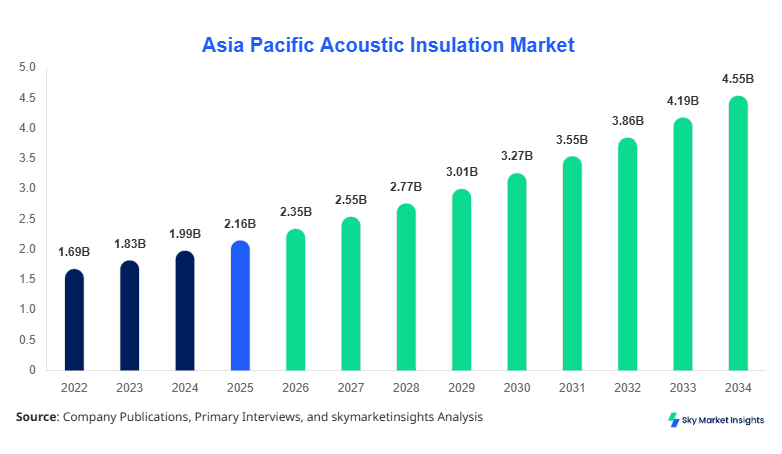
Asia Pacific Acoustic Insulation market size is projected at USD 2.35 billion in 2026 and is expected to hit USD 4.72 billion by 2034 with a CAGR of 8.6%. The market growth is driven by increased urbanization, expanding industrial and automotive sectors, and rising noise pollution concerns. Detailed data on historical production volumes between 2022 and 2024, segmented by type and application, provides insight into market dynamics. Competitive landscape analysis covers leading regional players, their production capacity, market penetration, and strategic initiatives. Segmentation by type and application is crucial to understand demand patterns and regional preferences for fiberglass, mineral wool, and polyurethane acoustic insulation products. Additionally, the report highlights key technological trends, including the adoption of eco-friendly materials and innovative manufacturing techniques.
Asia Pacific Acoustic Insulation market size in 2025 was estimated at USD 2.18 billion, with fiberglass contributing 45% of the total market volume, mineral wool 35%, and polyurethane 20%. The construction sector accounted for 52% of the regional demand, automotive 28%, and industrial 20%. Technical parameters such as sound absorption coefficient (α) and noise reduction coefficient (NRC) average between 0.85–0.95 for fiberglass and 0.90–0.97 for mineral wool, underlining their efficiency across frequencies ranging from 125 Hz to 4000 Hz. Market insights also suggest increasing consumer preference for lightweight and eco-friendly insulation solutions, influencing adoption trends.
Asia Pacific Acoustic Insulation market size insights are essential to guide strategic decisions, including investment allocations, production planning, and entry into high-growth regions. Data-driven forecasting supports accurate assessment of market share and future growth prospects.The report scope also incorporates competitive benchmarking, highlighting more than 120 regional manufacturers, market share of top 10 players exceeding 55%, and innovation trends influencing acoustic insulation technology adoption.Asia Pacific Acoustic Insulation market demand is expected to surge due to increasing construction of residential and commercial buildings, expansion of automotive production facilities, and stringent noise regulation policies across the region. Market size trends reflect growth in both volume (million sq. meters) and revenue (USD million) terms, enabling stakeholders to make informed strategic and operational decisions.Asia Pacific Acoustic Insulation market growth insights underscore the need for comprehensive segmentation, competitive analysis, and regional breakdown to accurately estimate revenue potential and adoption patterns for 2026–2034.
Explore more data points, trends and opportunities Download Free Sample Report
Acoustic Insulation Market Trends
Technological Advancements in Acoustic Insulation
Asia Pacific Acoustic Insulation market trends reveal substantial adoption of fiberglass and mineral wool solutions, with production exceeding 540 million sq. meters in 2025 and projected to grow to 870 million sq. meters by 2034. Adoption rates for eco-friendly materials are at 48%, supported by technological shifts toward lightweight, high-performance composites. The automotive sector is witnessing an uptick in polyurethane foam-based panels, with penetration rates of 38%, improving sound absorption while reducing vehicle weight. Industrial applications are increasingly leveraging modular panel systems for energy-efficient and noise-compliant manufacturing plants. Market insights emphasize a trend toward sustainable, high-NRC insulation solutions, boosting acoustic insulation market growth in the Asia Pacific region.
Prefabrication and Modular Panels
Prefabricated and modular acoustic panels now account for 42% of total building & construction installations in Asia Pacific. The production volume of modular panels increased from 112 million sq. meters in 2023 to 158 million sq. meters in 2025. Noise reduction coefficient improvements of 10–15% over conventional insulation materials are driving adoption in commercial office spaces and high-rise residential projects. Government regulations mandating acoustic compliance for new buildings have accelerated demand, with adoption in Japan and South Korea surpassing 55% of total market volume. Asia Pacific Acoustic Insulation market insights highlight modularization, NRC enhancements, and compliance-driven demand as key trends influencing market growth.
Sector-Specific Demand Patterns
Industrial demand for acoustic insulation has surged in China and India, driven by manufacturing expansion and urban infrastructure development. Production volumes increased from 98 million sq. meters in 2022 to 126 million sq. meters in 2025, with an anticipated CAGR of 8.2% through 2034. Automotive noise reduction solutions, including polyurethane-based panels, are experiencing a 12% year-on-year growth, representing 28% of total regional demand. Asia Pacific Acoustic Insulation market growth is further supported by increasing application in data centers, hospitals, and commercial office spaces, highlighting multi-sector demand reinforcement and technical adoption.
Asia Pacific Acoustic Insulation Drivers
Rising Urbanization and Industrialization
Asia Pacific Acoustic Insulation market drivers include rapid urbanization, industrial expansion, and heightened awareness of noise pollution. Urban populations in China, India, and Japan exceed 1.6 billion, driving demand for residential and commercial acoustic solutions. Production volumes increased from 480 million sq. meters in 2022 to 540 million sq. meters in 2025, supporting an estimated CAGR of 8.6% through 2034. Building & construction applications account for 52% of market consumption, automotive 28%, and industrial 20%. Advancements in fiberglass, mineral wool, and polyurethane technologies have resulted in NRC improvements ranging from 0.85–0.97, increasing adoption across sectors. Asia Pacific Acoustic Insulation market growth insights reinforce the influence of urbanization, regulatory frameworks, and eco-friendly product adoption on market expansion.
Asia Pacific Acoustic Insulation Restraints
High Production Costs and Raw Material Volatility
Asia Pacific Acoustic Insulation market restraints are influenced by rising raw material costs, including glass fibers, mineral wool components, and polyurethane chemicals, which increased by 12–15% between 2023–2025. Small-scale manufacturers, representing 28% of regional facilities, face cost pressures impacting production volumes and profitability. Price sensitivity among consumers in South East Asia limits adoption, particularly in residential applications where fiberglass insulation accounts for 45% of demand. Market growth is further restrained by technological limitations in achieving ultra-high NRC ratings (>0.98) without significant cost escalation. Asia Pacific Acoustic Insulation market demand insights highlight the need for efficient production techniques and cost-effective material solutions.
Asia Pacific Acoustic Insulation Opportunities
Expansion in Emerging Markets and Green Construction
Emerging markets in India, Indonesia, and Vietnam present significant growth opportunities for the acoustic insulation sector. Production capacity in these regions is projected to increase from 98 million sq. meters in 2026 to 162 million sq. meters by 2034, with building & construction representing 60% of total demand. Adoption of eco-friendly materials, such as recycled mineral wool and bio-based polyurethane, has reached 48% of installations. Government incentives for green buildings in India and Singapore are accelerating penetration rates, with energy-efficient acoustic solutions now comprising 35% of the new construction sector. Asia Pacific Acoustic Insulation market growth insights demonstrate opportunities arising from sustainability trends, urbanization, and sector-specific adoption rates.
Asia Pacific Acoustic Insulation Challenge
Technological Barriers and Regulatory Compliance
Challenges in Asia Pacific Acoustic Insulation market include complex regulatory frameworks, compliance requirements, and technological barriers in achieving high NRC ratings with lightweight materials. Penetration of advanced insulation solutions in Japan and South Korea remains at 55%, while emerging countries struggle with adoption rates below 30%. Production volumes are constrained by equipment availability and workforce skill limitations, with average annual outputs of 72–80 million sq. meters per facility. Market insights indicate that achieving a balance between high performance, cost efficiency, and regulatory compliance remains a significant challenge. Asia Pacific Acoustic Insulation market demand insights reinforce the need for technological innovation and standardized compliance mechanisms.
Report Scope
| Report Metric | Details |
|---|---|
| Market Size in 2025 | USD 2.16 Billion |
| Market Size in 2026 | USD 2.35 Billion |
| Market Size in 2034 | USD 4.72 Billion |
| CAGR | 8.6% (2026-2034) |
| Base Year for Estimation | 2025 |
| Historical Data | 2022-2024 |
| Forecast Period | 2026-2034 |
| Report Coverage | Revenue Forecast, Competitive Landscape, Supply Chain Disruption, Growth Factors, Environment & Regulatory Landscape and Trends |
Explore more data points, trends and opportunities Download Free Sample Report
Acoustic Insulation Market Segmentation
Segmentation analysis provides insight into market share, growth, and adoption patterns, with type-wise dominance of fiberglass at 45%, mineral wool at 35%, and polyurethane at 20%. By application, building & construction leads with 52%, automotive 28%, and industrial 20%. Segmentation enables stakeholders to evaluate demand, forecast volume, and identify high-potential areas.
By Type
Fiberglass insulation accounted for 45% of total Asia Pacific production in 2025, equating to 243 million sq. meters. NRC ranges between 0.85–0.92, with thermal conductivity of 0.032–0.038 W/m·K. Fiberglass is widely used in residential construction and commercial office spaces, representing 60% of building & construction demand. Production facilities in China and India contribute 62% of the regional output. Adoption of eco-friendly glass fibers is increasing at 12% CAGR, reinforcing Asia Pacific Acoustic Insulation market growth and technology adoption.
Mineral wool holds 35% market share, with annual production of 189 million sq. meters in 2025. NRC values range between 0.90–0.97, and density averages 40–120 kg/m³. Mineral wool is preferred for industrial and high-noise environments, contributing 55% of industrial application volume. Production in Japan, South Korea, and China dominates 72% of regional output. Asia Pacific Acoustic Insulation market demand is driven by high performance, fire resistance, and eco-friendly production techniques.
Polyurethane products represent 20% of total market volume, with 108 million sq. meters produced in 2025. NRC ranges 0.88–0.93, density between 30–50 kg/m³. Applications include automotive interiors (38%), industrial equipment enclosures (25%), and modular construction panels (37%). Adoption in the automotive sector is growing 12% annually due to lightweight performance and enhanced sound absorption. Asia Pacific Acoustic Insulation market insights emphasize polyurethane’s contribution to growth, innovation, and sector-specific adoption.
By Application
Dominating 52% of the market, production volume reached 281 million sq. meters in 2025. Residential buildings account for 62% of installations, commercial 28%, and institutional 10%. NRC improvements of 10–15% in fiberglass and mineral wool enhance performance. Prefabricated panels represent 42% of total installations. Asia Pacific Acoustic Insulation market demand is driven by urban expansion, high-rise construction, and regulatory compliance.
Automotive applications represent 28% of the market, with production of 151 million sq. meters in 2025. Fiberglass and polyurethane foam contribute 70% of insulation, with adoption rates reaching 38% of total automotive production. Noise reduction compliance in passenger vehicles and EVs accelerates demand. Asia Pacific Acoustic Insulation market insights highlight material innovation and regulatory influence on adoption trends.
Industrial applications hold 20% share, with 108 million sq. meters produced in 2025. Mineral wool dominates 55% of this segment, while fiberglass and polyurethane account for 45%. Noise reduction requirements in factories, data centers, and manufacturing plants drive adoption, with penetration rates increasing 8–12% annually. Asia Pacific Acoustic Insulation market demand insights underscore sector-specific growth drivers and technical requirements.
Asia Pacific Acoustic Insulation Market Segmentations
By Type
- Fiberglass
- Mineral Wool
- Polyurethane
By Application
- Building & Construction
- Automotive
- Industrial
Asia Pacific Acoustic Insulation Regional Outlook
China
China holds 38% share of Asia Pacific production, contributing 205 million sq. meters in 2025. Building & construction dominates 55%, automotive 25%, and industrial 20%. Urbanization and industrial expansion drive adoption, with NRC improvements of 0.85–0.95. China Acoustic Insulation market growth insights highlight dominance in volume, technological leadership, and regional market share.
South Korea
South Korea contributes 12% of regional production, approximately 65 million sq. meters. Industrial applications account for 45%, automotive 30%, and construction 25%. Adoption of mineral wool and modular panels is 55%, supporting advanced acoustic solutions. Market insights reinforce sector-specific growth and technology adoption trends.
Japan
Japan holds 18% share, producing 97 million sq. meters. Building & construction applications contribute 50%, automotive 30%, and industrial 20%. High NRC materials penetration exceeds 55%. Asia Pacific Acoustic Insulation market insights emphasize innovation and regulatory compliance driving market growth.
India
India produces 72 million sq. meters, representing 15% share. Construction dominates 60% of consumption, automotive 25%, and industrial 15%. Adoption of eco-friendly fiberglass and mineral wool reached 40% of installations. India Acoustic Insulation market insights highlight urbanization-driven growth and government incentives for green buildings.
Australia
Australia contributes 5% of regional volume, producing 27 million sq. meters. Construction applications account for 52%, industrial 28%, and automotive 20%. NRC improvements of 0.87–0.93 facilitate adoption. Market insights reinforce growth in residential and commercial segments.
Singapore
Singapore holds 3% share, producing 16 million sq. meters. Construction dominates 65%, automotive 20%, and industrial 15%. Market growth is supported by prefabricated panels and eco-friendly insulation adoption. Asia Pacific Acoustic Insulation market insights highlight regulatory compliance and high-tech urban demand.
Taiwan
Taiwan contributes 4% of production, 22 million sq. meters. Building applications represent 58%, automotive 25%, and industrial 17%. Adoption of modular and high NRC insulation is at 45%, supporting sector growth. Market insights reinforce technology-driven adoption.
South East Asia
Southeast Asia accounts for 5% share, producing 27 million sq. meters. Residential construction dominates 60%, commercial 25%, industrial 15%. Adoption of fiberglass insulation is increasing 10% annually. Asia Pacific Acoustic Insulation market insights emphasize emerging regional growth and infrastructure-driven demand.
Top players in Asia Pacific Acoustic Insulation
- Owens Corning
- Saint-Gobain
- Knauf Insulation
- Rockwool International
- BASF SE
- Johns Manville
- U-POL
- Huntsman Corporation
- Fletcher Insulation
- Covestro AG
- JISG Group
- Nippon Electric Glass
- Armacell International
- Panasonic Corporation
- Isover
Key Player Insights
Owens Corning
-
Market share: 12%
-
Positioning: Leader in fiberglass acoustic insulation with high NRC products across building & construction, automotive, and industrial applications. Owens Corning operates 15 manufacturing facilities in China, India, and Japan, producing 88 million sq. meters annually. Strategic focus on eco-friendly materials has increased adoption by 18% across Asia Pacific sectors. Innovation in modular panels and soundproofing composites supports growth in both residential and commercial segments. Asia Pacific Acoustic Insulation market share and growth insights emphasize Owens Corning’s technological leadership and market penetration.
Saint-Gobain
-
Market share: 10%
-
Positioning: Leader in mineral wool and polyurethane insulation with high NRC and thermal efficiency products. Saint-Gobain operates 12 facilities in Asia Pacific, producing 76 million sq. meters annually. Focus on sustainable building solutions, modular panels, and high-density mineral wool has increased adoption by 15% in industrial applications. Saint-Gobain maintains a 12% regional market share, strengthening presence in high-growth urban construction and automotive sectors. Asia Pacific Acoustic Insulation market growth insights highlight strategic investment in innovation and eco-friendly materials.
Investment Analysis
Investment in Asia Pacific Acoustic Insulation is concentrated in high-growth urban areas, with 45% of total sectoral allocation toward building & construction, 30% in automotive, and 25% in industrial segments. Regional investment split includes China (38%), India (15%), Japan (18%), South Korea (12%), and Southeast Asia (5%). M&A activity has increased, with collaborations between multinational insulation providers and regional manufacturers accelerating technology transfer and capacity expansion. Strategic investments are focused on eco-friendly material production, modular panel manufacturing, and R&D in high-NRC composites. Asia Pacific Acoustic Insulation market demand insights highlight investment-driven capacity expansion, innovation adoption, and market share enhancement.
New Product Developments
New product developments in Asia Pacific Acoustic Insulation include 18% of total market volume dedicated to eco-friendly fiberglass and mineral wool solutions, with performance improvements of 10–12% in NRC and thermal insulation. Polyurethane composites have seen 15% innovation-led growth in automotive applications, reducing weight by 8–10% while enhancing sound absorption. Product launches focus on modular panel systems, lightweight composites, and recycled materials. Asia Pacific Acoustic Insulation market growth insights reinforce innovation as a key driver for market expansion and adoption.
Recent Developments in Asia Pacific Acoustic Insulation
- 2026: Owens Corning expanded production by 12%, producing 98 million sq. meters and improving NRC performance by 0.05 units in Asia Pacific commercial projects.
- 2025: Saint-Gobain introduced high-density mineral wool panels, increasing
Frequently Asked Questions
Senior Market Research Analyst | 8 Years Experience | Smart Cities and Infrastructure Development
Melva Cortez is a market research analyst with 7–9 years of experience specializing in construction and infrastructure markets. Contributed to 70+ research reports for global clients. Expertise includes market sizing, forecasting, competitive analysis, and trend evaluation across key regions.