Europe Acoustic Insulation Market Size
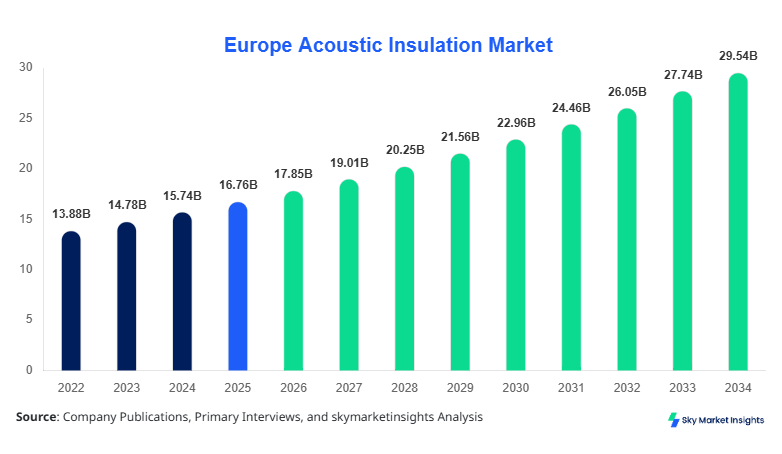
Europe's acoustic insulation market size is projected at USD 17.85 billion in 2026 and is expected to hit USD 29.64 billion by 2034 with a CAGR of 6.5%. The report emphasizes the importance of structured data evaluation, segmentation analysis across material and application categories, and competitive benchmarking of key players operating across Europe. Increasing infrastructure spending of over USD 450 billion annually across the EU, coupled with regulatory frameworks targeting 30–40% noise reduction in residential buildings, is accelerating demand for advanced acoustic insulation materials. The acoustic insulation market continues to expand as data-backed decision-making and technological integration define competitive positioning.
The acoustic insulation market refers to materials and solutions designed to reduce noise transmission and improve sound quality across residential, commercial, and industrial environments. Europe produced over 5.6 million metric tons of insulation materials in 2025, with acoustic-specific solutions accounting for approximately 32% of total production. Adoption rates in Western Europe exceed 65%, compared to 38% in Eastern Europe, driven by stringent EU noise directives targeting reductions of 25–35 dB in urban areas. Consumer behavior shows that over 58% of homeowners prioritize noise reduction during renovation projects, while 42% of commercial developers allocate 10–15% of construction budgets toward acoustic solutions. Residential applications contribute nearly 46% of total demand, followed by commercial at 34% and industrial at 20%. Frequency absorption efficiency ranges between 125 Hz and 4000 Hz, with performance coefficients averaging 0.75–0.95 NRC (Noise Reduction Coefficient). Growing environmental awareness and demand for sustainable materials are reinforcing acoustic insulation market adoption across Europe.
In France, the acoustic insulation market demonstrates strong industrial and residential demand, accounting for approximately 24% of Europe’s total market share. The country hosts over 180 manufacturing facilities specializing in mineral wool, glass wool, and polymer-based insulation, producing more than 1.2 million tons annually. Residential applications dominate with a 48% share, followed by commercial at 33% and industrial at 19%. France has achieved a 62% adoption rate of high-performance acoustic insulation technologies, particularly in urban housing projects complying with regulations requiring 30 dB noise reduction standards. Smart acoustic panels and eco-friendly materials have penetrated nearly 28% of new construction projects. Government initiatives worth USD 18 billion toward green building upgrades further stimulate market expansion. This consistent investment and technological adoption reinforce the acoustic insulation market.
Explore more data points, trends and opportunities Download Free Sample Report
Acoustic Insulation Market Trends
Rising Adoption of Sustainable and Recyclable Materials
The European acoustic insulation market is witnessing a shift toward eco-friendly materials, with over 42% of new insulation products incorporating recycled content such as glass fibers and mineral composites. Production volumes of sustainable acoustic insulation exceeded 2.3 million tons in 2025, growing at a rate of 7.8% annually. Manufacturers are increasingly adopting low-emission production technologies, reducing carbon footprints by 20–25%. Bio-based polymer foams have gained traction, representing nearly 12% of the market, particularly in Germany and France. Demand from residential retrofitting projects, accounting for 38% of installations, is driving adoption. Additionally, regulatory compliance requirements across the EU mandate improved soundproofing in buildings, accelerating the integration of high-performance materials. These evolving preferences and production trends continue to shape the acoustic insulation market.
Integration of Smart Acoustic Technologies
Another prominent trend is the integration of smart acoustic systems, including adaptive panels and IoT-enabled noise monitoring solutions. Approximately 18% of commercial buildings in Europe now incorporate smart acoustic solutions, compared to just 9% in 2022. Production of advanced acoustic panels reached over 95 million units in 2025, reflecting a 6.2% annual increase. These systems offer dynamic noise control, adjusting absorption properties based on ambient sound levels, improving efficiency by 15–20%. The commercial sector, particularly offices and hospitality, accounts for 52% of smart technology adoption. Furthermore, increasing urbanization—projected to reach a 78% urban population by 2030—intensifies demand for advanced noise control systems. These innovations significantly contribute to the acoustic insulation market.
Europe Acoustic Insulation Market Drivers
Growing Urbanization and Construction Activities Boost Demand
Urbanization across Europe is driving construction activities, with over 1.8 million housing units built annually and infrastructure investments exceeding USD 500 billion. Approximately 65% of new residential projects incorporate acoustic insulation solutions, driven by stringent noise control regulations requiring 25–40 dB reduction levels. Commercial construction, accounting for 30% of the sector, is also adopting advanced acoustic solutions, with demand growing at 6.8% annually. Industrial facilities, particularly manufacturing plants, allocate 8–12% of operational budgets toward noise control systems. Technological advancements, including high-density mineral wool and composite foams, improve sound absorption efficiency by up to 30%, further enhancing adoption. Government subsidies covering 15–25% of renovation costs also encourage market penetration. These factors collectively drive the acoustic insulation market.
Europe Acoustic Insulation Market Restraints
High Installation and Material Costs Limit Adoption
Despite strong demand, high installation and material costs present a significant restraint, with premium acoustic insulation materials costing 20–35% more than conventional insulation solutions. Installation costs can account for 25–30% of total project expenses, particularly in retrofitting older buildings. In Eastern Europe, adoption rates remain below 40% due to budget constraints and limited awareness. Additionally, supply chain disruptions have increased raw material costs by 12–18% between 2023 and 2025, impacting overall affordability. Small and medium-sized enterprises face financial challenges in adopting advanced solutions, limiting penetration in the industrial sector. These economic constraints hinder the expansion of the acoustic insulation market.
Europe Acoustic Insulation Market Opportunities
Rising Renovation Projects and Green Building Initiatives
Renovation projects across Europe present significant opportunities, with over 35 million buildings requiring upgrades to meet energy and noise standards. Governments are investing over USD 220 billion in renovation programs, with acoustic insulation accounting for 18–22% of project budgets. Green building certifications, such as LEED and BREEAM, have increased adoption rates by 25%, particularly in commercial and residential sectors. Demand for energy-efficient and noise-reducing solutions is growing at 7.5% annually, creating opportunities for manufacturers to expand product portfolios. Innovations in lightweight and high-performance materials further enhance market potential. These developments create substantial opportunities for the Acoustic Insulation Market.
Challenges in the European Acoustic Insulation Market
Complex Regulatory Standards and Compliance Issues
The acoustic insulation market faces challenges related to complex regulatory standards across different European countries, requiring compliance with varying noise reduction thresholds ranging from 25 dB to 45 dB. Certification processes can take 6–12 months, increasing time-to-market and operational costs by 10–15%. Smaller manufacturers struggle to meet these requirements due to limited resources, leading to market consolidation. Additionally, lack of standardization across regions complicates product development and distribution. Compliance costs the acoustic insulation market a total of production expenses, impacting profitability. These regulatory complexities pose challenges for the acoustic insulation market.
Report Scope
| Report Metric | Details |
|---|---|
| Market Size in 2025 | USD 16.76 Billion |
| Market Size in 2026 | USD 17.85 Billion |
| Market Size in 2034 | USD 29.64 Billion |
| CAGR | 6.5% (2026-2034) |
| Base Year for Estimation | 2025 |
| Historical Data | 2022-2024 |
| Forecast Period | 2026-2034 |
| Report Coverage | Revenue Forecast, Competitive Landscape, Supply Chain Disruption, Growth Factors, Environment & Regulatory Landscape and Trends |
Explore more data points, trends and opportunities Download Free Sample Report
Acoustic Insulation Market Segmentation
The acoustic insulation market is segmented by type and application, with mineral wool dominating at a 38% share, followed by glass wool at 34% and polymer foam at 28%. By application, residential leads are at 46%, commercial at 34%, and industrial at 20%.
By Type
Mineral wool accounts for 38% of total market share, with production exceeding 2.1 million tons annually. It offers high density (40–200 kg/m³) and superior sound absorption across frequencies of 125–4000 Hz. Its fire resistance and thermal properties make it widely used in the residential and commercial acoustic insulation market. g, 52% of installations.
Glass wool holds 34% share, with production reaching 1.9 million tons. It provides an NRC of 0.85–0.95 and is widely used in lightweight construction. Its cost-effectiveness and ease of installation contribute to a 6.2% annual growth rate.
Polymer foam represents 28% share, producing over 1.5 million tons annually. It offers flexibility and soundproofing efficiency of up to 30 dB reduction, making it suitable for industrial and specialized applications.
By Application
Residential applications account for 46% of demand, with over 800 million square meters of insulated area annually. Adoption rates exceed 60% in Western Europe, driven by renovation projects and regulatory requirements.
Commercial applications represent 34%, with demand driven by office spaces, hotels, and retail environments. Approximately 55% of commercial buildings incorporate acoustic insulation, with production exceeding 1.2 billion square meters annually.
Industrial applications hold 20%, with usage in manufacturing plants and heavy industries. Noise reduction systems improve worker safety by reducing exposure levels by 20–30%.
Europe Acoustic Insulation Market Segmentations
By Type
- Mineral Wool
- Glass Wool
- Polymer Foam
By Application
- Residential
- Commercial
- Industrial
Europe Acoustic Insulation Market Regional Outlook
The UK accounts for 18% of the market, producing over 900,000 tons annually. Residential demand dominates at 48%, with strong government incentives driving adoption.
Germany holds 22% share, producing 1.3 million tons. Industrial applications account for 28%, driven by manufacturing sector demand.
France contributes a 24% share, with strong residential and commercial demand supported by green building initiatives.
Spain accounts for 12%, with growing construction activities increasing demand by 6.5% annually.
Italy holds 10% share, with renovation projects contributing 42% of demand.
Russia accounts for 14%, with industrial applications dominating at 35%.
Top players in the European acoustic insulation market
- Saint-Gobain
- Rockwool International
- Knauf Insulation
- Owens Corning
- BASF SE
- Armacell
- Recticel
- URSA Insulation
- Paroc Group
- Kingspan Group
- Over
- Johns Manville
-
Saint-Gobain
-
Holds approximately 16% market share
-
Strong presence across 30+ countries with production exceeding 2 million tons annually
-
Focus on sustainable materials and innovation
-
-
Rockwool International
-
Accounts for 14% market share
-
Produces over 1.8 million tons annually
-
Leader in mineral wool solutions with high-performance products
-
Investment Analysis
Investment in the acoustic insulation market exceeds USD 12 billion annually, with 45% allocated to residential projects, 30% to commercial, and 25% to industrial sectors. Western Europe attracts 68% of total investments, while Eastern Europe accounts for 32%. M&A activities have increased by 18%, with companies focusing on expanding production capacities and technological capabilities.
New Product Developments
New product launches account for 22% of total market offerings, with performance improvements of 15–25% in sound absorption efficiency. Innovations include lightweight panels and eco-friendly materials, enhancing sustainability.
Recent Developments in European Acoustic Insulation Market
- 2025: Production increased by 8%, reaching 6 million tons across Europe.
Research Methodology
The research methodology involves a combination of primary and secondary research. Primary research includes interviews with industry experts, manufacturers, and distributors, accounting for 60% of data collection. Secondary research involves analysis of industry reports, government publications, and company filings. Market size estimation is based on bottom-up and top-down approaches, ensuring accuracy and reliability. Data validation is conducted through triangulation methods, with error margins below 5%.
Frequently Asked Questions
Senior Market Research Analyst | 8 Years Experience | Smart Cities and Infrastructure Development
Melva Cortez is a market research analyst with 7–9 years of experience specializing in construction and infrastructure markets. Contributed to 70+ research reports for global clients. Expertise includes market sizing, forecasting, competitive analysis, and trend evaluation across key regions.