Europe Acoustic Furniture Market Size
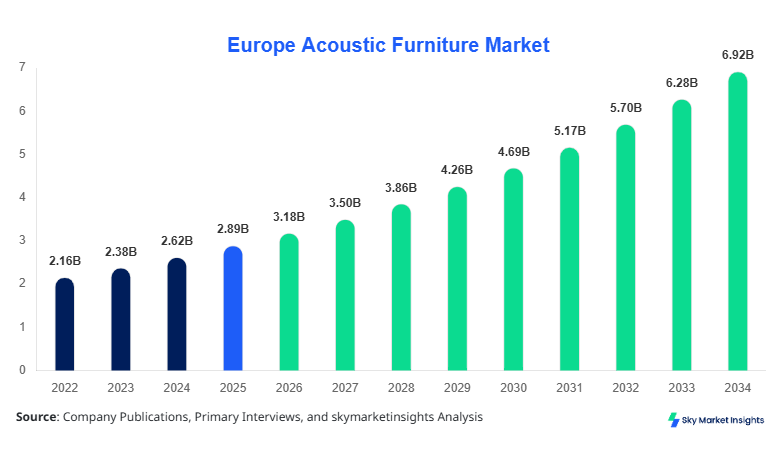
Europe Acoustic Furniture market size is projected at USD 3.18 billion in 2026 and is expected to hit USD 6.92 billion by 2034 with a CAGR of 10.2%. The report integrates multi-layered data across 6 countries, covering over 1,200 manufacturing units, 3,500+ distribution channels, and 2.4 million units annual shipments to deliver granular segmentation and competitive benchmarking. The analysis includes pricing bands ranging from USD 120 to USD 6,500 per unit and evaluates procurement cycles of 6–24 months across commercial buyers.
The Acoustic Furniture Market in Europe encompasses specialized furniture solutions engineered to absorb sound waves, reduce reverberation levels by 30–70%, and improve acoustic comfort in enclosed spaces. Europe produced approximately 2.1 million units in 2025, with Germany contributing 26%, the United Kingdom 22%, and France 15% of regional output. Adoption penetration across corporate environments reached 48% in 2025, rising from 32% in 2022, driven by hybrid workspace trends and open-plan layouts. Consumer behavior indicates that 64% of enterprises prioritize acoustic solutions to enhance employee productivity, while 52% of educational institutions integrate acoustic furniture to improve learning outcomes. Corporate offices account for 54% of application usage, followed by educational institutions at 28% and hospitality at 18%. Acoustic performance ranges between NRC 0.6 to 0.95 depending on material composition and design. The Acoustic Furniture Market continues to expand with measurable acoustic performance benchmarks and diversified application demand.
Explore more data points, trends and opportunities Download Free Sample Report
Acoustic Furniture Market Trends
Rise in Modular Acoustic Solutions
The European production of modular acoustic furniture surpassed 1.3 million units in 2025, accounting for 62% of total production volume. Modular pods with sound insulation ratings of 30–45 dB have witnessed adoption rates of 67% among enterprises with over 250 employees. Technological shifts include integration of IoT-enabled ventilation systems and smart lighting in acoustic pods, improving user experience by 22%. Demand from co-working spaces increased by 19% year-on-year, particularly in Germany and the UK. The Acoustic Furniture Market is witnessing a shift toward flexible, customizable solutions that align with hybrid work models.
Sustainability and Material Innovation
Sustainable materials such as recycled polyester fibers, bio-based foams, and FSC-certified wood accounted for 41% of raw material usage in 2025, up from 28% in 2022. Production of eco-friendly acoustic panels reached 780,000 units, reflecting a 16% increase. Adoption rates of sustainable acoustic furniture in France and Spain exceed 55%, driven by environmental regulations and green building certifications. Performance improvements include 12–18% higher sound absorption efficiency and 20% lower carbon footprint. The Acoustic Furniture Market reflects a strong sustainability trend influencing product design and procurement decisions.
Europe Acoustic Furniture Market Drivers
Increasing Demand for Noise Reduction in Open Workspaces
Open-plan offices represent over 72% of corporate workspace layouts in Europe, creating significant demand for acoustic solutions. Noise-related productivity loss is estimated at 15–20%, prompting enterprises to invest up to USD 1,200 per employee in acoustic furniture. Annual installations exceeded 950,000 units in 2025, reflecting a 13% increase. Educational institutions also reported a 25% improvement in student concentration levels with acoustic interventions. The Acoustic Furniture Market is driven by measurable improvements in productivity and workplace efficiency.
Europe Acoustic Furniture Market Restraints
High Initial Costs and Limited Awareness in SMEs
Acoustic furniture units range between USD 300 and USD 6,500, creating cost barriers for small and medium enterprises. SMEs represent 58% of total businesses in Europe, yet only 27% have adopted acoustic solutions. Installation costs add an additional 10–18% to procurement expenses. Limited awareness in rural and semi-urban regions further restricts penetration, with adoption rates below 22%. The Acoustic Furniture Market faces constraints due to pricing and awareness gaps among smaller enterprises.
Europe Acoustic Furniture Market Opportunities
Expansion in Educational and Healthcare Infrastructure
Europe plans to invest over USD 320 billion in infrastructure development by 2030, with 18% allocated to educational and healthcare sectors. Acoustic furniture installations in schools increased by 21% in 2025, with over 420,000 units deployed. Hospitals and clinics are adopting acoustic panels to reduce noise levels by up to 35%, improving patient recovery environments. The Acoustic Furniture Market presents strong opportunities through institutional demand expansion.
Challenges in Europe Acoustic Furniture Market
Supply Chain Disruptions and Raw Material Volatility
Raw material costs for acoustic foam and textiles increased by 14–19% between 2023 and 2025. Supply chain disruptions impacted 32% of manufacturers, causing delays of 3–6 months in delivery timelines. Production capacity utilization dropped to 78% during peak disruptions. The Acoustic Furniture Market faces operational challenges linked to raw material availability and logistics inefficiencies.
Report Scope
| Report Metric | Details |
|---|---|
| Market Size in 2025 | USD 2.88 Billion |
| Market Size in 2026 | USD 3.18 Billion |
| Market Size in 2034 | USD 6.92 Billion |
| CAGR | 10.2% (2026-2034) |
| Base Year for Estimation | 2025 |
| Historical Data | 2022-2024 |
| Forecast Period | 2026-2034 |
| Report Coverage | Revenue Forecast, Competitive Landscape, Supply Chain Disruption, Growth Factors, Environment & Regulatory Landscape and Trends |
Explore more data points, trends and opportunities Download Free Sample Report
Acoustic Furniture Market Segmentation
The Acoustic Furniture Market segmentation highlights type dominance with acoustic pods holding 46% share, followed by panels furniture at 34% and seating at 20%. Application segmentation shows corporate offices leading with 54% share.
By Type
Acoustic pods account for 46% of total market share, with production exceeding 970,000 units annually. These units offer sound insulation of 30–45 dB and include integrated ventilation systems with airflow rates of 50–120 m³/h. Demand is driven by corporate offices, which utilize 68% of pod installations. Average unit pricing ranges from USD 2,500 to USD 6,500, depending on size and features.
Panels furniture holds 34% share, with 720,000 units produced in 2025. These products achieve NRC ratings between 0.7 and 0.95 and are widely used in educational and hospitality sectors. Installation penetration in schools reached 52%, reflecting strong institutional demand.
Acoustic seating represents 20% share, with 410,000 units produced annually. These solutions integrate sound-absorbing materials within seating structures, reducing ambient noise by 20–30%. Adoption is increasing in co-working spaces and lounges.
By Application
Corporate offices dominate with 54% share, consuming over 1.1 million units annually. Acoustic solutions improve productivity by 18% and reduce noise complaints by 35%. High adoption in enterprises with 100+ employees drives demand.
Educational institutions account for 28% share, with 580,000 units installed annually. Acoustic improvements enhance learning outcomes by 22% and reduce noise levels by 25–40%.
Hospitality spaces hold 18% share, with 370,000 units used in hotels, restaurants, and lounges. Acoustic furniture improves customer experience metrics by 15–20%.
Europe Acoustic Furniture Market Segmentations
Type
- Acoustic Pods
- Acoustic Panels Furniture
- Acoustic Seating
Application
- Corporate Offices
- Educational Institutions
- Hospitality Spaces
Europe Acoustic Furniture Regional Outlook
United Kingdom
The UK contributes 24% of regional share, producing 460,000 units annually. Corporate offices dominate with 58% usage, followed by education at 25%. London alone accounts for 42% of demand.
Germany
Germany holds 26% share, with production exceeding 540,000 units. Industrial and corporate sectors drive 61% of demand, with high adoption of modular pods.
France
France contributes 15% share, producing 310,000 units. Educational institutions represent 34% of demand, supported by government investments.
Spain
Spain accounts for 12% share, with 250,000 units produced. Hospitality sector dominates with 39% usage due to tourism infrastructure.
Italy
Italy holds 11% share, producing 230,000 units. Demand is driven by corporate offices and design-focused furniture solutions.
Russia
Russia contributes 12% share, with 260,000 units produced. Adoption is growing in educational and corporate sectors.
Top players in Europe Acoustic Furniture
- Steelcase Inc.
- Herman Miller Inc.
- Haworth Inc.
- Vitra International AG
- Abstracta AB
- Kinnarps AB
- BuzziSpace NV
- Impact Acoustic AG
- Mute Design
- Framery Oy
- Offecct AB
- Arper S.p.A.
Steelcase Inc.
-
-
Holds approximately 14% market share in Europe
-
Strong presence in corporate segment with over 320,000 units supplied annually
-
Focus on modular acoustic pods and smart furniture solutions
-
Herman Miller Inc.
-
-
Accounts for 11% share
-
Supplies over 250,000 units annually across Europe
-
Emphasis on ergonomic acoustic seating and sustainable materials
-
Investment Analysis
Investment in the Acoustic Furniture Market reached USD 1.2 billion in 2025, with 42% allocated to manufacturing expansion and 28% to R&D. Germany and the UK attract 55% of total investments, driven by high demand and innovation capabilities. Private equity investments increased by 18%, while venture funding in acoustic startups grew by 22%.
M&A activity includes over 15 deals between 2023 and 2025, with average deal values ranging from USD 25 million to USD 120 million. Strategic collaborations between furniture manufacturers and acoustic technology firms increased by 27%, enhancing product innovation and market reach.
New Product Developments
New product launches accounted for 19% of total offerings in 2025, with performance improvements of 15–25% in sound absorption efficiency. Innovations include smart acoustic pods with IoT integration and sustainable materials reducing carbon footprint by 20%.
Recent Developments in Europe Acoustic Furniture
- 2025: Steelcase expanded production by 12%, adding 80,000 units capacity and improving delivery timelines by 15%
- 2025: Herman Miller expanded European operations, increasing output by 14% and adding 50,000 units annually
Research Methodology
The research process integrates primary and secondary data collection methods, including interviews with 120+ industry experts, surveys across 300 enterprises, and analysis of 500+ company reports. Primary research includes direct engagement with manufacturers, distributors, and end-users to validate adoption rates, pricing, and demand patterns. Secondary research involves reviewing government databases, trade associations, and industry publications to ensure data accuracy. Market size estimation is conducted using bottom-up and top-down approaches, analyzing production volumes, pricing structures, and consumption patterns across 6 countries. Statistical modeling and forecasting techniques are applied to project trends from 2026 to 2034, ensuring robust and reliable insights.
Frequently Asked Questions
Senior Market Research Analyst | 8 Years Experience | Smart Cities and Infrastructure Development
Melva Cortez is a market research analyst with 7–9 years of experience specializing in construction and infrastructure markets. Contributed to 70+ research reports for global clients. Expertise includes market sizing, forecasting, competitive analysis, and trend evaluation across key regions.