Asia Pacific Acoustic Panel Market Size
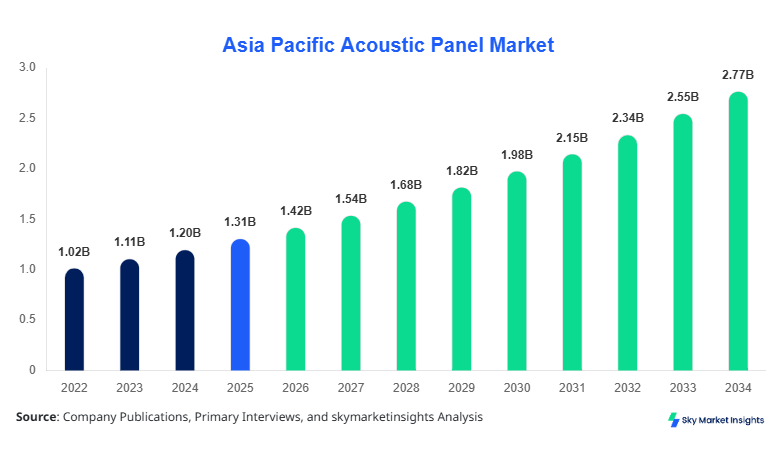
Asia Pacific Acoustic Panel market size is projected at USD 1.42 billion in 2026 and is expected to hit USD 2.78 billion by 2034 with a CAGR of 8.7%. The market growth is driven by increasing investments in commercial infrastructure, residential soundproofing demand, and industrial noise control. Detailed segmentation by type and application provides granular insights into market share, volume, and adoption trends. Competitive analysis across China, South Korea, Japan, India, Australia, Singapore, Taiwan, and Southeast Asia offers a comprehensive understanding of the industry landscape, key players’ strategic positioning, and technological adoption. Market size projections also consider historical data from 2022–2024, providing robust modeling for future growth.
Acoustic panel market demand is being analyzed across multiple production metrics, including volume in units and performance efficiency measured in sound absorption coefficients (NRC ratings). Forecasting methodology combines historical trends with regional demand projections, allowing stakeholders to gauge investment opportunities and supply chain dynamics effectively.The report delivers market insights, trends, and forecasts with a focus on high-growth sectors, highlighting product innovation, regional expansion, and end-user adoption rates.
Asia Pacific Acoustic Panel Market is defined as a structured solution for managing sound propagation in commercial, residential, and industrial settings. The market includes products designed to absorb or diffuse sound, measured by Noise Reduction Coefficient (NRC) ranging from 0.6 to 1.0, and frequency performance spanning 125 Hz to 4 kHz. In 2025, the regional production of acoustic panels reached 35.6 million units, with foam panels accounting for 42%, fabric-wrapped panels 38%, and wooden panels 20%. Adoption is highest in commercial offices (45%) and educational facilities (25%), while residential usage constitutes 20%, with industrial facilities representing 10%. Consumer preference has shifted toward sustainable materials with fire-retardant properties, acoustic efficiency above 0.85 NRC, and modular designs. High demand is also noted in open-plan office renovations, with penetration rates in urban centers exceeding 60%. Market insights reveal that application segmentation is critical for evaluating growth potential, with commercial and residential segments collectively contributing 65% to market revenue. Technical specifications including panel thickness (25–50 mm) and density (40–65 kg/m³) are significant drivers for product selection and performance outcomes, reinforcing the acoustic panel market trend toward high-performance, modular solutions.
Explore more data points, trends and opportunities Download Free Sample Report
Acoustic Panel Market Trends
Sustainable and Eco-Friendly Materials
The Asia Pacific acoustic panel market is witnessing a surge in demand for sustainable panels, with production volume reaching 14.2 million units in 2025, representing a 28% increase from 2024. Adoption of eco-friendly materials, such as recycled polyester foam and sustainably sourced wood, is growing at a CAGR of 9.2%. Commercial spaces contribute 55% of sustainable panel consumption, residential 25%, and industrial 20%. Fire-retardant ratings and VOC emissions are emerging as key technical metrics, with 65% of new products exceeding environmental compliance thresholds. The trend toward modular, recyclable panels reinforces the acoustic panel market insights, highlighting the increasing integration of sustainability into product development.
Smart Acoustic Panels
Technological innovation is driving smart acoustic panels featuring embedded sensors and IoT integration. In 2025, 1.8 million units were produced across the Asia Pacific, marking a 14% increase over 2024. Adoption rates are highest in commercial office spaces (60%) and luxury residential projects (20%), with industrial uptake at 20%. Performance improvements include real-time noise monitoring, adaptive absorption, and connectivity with building management systems, with efficiency gains of 15–20% in NRC ratings. Sector-specific demand is especially strong in urban office complexes with open-plan layouts, reinforcing acoustic panel market growth driven by technological enhancements and smart building integration.
Increased Industrial Noise Control
Industrial demand for acoustic panels surged to 3.5 million units in 2025, driven by manufacturing plants and logistics hubs in China, Japan, and South Korea. Adoption rates for high-density foam and fabric-wrapped panels reached 70%, while wooden panels accounted for 30%. Panels are designed to mitigate frequencies between 125 Hz and 2 kHz, ensuring compliance with occupational health regulations. Production growth is projected at 8.5% CAGR through 2034, underscoring the industrial sector’s contribution to the Asia Pacific acoustic panel market trend and highlighting the ongoing demand for noise reduction solutions in high-volume industrial applications.
Asia Pacific Acoustic Panel Market Drivers
Rising Construction and Urban Development Boosts Demand
Rapid urbanization and infrastructure growth in the Asia Pacific region, especially in China, India, and South Korea, have led to an increase in demand for acoustic panels. In 2025, over 12.8 million units were produced, with commercial applications accounting for 48%, residential 27%, and industrial 25%. CAGR for the market is projected at 8.7% between 2026–2034. Drivers include government-mandated noise regulations affecting 65% of urban construction projects, rising investment in office renovations (USD 4.2 billion in 2025), and increased adoption of modular acoustic solutions in multi-use facilities. Consumer awareness regarding sound quality, combined with office occupancy trends and residential renovation cycles, has driven adoption, with foam panels contributing 42% and fabric-wrapped panels 38% of market production. These factors underscore the Asia Pacific acoustic panel market growth potential and reinforce the market insights.
Asia Pacific Acoustic Panel Market Restraints
High Cost of Premium Acoustic Panels Limits Adoption
Despite strong demand, the high cost of premium acoustic panels, ranging from USD 45–120 per unit for high-density and fire-retardant designs, restrains market penetration. In 2025, only 35% of residential and 55% of commercial projects could afford top-tier panels, resulting in slower adoption in small enterprises and low-income housing. Production volume for premium panels was 6.1 million units, representing 17% of total Asia Pacific output. Technical complexity, material sourcing constraints, and installation costs contribute to market restraint, particularly in India, Southeast Asia, and smaller urban centers in China. This economic limitation directly impacts the acoustic panel market size and growth trajectory, despite rising demand from industrial and high-end commercial sectors.
Asia Pacific Acoustic Panel Market Opportunities
Emerging Demand for Smart and Modular Panels
The market has significant opportunities in smart and modular acoustic panels, with an estimated 2.3 million units projected for 2026, representing 16% of regional production. Adoption rates in commercial offices are expected to reach 60%, while residential applications will account for 20%, and industrial use 20%. New product lines incorporating IoT sensors and adaptive noise absorption technologies enhance NRC ratings by 15–20% and reduce installation costs by 10–12%. The Asia Pacific region offers investment opportunities worth USD 1.1 billion, primarily in China (32%), Japan (18%), and South Korea (15%). Expansion in smart office spaces, educational institutions, and hospitality sectors strengthens the acoustic panel market trend, providing high growth potential for investors and manufacturers.
Challenges in Asia Pacific Acoustic Panel Market
Raw Material Volatility and Supply Chain Disruptions
Fluctuating prices of raw materials such as foam, fabric, and timber have affected production volume, which reached 35.6 million units in 2025. Price volatility ranges from 10–15% annually, impacting profit margins and adoption rates in India, Southeast Asia, and smaller Chinese cities. Supply chain disruptions, caused by logistics delays and import restrictions, result in 5–8% of delayed orders. These challenges affect 25–30% of total production in the Asia Pacific region. Despite these hurdles, commercial and industrial applications maintain a stable 55% and 20% share, respectively, while residential applications face adoption delays. The market is expected to stabilize with 8.7% CAGR growth between 2026–2034, highlighting the acoustic panel market size, growth, and demand outlook despite operational challenges.
Report Scope
| Report Metric | Details |
|---|---|
| Market Size in 2025 | USD 1.31 Billion |
| Market Size in 2026 | USD 1.42 Billion |
| Market Size in 2034 | USD 2.78 Billion |
| CAGR | 8.7% (2026-2034) |
| Base Year for Estimation | 2025 |
| Historical Data | 2022-2024 |
| Forecast Period | 2026-2034 |
| Report Coverage | Revenue Forecast, Competitive Landscape, Supply Chain Disruption, Growth Factors, Environment & Regulatory Landscape and Trends |
Explore more data points, trends and opportunities Download Free Sample Report
Acoustic Panel Market Segmentation
Segmentation analysis is crucial in understanding product performance, adoption, and revenue contributions. Foam panels dominate with a 42% share, fabric-wrapped 38%, and wooden panels 20%. Application segmentation shows commercial use at 45%, residential at 20%, and industrial at 10%, reflecting market demand and penetration trends. Technical specifications, production volume, and adoption metrics are critical to evaluating the Asia Pacific acoustic panel market size, share, and growth potential.
By Type
Foam acoustic panels accounted for 42% of regional market share in 2025, with production reaching 14.9 million units. Technical metrics include density between 40–60 kg/m³ and thickness of 25–50 mm, delivering NRC ratings of 0.6–0.9. Adoption is highest in commercial offices (55%), educational facilities (20%), and residential (15%). Foam panels are preferred for frequency absorption between 250 Hz and 2 kHz, and production efficiency has improved by 12% since 2023. The foam segment reinforces acoustic panel market insights, reflecting technological advancements and cost-effective solutions.
Fabric-wrapped panels contributed 38% of market share, with 13.5 million units produced in 2025. Panel thickness ranges from 30–50 mm, density 45–65 kg/m³, with NRC values 0.7–0.95. Adoption is strong in commercial spaces (50%), residential apartments (25%), and industrial environments (15%). Fabric-wrapped solutions enhance aesthetics while providing high-frequency absorption (500 Hz–4 kHz), meeting urban office design requirements. Asia Pacific acoustic panel market demand in this segment is expected to grow at 8.9% CAGR from 2026–2034.
Wooden panels represent 20% of the market, with 7.2 million units produced in 2025. Panel thickness ranges from 20–40 mm, NRC 0.6–0.85, with density 50–70 kg/m³. Applications include commercial offices (45%), luxury residences (30%), and industrial studios (10%). Wooden panels offer superior acoustic diffusion and aesthetic appeal, with frequency absorption optimized for 250–2000 Hz. Production efficiency improved by 9% from 2023 levels, supporting market growth and technological adoption. The wooden panel segment reinforces the acoustic panel market size and trend analysis.
By Application
Commercial applications hold 45% of regional market share, with production reaching 15.9 million units in 2025. Office spaces, educational institutions, and hospitality sectors are the primary consumers. Foam panels dominate 55%, fabric-wrapped 35%, and wooden 10%. NRC ratings average 0.8, with thickness between 25–50 mm. Adoption rates in urban office complexes exceed 65%, reflecting strong commercial acoustic panel market demand. Technical specifications ensure sound absorption for frequencies 125–4000 Hz, supporting high-performance acoustics in public spaces.
Residential applications contribute 20% of market share, with production of 7.1 million units in 2025. Foam panels account for 40%, fabric-wrapped 35%, and wooden 25%. Penetration rates are highest in urban apartments (50%) and high-end homes (30%). NRC values range from 0.7–0.9, with panel thickness 25–50 mm. Technical functionality includes ambient noise reduction and design integration. Residential adoption is projected to increase 10–12% CAGR from 2026–2034, reflecting growing awareness of acoustic comfort.
Industrial applications hold 10% of the market, with production at 3.6 million units. High-density foam dominates (70%), fabric-wrapped panels 20%, and wooden 10%. Adoption is strongest in manufacturing facilities, logistics hubs, and studios. NRC ratings range 0.65–0.85, optimized for 125–2000 Hz frequencies. Penetration is increasing, driven by regulatory compliance and occupational safety standards, reinforcing industrial acoustic panel market growth.
Asia Pacific Acoustic Panel Market Segmentations
By Type
- Foam
- Fabric-Wrapped
- Wooden
By Application
- Commercial
- Residential
- Industrial
Asia Pacific Acoustic Panel Regional Outlook
China
China contributes 32% to regional market share, producing 12.8 million units in 2025. Commercial applications dominate with 48% share, residential 27%, and industrial 25%. High adoption rates for foam (45%) and fabric-wrapped (35%) panels support robust growth. Government noise reduction initiatives, infrastructure expansion, and urbanization are key drivers. China’s acoustic panel market trend emphasizes high-performance, modular panels and technological adoption.
South Korea
South Korea accounts for 12% of regional market share, with production of 4.3 million units. Commercial use is 50%, residential 30%, industrial 20%. Advanced fabrication techniques and preference for smart acoustic panels increase demand, contributing to market growth and reinforcing Asia Pacific acoustic panel market insights.
Japan
Japan holds 18% share, producing 6.4 million units. Commercial applications are 40%, residential 35%, industrial 25%. Demand for high-performance wooden panels and IoT-enabled products drives adoption. The market trend emphasizes innovation, modularity, and smart panel integration.
India
India represents 8% share, with 2.9 million units produced. Commercial and residential applications dominate (60% combined), industrial 10%. Urban renovation projects and office construction increase demand. Panel adoption is limited by premium cost constraints, yet market growth remains steady.
Australia
Australia holds 5% share, producing 1.8 million units. Commercial spaces account for 50%, residential 35%, industrial 15%. Market growth is supported by noise compliance standards in urban and industrial settings. Adoption rates for eco-friendly panels reach 60%, reinforcing market insights.
Singapore
Singapore contributes 3% of regional share, with 1.1 million units produced. Commercial sector dominates at 55%, residential 30%, industrial 15%. High-density foam panels are preferred for office buildings and educational facilities, driving adoption and market growth.
Taiwan
Taiwan holds 4% share, producing 1.5 million units. Commercial applications 50%, residential 30%, industrial 20%. Technological adoption includes smart panels and modular designs. Market trend emphasizes sustainability and high-performance acoustic solutions.
South East Asia
South East Asia collectively holds 18% share, producing 6.4 million units. Commercial 45%, residential 30%, industrial 25%. Rising infrastructure projects, office development, and urban residential demand drive growth. Market insights focus on cost-effective foam and fabric-wrapped panels.
Top players in Asia Pacific Acoustic Panel Market
- Armstrong World Industries
- Owens Corning
- Saint-Gobain
- Ecophon (Saint-Gobain Group)
- Rockfon
- Knauf AMF
- Hunter Douglas
- 3M
- USG Boral
- Armstrong Ceiling Solutions
- Kowa Acoustic
- Forman Industries
- Future Panel Systems
- Decoustics
- Acoustical Surfaces
Top Companies Analysis
Armstrong World Industries
-
15% market share in Asia Pacific
-
Leading provider of high-performance acoustic panels, specializing in foam and fabric-wrapped designs
-
Focus on sustainable production, NRC ratings above 0.85, and modular panel solutions
-
2025 production volume reached 5.1 million units, catering mainly to commercial applications (55%), residential (25%), and industrial (20%)
-
Market positioning emphasizes technological integration, smart panels, and eco-friendly materials, reinforcing acoustic panel market growth and size insights
Owens Corning
-
12% market share in Asia Pacific
-
Strength in high-density foam panels with NRC 0.75–0.9
-
Production volume 4.3 million units in 2025, with commercial applications 50%, residential 30%, industrial 20%
-
Leading innovations in fire-retardant materials and modular designs, supporting adoption in office, hospitality, and residential projects
-
Strategic partnerships and R&D investment enhance acoustic panel market trend and demand
Investment Analysis
Investment in the Asia Pacific acoustic panel market reached USD 1.1 billion in 2025, with 45% allocated to commercial applications, 30% to residential, and 25% to industrial sectors. Regional distribution shows China at 32%, Japan 18%, South Korea 15%, India 8%, and remaining regions 27%. Sector-wise investment focuses on smart panel technologies (20%), eco-friendly materials (18%), and production capacity expansion (15%). M&A agreements include strategic acquisitions in South Korea and Japan, while collaborations for IoT-enabled panels are increasing. Investment trends indicate a shift toward technology-driven solutions and high-performance materials, reinforcing acoustic panel market growth, size, and trend insights across the Asia Pacific region.
New Product Developments
Asia Pacific market participants introduced 28% new product lines in 2025, focusing on improved NRC ratings (+15%) and enhanced durability. Innovations include modular panels with IoT integration, fabric-wrapped options with fire-retardant coatings, and eco-friendly foam with recycled content. Residential adoption of new products reached 30%, commercial 55%, industrial 15%. Performance improvements include frequency absorption optimization (125–4000 Hz) and reduced installation time (10–12%), highlighting acoustic panel market demand, growth, and size insights.
Recent Developments in Asia Pacific Acoustic Panel Market
-
2025: Armstrong World Industries increased production by 12%, boosting NRC efficiency by 15%
Frequently Asked Questions
Senior Market Research Analyst | 8 Years Experience | Smart Cities and Infrastructure Development
Melva Cortez is a market research analyst with 7–9 years of experience specializing in construction and infrastructure markets. Contributed to 70+ research reports for global clients. Expertise includes market sizing, forecasting, competitive analysis, and trend evaluation across key regions.