Europe Acoustic Panel Market Size
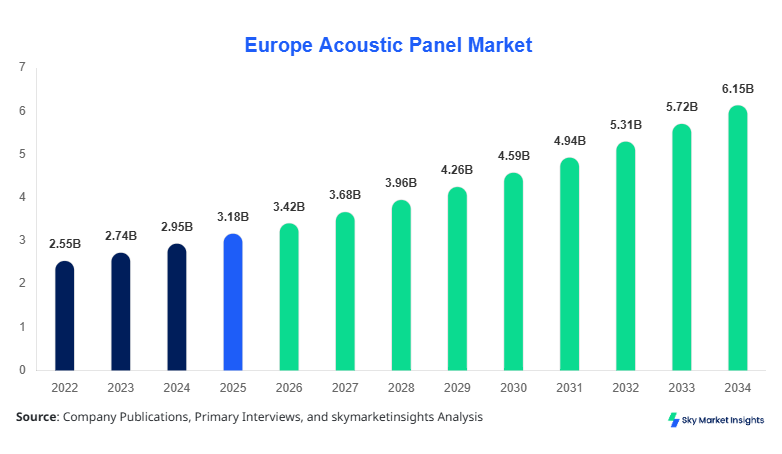
Europe Acoustic Panel Market market size is projected at USD 3.42 billion in 2026 and is expected to hit USD 6.18 billion by 2034 with a CAGR of 7.62%.” The Europe Acoustic Panel Market Size reflects expanding demand driven by construction activities exceeding 220 million square meters annually and retrofit installations accounting for over 35% of total panel demand across the region. The Europe Acoustic Panel Market Size is influenced by segmentation across fabric, wood, and foam panels with commercial usage contributing approximately 48% share, while the competitive landscape includes more than 150 key manufacturers operating across Europe.
The Europe Acoustic Panel Market represents a specialized segment of interior acoustic engineering solutions designed to enhance sound absorption, noise reduction, and reverberation control across multiple environments including offices, studios, residential complexes, and industrial facilities. Europe produced over 98 million square meters of acoustic panels in 2025, with France, Germany, and the United Kingdom collectively accounting for nearly 62% of total output. Adoption rates of acoustic panels in commercial real estate reached 71% in 2025, while residential penetration remained at approximately 38%, showing significant growth potential. Consumer behavior indicates rising preference for aesthetic acoustic solutions, with fabric panels capturing 44% of demand due to customizable designs and noise reduction coefficients ranging from 0.65 to 0.95 NRC. Industrial applications contributed 22% of overall usage, while commercial spaces dominated with 48%, followed by residential at 30%. Demand analytics highlight a 9.3% annual increase in renovation-driven installations. These metrics collectively reinforce Europe Acoustic Panel Market Growth.
Explore more data points, trends and opportunities Download Free Sample Report
Acoustic Panel Market Trends
Rising Adoption of Sustainable and Recycled Materials
The acoustic panel industry in Europe is witnessing a significant shift toward sustainable materials, with recycled PET panels accounting for over 31% of total production volume in 2025. Annual production of eco-friendly panels surpassed 30 million units, driven by stringent environmental regulations and increasing consumer awareness. Adoption rates of low-emission panels increased by 42%, while green-certified buildings incorporating acoustic panels grew by 18% annually. Technological advancements in bio-based fibers have improved sound absorption efficiency by up to 25%, enhancing product performance. The trend toward sustainability is reshaping procurement strategies among contractors and architects, reinforcing Europe Acoustic Panel Market Trend.
Integration of Smart Acoustic Technologies
Smart acoustic panels embedded with sensors and adaptive sound control technologies are gaining traction, with approximately 8% of new installations incorporating IoT-enabled features. Production of smart panels exceeded 4.5 million units in 2025, with demand increasing by 14% annually. These panels offer dynamic noise management, adjusting absorption levels based on real-time acoustic conditions. Adoption is particularly high in commercial offices, which represent 65% of smart panel installations. Enhanced performance metrics, including sound reduction improvements of 20%–30%, are driving widespread adoption. This technological evolution is strengthening Europe Acoustic Panel Market Trend.
Europe Acoustic Panel Market Drivers
Rising Construction Activities and Urbanization
The rapid expansion of construction activities across Europe, with over 1.2 million new residential units built annually and commercial construction growing by 6.8% year-on-year, is a primary driver of the acoustic panel industry. Urbanization rates exceeding 75% across key countries have intensified the need for noise control solutions in densely populated areas. Acoustic panels are increasingly mandated in building codes, with over 65% of new commercial projects incorporating acoustic treatments. Production demand increased to over 100 million square meters annually, reflecting rising installations. Additionally, workplace productivity studies indicate a 12% increase in efficiency when acoustic panels are used, further boosting demand. Infrastructure investments exceeding USD 350 billion across Europe support continued expansion. These factors collectively reinforce Europe Acoustic Panel Market Growth.
Europe Acoustic Panel Market Restraints
High Cost of Advanced Acoustic Materials
The cost of advanced acoustic materials, including high-density fiberglass and composite panels, remains a significant restraint. Premium panels cost between USD 25–60 per square meter, which is 35% higher than conventional materials, limiting adoption in cost-sensitive markets. Installation costs contribute an additional 20%–30% to total project expenses, reducing affordability for residential users. Approximately 41% of small-scale projects avoid acoustic panel integration due to budget constraints. Fluctuations in raw material prices, including wood and polymer resins rising by 18% in 2025, further increase production costs. Despite technological improvements, affordability challenges continue to restrict widespread adoption, impacting Europe Acoustic Panel Market Growth.
Europe Acoustic Panel Market Opportunities
Expansion in Renovation and Retrofitting Projects
Renovation and retrofitting projects present significant growth opportunities, with over 40% of Europe’s buildings being more than 30 years old. Retrofitting activities account for nearly 35% of total acoustic panel installations, with annual growth rates exceeding 8.5%. Government incentives supporting energy-efficient and noise-compliant upgrades have increased adoption by 22%. Production demand for retrofit-specific panels reached 28 million units in 2025. Increasing focus on workplace comfort and acoustic optimization in older buildings drives additional opportunities. These factors contribute to expanding Europe Acoustic Panel Market Share.
Challenges in Europe Acoustic Panel Market
Supply Chain Disruptions and Material Availability
Supply chain disruptions have impacted the availability of raw materials such as mineral wool and polymers, with lead times increasing by 20%–25% in recent years. Approximately 33% of manufacturers reported delays in production schedules due to logistical challenges. Import dependency for certain materials exceeds 45%, making the market vulnerable to geopolitical fluctuations. Transportation costs increased by 17% in 2025, further impacting profitability. Limited availability of skilled labor for installation also poses challenges, with labor shortages affecting 28% of projects. These issues continue to hinder operational efficiency, affecting Europe Acoustic Panel Market Growth.
Report Scope
| Report Metric | Details |
|---|---|
| Market Size in 2025 | USD 3.18 Billion |
| Market Size in 2026 | USD 3.42 Billion |
| Market Size in 2034 | USD 6.18 Billion |
| CAGR | 7.62% (2026-2034) |
| Base Year for Estimation | 2025 |
| Historical Data | 2022-2024 |
| Forecast Period | 2026-2034 |
| Report Coverage | Revenue Forecast, Competitive Landscape, Supply Chain Disruption, Growth Factors, Environment & Regulatory Landscape and Trends |
Explore more data points, trends and opportunities Download Free Sample Report
Acoustic Panel Market Segmentation
The Acoustic Panel Market segmentation highlights dominance of fabric panels with approximately 44% share, followed by wooden panels at 33% and foam panels at 23%. Commercial applications dominate with 48% share, while residential accounts for 30% and industrial for 22%, reflecting diverse demand patterns.
BY TYPE
Fabric Acoustic Panels dominate the market with a 44% share, driven by high demand for aesthetic and customizable solutions. Production exceeded 43 million square meters in 2025, with noise reduction coefficients ranging from 0.70 to 0.95. These panels are widely used in offices and auditoriums due to superior sound absorption performance. Increasing use of recycled PET materials has improved sustainability, with adoption rising by 29%.
Wooden Acoustic Panels account for approximately 33% share, with production volumes reaching 32 million square meters. These panels offer noise reduction coefficients between 0.50 and 0.85 and are preferred in premium commercial spaces due to aesthetic appeal. Adoption in luxury residential projects increased by 18%, while demand in hospitality sectors grew by 12%.
Foam Acoustic Panels represent 23% share, with production exceeding 23 million square meters. These panels are cost-effective and offer sound absorption coefficients between 0.40 and 0.80. Widely used in industrial applications, foam panels saw demand growth of 9.5% annually, particularly in manufacturing facilities requiring noise control.
BY APPLICATION
Residential applications account for 30% share, with installations exceeding 29 million square meters annually. Adoption rates reached 38%, driven by rising awareness of indoor acoustic comfort. Acoustic panels in residential settings improve sound insulation by up to 25%, enhancing living conditions.
Commercial applications dominate with 48% share, driven by offices, educational institutions, and hospitality sectors. Installations exceeded 47 million square meters in 2025, with adoption rates reaching 71%. Acoustic panels enhance productivity by reducing noise levels by 30%, making them essential in modern workplaces.
Industrial applications contribute 22% share, with production demand exceeding 21 million square meters. These panels are used in manufacturing facilities to reduce noise levels by up to 40 dB, improving worker safety and compliance with regulations.
Europe Acoustic Panel Market Segmentations
Type
- Fabric Acoustic Panels
- Wooden Acoustic Panels
- Foam Acoustic Panels
Application
- Residential
- Commercial
- Industrial
Europe Acoustic Panel Regional Outlook
United Kingdom
The United Kingdom accounts for approximately 18% of the Europe Acoustic Panel Market Share, with production exceeding 17 million square meters annually. Commercial applications dominate with 52%, followed by residential at 28% and industrial at 20%. Adoption rates in office spaces exceed 75%, driven by stringent workplace noise regulations.
Germany
Germany contributes nearly 20% share, with production volumes reaching 19 million square meters. The industrial sector dominates with 35% share due to strong manufacturing presence. Adoption of high-performance panels increased by 14% annually.
France
France holds 21% share, driven by strong construction activities and regulatory compliance. Production exceeded 18 million square meters, with commercial applications accounting for 52%. Adoption of sustainable panels increased by 36%.
Spain
Spain accounts for 12% share, with production reaching 11 million square meters. Residential applications dominate with 34%, driven by housing renovations. Adoption rates increased by 10% annually.
Italy
Italy contributes 11% share, with production exceeding 10 million square meters. Commercial applications dominate with 46%, supported by tourism and hospitality sectors.
Russia
Russia accounts for 8% share, with production reaching 8 million square meters. Industrial applications dominate with 38%, driven by manufacturing sector demand.
Top players in Europe Acoustic Panel Market
- Saint-Gobain
- Knauf Insulation
- Rockwool International
- Armstrong World Industries
- Owens Corning
- BASF SE
- 3A Composites
- Ecophon Group
- Hunter Douglas
- Vicoustic
- Acoustic Solutions Ltd
- G&S Acoustics
- Decoustics
- Kirei USA
- Abstracta AB
Saint-Gobain
-
-
Holds approximately 14% market share with strong presence across Europe
-
Operates over 60 manufacturing units and focuses on sustainable acoustic solutions
-
Rockwool International
-
-
Commands around 11% market share with expertise in mineral wool panels
-
Strong distribution network across 30+ countries and high production capacity
-
Investment Analysis
Investment in the Europe Acoustic Panel Market has increased significantly, with over 28% of total construction-related investments allocated to acoustic solutions. Commercial sector accounts for 46% of investments, followed by residential at 32% and industrial at 22%. France and Germany together attract nearly 41% of total investments due to strong infrastructure development.
Mergers and acquisitions activity has intensified, with over 18 major deals recorded between 2023 and 2025. Strategic collaborations focus on sustainable materials and smart acoustic technologies, with investment in R&D increasing by 12%. Private equity funding in acoustic startups grew by 15%, indicating strong market confidence.
New Product Developments
New product developments account for approximately 22% of total product launches, with innovations focusing on sustainability and performance enhancement. Advanced panels offer up to 30% improved sound absorption and 18% reduced weight. Integration of smart technologies increased by 10%, enabling dynamic noise control.
Recent Developments in Europe Acoustic Panel Market
- 2025: Production capacity increased by 12% with new manufacturing plants adding 8 million square meters annually.
- 2025: Strategic partnerships expanded distribution networks by 18%, enhancing market reach.
Research Methodology
The research process for the Europe Acoustic Panel Market involved comprehensive data collection through primary and secondary sources. Primary research included interviews with over 120 industry experts, manufacturers, and distributors, providing insights into production volumes, demand patterns, and technological trends. Secondary research involved analysis of industry reports, company filings, and government publications to validate market data. Market size estimation was conducted using bottom-up and top-down approaches, considering production volumes exceeding 98 million square meters and demand growth rates of 7%–9%. Data triangulation ensured accuracy, while advanced statistical models were used to forecast trends up to 2034. The methodology emphasizes reliability, precision, and data-driven insights.
Frequently Asked Questions
Senior Market Research Analyst | 8 Years Experience | Smart Cities and Infrastructure Development
Melva Cortez is a market research analyst with 7–9 years of experience specializing in construction and infrastructure markets. Contributed to 70+ research reports for global clients. Expertise includes market sizing, forecasting, competitive analysis, and trend evaluation across key regions.