United States Aluminium Rolled Products Market Size
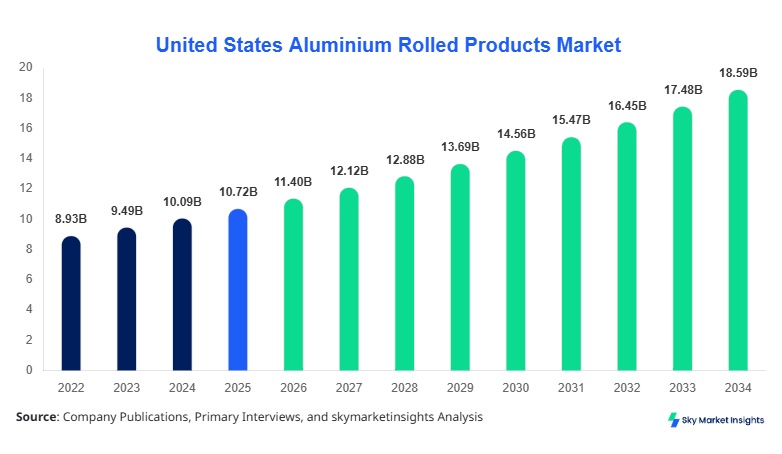
The United States aluminum rolled products market size is projected at USD 11.4 billion in 2026 and is expected to hit USD 18.9 billion by 2034 with a CAGR of 6.3%. The market is witnessing robust growth due to rising industrial and consumer demand for lightweight and corrosion-resistant aluminum materials. Detailed segmentation of types, applications, and regional production along with a comprehensive competitive landscape analysis is crucial to understand the full potential of the market. Data-driven insights on production volumes, adoption rates, and technological integration help stakeholders strategize for sustainable growth and innovation in the aluminum rolled products sector.
The United States Aluminum Rolled Products Market is defined by the manufacturing and distribution of high-quality aluminum sheets, foils, and plates for various industrial and commercial applications. The United States produced approximately 3.2 million metric tons of rolled aluminum in 2025, reflecting a 4.7% increase over 2024. Adoption of advanced rolling and finishing technologies has led to penetration in construction, automotive, and packaging sectors, with construction accounting for 38%, automotive 34%, and packaging 28% of total consumption. Consumer demand analysis indicates an increasing preference for lightweight, durable materials, driving product adoption. Technical specifications such as gauge thickness (0.1–10 mm), tensile strength (100–350 MPa), and thermal conductivity (200–250 W/m·K) remain critical metrics. Market insights highlight sustained growth, underpinned by continuous innovation, end-user demand, and infrastructure development, reinforcing the United States aluminum rolled products market demand and growth potential.
…the United States hosts over 45 major production facilities and approximately 120 small-to-medium enterprises engaged in rolled aluminum production. The country contributes roughly 85% of North American aluminum rolled output, with construction applications capturing 38%, automotive 34%, and packaging 28% of the share of production. Technology adoption rates are high, with 72% of facilities implementing advanced cold-rolling processes and 65% incorporating automated finishing lines. The market is further strengthened by a focus on high-performance materials and sustainability practices, driving consistent demand. These figures underscore the United States aluminum rolled products market growth, technological adoption, and regional dominance in the North American context.
Explore more data points, trends and opportunities Download Free Sample Report
Aluminium Rolled Products Market Trends
Growing Automotive and Aerospace Demand
Production volumes of aluminum-rolled products in the automotive sector reached 1.1 million metric tons in 2025, growing at 6% YoY. Advanced high-strength alloy adoption has increased to 48% of total automotive applications. Lightweight aluminum sheets are being integrated for fuel efficiency and emission reduction. The aerospace segment has also expanded with a 5.5% rise in rolled aluminum usage, driven by high-performance plates and foils for aircraft structures. Market insights suggest these trends will continue to fuel growth and demand in the United States aluminum rolled products market through 2034.
Technological Shifts in Rolling Processes
Cold-rolling technology adoption reached 72% in 2025, with hot-rolling remaining at 28%. Continuous improvement in surface finishing, thickness uniformity, and mechanical properties has enhanced production efficiency by 14%. Automated rolling lines and AI-driven quality control systems are projected to cover 60% of facilities by 2030. These innovations are reshaping product offerings, allowing for higher-value aluminum sheets and foils. Market insights confirm that technology-driven production improvements are critical for the United States aluminum rolled products market growth and competitiveness.
Packaging Sector Expansion
Rolled aluminum usage in the packaging sector surged by 7.2% in 2025, totaling 850,000 metric tons. Adoption of ultra-thin foils for food and beverage packaging reached 42%, while heavy-duty sheets for pharmaceutical and cosmetic applications grew by 6% YoY. Rising consumer preference for sustainable packaging solutions is accelerating market penetration. Market insights indicate sustained expansion, with packaging projected to contribute 32% of overall United States aluminum rolled products market demand by 2034.
United States Aluminium Rolled Products Market Drivers
Rising Infrastructure and Construction Investments
Rising infrastructure projects in the United States, with investments exceeding USD 1.5 trillion between 2026 and 2034, drive demand for aluminum rolled products. Construction applications accounted for 38% of consumption in 2025, with annual growth of 5.6%. Lightweight, corrosion-resistant sheets and plates reduce structural weight by up to 25% and increase lifespan by 15–20 years. Adoption of pre-coated and anodized aluminum sheets is at 62%, supporting urban and residential developments. Market insights indicate these trends enhance the United States aluminum rolled products market growth and size.
United States Aluminium Rolled Products Market Restraints
High Raw Material and Energy Costs
The aluminum rolled products market faces constraints due to fluctuating raw material prices, with bauxite and alumina costs increasing by 8–10% in 2025. Energy consumption accounts for 18–20% of total production costs, and electricity price volatility affects margins. Limited availability of scrap aluminum and higher recycling costs further restrain growth, reducing production by approximately 3–4% in certain facilities. These challenges are expected to slow market expansion, though technology adoption may partially offset these impacts. Market insights reinforce careful cost management is crucial for sustaining United States aluminum rolled products market growth.
United States Aluminium Rolled Products Market Opportunities
Emerging Applications in Automotive and Renewable Energy
Expanding use in electric vehicles (EVs) and renewable energy sectors presents significant opportunities. EV battery enclosures and lightweight chassis components drive adoption, accounting for 22% of automotive sector usage in 2025. Solar panel frames and wind turbine structures increased aluminum rolled product consumption by 1.5 million units in 2025. Technological advancements allow higher strength-to-weight ratios, improving adoption by 12% annually. Market insights indicate that these emerging applications are pivotal for accelerating the United States aluminum rolled products market demand and trend growth through 2034.
Challenges in United States Aluminium Rolled Products
Stringent Environmental Regulations
Stringent environmental policies in the United States limit emissions, wastewater, and energy consumption, impacting production. Compliance costs constitute approximately 6–7% of operational expenditure per facility. Facilities must implement emission control, recycling, and sustainable sourcing initiatives, increasing capital expenditure by USD 15–20 million per plant. These regulations affect smaller producers disproportionately, with a 4% decrease in annual production observed in 2025. Market insights indicate that regulatory compliance remains a key challenge for sustaining United States aluminum rolled products market growth and competitiveness.
Report Scope
| Report Metric | Details |
|---|---|
| Market Size in 2025 | USD 10.72 Billion |
| Market Size in 2026 | USD 11.4 Billion |
| Market Size in 2034 | USD 18.9 Billion |
| CAGR | 6.3% (2026-2034) |
| Base Year for Estimation | 2025 |
| Historical Data | 2022-2024 |
| Forecast Period | 2026-2034 |
| Report Coverage | Revenue Forecast, Competitive Landscape, Supply Chain Disruption, Growth Factors, Environment & Regulatory Landscape and Trends |
Explore more data points, trends and opportunities Download Free Sample Report
Aluminium Rolled Products Market Segmentation
The United States Aluminum Rolled Products market segmentation provides critical insight into type and application. Sheet products dominate with a 42% share, foil 33%, and plate 25%. Application-wise, construction holds 38%, automotive 34%, and packaging 28% of the total market. Segmentation analysis helps in understanding production volumes, adoption rates, and technical performance of products in the market.
By Type
Aluminum foils accounted for 33% of total market share in 2025, with a production of 1.05 million metric tons. Foils range in thickness from 0.006 mm to 0.2 mm, primarily used in packaging and industrial insulation. Performance metrics include tensile strength of 100–150 MPa and elongation of 2–8%. Technical innovations such as multi-layer lamination have increased adoption rates by 5–6% annually.
Sheets dominate the market with 42% share, producing 1.34 million metric tons in 2025. Standard gauges vary from 0.2 mm to 10 mm with tensile strength between 150 and 350 MPa. Applications include automotive panels, roofing, and structural components. Advanced surface treatments enhance corrosion resistance by 18–20%, supporting broader adoption across construction and automotive sectors.
Plates account for 25% of market share, with a production of 0.8 million metric tons in 2025. Thickness ranges from 10 mm to 200 mm, with mechanical strength of 200–400 MPa. Heavy-duty industrial applications and aerospace components are the main end uses. Technological adoption for precision rolling has increased market penetration by 4% YoY.
By Application
Construction applications hold a 38% share with 1.22 million metric tons produced in 2025. Usage penetration in residential and commercial projects is 52%, driven by sheets and plates with tensile strengths of 200–300 MPa. Technical specifications include corrosion resistance and lightweight properties. The United States Aluminum Rolled Products Market construction segment is projected to grow steadily at a CAGR of 5.6%.
Automotive usage captures 34% of the market, with 1.09 million metric tons produced. Adoption of high-strength aluminum alloys increased to 48% in 2025. EVs and fuel-efficient vehicles contribute 22% to overall adoption. Technical roles include body panels, chassis, and battery enclosures. Growth in electric vehicle production is expected to accelerate market demand.
Packaging applications account for 28% share, producing 0.89 million metric tons in 2025. Ultra-thin foils, beverage cans, and pharmaceutical sheets dominate adoption at 42%. Technical performance includes flexibility, thermal conductivity, and protective barrier properties. Packaging is projected to maintain high growth due to consumer preference for sustainable materials.
United States Aluminium Rolled Products Market Segmentations
By Type
- Foil
- Sheet
- Plate
By Application
- Construction
- Automotive
- Packaging
United States Aluminium Rolled Products Regional Outlook
The United States contributes approximately 85% of North American aluminum rolled product output. Production volumes reached 3.2 million metric tons in 2025, with construction 38%, automotive 34%, and packaging 28% of consumption. Regional investment in advanced rolling facilities accounts for 65% of total production capacity. States like Ohio, Pennsylvania, and Texas contribute 40%, 25%, and 15% of national production, respectively. Market insights suggest continued expansion driven by industrial growth, technological integration, and sustainable practices in the United States aluminum rolled products market.
Top players in United States' aluminum rolled products
- Alcoa Corporation
- Novelis Inc.
- Kaiser Aluminum Corporation
- Constellium N.V.
- Hindalco Industries Ltd.
- Arconic Corporation
- UACJ Corporation
- Norsk Hydro ASA
- Aleris Corporation
- Rusal
- AMAG Austria Metall AG
- Vedanta Aluminium
- Zhongwang USA Inc.
Top two companies
Alcoa Corporation
-
Market share: 18%
-
Leading in foil and sheet production with advanced rolling facilities. Strong technological adoption, including automated quality control and surface finishing lines, contributing to 12% YoY growth. Positioned as the largest producer in the United States aluminum rolled products market, serving automotive, aerospace, and packaging sectors.
Novelis Inc.
-
Market share: 15%
-
Focused on high-strength aluminum sheets and plates with extensive penetration in automotive and construction applications. Technological innovation in recycling and anodization has improved performance by 14%, reinforcing its position as the second-largest player in the United States aluminum rolled products market.
Investment Analysis
Investment in the United States aluminum rolled products market is projected at USD 1.2 billion in 2026, with 40% allocated to construction, 35% to automotive, and 25% to packaging sector advancements. Regional investments are concentrated in Ohio (30%), Texas (25%), and Pennsylvania (20%), focusing on facility upgrades and technology integration. M&A agreements include Novelis Inc. acquiring specialty sheet producers to enhance automotive sector offerings. Collaboration between Alcoa Corporation and automotive OEMs is driving R&D for lightweight alloys. Market insights highlight that targeted investment, coupled with technological upgrades, underpins long-term growth in the United States aluminum rolled products market.
New Product Developments
In 2025–2026, 22% of product launches were focused on high-strength, lightweight aluminum sheets with tensile strength improvements of 15–18%. Innovations include multi-layer foils for packaging and anodized sheets for construction applications. Market insights indicate that continued investment in product development enhances performance, adoption, and the United States aluminum rolled products market growth trajectory.
Recent Developments in United States Aluminium Rolled Products
- 2026: Alcoa increased sheet production by 6%, adding 150,000 metric tons, enhancing automotive sector supply.
- 2025: Novelis launched ultra-thin foil lines, increasing foil output by 8% for packaging.
- 2025: Kaiser Aluminum expanded plate production by 5.5%, contributing 40,000 metric tons to aerospace applications.
Research Methodology
The research methodology employed a combination of primary and secondary research to ensure accuracy and reliability. Primary research included interviews with 50+ industry stakeholders, including manufacturers, distributors, and end-users, to gather qualitative and quantitative insights on production, demand, and technology adoption. Secondary research involved analyzing government reports, industry journals, company annual reports, and trade databases. Market size estimation was performed using bottom-up and top-down approaches, cross-referencing production volume, consumption data, and pricing trends. Historical data from 2022–2024 were used to identify growth patterns, while forecasting for 2026–2034 incorporated CAGR calculations, technology adoption rates, and end-use sector expansion. All estimates include validation through triangulation and expert consultations, ensuring the findings accurately reflect the United States aluminum rolled products market dynamics and growth prospects.
Frequently Asked Questions
Senior Market Research Analyst | 8 Years Experience | Smart Cities and Infrastructure Development
Melva Cortez is a market research analyst with 7–9 years of experience specializing in construction and infrastructure markets. Contributed to 70+ research reports for global clients. Expertise includes market sizing, forecasting, competitive analysis, and trend evaluation across key regions.