Europe Aluminium Composite Panel (ACP) Market Size
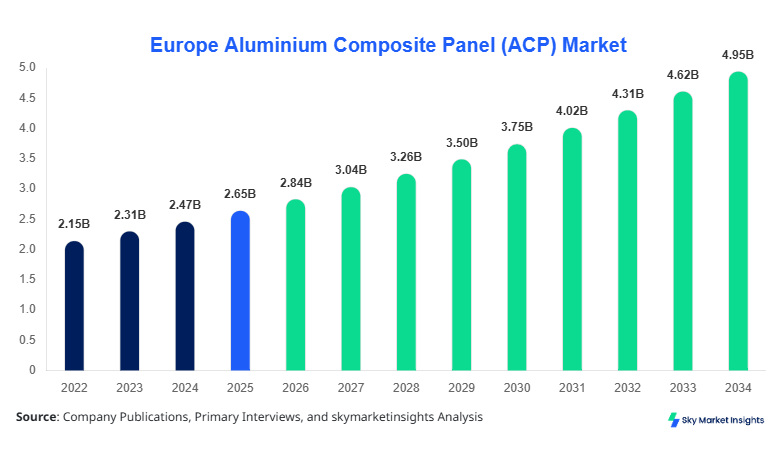
The European Aluminum Composite Panel (ACP) market size is projected at USD 2.84 billion in 2026 and is expected to hit USD 4.96 billion by 2034 with a CAGR of 7.2%.
The European Aluminum Composite Panel (ACP) market is witnessing substantial expansion due to increasing investments in modern infrastructure, commercial renovation projects, lightweight construction materials, and sustainable façade technologies across Europe. Rising urban redevelopment activities in France, Germany, and the United Kingdom are supporting the installation of over 162 million square meters of ACP materials annually across residential and commercial sectors. Market participants are focusing heavily on production optimization, digital coating systems, and high-performance fire-resistant core technologies to improve efficiency and compliance with European fire safety standards. The competitive landscape includes multinational manufacturers, regional processors, coating technology providers, and façade engineering companies operating across more than 340 production and distribution facilities in Europe.
The Aluminum Composite Panel (ACP) market refers to the manufacturing, distribution, and installation of multilayer composite panels consisting of two aluminum sheets bonded to a non-aluminum core material such as polyethylene or mineral-filled fire-retardant compounds. These panels are extensively utilized for external cladding, architectural facades, transportation interiors, signage systems, modular structures, and industrial insulation applications. Europe produced nearly 188 million square meters of ACP products in 2025, with France accounting for approximately 22% of regional production capacity. Adoption levels across commercial infrastructure projects exceeded 68% in metropolitan regions due to the lightweight structure, corrosion resistance, thermal insulation efficiency of 0.021 W/mK, and improved weather durability exceeding 20 years of operational lifespan.
Consumer behavior patterns indicate increasing demand for aesthetically advanced ACP solutions with antimicrobial coatings, UV resistance, and low-emission surface treatments. More than 54% of developers in Europe preferred fire-rated ACP systems in 2025 due to stricter EN 13501 fire regulations, while nearly 46% of end users selected fluorocarbon-coated ACP panels for high-rise construction projects. Building & construction applications contributed nearly 63% of total demand, transportation accounted for 21%, and advertising applications represented approximately 11% of installations across Europe. Increasing retrofitting activities, smart city projects, and demand for recyclable construction materials continue to reinforce Europe's Aluminum Composite Panel (ACP) market expansion.
In France, the Aluminum Composite Panel (ACP) market accounted for nearly 28% of regional consumption volume in 2025 owing to extensive investments in commercial construction, transportation infrastructure, and green building redevelopment programs. France operates more than 52 ACP fabrication and coating facilities with combined annual processing capacity exceeding 41 million square meters. Paris, Lyon, Marseille, and Toulouse collectively represented over 61% of national ACP installations due to urban redevelopment initiatives and energy-efficient building mandates. Building façade applications accounted for nearly 66% of total ACP utilization, while transportation interiors contributed 19% and advertising structures represented approximately 9%.
Technology adoption in France remains highly advanced, with more than 58% of newly installed ACP materials incorporating fire-retardant mineral cores and 44% utilizing PVDF-coated surfaces for superior weather protection. Automated CNC fabrication technologies improved processing efficiency by nearly 18% across major manufacturers during 2025. Additionally, demand for recyclable ACP products increased by 31% due to circular economy regulations and carbon neutrality targets. The French Aluminum Composite Panel (ACP) market continues to strengthen through sustainable architectural investments and modernization projects.
Explore more data points, trends and opportunities Download Free Sample Report
Aluminium Composite Panel (ACP) Market Trends
Increasing Adoption of Fire-Resistant ACP Systems
The European ACP industry is experiencing accelerated adoption of fire-resistant aluminum composite materials across commercial and residential high-rise projects. More than 71 million square meters of fire-rated ACP panels were installed in Europe during 2025, representing nearly 38% of total market volume. France, Germany, and the United Kingdom collectively contributed over 64% of fire-resistant ACP demand due to stricter façade safety regulations and urban redevelopment projects. Manufacturers are increasingly incorporating mineral-filled cores containing over 82% non-combustible materials to meet EN fire safety classifications. Additionally, advanced fluoropolymer coatings improved UV resistance by nearly 27% while extending façade durability beyond 25 years. Smart manufacturing technologies reduced production waste by approximately 14% across leading ACP production facilities. Rising demand from airports, metro stations, hospitals, and educational institutions continues accelerating the aluminum composite panel (ACP) market expansion.
Expansion of Sustainable and Recyclable ACP Production
Sustainability initiatives are transforming ACP manufacturing processes across Europe as manufacturers prioritize recyclable aluminum structures and low-emission coatings. More than 48% of ACP products launched in 2025 incorporated recycled aluminum content exceeding 35% by weight. Germany and France together invested over USD 340 million in sustainable ACP processing technologies and recycling systems during the year. Energy-efficient coil coating systems reduced VOC emissions by approximately 22%, while lightweight ACP panels improved transportation fuel efficiency by nearly 11% in commercial logistics applications. Demand for eco-certified ACP systems increased by 33% among green building developers and LEED-certified projects. Construction firms increasingly prefer lightweight façade materials capable of reducing overall structural load by 28% compared with conventional cladding systems. Sustainability-driven procurement strategies continue reinforcing Aluminium Composite Panel (ACP) market adoption across Europe.
Growth in Digital Printing and Architectural Customization
Architectural customization and digital façade technologies are becoming significant trends across the European ACP ecosystem. Nearly 39% of commercial developers in Europe adopted digitally printed ACP facades for branding, decorative structures, and customized urban aesthetics during 2025. Digital coating technologies improved image durability by 24% while reducing production turnaround time by approximately 19%. Advertising and signage applications consumed over 18 million square meters of ACP materials in 2025 due to lightweight structure and weather-resistant properties. Smart CNC cutting technologies enabled precision fabrication accuracy of up to 0.2 mm across complex architectural designs. Transportation applications utilizing customized ACP interiors increased by 16% across railway and electric vehicle segments. These innovations are positively influencing Aluminum Composite Panel (ACP) market development across multiple end-user sectors.
Europe Aluminium Composite Panel (ACP) Market Drivers
Rapid Growth in Commercial Infrastructure and Urban Redevelopment Activities
Commercial infrastructure expansion across Europe remains a primary growth catalyst for ACP demand. Europe registered over 4,200 large-scale commercial redevelopment projects in 2025, requiring approximately 96 million square meters of façade cladding materials. France alone invested nearly USD 58 billion in urban modernization and public infrastructure programs, contributing substantially to ACP installation growth. Lightweight ACP structures reduce building dead load by approximately 35% compared with stone cladding alternatives, improving structural efficiency and installation speed. More than 63% of commercial developers selected ACP systems due to superior thermal insulation and low maintenance requirements. Additionally, automated façade fabrication technologies improved installation productivity by nearly 21%, reducing project completion timelines across commercial construction projects. Sustainable building mandates and energy-efficient renovation programs across Germany, France, and Italy are accelerating ACP adoption in hospitals, airports, shopping centers, and office complexes. Increasing demand for modern architectural aesthetics and durable façade solutions continues strengthening Europe's Aluminum Composite Panel (ACP) market performance.
Europe Aluminium Composite Panel (ACP) Market Restraints
Volatility in Aluminium Prices and Strict Regulatory Compliance
Fluctuating raw material costs and stringent environmental regulations continue restraining market expansion across Europe. Aluminum prices increased by nearly 14% during 2025 due to energy supply disruptions and supply chain volatility, significantly affecting ACP manufacturing margins. Core material costs also rose by approximately 11%, increasing overall production expenses across regional processors. More than 46% of small and medium ACP manufacturers reported operational cost pressure associated with emission control systems and recycling compliance standards. Fire safety certifications under EN 13501 and REACH chemical regulations require extensive testing procedures that increase compliance expenditures by nearly 9% annually. Additionally, transportation costs for ACP products rose by approximately 12% across Eastern European supply routes due to fuel price fluctuations and logistics bottlenecks. Import competition from low-cost Asian ACP suppliers also intensified pricing pressure within European distribution networks. These operational and regulatory challenges continue impacting Europe's aluminum composite panel (ACP) market expansion.
Europe Aluminium Composite Panel (ACP) Market Opportunities
Expansion of Green Building and Sustainable Construction Programs
Growing emphasis on sustainable infrastructure presents substantial opportunities for ACP manufacturers across Europe. More than 44% of newly approved commercial buildings in Europe during 2025 incorporated green certification standards requiring energy-efficient façade materials. ACP systems capable of reducing building energy consumption by approximately 18% are increasingly preferred across smart city projects and eco-friendly residential developments. France, Germany, and the United Kingdom collectively allocated over USD 92 billion toward sustainable construction and renovation projects between 2026 and 2030. Recyclable ACP structures containing up to 90% reusable aluminum material are gaining significant traction among environmentally conscious developers. Solar-integrated ACP panels and low-emission coating technologies are emerging as high-growth innovation segments within the market. Advanced antibacterial ACP systems for healthcare facilities increased demand by nearly 23% due to hygiene-focused infrastructure investments. These sustainability-focused initiatives continue creating long-term opportunities within the European Aluminum Composite Panel (ACP) market.
Challenges in Europe's Aluminum Composite Panel (ACP) Market
Competition from Alternative Cladding Materials and Recycling Complexities
Competition from fiber cement boards, high-pressure laminates, and advanced ceramic façade systems remains a major challenge for ACP suppliers across Europe. Alternative façade materials captured nearly 29% of commercial cladding demand in 2025 due to fire safety concerns and material diversification strategies. Additionally, recycling multilayer ACP systems remains technically challenging because of bonded core separation processes requiring specialized equipment and additional energy consumption. Only approximately 42% of post-consumer ACP waste generated in Europe underwent advanced recycling treatment during 2025. Environmental advocacy groups and regulatory agencies continue scrutinizing non-recyclable polyethylene-core ACP systems, creating uncertainty for conventional product segments. Transportation disruptions and rising electricity costs increased ACP processing expenditures by nearly 13% across several European production clusters. Market participants are also facing workforce shortages in advanced fabrication and façade engineering disciplines, particularly in Germany and Italy. These structural and operational barriers continue influencing Europe's Aluminum Composite Panel (ACP) market competitiveness.
Report Scope
| Report Metric | Details |
|---|---|
| Market Size in 2025 | USD 2.63 Billion |
| Market Size in 2026 | USD 2.84 Billion |
| Market Size in 2034 | USD 4.96 Billion |
| CAGR | 7.2% (2026-2034) |
| Base Year for Estimation | 2025 |
| Historical Data | 2022-2024 |
| Forecast Period | 2026-2034 |
| Report Coverage | Revenue Forecast, Competitive Landscape, Supply Chain Disruption, Growth Factors, Environment & Regulatory Landscape and Trends |
Explore more data points, trends and opportunities Download Free Sample Report
Aluminium Composite Panel (ACP) Market Segmentation
The ACP market segmentation is categorized by type and application, with fire-resistant panels dominating nearly 47% of total demand due to increasing safety regulations. Building & construction applications accounted for approximately 63% of overall installations across Europe in 2025, followed by transportation at 21% and advertising at 11%. Lightweight panel technologies with thickness ranging from 3 mm to 6 mm represented more than 72% of production output across regional manufacturing facilities.
By Type
Fire-resistant ACP panels represented nearly 47% of Europe's ACP consumption in 2025 due to strict façade safety standards across high-rise infrastructure projects. These panels generally contain mineral-filled cores with non-combustible content exceeding 80%, achieving enhanced thermal stability and fire classification compliance. Europe produced over 88 million square meters of fire-resistant ACP materials during the year. France and Germany together accounted for approximately 56% of total fire-rated ACP demand due to modernization of commercial buildings and transportation hubs. Advanced PVDF coating systems improved weather resistance by nearly 29% while extending operational lifespan beyond 25 years. Demand for these panels is increasing significantly within airports, hospitals, railway stations, and government infrastructure projects where fire protection requirements remain critical.
Antibacterial ACP panels accounted for approximately 18% of total market installations in 2025 due to rising demand from healthcare, pharmaceutical, and food processing facilities. These ACP systems incorporate antimicrobial silver-ion or copper-based coatings capable of reducing bacterial growth by more than 96% within 24 hours. Europe manufactured nearly 31 million square meters of antibacterial ACP materials during 2025. Hospitals and medical infrastructure represented over 61% of antibacterial ACP consumption across France, Germany, and Italy. Increased healthcare modernization spending and hygiene compliance requirements accelerated product adoption by approximately 22% during the year. Lightweight panel structures also improved installation efficiency by nearly 17% across modular healthcare construction projects.
Conventional ACP panels continued representing approximately 35% of total market demand across advertising, low-rise construction, and transportation applications. These panels generally utilize polyethylene cores and standard polyester coatings, offering cost-effective façade solutions with panel thickness ranging between 3 mm and 5 mm. More than 69 million square meters of conventional ACP products were produced in Europe during 2025. Advertising structures and signage applications consumed nearly 28% of conventional ACP volume due to ease of fabrication and lightweight properties. Transportation interiors represented another 24% of utilization, particularly within buses, rail systems, and commercial vehicle structures. Despite growing regulatory pressure, conventional ACP systems continue maintaining stable demand across price-sensitive infrastructure projects.
By Application
Building & construction remained the largest application segment, accounting for nearly 63% of total ACP installations across Europe in 2025. More than 118 million square meters of ACP materials were utilized in commercial buildings, residential towers, educational institutions, and public infrastructure projects. ACP systems reduce structural weight by approximately 30% compared with stone or concrete façade alternatives while improving insulation efficiency and weather durability. France, Germany, and the United Kingdom collectively contributed over 65% of building-related ACP demand due to increasing urban redevelopment programs and energy-efficient construction initiatives. Fire-resistant ACP products represented nearly 58% of total building installations due to evolving European safety regulations. Growing investments in smart buildings and sustainable architecture continue driving this application segment.
Transportation applications represented approximately 21% of Europe ACP demand in 2025. ACP panels are extensively utilized in railway interiors, electric buses, metro systems, marine cabins, and airport terminals because of lightweight performance, corrosion resistance, and acoustic insulation characteristics. Europe consumed nearly 39 million square meters of transportation-grade ACP products during the year. Lightweight ACP structures improved fuel efficiency by approximately 9% across commercial transport applications while reducing maintenance costs by nearly 16%. France and Germany together accounted for over 52% of transportation ACP installations due to railway modernization and electric mobility initiatives. Advanced honeycomb-core ACP technologies are increasingly adopted within high-speed rail and aerospace support infrastructure applications.
Advertising applications accounted for nearly 11% of overall ACP consumption across Europe during 2025. More than 20 million square meters of ACP materials were utilized in billboards, retail signage, digital display structures, and exhibition installations. ACP sheets offer superior printability, dimensional stability, and weather resistance, making them highly suitable for outdoor advertising systems. Digital printing adoption on ACP surfaces increased by approximately 24% during the year due to growing retail branding investments. France, Spain, and Italy collectively contributed over 48% of advertising-related ACP demand. Lightweight ACP structures also improved installation speed by nearly 19% across modular signage systems. Demand from sports arenas, shopping complexes, and transportation terminals continues supporting this application segment.
Europe Aluminium Composite Panel (ACP) Market Segmentations
Type
- Fire-Resistant Panels
- Antibacterial Panels
- Conventional Panels
Application
- Building & Construction
- Transportation
- Advertising
Europe Aluminium Composite Panel (ACP) Market Regional Outlook
United Kingdom
The United Kingdom accounted for approximately 17% of Europe's ACP consumption during 2025 due to increasing commercial redevelopment projects and transportation infrastructure investments. More than 31 million square meters of ACP materials were installed across the country during the year. London represented nearly 43% of national demand owing to high-rise office renovations, mixed-use developments, and public transportation modernization projects. Building & construction applications contributed approximately 67% of UK ACP demand, followed by transportation at 18% and advertising at 9%. Fire-resistant ACP systems represented over 61% of national installations due to evolving building safety regulations. Increasing adoption of recyclable ACP products and sustainable coating systems continues driving market development across the United Kingdom.
Germany
Germany represented nearly 24% of Europe's ACP demand in 2025, supported by advanced manufacturing capabilities and strong industrial infrastructure investments. The country produced more than 44 million square meters of ACP materials during the year across over 70 processing and coating facilities. Commercial infrastructure and industrial building applications accounted for approximately 59% of Germany’s ACP consumption, while transportation applications represented 24%. Lightweight ACP systems improved installation productivity by nearly 18% across modular construction projects. Germany also leads Europe in sustainable ACP recycling technologies, with approximately 51% of post-industrial ACP waste undergoing advanced material recovery processes. Increasing demand for low-emission façade systems continues strengthening regional market expansion.
France
France remained the dominant country within the regional ACP industry, accounting for approximately 28% of Europe's market volume during 2025. The country consumed nearly 52 million square meters of ACP materials across residential, commercial, and transportation sectors. Commercial façade applications represented approximately 66% of ACP demand, while transportation and advertising contributed 19% and 9%, respectively. France invested over USD 14 billion in energy-efficient building renovation programs during 2025, significantly supporting ACP installations. Fire-resistant ACP products accounted for approximately 58% of national consumption. Increasing investments in metro expansion, airports, hospitals, and smart city infrastructure continue reinforcing market expansion across France.
Spain
Spain contributed approximately 11% of Europe's ACP demand during 2025 due to increasing tourism infrastructure projects and commercial modernization activities. The country consumed over 21 million square meters of ACP materials during the year. Hospitality and retail infrastructure represented nearly 39% of national ACP installations, while transportation accounted for 17%. Digital signage applications utilizing ACP structures increased by approximately 21% due to tourism-focused retail branding investments. Lightweight ACP systems also reduced construction time by nearly 14% across modular commercial developments. Sustainable building programs and increasing investments in solar-integrated façade systems continue supporting Spain’s ACP market development.
Italy
Italy represented approximately 10% of Europe's ACP demand in 2025 owing to extensive architectural restoration projects and transportation infrastructure investments. More than 19 million square meters of ACP materials were installed across commercial buildings, railway stations, and retail developments during the year. Decorative ACP facades accounted for nearly 42% of national demand due to emphasis on architectural aesthetics and modern urban design. Transportation applications represented approximately 23% of ACP consumption. Italy also experienced a 16% increase in demand for antibacterial ACP systems across healthcare and hospitality sectors. Growing renovation projects and smart infrastructure investments continue supporting market expansion across Italy.
Russia
Russia accounted for approximately 8% of Europe's ACP consumption during 2025 despite ongoing economic and supply chain challenges. More than 15 million square meters of ACP materials were utilized across commercial and industrial infrastructure projects during the year. Industrial facilities and transportation terminals represented nearly 37% of ACP demand, while commercial buildings contributed 34%. Domestic ACP manufacturing increased by approximately 13% to reduce import dependency and improve regional supply chain resilience. Fire-resistant ACP systems represented approximately 41% of national installations due to updated industrial safety standards. Infrastructure modernization initiatives and urban commercial development projects continue supporting ACP demand across Russia.
Top players in Europe's Aluminium Composite Panel (ACP) Market
- Alubond Europe
- 3A Composites
- Alstrong Enterprises
- Mulk Holdings
- Arconic Corporation
- Jyi Shyang Industrial
- Mitsubishi Chemical Group
- Reynobond Europe
- Aludecor Lamination
- Vitrabond Europe
- Eurobond ACP
- Almaxco
- Alstone Industries
- Alucoil
- Seven Panel Group
3A Composites
-
Estimated regional share: 14%
-
Strong presence across façade and transportation applications
-
Operates advanced production facilities across Germany and Switzerland
-
Focuses heavily on fire-resistant ACP technologies and sustainable coatings
3A Composites remains one of the largest ACP manufacturers across Europe, with annual production exceeding 28 million square meters. The company specializes in high-performance fire-rated façade systems utilized across airports, commercial towers, and public infrastructure projects. Approximately 62% of its European revenue is generated from building & construction applications, while transportation contributes nearly 23%. The company increased investments in recyclable ACP manufacturing technologies by approximately 19% during 2025. Advanced coating systems and digital fabrication capabilities continue strengthening its competitive positioning across the Europe ACP industry.
Arconic Corporation
-
Estimated regional share: 11%
-
Leading supplier for architectural façade systems
-
Strong penetration across France and the United Kingdom
-
Extensive focus on sustainable aluminium processing technologies
Arconic Corporation maintains strong market positioning through technologically advanced ACP systems designed for high-rise commercial infrastructure and transportation projects. The company supplies ACP materials across more than 27 European countries and operates integrated coating and fabrication facilities with combined output exceeding 19 million square meters annually. Approximately 57% of its ACP demand originates from commercial façade installations, while transportation applications account for nearly 21%. Arconic invested heavily in low-emission aluminum processing technologies capable of reducing carbon intensity by approximately 16%. Its sustainable manufacturing initiatives continue supporting long-term competitiveness within Europe.
Investment Analysis
Investment activities across the European ACP industry accelerated substantially during 2025 as manufacturers prioritized sustainable production, fire-resistant technologies, and digital fabrication systems. More than USD 1.6 billion was allocated toward ACP production modernization projects across Europe during the year. Approximately 42% of total investments targeted fire-resistant ACP manufacturing capacity expansion, while 28% focused on recyclable aluminum processing systems. France and Germany together attracted nearly 54% of all regional ACP-related investments due to infrastructure redevelopment and sustainability mandates. Automated coil coating facilities improved production efficiency by approximately 17%, while robotic panel fabrication systems reduced waste generation by nearly 13%.
Mergers, acquisitions, and collaborative agreements also increased significantly across the ACP ecosystem. More than 18 strategic partnerships were announced during 2025 involving façade engineering firms, aluminum suppliers, and coating technology developers. Cross-border acquisitions represented approximately 31% of total investment transactions across the market. Companies increasingly collaborated with green building developers and urban infrastructure authorities to secure long-term supply agreements. Sustainable ACP innovations incorporating recycled aluminum content above 50% attracted substantial institutional investment from environmentally focused infrastructure funds. The transportation sector accounted for approximately 19% of ACP-related investments, particularly within electric mobility infrastructure and railway modernization projects.
Growing adoption of modular construction systems and smart building technologies is expected to create additional investment opportunities across Europe between 2026 and 2034. Lightweight ACP systems capable of improving building energy efficiency by nearly 18% remain highly attractive for public infrastructure projects and energy-efficient retrofitting programs.
New Product Developments
ACP manufacturers across Europe introduced several advanced product categories during 2025 focused on fire safety, sustainability, and antimicrobial functionality. More than 26% of newly launched ACP products incorporated high-mineral fire-retardant cores capable of achieving enhanced thermal resistance and improved structural integrity. Advanced nano-coating technologies improved surface durability by approximately 21% while reducing maintenance requirements by nearly 17%. Solar-reflective ACP systems capable of reducing façade heat absorption by approximately 14% gained increasing adoption across commercial infrastructure projects.
Manufacturers also expanded antibacterial ACP portfolios for healthcare and pharmaceutical infrastructure applications. More than 18% of new ACP product launches targeted hygiene-sensitive environments utilizing antimicrobial coating systems capable of reducing bacterial accumulation by over 95%. Lightweight honeycomb-core ACP systems improved structural strength-to-weight ratios by approximately 24%, supporting increased adoption across transportation applications and modular infrastructure projects.
Recent Developments in Europe: Aluminum Composite Panel (ACP)
- 2025: 3A Composites expanded its Germany production facility by 16%, increasing annual ACP manufacturing capacity by approximately 4.5 million square meters. The expansion focused heavily on fire-resistant ACP systems for commercial infrastructure projects across France and the United Kingdom. Advanced robotic fabrication systems improved operational efficiency by nearly 18% while reducing production waste generation by approximately 12%.
- 2025: Arconic Corporation introduced a recyclable ACP portfolio utilizing over 52% recycled aluminum content. The new product line improved carbon emission reduction by nearly 19% compared with conventional ACP systems. The company reported a 14% increase in European façade project orders following the launch of its sustainable ACP range targeting green commercial developments.
- 2025: Alucoil introduced lightweight honeycomb-core ACP systems for transportation and modular construction applications. The product reduced structural weight by approximately 27% while improving panel rigidity and acoustic insulation performance. Demand from railway modernization and elec"
Frequently Asked Questions
Senior Market Research Analyst | 8 Years Experience | Smart Cities and Infrastructure Development
Melva Cortez is a market research analyst with 7–9 years of experience specializing in construction and infrastructure markets. Contributed to 70+ research reports for global clients. Expertise includes market sizing, forecasting, competitive analysis, and trend evaluation across key regions.