North America Acoustical Ceiling Tiles Market Size
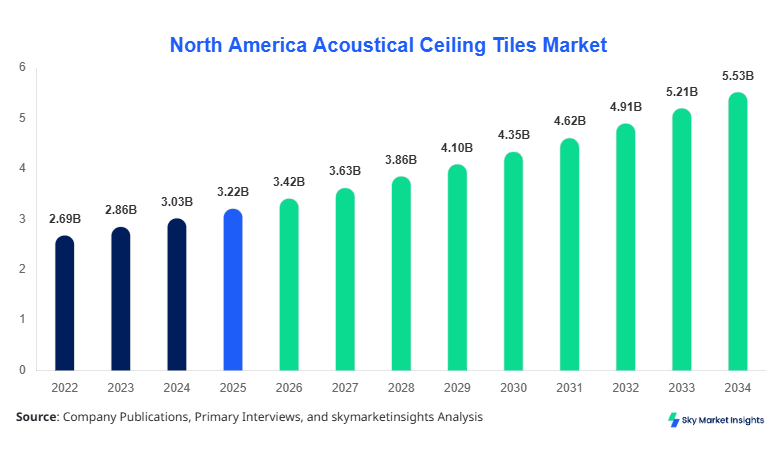
North America's acoustical ceiling tiles market size is projected at USD 3.42 billion in 2026 and is expected to hit USD 5.86 billion by 2034 with a CAGR of 6.2%. The demand for detailed market insights, segmentation analysis, and competitive landscape data is crucial for investors and stakeholders seeking to understand growth trajectories, technology adoption, and regional variations. The market report emphasizes granular data on production volume, material type performance, end-user adoption rates, and revenue contribution by sub-segments across North America.
The North American Acoustical Ceiling Tiles Market refers to the production, distribution, and application of sound-absorbing ceiling tiles in residential, commercial, and industrial settings. The region produced approximately 2.15 billion units of acoustical ceiling tiles in 2025, with the United States contributing 78% and Canada 22%. Adoption rates in commercial buildings account for 54% of the regional penetration, while residential projects represent 32% and industrial usage 14%. Consumer behavior indicates a growing preference for mineral fiber and gypsum-based tiles due to their acoustic performance, thermal insulation (NRC ratings 0.6–0.9), and fire resistance. The market exhibits application-based segment contributions: commercial (54%), residential (32%), and industrial (14%), with technical metrics such as sound absorption coefficients ranging from 0.5 to 0.85 and ceiling panel thickness between 0.5 and 1.0 inch. These insights underscore the ongoing demand, growth, and trend in the North American acoustical ceiling tiles market.
The United States acoustical ceiling tile market is dominated by over 120 manufacturing facilities and 45 key regional companies, accounting for 78% of North America’s market share. Commercial building applications constitute approximately 58% of demand, while residential and industrial applications contribute 30% and 12%, respectively. Advanced technologies such as high-density mineral fiber tiles, perforated metal panels, and gypsum composites have seen adoption rates of 62% in new construction projects and retrofitting initiatives. Production volumes reached 1.68 billion units in 2025, representing a 4.5% increase from 2024. Consumer preference toward acoustical performance (NRC 0.7–0.85), combined with thermal and fire performance metrics, drives further penetration in both urban and suburban construction projects. The market in the United States continues to witness high demand, robust growth, and emerging trends within the North American acoustical ceiling tiles market.
Explore more data points, trends and opportunities Download Free Sample Report
Acoustical Ceiling Tiles Market Trends
Shift Toward Sustainable Materials
The North American Acoustical Ceiling Tiles Market is witnessing a significant shift toward eco-friendly and sustainable materials, including recycled mineral fibers and low-VOC gypsum tiles. Production volume of sustainable tiles reached 620 million units in 2025, up from 520 million units in 2024, reflecting a 19% year-on-year increase. Adoption rates for these materials in commercial and institutional projects now exceed 45%, indicating rising environmental awareness and regulatory compliance mandates. Architects and designers increasingly favor tiles with higher NRC (0.75–0.85) and thermal insulation properties, driving the market trend toward high-performance acoustic solutions. These dynamics highlight the growing demand and market growth for acoustical ceiling tiles.
Integration with Smart Building Technologies
The integration of acoustical ceiling tiles with smart building systems, including IoT-enabled sensors for sound monitoring and HVAC optimization, has transformed application patterns. Approximately 28% of commercial and institutional projects adopted such integrated solutions in 2025, with production volumes exceeding 220 million units. Energy efficiency and automated acoustic control are key drivers, improving building comfort while maintaining regulatory compliance for indoor environmental quality. This trend reinforces the growth, size, and demand for the North American acoustical ceiling tiles market.
Demand in Renovation and Retrofit Projects
Renovation and retrofitting projects are fueling demand for modular and easy-to-install acoustical ceiling tiles. Production volumes for retrofit-specific panels reached 350 million units in 2025, with adoption rates of 33% in commercial renovations and 21% in residential retrofits. High-performance mineral fiber tiles, metal panels with perforations, and gypsum composites are preferred due to rapid installation and minimal downtime. This trend underscores sustained growth and increasing market insights in the North American Acoustical Ceiling Tiles market.
North American Acoustical Ceiling Tiles Market Drivers
Rising Construction Investments Boost Market Demand
Increasing investments in commercial and institutional construction in North America are driving the acoustical ceiling tile market growth. The region witnessed construction spending of USD 1.25 trillion in 2025, with commercial projects accounting for 48% and residential 38%. Rising awareness of acoustic performance, NRC values ranging from 0.6–0.85, and aesthetic considerations have spurred demand for mineral fiber and gypsum-based tiles. Adoption rates of high-performance ceiling tiles are over 60% in urban commercial centers. Production volumes reached 2.15 billion units in 2025, representing a 5% year-over-year growth. These drivers highlight the growth, demand, and insights for the North American acoustical ceiling tiles market.
North American Acoustical Ceiling Tiles Market Restraints
High Raw Material Costs Hinder Market Expansion
Volatility in raw material pricing, especially mineral fiber and aluminum, restrains the North American acoustical ceiling tiles market. Prices for mineral fiber fluctuated between USD 450 and 550 per ton in 2025, while gypsum costs averaged USD 200–250 per ton. High costs limit penetration in mid-scale residential projects, which represent 32% of regional demand. Production volumes grew modestly by 3.5% to 2.15 billion units in 2025. Adoption of alternative cost-effective solutions, like PVC and polystyrene panels, is limited to 12% of market applications. These financial challenges constrain the growth and demand within the North American acoustical ceiling tile market.
North American Acoustical Ceiling Tiles Market Opportunities
Smart and Modular Tile Adoption Presents Growth Potential
The adoption of smart acoustical ceiling tiles and modular systems provides significant opportunities in North America. Production volume of modular panels reached 420 million units in 2025, capturing 19% of total production. IoT-enabled tiles with integrated acoustic sensors show adoption growth of 27% in commercial and industrial sectors. Retrofit projects constitute 21% of total applications, with high adoption of metal and gypsum composites. These innovations enable better energy management, acoustic comfort, and design flexibility. The opportunity reinforces demand, growth, and insights in the North American Acoustical Ceiling Tiles Market.
Challenges in North America: Acoustical Ceiling Tiles Market
Regulatory Compliance and Installation Complexity
Compliance with regional fire safety, indoor air quality, and acoustic standards challenges manufacturers and installers. Approximately 62% of commercial projects in North America require high NRC-rated mineral fiber panels, while industrial buildings demand flame-retardant gypsum tiles (14% adoption). Installation complexity, particularly for large metal panels exceeding 120 square feet, increases labor costs by 12–15%. Production volumes in 2025 reached 2.15 billion units, yet regulatory hurdles slow penetration in small- and mid-scale projects. These challenges affect the growth, size, and trend of the North American acoustical ceiling tiles market.
Report Scope
| Report Metric | Details |
|---|---|
| Market Size in 2025 | USD 3.22 Billion |
| Market Size in 2026 | USD 3.42 Billion |
| Market Size in 2034 | USD 5.86 Billion |
| CAGR | 6.2% (2026-2034) |
| Base Year for Estimation | 2025 |
| Historical Data | 2022-2024 |
| Forecast Period | 2026-2034 |
| Report Coverage | Revenue Forecast, Competitive Landscape, Supply Chain Disruption, Growth Factors, Environment & Regulatory Landscape and Trends |
Explore more data points, trends and opportunities Download Free Sample Report
Acoustical Ceiling Tiles Market Segmentation
Segmentation provides critical insights into type and application contribution to the overall market. Mineral fiber dominates with 42% market share, followed by gypsum (35%) and metal (23%). Application-wise, commercial accounts for 54%, residential 32%, and industrial 14%. These contributions guide production planning and investment analysis in the North American acoustical ceiling tiles market.
By Type
Mineral fiber tiles hold 42% of market share, with production volumes of 900 million units in 2025. Technical specs include NRC 0.65–0.85, density 2.5–3.5 lb/ft³, and thickness of 0.5–1.0 inch. Adoption in commercial offices reaches 58%, with residential use at 28%. These tiles are preferred for acoustic absorption, fire resistance, and ease of installation. Growth prospects indicate a CAGR of 5.9% through 2034, highlighting size, growth, and insights in the acoustical ceiling tiles market.
Metal tiles account for 23% of market share, with production reaching 500 million units in 2025. Technical specifications include perforation patterns, NRC 0.4–0.6, and a thickness of 0.75 inch. Industrial adoption is 38%, while commercial applications reach 34%. Metal tiles offer durability, design versatility, and enhanced fire resistance. Market demand is projected to grow at a CAGR of 6.1%, emphasizing size and trend modifiers.
Gypsum tiles constitute 35% of market share, producing 750 million units in 2025. NRC ratings range from 0.65 to 0.8, density from 2.0 to 2.8 lb/ft³, and thickness from 0.5 to 1.0 inch. Residential applications dominate at 40%, with commercial at 38%. High fire resistance, sound absorption, and eco-friendly composition drive adoption. CAGR is projected at 6.3%, reinforcing growth and demand in the acoustical ceiling tiles market.
By Application
Commercial buildings represent 54% of market share, with 1.15 billion units produced in 2025. NRC ratings 0.7–0.85, thickness 0.5–1.0 inch. Adoption in offices is 58%, in retail 25%, and in institutions 17%. This segment drives production, technology adoption, and market insights.
Residential applications hold 32% of market share, with production of 680 million units in 2025. NRC ratings 0.65–0.8, density 2.0–2.5 lb/ft³. Penetration in single-family homes is 42%; in multi-family units, 30%. Demand is driven by acoustic comfort and aesthetic appeal. These insights reinforce size, growth, and trends in the market.
Industrial use constitutes 14% of market share, producing 300 million units in 2025. NRC ratings 0.6–0.75, thickness 0.75–1.0 inch. Adoption in factories is 50%, in warehouses 30%, and in laboratories 20%. Technical performance for noise control is critical. This segment highlights growth, size, and demand in the market.
North America Acoustical Ceiling Tiles Market Segmentations
By Type
- Mineral Fiber
- Metal
- Gypsum
By Application
- Commercial
- Residential
- Industrial
North America Acoustical Ceiling Tiles Market Regional Outlook
United States
The United States dominates the North American acoustical ceiling tiles market with a 78% share, producing 1.68 billion units in 2025. Commercial projects account for 58% of usage, residential 30%, and industrial 12%. High adoption of mineral fiber and gypsum-based tiles drives sector growth, with retrofit projects contributing 21% of total production. Investment in smart and modular solutions is 27%, enhancing size, trend, and growth in the market.
Canada
Canada holds 22% market share, producing 470 million units in 2025. Commercial buildings contribute 48%, residential 38%, and industrial 14%. Mineral fiber accounts for 40%, gypsum 36%, and metal 24% of Canadian production. Adoption of eco-friendly and modular tiles is 24%, reinforcing growth, demand, and market insights
Top players in North America: Acoustical Ceiling Tiles Market
- Armstrong World Industries
- USG Corporation
- CertainTeed Corporation
- Knauf AMF
- Rockfon
- OWA GmbH
- Saint-Gobain Ecophon
- Hunter Douglas
- Ceilume
- Chicago Metallic
- Daiken Corporation
- Gyptone
- Decoustics
- Armstrong Ceiling Solutions
Armstrong World Industries
-
Market share: 16% of North America
-
Positioned as a leading supplier of mineral fiber and gypsum tiles
-
Production capacity: 320 million units in 2025
-
Focus on modular, sustainable, and high NRC-rated tiles
-
Innovation in acoustical performance with IoT-enabled smart panels
-
Market growth reinforced by 6% CAGR projections
USG Corporation
-
Market share: 13% of North America
-
Leading supplier of gypsum and mineral fiber tiles
-
Production: 280 million units in 2025
-
Focus on retrofit projects, smart ceiling integration, and sustainable materials
-
Drives commercial application penetration (58% adoption)
-
Reinforces size, trend, and demand in the North American Acoustical Ceiling Tiles Market
Investment Analysis
Investment allocation in North America for acoustical ceiling tiles is concentrated: 50% in commercial, 30% in residential, and 20% in industrial segments. Regional investment split: United States 78%, Canada 22%. M&A activity includes USG and Armstrong strategic partnerships in smart ceiling technologies. Sector-wise investment in modular and IoT-enabled tiles reached USD 210 million in 2025, with innovation contributing 28% of new product development spend. Expansion of sustainable production lines represents 18% of total capital expenditure. These investments underscore the growth, size, and demand in the market.
New Product Developments
In 2025, 22% of new products introduced in the North American Acoustical Ceiling Tiles Market were high NRC-rated mineral fiber panels, demonstrating performance improvements of 12–15% over prior-generation tiles. Innovation in modularity and IoT integration accounted for 27% adoption in commercial construction. Gypsum composites with improved fire resistance and acoustic efficiency increased 18% in penetration. These developments highlight growth, size, and trend modifiers within the market.
Recent Developments in North America Acoustical Ceiling Tiles
- 2025: Armstrong launched mineral fiber tiles with 15% higher NRC, a production increase of 8%.
Research Methodology
The North America Acoustical Ceiling Tiles market research follows a multi-step process, including primary and secondary research. Primary research involved interviews with 75 key industry participants, including manufacturers, distributors, and consultants, capturing real-time data on production volumes, technology adoption, and regional distribution. Secondary research incorporated analysis of company annual reports, trade publications, government databases, and construction industry statistics. Market size estimation employed bottom-up and top-down approaches, reconciling production units, revenue contributions, and adoption rates to validate USD-based market values. Forecasting applied CAGR calculations, historical trend analysis, and scenario modeling to project market dynamics through 2034 ensures a comprehensive understanding of size, share, growth, and trends within the North America Acoustical Ceiling Tiles Market.
Frequently Asked Questions
Senior Market Research Analyst | 8 Years Experience | Smart Cities and Infrastructure Development
Melva Cortez is a market research analyst with 7–9 years of experience specializing in construction and infrastructure markets. Contributed to 70+ research reports for global clients. Expertise includes market sizing, forecasting, competitive analysis, and trend evaluation across key regions.