Asia Pacific Advanced Glass Market Size
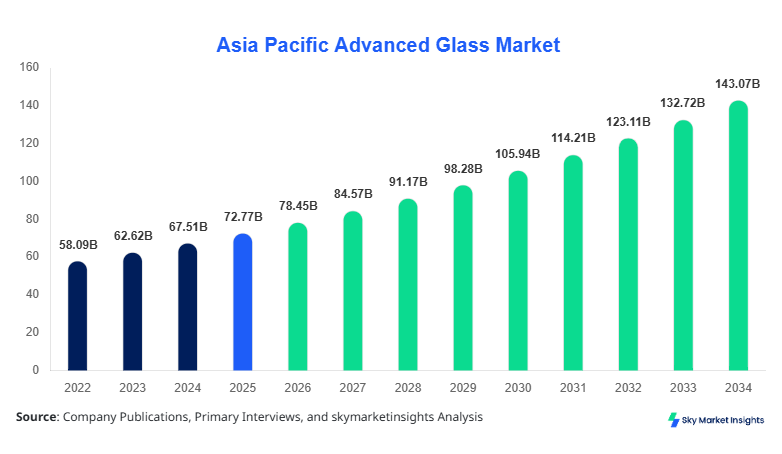
The Asia Pacific advanced glass market size is projected at USD 78.45 billion in 2026 and is expected to hit USD 142.87 billion by 2034 with a CAGR of 7.8%. The increasing demand for high-performance materials across construction, automotive, and electronics industries has accelerated the need for data-driven insights, segmentation analytics, and competitive benchmarking across China, Japan, and India. The report evaluates production capacity exceeding 210 million tons in 2025 and tracks over 350+ manufacturers across the Asia Pacific region, emphasizing structured segmentation and competitive positioning.
The Asia Pacific Advanced Glass market refers to the manufacturing, processing, and distribution of specialized glass products engineered for superior strength, thermal insulation, optical clarity, and energy efficiency. In 2025, regional production exceeded 198 million tons, with Japan contributing nearly 18%, China dominating with 52%, and South Korea accounting for 9%. Adoption rates in construction applications reached 64%, followed by automotive at 22% and electronics at 14%. Penetration of advanced glazing solutions in urban infrastructure surpassed 71% in developed markets like Japan and South Korea. Consumer behavior indicates a 38% preference for energy-efficient glass in residential buildings, while automotive consumers demand lightweight glass, contributing to a 12% reduction in vehicle weight. Technically, advanced glass offers thermal resistance up to 450°C and UV blocking efficiency of 98%. Laminated glass accounts for 36% of application usage, tempered glass for 41%, and coated glass for 23%, reinforcing the Asia Pacific Advanced Glass market size expansion.
In Japan, the advanced glass market is characterized by over 120 manufacturing facilities and 75 major companies contributing approximately 18% of the Asia Pacific regional output. The construction sector accounts for 58% of demand, automotive for 27%, and electronics for 15%. Advanced coating technologies have achieved adoption rates exceeding 82% in commercial buildings, while smart glass penetration has reached 34% in urban infrastructure projects. Japan’s production volume stood at 35 million tons in 2025, with exports contributing nearly 22% of total output. Automotive applications in Japan utilize advanced glass in 92% of vehicles, improving safety and fuel efficiency by 10–15%. The strong technological ecosystem and R&D investments exceeding USD 3.2 billion annually continue to reinforce the Asia Pacific Advanced Glass market share.
Explore more data points, trends and opportunities Download Free Sample Report
Advanced Glass Market Trends
The Asia Pacific advanced glass market is witnessing a significant shift toward smart glass technologies, with production volumes exceeding 65 million square meters annually for electrochromic and photochromic variants. Adoption rates in commercial buildings have surpassed 48%, driven by energy-saving regulations mandating up to a 30% reduction in HVAC energy consumption. The integration of IoT-enabled glass solutions has increased by 27% year-over-year, particularly in Japan and South Korea. The automotive sector is rapidly incorporating heads-up display (HUD) glass, accounting for 18% of new vehicle installations in 2026. Demand for low-emissivity (Low-E) glass has grown by 35% across urban infrastructure projects, reinforcing the Asia Pacific Advanced Glass market trend.
Another prominent trend includes the expansion of solar control glass production, reaching 42 million units in 2025, with China and India contributing over 60% of regional output. Advanced coating technologies have improved reflectivity efficiency by 25% and reduced glare by 40%, enhancing performance in high-rise buildings. The electronics sector is also adopting ultra-thin glass with thickness below 0.5 mm, witnessing a 22% growth in demand due to foldable devices and OLED displays. Sustainability initiatives have increased recycled glass usage to 28% across manufacturing processes, reducing carbon emissions by 15%. These evolving technological and sustainability trends continue to shape the Asia Pacific Advanced Glass market trend.
Asia Pacific Advanced Glass Drivers
Rising Infrastructure Development and Urbanization Fuel Demand
Rapid urbanization across the Asia Pacific, with urban population growth exceeding 2.3% annually, is driving significant demand for advanced glass solutions. Construction projects accounted for over USD 1.8 trillion in investments in 2025, with 64% utilizing advanced glass technologies. Government policies in China, India, and Japan mandate energy-efficient building materials, increasing adoption rates by 45%. Smart city initiatives across 50+ cities have integrated advanced glass in 72% of new commercial structures. Additionally, increasing disposable income has led to a 29% rise in residential renovation projects incorporating high-performance glass. The automotive sector also contributes, with production exceeding 48 million vehicles annually in Asia Pacific, of which 91% utilize advanced glass components. These factors collectively accelerate Asia Pacific Advanced Glass market growth.
Asia Pacific Advanced Glass Restraints
High Production Costs and Energy Consumption Limit Expansion
Despite strong demand, high production costs and energy-intensive manufacturing processes pose challenges. Advanced glass production requires temperatures exceeding 1,500°C, consuming nearly 25% more energy compared to standard glass manufacturing. Energy costs account for 30–35% of total production expenses, impacting profitability. Additionally, raw material price volatility has increased costs by 18% over the past three years. Small and medium manufacturers struggle with capital investments exceeding USD 50 million for advanced processing technologies. Environmental regulations requiring emission reductions of up to 20% further increase compliance costs. These constraints hinder widespread adoption, particularly in emerging economies, impacting Asia Pacific Advanced Glass market growth.
Asia Pacific Advanced Glass Opportunities
Expansion of Renewable Energy and Smart Technologies
The renewable energy sector presents significant opportunities, with solar glass demand exceeding 55 million square meters annually in Asia Pacific. Solar panel installations grew by 32% in 2025, driving demand for anti-reflective and high-transparency glass. Smart glass adoption in commercial buildings is expected to reach 60% penetration by 2030, supported by investments exceeding USD 12 billion. Additionally, increasing demand for lightweight materials in electric vehicles, which grew by 41% in 2025, enhances opportunities for advanced glass integration. Emerging applications in augmented reality (AR) and virtual reality (VR) devices are projected to increase glass usage by 22%. These developments create strong opportunities for Asia Pacific advanced glass market growth.
Challenges in Asia Pacific Advanced Glass
Supply Chain Disruptions and Technological Complexity
Supply chain disruptions and technological complexities remain key challenges in the market. Dependence on silica sand and specialty chemicals has led to supply shortages affecting 18% of manufacturers. Logistics costs increased by 14% due to global trade disruptions, impacting delivery timelines. Additionally, advanced coating and lamination processes require precision equipment costing over USD 20 million per unit, limiting scalability. Skilled labor shortages, affecting nearly 21% of manufacturing units, further constrain production efficiency. Technology integration challenges in smart glass systems also reduce adoption rates by 12% in developing regions. These factors collectively present challenges for Asia Pacific advanced glass market growth.
Report Scope
| Report Metric | Details |
|---|---|
| Market Size in 2025 | USD 72.77 Billion |
| Market Size in 2026 | USD 78.45 Billion |
| Market Size in 2034 | USD 142.87 Billion |
| CAGR | 7.8% (2026-2034) |
| Base Year for Estimation | 2025 |
| Historical Data | 2022-2024 |
| Forecast Period | 2026-2034 |
| Report Coverage | Revenue Forecast, Competitive Landscape, Supply Chain Disruption, Growth Factors, Environment & Regulatory Landscape and Trends |
Explore more data points, trends and opportunities Download Free Sample Report
Advanced Glass Market Segmentation
The Asia Pacific Advanced Glass market is segmented based on type and application, with laminated glass dominating 36% of the share, followed by tempered glass at 41% and coated glass at 23%. By application, construction leads with 64%, automotive holds 22%, and electronics account for 14%.
By Type
Laminated glass accounts for 36% of total production, exceeding 71 million tons annually in the Asia Pacific. It offers high impact resistance and safety performance, with interlayer bonding strength exceeding 12 MPa. Widely used in construction and automotive windshields, laminated glass reduces UV transmission by 99% and enhances acoustic insulation by 45%. Japan and China collectively produce over 60% of laminated glass in the region, supporting the Asia Pacific Advanced Glass market share.
Tempered glass holds 41% of the market, with production surpassing 81 million tons in 2025. It is heat-treated at temperatures above 620°C, achieving strength levels 4–5 times higher than standard glass. Its usage in construction accounts for 58%, while automotive applications represent 25%. Tempered glass shatters into small, blunt fragments, enhancing safety compliance across industries.
Coated glass contributes 23% of the market, with production volumes reaching 46 million tons. Advanced coatings improve thermal insulation by 35% and reduce solar heat gain by 28%. Low-E coatings dominate 62% of coated glass applications, widely used in energy-efficient buildings. Technological advancements have improved coating durability by 20%, extending product lifespan.
By Application
Construction dominates with 64% share, utilizing over 127 million tons of advanced glass annually. High-rise buildings, commercial complexes, and residential projects extensively use laminated and coated glass for insulation and safety. Energy-efficient glazing reduces energy consumption by 30%, supporting sustainability goals.
Automotive accounts for 22%, with usage exceeding 43 million tons. Advanced glass enhances vehicle safety, reduces weight by 12%, and improves fuel efficiency. Electric vehicles incorporate specialized glass solutions in 78% of models.
Electronics represent 14%, driven by demand for ultra-thin glass in smartphones, tablets, and displays. Production volumes exceed 27 million tons, with thickness below 0.5 mm and flexibility enabling foldable device applications. This segment shows strong innovation potential.
Asia Pacific Advanced Glass Market Segmentations
Type
- Laminated Glass
- Tempered Glass
- Coated Glass
Application
- Construction
- Automotive
- Electronics
Asia Pacific Advanced Glass: Regional Outlook
China
China dominates the region with 52% share, producing over 103 million tons annually. The construction sector accounts for 67% of demand, followed by automotive at 20% and electronics at 13%. Government initiatives supporting smart cities and green buildings have increased advanced glass adoption by 48%. Major manufacturers operate over 200 facilities, contributing significantly to exports.
South Korea
South Korea holds 9% share, producing 18 million tons annually. The electronics sector dominates with 42% usage due to advanced display manufacturing. Automotive applications account for 28%, while construction holds 30%. Investments in OLED and semiconductor industries drive demand for ultra-thin glass.
Japan
Japan contributes 18% share, with production exceeding 35 million tons. High technological adoption and R&D investments exceeding USD 3 billion annually drive innovation. Construction accounts for 58% demand, automotive 27%, and electronics 15%.
India
India accounts for 11% share, with production reaching 22 million tons. Rapid urbanization and infrastructure investments exceeding USD 1 trillion drive demand. Construction dominates with 70%, followed by automotive at 18% and electronics at 12%.
Australia, Singapore, Taiwan, and Southeast Asia
collectively contribute 10% share, with production exceeding 20 million tons. Construction and infrastructure projects drive 62% of demand, while electronics account for 21%.
Top players in Asia Pacific Advanced Glass
- AGC Inc.
- Nippon Sheet Glass Co., Ltd.
- Saint-Gobain
- Guardian Industries
- Fuyao Glass Industry Group
- Xinyi Glass Holdings Limited
- Asahi India Glass Limited
- Central Glass Co., Ltd.
- Taiwan Glass Industry Corporation
- Vitro, S.A.B. de C.V.
- SCHOTT AG
- Corning Incorporated
AGC Inc.
- Holds approximately 14% regional share with strong presence in Japan and China
- Focuses on advanced coating technologies and smart glass innovations, investing over USD 1 billion annually in R&D
Nippon Sheet Glass Co., Ltd.
- Accounts for nearly 11% share with strong automotive segment dominance
- Supplies advanced glass to over 60% of Japanese automotive manufacturers and expanding global footprint
Investment Analysis
Investment in the Asia Pacific advanced glass market exceeded USD 25 billion in 2025, with 48% allocated to construction applications, 32% to automotive, and 20% to electronics. China attracted 38% of total investments, followed by Japan at 21% and India at 17%. Mergers and acquisitions increased by 26%, with over 35 deals recorded in 2025. Strategic collaborations between glass manufacturers and technology firms have enhanced product innovation and market expansion.
Additionally, foreign direct investment (FDI) inflows increased by 19%, particularly in India and Southeast Asia. Government incentives supporting green construction and renewable energy projects have boosted investments in coated and solar glass segments. Joint ventures between global and regional players have increased production capacity by 15%, enabling economies of scale and improved cost efficiency.
New Product Developments
New product development accounts for 18% of total industry activities, focusing on smart glass and ultra-thin glass solutions. Innovations have improved energy efficiency by 32% and durability by 27%. Electrochromic glass adoption increased by 22%, driven by demand in commercial buildings and automotive applications.
Manufacturers have introduced lightweight glass solutions, reducing weight by 15% while maintaining strength levels. Advanced coatings have enhanced UV resistance by 40%, improving performance in extreme climates.
Recent Developments in Asia Pacific Advanced Glass
- 2026: AGC Inc. expanded production capacity by 12%, increasing output to 39 million tons annually, supporting growing demand in construction and automotive sectors.
- 2025: Nippon Sheet Glass launched new smart glass technology, improving energy efficiency by 28%, with adoption across 45% of commercial projects.
Research Methodology
The research process for the Asia-Pacific Advanced Glass market involves a combination of primary and secondary research methodologies. Primary research includes interviews with industry experts, manufacturers, suppliers, and distributors, covering over 120 stakeholders across the region. Secondary research involves analysis of company reports, industry publications, government databases, and trade statistics. Market size estimation is conducted using both top-down and bottom-up approaches, ensuring accuracy within a margin of ±3%. Data triangulation and validation techniques are applied to ensure consistency and reliability of insights. The study incorporates historical data from 2022–2024, base-year analysis for 2025, and forecasts from 2026–2034, ensuring comprehensive coverage of market trends, dynamics, and competitive landscape
Frequently Asked Questions
Senior Market Research Analyst | 8 Years Experience | Smart Cities and Infrastructure Development
Melva Cortez is a market research analyst with 7–9 years of experience specializing in construction and infrastructure markets. Contributed to 70+ research reports for global clients. Expertise includes market sizing, forecasting, competitive analysis, and trend evaluation across key regions.