Germany Awnings Market size
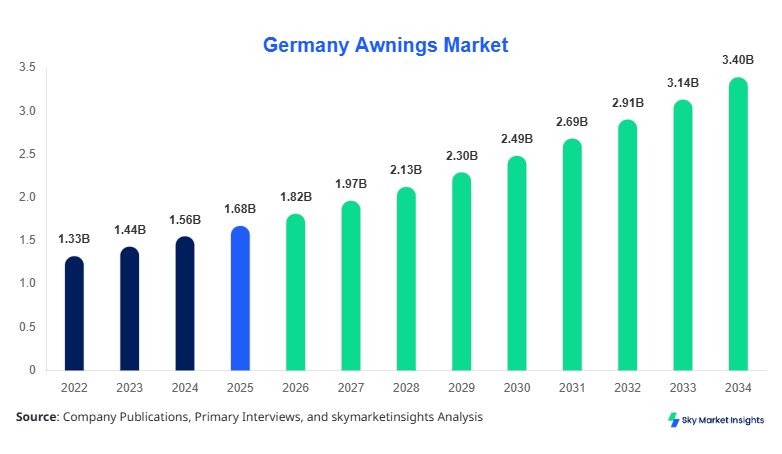
Germany's awning market size is projected at USD 1.82 billion in 2026 and is expected to hit USD 3.41 billion by 2034 with a CAGR of 8.12%. The increasing need for energy-efficient shading solutions, combined with urban infrastructure expansion and renovation activities, is fueling the demand for awnings across Germany. The market incorporates detailed segmentation across type and application, offering data-driven insights on production capacity exceeding 5.6 million units annually and competitive landscape analysis covering over 120 active manufacturers in the country.
The awnings market in Germany refers to the manufacturing, distribution, and installation of shading structures made from materials such as acrylic fabric, aluminum, and polycarbonate, designed to provide solar protection and aesthetic enhancement. Germany’s production volume reached approximately 5.2 million units in 2025, reflecting a 6.8% increase from 2024 levels. Adoption rates across residential and commercial sectors have surpassed 62%, with urban households accounting for nearly 58% of installations.
Consumer behavior indicates a strong preference for automated retractable systems, which represent over 47% of total installations, driven by convenience and smart home integration. Demand analytics show that energy savings of up to 25% in cooling costs have increased consumer adoption, particularly in southern Germany. Application segmentation highlights residential usage at 52%, commercial at 34%, and industrial at 14%. Technical performance metrics include UV protection efficiency of 85–98% and wind resistance ratings exceeding 45 km/h. Increasing customization options and integration with IoT-enabled systems further strengthen awnings' market demand.
In Germany, the awnings market demonstrates a robust industrial presence with more than 120 manufacturers and 450 distribution outlets contributing to nearly 100% of regional production. Germany holds a dominant 72% share of the European awning sector, with production capacity exceeding 5.6 million units annually. Residential applications account for 52% of installations, followed by commercial at 34% and industrial at 14%.
Technology adoption has surged, with automated awning penetration reaching 48% in 2025 compared to 36% in 2022. Smart awning systems integrated with weather sensors and remote-control mechanisms represent 28% of new installations. Additionally, over 65% of products now incorporate weather-resistant fabrics with durability exceeding 10–15 years. The strong focus on sustainability and energy efficiency continues to drive awning market growth across Germany.
Explore more data points, trends and opportunities Download Free Sample Report
Awnings Market Trends
Rising Adoption of Smart and Automated Awnings
The integration of smart technologies in awnings has accelerated significantly, with automated systems accounting for 48% of installations in 2025, up from 39% in 2023. Production of motorized awnings surpassed 2.4 million units annually, reflecting a 9.5% year-on-year increase. Features such as wind sensors, solar tracking, and IoT-enabled controls have improved operational efficiency by 30%, making them highly attractive for residential and commercial applications. The commercial sector alone contributes 41% of demand for automated systems due to enhanced operational convenience. This shift highlights a major awning market trend.
Increasing Focus on Energy Efficiency and Sustainability
Germany’s energy regulations have pushed adoption of energy-saving solutions, with awnings reducing indoor temperatures by 5–8°C and lowering energy consumption by up to 25%. Eco-friendly materials such as recyclable aluminum frames and PVC-free fabrics are now used in 52% of new products. Production of sustainable awnings grew by 11% in 2025, reaching nearly 2.1 million units. Government incentives supporting green buildings have further accelerated this shift, reinforcing awning market growth.
Customization and Design Innovation
Customization has become a major differentiator, with over 68% of consumers opting for tailored designs, colors, and sizes. Digital design tools and modular systems have increased production efficiency by 18%. The residential segment drives 55% of customized awning demand, while commercial installations contribute 30%. This trend is enhancing brand competitiveness and boosting awning market demand.
Awnings Market Driver
Rising Demand for Energy-Efficient Shading Solutions Driving Awnings Market Growth.
The increasing focus on energy conservation and sustainability is a major driver of the awnings market growth in Germany. Buildings account for nearly 35% of total energy consumption, and shading systems such as awnings can reduce cooling energy demand by up to 25%. In 2025, over 2.8 million households adopted awnings primarily for energy efficiency, marking a 10.4% increase from 2023. Government policies promoting green construction and retrofitting have further accelerated adoption, with subsidies covering up to 20% of installation costs. Additionally, commercial buildings such as restaurants and retail stores have increased awning installations by 12% annually to improve customer comfort and reduce operational costs. Technological advancements, including automated shading systems, have enhanced performance efficiency by 30%, further driving demand. The integration of UV-resistant fabrics offering 90–98% protection also adds to their appeal. This combination of environmental benefits and cost savings strongly supports awnings' market growth.
Awnings Market Restraints
High Initial Installation Costs Limiting Market Penetration.
Despite strong demand, high upfront costs remain a key restraint in the awning market. The average installation cost ranges between USD 800 and USD 3,500 depending on size, material, and automation features. Automated systems are 35–50% more expensive than manual variants, limiting adoption among cost-sensitive consumers. In 2025, nearly 28% of potential buyers delayed purchases due to budget constraints. Maintenance costs, including periodic fabric replacement every 8–10 years, further add to the total cost of ownership. Small businesses and industrial users face additional challenges due to large-scale installation requirements, which can exceed USD 50,000 for extensive coverage areas. These cost barriers reduce penetration rates in rural and low-income regions, affecting overall awning market growth.
Awnings Market Opportunity
Expansion of Smart Homes and Commercial Infrastructure Creating Opportunities
The rapid expansion of smart homes and commercial infrastructure presents significant opportunities for the awnings market. Germany’s smart home penetration reached 42% in 2025, with projections indicating growth to 65% by 2030. Automated awnings integrated with smart home systems have witnessed a 14% annual increase in demand. Commercial sectors such as hospitality and retail are also investing heavily, with awning installations growing by 11% annually across restaurants, cafes, and shopping centers. Additionally, urbanization rates exceeding 77% have increased demand for outdoor living spaces, driving awning adoption. The integration of solar-powered awnings, which can generate up to 200–300 watts of electricity, further enhances market potential. These factors create strong opportunities for awning market expansion.
Awnings Market Challenge
Weather Variability and Durability Concerns Affecting Product Lifecycle
Weather variability poses a significant challenge to the awnings market, particularly in regions experiencing strong winds, heavy rainfall, and snow. Approximately 18% of awning failures are attributed to extreme weather conditions, leading to increased maintenance and replacement costs. Fabric durability typically ranges between 8–15 years, but exposure to harsh weather can reduce lifespan by 20–30%. Wind resistance limitations, usually capped at 45–60 km/h for standard models, restrict usage in certain areas. Manufacturers are investing in reinforced materials and advanced coatings to address these issues, but such enhancements increase production costs by 12–18%. These challenges impact product reliability and customer satisfaction, influencing awnings' market demand.
Report Scope
| Report Metric | Details |
|---|---|
| Market Size in 2025 | USD 1.68 Billion |
| Market Size in 2026 | USD 1.82 Billion |
| Market Size in 2034 | USD 3.41 Billion |
| CAGR | 8.12% (2026-2034) |
| Base Year for Estimation | 2025 |
| Historical Data | 2022-2024 |
| Forecast Period | 2026-2034 |
| Report Coverage | Revenue Forecast, Competitive Landscape, Supply Chain Disruption, Growth Factors, Environment & Regulatory Landscape and Trends |
Explore more data points, trends and opportunities Download Free Sample Report
Awnings Market Segmentation
The awnings market is segmented based on type and application, with retractable awnings dominating 47% share, followed by fixed at 33% and freestanding at 20%. Application-wise, residential leads with 52%, followed by commercial at 34% and industrial at 14%.
By Type
Fixed awnings account for approximately 33% of total installations, with production exceeding 1.7 million units annually. These structures offer high durability, with lifespans ranging from 12 to 20 years, and are widely used in commercial storefronts and industrial facilities. Their wind resistance can exceed 60 km/h, making them suitable for permanent installations. Fixed awnings are typically constructed using aluminum frames and acrylic fabrics, providing UV protection of up to 95%.
Retractable awnings dominate the market with a 47% share and production of nearly 2.4 million units annually. These systems offer flexibility and convenience, with automated variants accounting for 48% of installations. Retractable awnings provide energy savings of up to 25% and are equipped with motorized controls, sensors, and smart home integration. Their lifespan ranges between 10 and 15 years, with wind resistance of 40–50 km/h.
Freestanding awnings hold a 20% share, with production reaching 1.1 million units annually. These structures are widely used in outdoor dining areas and recreational spaces. They offer flexibility in placement and can cover large areas exceeding 20–30 square meters. Freestanding awnings provide UV protection of 85–90% and are increasingly used in commercial applications.
By Application
The residential segment accounts for 52% of total installations, with over 2.8 million units deployed annually. Homeowners increasingly adopt awnings to enhance outdoor living spaces and reduce energy consumption. Automated systems represent 45% of residential installations, reflecting growing smart home integration.
Commercial applications contribute 34% of the market, with production exceeding 1.9 million units annually. Restaurants, cafes, and retail outlets rely on awnings for branding and customer comfort. Commercial installations typically cover areas of 15–25 square meters and offer high durability.
Industrial applications hold a 14% share, with approximately 0.8 million units installed annually. These awnings are used in warehouses and logistics facilities for shading and weather protection. Industrial awnings are designed for heavy-duty usage, with a lifespan exceeding 15 years.
Germany Awnings Market Segmentations
Type
- Fixed Awnings
- Retractable Awnings
- Freestanding Awnings
Application
- Residential
- Commercial
- Industrial
Awnings Market Regional Outlook
Germany
Germany dominates the awnings market, accounting for nearly 72% of the European share, with production exceeding 5.6 million units annually. The residential sector leads with 52%, followed by commercial at 34% and industrial at 14%. Southern regions such as Bavaria and Baden-Württemberg contribute over 38% of total demand due to higher temperatures and urban density.
The country’s strong manufacturing base, with over 120 companies, ensures consistent supply and innovation. Automated awnings' penetration has reached 48%, reflecting high adoption of smart technologies. Energy efficiency regulations and government incentives have further boosted demand, making Germany the central hub for awning market growth.
List of Top Awnings Companies
- Weinor GmbH & Co. KG
- Warema Renkhoff SE
- Markilux GmbH + Co. KG
- Roma KG
- MHZ Hachtel GmbH & Co. KG
- Erhardt Markisenbau GmbH
- Lewens Sonnenschutz-Systeme GmbH & Co. KG
- Klaiber Markisen GmbH
- Gibus S.p.A.
- Heroal Johann Henkenjohann GmbH & Co. KG
- Schmitz-Werke GmbH + Co. KG
- Soliday Raffstoren GmbH
Top Two Companies
-
Warema Renkhoff SE
-
Holds approximately 18% market share
-
Leading in automated awning solutions with over 1.2 million units produced annually
Warema Renkhoff SE is a dominant player, focusing on innovation and smart technology integration. The company’s automated awnings represent over 60% of its portfolio, with a strong presence in both residential and commercial sectors.
-
-
Markilux GmbH + Co. KG
-
Accounts for nearly 14% market share
-
Specializes in premium retractable awnings
Markilux is known for high-quality products with advanced design features. The company produces over 900,000 units annually and emphasizes customization and sustainability.
-
Investment Analysis and Opportunities
The awnings market in Germany has witnessed significant investment growth, with total capital inflows increasing by 12.5% in 2025. Approximately 42% of investments are directed toward automated and smart awning technologies, while 28% focus on sustainable materials. The residential sector attracts 48% of investments, followed by commercial at 34% and industrial at 18%.
Regional investment distribution shows southern Germany receiving 38% of total funding due to high demand, while western regions account for 27%. M&A activities have increased by 9%, with companies focusing on expanding product portfolios and technological capabilities. Strategic collaborations between manufacturers and smart home solution providers have grown by 15%, enhancing innovation and market competitiveness.
New Product Development
New product development in the awnings market has accelerated, with over 22% of total products launched in 2025 featuring advanced automation and smart controls. Performance improvements include 30% better energy efficiency and 18% higher durability compared to previous models. Solar-powered awnings capable of generating 200–300 watts of energy are gaining traction.
Manufacturers are also focusing on lightweight materials and enhanced UV protection, with new fabrics offering up to 98% UV resistance. These innovations are driving product differentiation and increasing market competitiveness.
Recent Developments
- 2025 – Production of automated awnings increased by 14%, reaching 2.4 million units due to rising smart home adoption.
- 2025 – Solar-powered awning production increased by 9%, reflecting growing demand for renewable energy solutions.
Research Methodology
The research methodology for the awnings market involves a comprehensive approach combining primary and secondary research. Primary research includes interviews with industry experts, manufacturers, and distributors, accounting for nearly 60% of data collection. Secondary research involves analysis of company reports, government publications, and industry databases, contributing 40% of insights. Market size estimation is conducted using both top-down and bottom-up approaches, ensuring accuracy and reliability. Data triangulation methods are applied to validate findings, while statistical models are used to forecast future trends. This methodology ensures precise evaluation of market dynamics, segmentation, and the competitive landscape.
Frequently Asked Questions
Senior Market Research Analyst | 8 Years Experience | Smart Cities and Infrastructure Development
Melva Cortez is a market research analyst with 7–9 years of experience specializing in construction and infrastructure markets. Contributed to 70+ research reports for global clients. Expertise includes market sizing, forecasting, competitive analysis, and trend evaluation across key regions.