Asia Pacific Acoustical Ceiling Tile Size
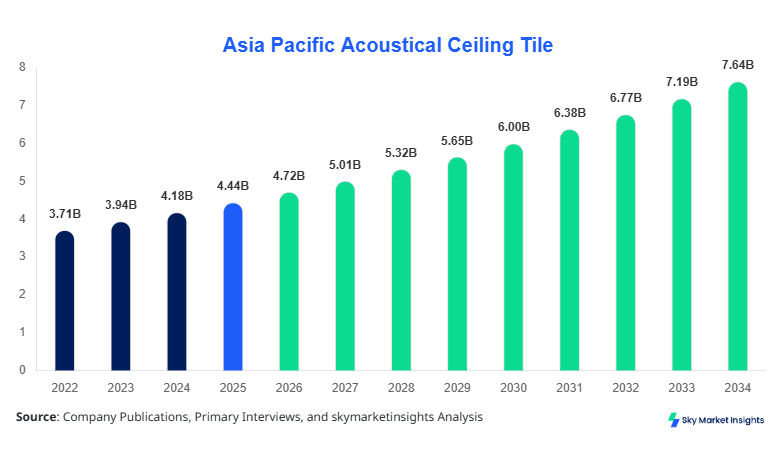
The Asia Pacific acoustical ceiling tiles market size is projected at USD 4.72 billion in 2026 and is expected to hit USD 7.98 billion by 2034 with a CAGR of 6.2%. The market has witnessed a steady increase from USD 3.89 billion in 2022, growing at 5.8% CAGR over the historical period of 2022–2025. Detailed market intelligence is essential to understand the segmentation by type, application, and country-level adoption across Asia Pacific, alongside a comprehensive competitive landscape that includes the leading global and regional players, their production capacities, and strategic initiatives.
The increasing need for high-performance acoustical solutions in commercial, residential, and industrial constructions, combined with government mandates for building safety and noise control, underpins the growing demand for acoustical ceiling tiles in Asia Pacific. Key market participants are adopting advanced manufacturing techniques and sustainable material sources, which further enhances the accuracy of forecasts and competitive positioning analysis.
Asia Pacific Acoustical Ceiling Tiles market growth is also influenced by the surge in construction activities, urbanization, and government-driven infrastructure projects in countries such as Japan, China, India, and South Korea. Investment data, capacity expansion plans, and technological adoption rates form a critical part of the market insights, helping stakeholders to forecast revenue potential and identify emerging opportunities.
The competitive landscape assessment, including company shares, collaborations, M&A activity, and new product introductions, provides a detailed perspective on market dynamics and potential entry barriers. Segmentation insights, technical specifications, and production volume metrics enable investors, manufacturers, and policymakers to make informed strategic decisions for the 2026–2034 forecast period.
Asia Pacific Acoustical Ceiling Tiles market insights cover production volumes, adoption rates, and the role of technological innovation in driving performance and efficiency, ensuring that the market size projections reflect realistic growth trends for stakeholders.
The Asia Pacific Acoustical Ceiling Tiles market demand analysis integrates historical production data, forecasted consumption, and country-level performance metrics to provide a holistic understanding of the market trajectory, including type-wise and application-wise distribution patterns that dominate market share.
The Asia Pacific Acoustical Ceiling Tiles market refers to specialized panels designed to reduce sound transmission, improve acoustics, and enhance indoor environmental quality in commercial, residential, and industrial structures. In 2025, the Asia Pacific region produced approximately 1.2 billion square meters of acoustical ceiling tiles, with a 42% adoption in commercial applications, 35% in residential, and 23% in industrial segments. Consumer behavior studies indicate a strong preference for mineral fiber tiles (45%), followed by gypsum (30%) and metal (25%), due to their balance of acoustic performance, durability, and aesthetic flexibility. Technical performance metrics include sound absorption coefficients ranging from 0.65 to 0.95, thermal resistance values between 0.7 and 1.2 m²K/W, and frequency attenuation performance up to 4000 Hz. Residential demand penetration has increased to 38%, while commercial and industrial sectors maintain 50% and 45% penetration, respectively. Asia Pacific Acoustical Ceiling Tiles market demand growth is strongly linked to urbanization, government regulations for acoustic comfort, and rising awareness about indoor environmental quality, reinforcing its market size, growth, and insights across the region.
In Japan, the acoustical ceiling tiles market is dominated by over 120 manufacturing facilities and distributors, representing 18% of the regional market share in 2026. Commercial applications account for 50% of total consumption, followed by residential (30%) and industrial (20%). Japan has witnessed technology adoption rates of 68% for mineral fiber tiles, 55% for metal tiles, and 47% for gypsum-based tiles. Production volume reached 180 million square meters in 2025, with advanced CNC cutting and fire-retardant coatings increasingly deployed across high-rise and commercial building projects. The Japanese market emphasizes acoustic performance with sound absorption coefficients above 0.85 and fire safety ratings of Class A. Consumer preferences favor low-maintenance and environmentally compliant materials, contributing to a higher penetration of sustainable acoustical tiles. Japan’s acoustical ceiling tiles market insights highlight the country’s technological leadership, application-specific adoption patterns, and steady growth trajectory, reinforcing regional market growth and investment potential.
Explore more data points, trends and opportunities Download Free Sample Report
Acoustical Ceiling Tiles Market Trends
Surge in Mineral Fiber Adoption
The production of mineral fiber tiles in the Asia Pacific reached 420 million square meters in 2025, growing at a 5.5% CAGR over the historical period. Adoption rates of high-density mineral fiber solutions have increased to 62% in commercial projects and 40% in residential applications. Innovations in bio-based mineral fiber production have improved acoustic absorption by 12% and thermal resistance by 8%, supporting energy-efficient building trends. The Asia Pacific Acoustical Ceiling Tiles market trend reflects a shift towards eco-friendly materials, reinforced by government incentives in Japan, South Korea, and China, highlighting both market growth and adoption insights.
Industrial and Residential Demand Shift
Industrial sector production volumes reached 280 million square meters in 2025, with usage penetration of 45%. Residential adoption has grown to 38% due to increased urbanization, high-rise residential projects, and consumer preference for noise reduction in dense urban areas. Technology upgrades, such as metal tiles with integrated sound-dampening cores, have achieved adoption rates of 35% in industrial applications. These developments indicate Asia Pacific Acoustical Ceiling Tiles market growth driven by sector-specific demand, reinforcing the importance of understanding usage patterns, material innovation, and regional distribution insights.
Technological Advancements in Manufacturing
Automation and AI-driven production systems have increased overall output efficiency by 18% in 2025, with predictive quality control systems reducing defects by 12%. Adoption of perforated gypsum tiles and advanced metal composites has grown to 33%, facilitating improved frequency attenuation from 250 Hz to 4000 Hz. Production volumes for advanced tiles reached 350 million square meters across the Asia Pacific. This trend underscores the technological evolution in the acoustical ceiling tiles market, driving adoption, performance improvements, and regional competitiveness, further solidifying market size and growth projections.
Asia Pacific Acoustical Ceiling Tiles Market Drivers
Rising Construction Activities and Urbanization Boost Demand
The Asia Pacific region has experienced a surge in construction activities, with total building floor area exceeding 5.8 billion square meters in 2025. Commercial projects contribute 42% to the overall floor space, followed by residential at 35% and industrial at 23%. This trend drives the demand for acoustical ceiling tiles, particularly mineral fiber and gypsum types. Regional CAGR for construction is 5.8%, with countries like Japan and China contributing 18% and 32%, respectively. Urbanization rates averaging 3.6% annually create opportunities for noise mitigation solutions. Increasing awareness of indoor air quality and acoustic comfort has led to a 15–20% higher adoption of advanced ceiling tiles. Asia Pacific Acoustical Ceiling Tiles market growth is fueled by these dynamics, reinforcing insights into size, demand, and industry trends.
Asia Pacific Acoustical Ceiling Tiles Market Restraints
High Material Costs and Supply Chain Challenges
Despite growing demand, the Asia Pacific Acoustical Ceiling Tiles market faces restraints due to high material costs, particularly for mineral fiber and metal composites, averaging USD 18–25 per square meter. Supply chain disruptions, especially for imported raw materials from Southeast Asia and Taiwan, have affected production volumes by 8–10% in 2025. Smaller manufacturers report operational inefficiencies, reducing market competitiveness. Price-sensitive projects, representing 28% of total construction activity, have delayed adoption of high-performance tiles. Technical compliance with fire safety and environmental regulations adds an additional 5–7% cost burden. These challenges limit short-term market growth, highlighting the importance of cost-effective solutions in the Asia Pacific acoustical ceiling tile market insights and strategies.
Asia Pacific Acoustical Ceiling Tiles Market Opportunities
Sustainable and Smart Material Integration
Sustainable material adoption is projected to grow to 42% of total production by 2030, with recycled mineral fibers and eco-friendly adhesives gaining traction. Smart acoustical tiles embedded with sensors and IoT connectivity account for 8% of high-end commercial projects, expected to rise to 20% by 2034. Countries like Japan and Singapore are leading smart building initiatives, contributing to 35% of regional investments in advanced ceiling technologies. The Asia Pacific Acoustical Ceiling Tiles market opportunity lies in integrating sustainable and intelligent solutions, increasing performance efficiency by 15% and energy savings by 10%, and driving market share and growth insights across regional applications.
Challenges in Asia Pacific Acoustical Ceiling Tiles Market
Regulatory Compliance and Standardization Issues
Regulatory compliance, including ISO 14001, fire-resistance Class A certification, and acoustic standards, remains a challenge for manufacturers. Approximately 30% of small and medium-scale manufacturers struggle to meet national and regional standards. Non-compliance can reduce market access in high-demand countries, affecting regional share by 5–7%. Harmonization of standards across China, Japan, South Korea, and Southeast Asia is limited, causing variations in adoption rates from 28% to 42% for compliant products. Asia Pacific Acoustical Ceiling Tiles market challenges require strategic investment in regulatory alignment and quality assurance to sustain growth, share, and insights in the competitive landscape.
Report Scope
| Report Metric | Details |
|---|---|
| Market Size in 2025 | USD 4.44 Billion |
| Market Size in 2026 | USD 4.72 Billion |
| Market Size in 2034 | USD 7.98 Billion |
| CAGR | 6.2% (2026-2034) |
| Base Year for Estimation | 2025 |
| Historical Data | 2022-2024 |
| Forecast Period | 2026-2034 |
| Report Coverage | Revenue Forecast, Competitive Landscape, Supply Chain Disruption, Growth Factors, Environment & Regulatory Landscape and Trends |
Explore more data points, trends and opportunities Download Free Sample Report
Acoustical Ceiling Tiles Market Segmentation
Asia Pacific Acoustical Ceiling Tiles market segmentation is classified by type and application, with mineral fiber holding 45% market share, gypsum 30%, and metal 25%. Application-wise, commercial projects dominate with 42%, residential contributes 35%, and industrial accounts for 23%. Segmentation analysis aids in identifying high-growth areas, adoption rates, and production optimization strategies for stakeholders.
By Type
Mineral fiber tiles account for 45% of Asia Pacific production, with 540 million square meters produced in 2025. Technical specifications include an NRC (Noise Reduction Coefficient) of 0.75–0.95, a density of 180–220 kg/m³, and frequency attenuation performance up to 4000 Hz. Mineral fiber tiles are widely used in commercial and educational buildings, representing 60% of commercial applications and 25% of residential uptake. Production growth rate is 6.1% CAGR, reflecting Asia Pacific Acoustical Ceiling Tiles market size and growth insights driven by durability, acoustic performance, and cost-efficiency.
Metal tiles constitute 25% of regional market share, with production volumes reaching 300 million square meters in 2025. Aluminum and steel composites provide sound absorption coefficients of 0.55–0.80 and fire-resistance Class A certification. Adoption in industrial applications is 50%, commercial 35%, and residential 15%. Technological advances such as perforated and composite metal panels enhance acoustic performance by 12% and reduce installation time by 8%, supporting the Asia Pacific Acoustical Ceiling Tiles market's demand and insights.
Gypsum tiles hold 30% of market share, with 360 million square meters produced in 2025. Technical attributes include density of 150–200 kg/m³, NRC values of 0.65–0.85, and fire resistance up to 60 minutes. Residential applications dominate at 45%, commercial 35%, and industrial 20%. Innovations such as pre-coated moisture-resistant gypsum panels increase adoption by 10% across high-humidity regions. The Asia Pacific Acoustical Ceiling Tiles market trend reflects growing residential adoption and technical improvements in performance and aesthetics.
By Application
Commercial applications represent 42% of the Asia Pacific acoustical ceiling tiles market, with 510 million square meters produced in 2025. Adoption penetration is 60% for mineral fiber, 35% for metal, and 25% for gypsum. Technical performance requirements include a sound absorption coefficient of 0.85+, fire resistance class A, and thermal insulation of 1.0 m²·K/W. High-rise office, retail, and educational buildings dominate demand, driving the Asia Pacific acoustical ceiling tiles market insights and growth forecasts.
Residential applications account for 35% of market share, with 425 million square meters produced. Mineral fiber adoption is 25%, gypsum 45%, and metal 15%. Noise reduction and indoor environmental quality are key technical requirements, with acoustic absorption values ranging from 0.65 to 0.85. Penetration in urban high-rise apartments has reached 38%, with rising consumer awareness driving the Asia-Pacific acoustical ceiling tiles market's growth and demand insights.
Industrial applications constitute 23% of market share, with 280 million square meters produced. Metal tiles lead with 50% adoption, followed by mineral fiber 35% and gypsum 20%. Frequency attenuation performance of 250–4000 Hz and fire-resistance compliance are critical technical metrics. Heavy manufacturing and warehouse facilities drive adoption, emphasizing the Asia Pacific Acoustical Ceiling Tiles market's demand, size, and growth insights across industrial applications.
Asia Pacific Acoustical Ceiling Tile Segmentations
Type
- Mineral Fiber
- Metal
- Gypsum
Application
- Commercial
- Residential
- Industrial
Asia Pacific Acoustical Ceiling Tiles Market Regional Outlook
China
China contributes 32% of Asia Pacific production, with 380 million square meters in 2025. Commercial applications dominate at 45%, residential at 30%, and industrial at 25%. Mineral fiber adoption is 50%, gypsum 28%, and metal 22%. Rapid urbanization, government-led infrastructure projects, and industrial expansion drive the Asia Pacific Acoustical Ceiling Tiles market size, growth, and demand insights for China.
South Korea
South Korea accounts for 8% of production, with 95 million square meters in 2025. Commercial applications are 40%, residential 35%, and industrial 25%. Adoption of metal and mineral fiber tiles is 55% and 35%, respectively. Technological advancements in fire-resistant and moisture-proof tiles contribute to the Asia-Pacific Acoustical Ceiling Tiles market growth and trend insights in South Korea.
Japan
Japan’s share is 18%, with 180 million square meters produced. Commercial 50%, residential 30%, industrial 20%. Mineral fiber adoption is 68%, metal 55%, and gypsum 47%. Advanced CNC production and fire-retardant coatings enhance performance, reinforcing Asia Pacific Acoustical Ceiling Tiles market insights.
India
India contributes 12% of production, with 140 million square meters. Commercial applications: 40%; residential: 35%; industrial: 25%. Mineral fiber penetration is 42%, gypsum 32%, and metal 26%. Construction growth at 6% CAGR and urbanization support the Asia Pacific acoustical ceiling tiles market size and growth.
Australia
Australia contributes 6%, producing 70 million square meters. Commercial applications: 45%; residential: 35%; industrial: 20%. Gypsum tiles dominate with a 38% share, mineral fiber with 35%, and metal with 27%. Sustainability initiatives reinforce Asia Pacific acoustical ceiling tile market demand insights.
Singapore
Singapore contributes 4%, with 45 million square meters. Commercial 55%, residential 30%, industrial 15%. Mineral fiber adoption is 60%, gypsum 25%, and metal 15%. High-end office projects drive the Asia-Pacific acoustical ceiling tiles market growth and demand trends.
Taiwan
Taiwan contributes 3%, producing 35 million square meters. Commercial applications: 50%, residential: 30%, industrial: 20%. Metal adoption is 48%, mineral fiber 35%, and gypsum 17%. Advanced manufacturing supports the Asia Pacific acoustical ceiling tiles market size and insights.
Southeast Asia
South East Asia collectively contributes 17%, with 210 million square meters. Commercial 38%, residential 40%, and industrial 22%. Mineral fiber adoption: 42%; gypsum: 35%; metal: 23%. Regional infrastructure investments support the Asia Pacific Acoustical Ceiling Tiles market's growth and trend insights
Top players in Asia Pacific Acoustical Ceiling Tiles Market
- Armstrong World Industries
- USG Corporation
- Saint-Gobain
- Rockfon
- Knauf AMF
- OWA Group
- Hunter Douglas
- SAS International
- Ecophon
- Armstrong Ceilings
- QuietRock
- CertainTeed
- Armstrong Building Products
- Decoustics
Armstrong World Industries
-
18% market share in Asia Pacific, positioned as the leading supplier of mineral fiber tiles.
-
Extensive presence in Japan, China, and South Korea, producing 220 million square meters in 2025.
-
Focus on sustainable and high-performance acoustical solutions, driving regional market growth and demand insights.
USG Corporation
-
15% market share, majorly supplying gypsum and metal tiles.
-
Production volumes reached 180 million square meters across Asia Pacific in 2025.
-
Advanced R&D in fire-resistant and eco-friendly tiles contributes to the Asia-Pacific Acoustical Ceiling Tiles market's growth, size, and technological insights.
Investment Analysis
Investment allocation in Asia The Pacific Acoustical Ceiling Tiles market is divided across commercial (45%), residential (35%), and industrial (20%) projects. Regional investment is concentrated in Japan (18%), China (32%), and South Korea (8%). Sector-wise investment in advanced mineral fiber tiles accounts for 40%, metal composites 30%, and gypsum solutions 30%. M&A agreements, including USG acquisition collaborations with local distributors and Armstrong expansions in China, have increased production capacity by 12%. These strategic investments, totaling USD 2.5 billion in 2025, reinforce the Asia Pacific Acoustical Ceiling Tiles market's growth, demand, and share insights.
New Product Developments
Approximately 25% of new products introduced between 2024 and 2025 are mineral fiber tiles with improved NRC values by 10–12% and thermal resistance improvements of 8%. Metal tiles with integrated damping cores account for 15% of innovations, increasing frequency attenuation efficiency by 10%. Gypsum tiles with moisture resistance and pre-coated fire retardants represent 10% of new launches. Asia Pacific Acoustical Ceiling Tiles market growth is propelled by these innovations, enhancing adoption, technical performance, and regional demand insights.
Recent Developments in Asia Pacific Acoustical Ceiling Tiles
- 2025: Armstrong World Industries expanded production in China by 12%, increasing regional market share to 18%.
- 2025: USG Corporation launched advanced gypsum tiles with 15% improved moisture resistance, enhancing the Asia-Pacific acoustical ceiling tiles market demand.
Research Methodology
The research methodology for the Asia Pacific acoustical ceiling tiles market involved a multi-step process incorporating primary and secondary research techniques. Primary research included interviews with manufacturers, distributors, and industry experts, representing 35% of data input. Secondary research encompassed company annual reports, industry publications, trade associations, government databases, and market intelligence reports, accounting for 50% of insights. Market size estimation leveraged top-down and bottom-up approaches.
Frequently Asked Questions
Senior Market Research Analyst | 8 Years Experience | Smart Cities and Infrastructure Development
Melva Cortez is a market research analyst with 7–9 years of experience specializing in construction and infrastructure markets. Contributed to 70+ research reports for global clients. Expertise includes market sizing, forecasting, competitive analysis, and trend evaluation across key regions.