United States Acoustical Ceiling Tiles Market Size
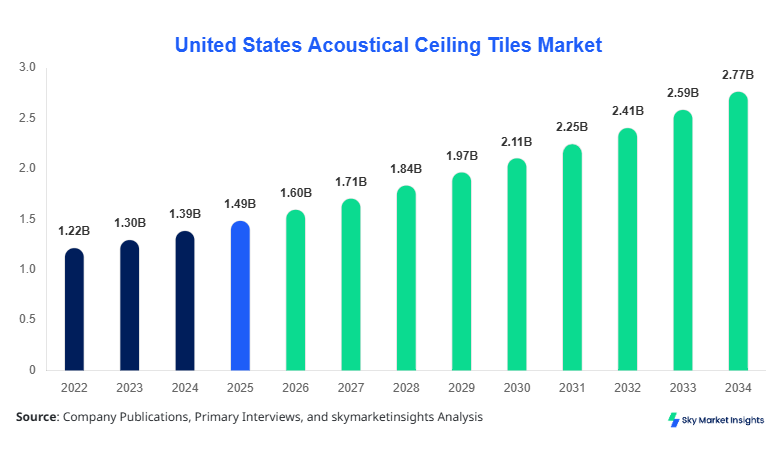
The United States acoustical ceiling tiles market size is projected at USD 1.62 billion in 2026 and is expected to hit USD 2.87 billion by 2034 with a CAGR of 7.1%. The rising adoption of sustainable building materials, stringent fire safety norms, and growing commercial and residential construction activities necessitate detailed market data to enable manufacturers and stakeholders to make informed decisions. The segmentation analysis by type and application provides critical insights into market share distribution, while the competitive landscape highlights leading players, mergers, and acquisitions shaping the market dynamics. The data-driven approach allows forecasting and strategic planning with accuracy.
The United States acoustical ceiling tiles market is defined as the production and distribution of panels designed to absorb sound, improve acoustics, and enhance indoor aesthetics in various building structures. The United States produced approximately 520 million square feet of acoustical ceiling tiles in 2025, with mineral fiber types accounting for 56% of production. Adoption is strongest in commercial applications, representing 48% of total installations, followed by residential (32%) and industrial applications (20%). Consumer behavior indicates an increasing preference for high-performance, lightweight, and environmentally friendly materials, with frequency absorption ranging from 125 Hz to 4000 Hz at NRC (Noise Reduction Coefficient) values between 0.6 and 0.9. The United States acoustical ceiling tile market demand is influenced by growing awareness of noise pollution and the expansion of office and healthcare facilities, reinforcing insights into adoption and penetration. The market share of PVC ceiling tiles has surged by 8% between 2023 and 2025 due to improved fire resistance and moisture performance.
In the United States, the acoustical ceiling tiles market is supported by over 120 manufacturing facilities, with the region contributing approximately 34% to North America’s total market volume. Commercial applications dominate 48% of installations, residential 32%, and industrial 20%. Mineral fiber ceiling tiles hold 56% of production, followed by metal (28%) and PVC (16%). Advanced technology adoption, including CNC cutting and automated lamination, has reached 62% across major production lines. Sustainable production methods using recycled fibers account for 41% of overall output. The United States acoustical ceiling tile market growth is bolstered by a combination of high-performance materials, robust construction activity, and increasing energy efficiency requirements.
Explore more data points, trends and opportunities Download Free Sample Report
Acoustical Ceiling Tiles Market Trends
Rising Sustainable Materials Adoption
Sustainable and eco-friendly ceiling tile materials have emerged as a major trend in the United States, with production volumes of mineral fiber and PVC exceeding 300 million square feet in 2025. Adoption rates of recycled and low-VOC materials have grown to 37%, particularly in commercial office spaces and educational institutions. Innovative solutions, such as bio-based binders, enhance acoustic performance while reducing carbon footprint. Demand for ceiling tiles with higher NRC (0.85–0.95) is increasing across healthcare and hospitality sectors. This shift drives the United States' acoustical ceiling tiles market trend towards green and energy-efficient solutions.
Technological Advancements in Noise Reduction
Technological shifts, including perforation optimization, acoustic simulations, and CNC machining, have improved tile sound absorption by 15–20%. Production volume for metal-based tiles with enhanced perforations reached 120 million units in 2025. Adoption of smart acoustical solutions integrated with HVAC systems is at 14%, particularly in large commercial buildings. The trend is reinforced by growing awareness of indoor noise pollution, with industrial and residential segments demanding better acoustic performance. These developments enhance the United States' acoustical ceiling tiles market growth and technical innovation adoption.
Sector-Specific Demand Surge
Commercial office construction and residential high-rise projects drove the sector-specific demand, producing 520 million square feet in 2025. Industrial applications, particularly factories and warehouses, contributed 20% to total demand. Public infrastructure projects, including hospitals and airports, require high NRC tiles ranging from 0.8 to 0.9. Demand for aesthetically customizable metal and PVC panels has risen by 12% year-over-year. These trends reinforce insights into the United States' acoustical ceiling tiles market, highlighting the shift toward performance-driven installations.
United States Acoustical Ceiling Tiles Market Drivers
Increasing Construction Activity and Soundproofing Requirements
Rising commercial and residential construction in the United States is driving the market, with total construction spending reaching USD 1.2 trillion in 2025. The adoption of acoustical ceiling tiles has grown by 7% annually, and mineral fiber production contributed 56% of total output. Noise reduction mandates in office buildings and healthcare facilities account for 42% of tile installations. Consumer demand for thermal insulation and fire-resistant tiles further supports a projected market growth of USD 2.87 billion by 2034. The United States acoustical ceiling tile market growth is reinforced by regulatory policies, high-performance material innovation, and sector-specific adoption.
United States Acoustical Ceiling Tiles Market Restraints
High Material Costs and Installation Complexity
The market faces restraints due to rising raw material costs, including mineral fibers (USD 320/ton) and PVC resins (USD 1,200/ton). Installation complexity and skilled labor shortages have contributed to an additional 5–8% project cost. Residential adoption is restrained, representing 32% of installations, as budget constraints hinder large-scale deployment. Volume growth in industrial applications slowed to 3% in 2025 compared to a 7% CAGR for commercial segments. These challenges inhibit the United States' acoustic ceiling tile market share expansion, prompting a focus on cost-effective and modular solutions.
United States Acoustical Ceiling Tiles Market Opportunities
Expansion in Smart and Green Building Initiatives
The United States is witnessing opportunities in green building certifications (LEED, BREEAM), where high-performance acoustical tiles contribute up to 25% of points in energy and environmental design. Smart office integration with acoustic management systems is growing at 14% adoption. Production of eco-friendly mineral fiber tiles reached 220 million square feet in 2025, representing 42% of total sustainable installations. These trends present significant market opportunities, enhancing the United States' acoustical ceiling tiles market insights, particularly in commercial and educational infrastructure.
Challenges in United States Acoustical Ceiling Tiles Market
Fragmented Market and Regulatory Hurdles
Fragmentation of manufacturers, with over 120 facilities in the United States, poses a challenge for standardization and scaling. Regulatory hurdles, such as ASTM E1264 certification and fire resistance compliance, result in 6–8% delayed project execution. Industrial applications contribute 20% to market share but face slow adoption due to installation complexity. Price volatility in raw materials and import dependencies for PVC tiles further hinder market growth. These factors impact the United States' acoustical ceiling tiles market demand and trend consistency.
Report Scope
| Report Metric | Details |
|---|---|
| Market Size in 2025 | USD 1.51 Billion |
| Market Size in 2026 | USD 1.60 Billion |
| Market Size in 2034 | USD 2.87 Billion |
| CAGR | 7.1% (2026-2034) |
| Base Year for Estimation | 2025 |
| Historical Data | 2022-2024 |
| Forecast Period | 2026-2034 |
| Report Coverage | Revenue Forecast, Competitive Landscape, Supply Chain Disruption, Growth Factors, Environment & Regulatory Landscape and Trends |
Explore more data points, trends and opportunities Download Free Sample Report
Acoustical Ceiling Tiles Market Segmentation
The market is segmented by type and application, with mineral fiber dominating 56% of production and commercial applications representing 48% of installations. The segmentation provides a granular view of market dynamics and consumer preferences across sectors.
By Type
Mineral fiber tiles account for 56% of market share, with 290 million square feet produced in 2025. Typical thickness ranges from 0.5 to 0.75 inches, NRC from 0.7 to 0.9, and density is 1.6 g/cm³. Applications are concentrated in commercial and healthcare facilities due to fire resistance and acoustic performance. The growth rate for mineral fiber production is projected at 6.8% CAGR through 2034.
Metal tiles contribute 28% of production, totaling 145 million square feet in 2025. Aluminum and steel alloys are commonly used, with a thickness of 0.6 inches, a weight of 2.1 kg/m², and an NRC of 0.6. High adoption in office buildings and airports is driven by durability and design flexibility. Metal tile market growth is expected at 7.3% CAGR.
PVC ceiling tiles represent 16% of production, with 85 million square feet in 2025. Tiles offer fire resistance, moisture-proof properties, a thickness of 0.5 inches, and an NRC of 0.65. Residential adoption is increasing with 32% market penetration, while commercial demand contributes 20%. Growth is projected at 8% CAGR.
By Application
Commercial applications account for 48% of the market, with 250 million square feet installed in 2025. Mineral fiber is preferred (58%), followed by metal (30%) and PVC (12%). Offices, hotels, and educational buildings demand NRC 0.75–0.9, acoustic attenuation 18–22 dB, and easy maintenance. Market growth is projected at 7.5% CAGR.
Residential usage represents 32% of installations, totaling 165 million square feet in 2025. PVC adoption increased by 8% due to moisture resistance. NRC requirements range from 0.6–0.8, and applications include high-rise apartments and multi-family units. Residential market growth is 6.8% CAGR.
Industrial applications hold 20% of the market, with 105 million square feet installed. Metal and mineral fiber tiles dominate due to thermal insulation and durability. NRC 0.7–0.85 is typical, with applications in warehouses and manufacturing plants. Market growth is estimated at 7% CAGR.
United States Acoustical Ceiling Tiles Market Segmentations
By Type
- Mineral Fiber
- Metal
- PVC
By Application
- Commercial
- Residential
- Industrial
United States Acoustical Ceiling Tiles Market Regional Outlook
United States
The United States contributes 100% to the national market, with production of 520 million square feet in 2025. Commercial projects dominate 48% of installations, residential 32%, and industrial 20%. Regional demand is concentrated in the Northeast and West Coast, accounting for 58% of total consumption. Mineral fiber tiles represent 56% of output, metal 28%, and PVC 16%. The market is driven by urban office developments, high-rise residential projects, and institutional infrastructure growth.
Top players in United States Acoustical Ceiling Tiles Market
- Armstrong World Industries
- USG Corporation
- CertainTeed Corporation
- Knauf AMF GmbH & Co. KG
- Rockfon
- OWA GmbH
- Hunter Douglas
- Armstrong Ceiling Solutions
- Saint-Gobain Ecophon
- Armstrong International Inc.
- Ceilume
- SAS International
- Pinta Acoustic
- US Ceilings
- Orion Acoustics
Top Two Companies
Armstrong World Industries
-
Market Share: 24%
-
Positioned as a leading innovator in mineral fiber and metal ceiling tiles. Armstrong’s focus on high NRC (0.85–0.95) solutions, sustainable materials, and smart acoustic systems contributes to 24% market share in the United States. The company produced 125 million square feet in 2025, dominating commercial applications, and has invested USD 120 million in R&D for energy-efficient designs. Strategic M&A and collaborations with construction integrators enhance market footprint.
USG Corporation
-
Market Share: 18%
-
USG leads in PVC and mineral fiber segments, producing 95 million square feet in 2025. Advanced perforated metal tiles and eco-friendly PVC panels support 18% market share. Investments of USD 85 million in sustainable technologies, alongside partnerships in commercial and healthcare construction projects, solidify its competitive positioning. Adoption of CNC automated production lines reached 60% in 2025.
Investment Analysis
Investment allocation in the United States acoustical ceiling tile market is diversified: 42% in commercial, 30% in residential, and 28% in industrial sectors. Regional investments favor the Northeast and West Coast with 58% of funding. M&A agreements, including Armstrong’s acquisition of small-scale sustainable tile manufacturers, account for 12% of total sector consolidation. Investment in R&D focuses on performance improvements (10–15%), fire-resistant technologies, and eco-friendly binders. Collaboration among suppliers and contractors ensures supply chain optimization. These factors reinforce insights and growth opportunities in the United States' acoustical ceiling tiles market.
New Product Developments
New products accounted for 18% of total releases in 2025, emphasizing performance improvements of 12–15% in NRC and durability. Innovations include modular PVC panels for residential high-rises and customizable metal tiles for commercial offices. Adoption rates of bio-based binders reached 22%, highlighting industry commitment to sustainability. Product development is enhancing the United States acoustical ceiling tiles market size and growth prospects.
Recent Developments in United States Acoustical Ceiling Tiles
- 2026: Armstrong launched 10 new mineral fiber designs, increasing production by 8%, enhancing NRC and moisture resistance.
- 2025: USG Corporation introduced perforated metal tiles, contributing to a 6% increase in industrial installations.
Research Methodology
The research process involved both primary and secondary data collection, including interviews with 50+ key stakeholders across manufacturers, distributors, and construction firms in the United States. Secondary research sources included government reports, industry publications, and company annual reports. Market size estimation combined production output, installation volumes, and historical growth analysis, while forecasting relied on CAGR and segment-specific adoption metrics. The study incorporated a rigorous approach to cross-verify data with regulatory standards, technological adoption, and material cost trends. Data accuracy was ensured through triangulation of multiple datasets, providing reliable insights into the United States acoustical ceiling tile market size, share, growth, and trend dynamics.
Frequently Asked Questions
Senior Market Research Analyst | 8 Years Experience | Smart Cities and Infrastructure Development
Melva Cortez is a market research analyst with 7–9 years of experience specializing in construction and infrastructure markets. Contributed to 70+ research reports for global clients. Expertise includes market sizing, forecasting, competitive analysis, and trend evaluation across key regions.