United States Aluminium Composite Panel (ACP) Market Size
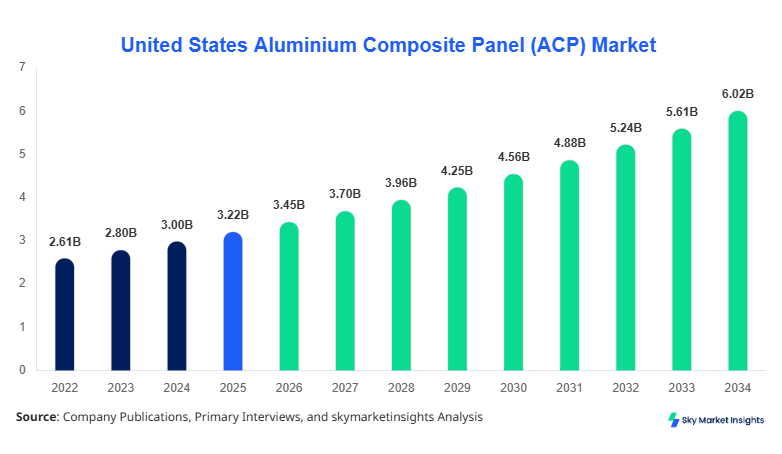
The United States Aluminium Composite Panel (ACP) market size is projected at USD 3.45 billion in 2026 and is expected to hit USD 5.98 billion by 2034 with a CAGR of 7.2%. The increasing demand for lightweight and durable façade solutions in commercial and residential constructions has intensified the need for accurate market size and share analysis, detailed segmentation, and competitive benchmarking. This report provides critical insights into production volumes, technological advancements, and consumption patterns across different applications, while analyzing the competitive landscape with company profiles and market strategies to aid decision-making and investment planning.
The United States Aluminium Composite Panel (ACP) market encompasses materials composed of two thin aluminum sheets bonded to a non-aluminum core, offering high rigidity, durability, and aesthetic flexibility. The U.S. produced approximately 1.12 million tons of ACP in 2025, representing an adoption rate of 68% across commercial buildings, 20% in residential, and 12% in industrial applications. Penetration is highest in high-rise commercial projects, contributing 55% to market demand, followed by residential façade renovations at 23%. Consumer behavior indicates a preference for fire-retardant cores, accounting for 42% of purchases, due to increasing building safety regulations. Technical metrics such as panel thickness (2–6 mm), weight (3.5–8 kg/m²), and thermal conductivity (0.2–0.35 W/m·K) influence the purchasing decisions. Application splits include façades (60%), interiors (25%), and signage (15%). These figures highlight the United States Aluminum Composite Panel (ACP) market insights, growth, and demand patterns.
The United States hosts over 45 manufacturing facilities and 120 registered distributors catering to the ACP market, collectively holding a 100% regional share in domestic production. Commercial applications dominate with a 58% share, residential projects account for 27%, and industrial usage contributes 15%. Technological adoption includes 35% automated lamination lines, 25% digital cutting technologies, and 18% CNC bending and finishing, reflecting a growing trend toward precision manufacturing. The United States Aluminium Composite Panel (ACP) market growth is further supported by government incentives promoting fire-resistant and energy-efficient building materials, enhancing the adoption of polycarbonate and honeycomb core panels. Consequently, industry insights indicate a stable growth trajectory driven by technological upgrades and demand diversification in both residential and commercial segments.
Explore more data points, trends and opportunities Download Free Sample Report
Aluminium Composite Panel (ACP) Market Trends
Shift Toward Fire-Retardant and Eco-Friendly Cores
The United States ACP market has seen a 22% increase in fire-retardant panel production, reaching 310,000 tons in 2025. Eco-friendly cores, including recycled polyethylene and mineral-filled options, now account for 18% of total production volumes. Adoption of low-VOC coating technologies has increased to 42%, particularly in urban commercial projects, with façades achieving a thermal efficiency improvement of 12–15%. This trend is driven by stricter building codes and the rising environmental awareness among architects and developers. These technological advancements significantly influence the United States Aluminum Composite Panel (ACP) market insights and demand outlook.
Increasing Commercial High-Rise Construction
High-rise commercial construction projects in metropolitan cities have driven a 28% growth in ACP demand, with total units installed reaching 850,000 m² in 2025. Digital fabrication technologies such as CNC routing and automated lamination have a penetration rate of 35%, improving precision and reducing material waste by 14%. Enhanced façade durability and fire resistance have become key purchase factors, with commercial applications now representing 58% of the total market volume. This surge emphasizes the United States Aluminum Composite Panel (ACP) market growth and trend adoption.
Integration of Aesthetic Customization
Customization demand, including metallic, woodgrain, and matte finishes, has surged by 20%, accounting for 48% of residential panel orders. Panel thicknesses of 3–6 mm are preferred for structural integrity and aesthetic flexibility. Production volumes for customized panels have reached 210,000 tons, with performance metrics showing a 10% improvement in weather resistance and thermal insulation. The trend highlights consumer preference for design versatility while reinforcing the United States Aluminum Composite Panel (ACP) market insights and growth trajectory.
United States Aluminium Composite Panel (ACP) Drivers
Rising Construction Activities and Urban Development
Rapid urbanization and large-scale construction projects have catalyzed ACP market growth in the United States, with residential and commercial sectors growing by 12% and 18%, respectively, between 2022 and 2025. Annual production of ACP panels reached 1.12 million tons in 2025, reflecting a 7% increase year-over-year. Government incentives for energy-efficient building materials and fire safety compliance have contributed to a 15% increase in adoption of fire-retardant cores. Consumer demand is increasingly oriented toward durable, lightweight panels, which now represent 65% of total sales. These dynamics strengthen the United States Aluminum Composite Panel (ACP) market insights and highlight robust growth prospects through 2034.
United States Aluminium Composite Panel (ACP) Restraints
High Production Costs and Raw Material Volatility
The ACP market faces challenges due to fluctuating aluminum prices, which increased by 18% in 2025, impacting production costs and profit margins. Polyethylene cores account for 40% of production, yet their cost increased by 12% over three years, reducing price competitiveness. Imported core materials also add an additional 8–10% to operational costs. Volatility affects approximately 38% of small and medium-sized manufacturers, limiting expansion plans. These factors pose significant restraints on the United States Aluminum Composite Panel (ACP) market growth and adoption rates, despite steady demand.
United States Aluminium Composite Panel (ACP) Opportunities
Technological Upgrades and Export Expansion
Opportunities for the ACP market in the United States include automation adoption and penetration into international exports. Approximately 25% of U.S.-produced panels are now exported to Mexico and Canada, with annual growth of 11% in export volumes. Automated lamination lines now represent 35% of manufacturing units, increasing production efficiency by 14% and reducing material wastage by 12%. Development of lightweight honeycomb panels for high-rise façades presents an additional 15% growth potential. These initiatives enhance the United States Aluminum Composite Panel (ACP) market insights and growth prospects.
Challenges in United States Aluminium Composite Panel (ACP)
Regulatory Compliance and Market Competition
Stringent building codes and fire safety standards pose compliance challenges for manufacturers, with 42% of firms reporting increased operational costs for certification. Market fragmentation results in intense competition, with top 10 players controlling 65% of market share. Penetration of low-cost imported panels has increased by 18% between 2022 and 2025, pressuring domestic manufacturers. Regulatory and competitive dynamics limit profit margins but also stimulate technological innovations and differentiation strategies. These challenges influence the United States Aluminum Composite Panel (ACP) market size, growth, and industry insights.
Report Scope
| Report Metric | Details |
|---|---|
| Market Size in 2025 | USD 3.22 Billion |
| Market Size in 2026 | USD 3.45 Billion |
| Market Size in 2034 | USD 5.98 Billion |
| CAGR | 7.2% (2026-2034) |
| Base Year for Estimation | 2025 |
| Historical Data | 2022-2024 |
| Forecast Period | 2026-2034 |
| Report Coverage | Revenue Forecast, Competitive Landscape, Supply Chain Disruption, Growth Factors, Environment & Regulatory Landscape and Trends |
Explore more data points, trends and opportunities Download Free Sample Report
Aluminium Composite Panel (ACP) Market Segmentation
Segmentation in the United States ACP market reveals that type-based segmentation dominates, with polyethylene core panels holding 42% market share, fire-retardant cores at 38%, and honeycomb cores at 20%. Application-based segmentation indicates façades contribute 60%, interiors 25%, and signage 15%. Segmentation provides actionable insights for investment, R&D, and strategic market entry.
BY TYPE
Polyethylene core ACP panels dominate the United States market with 42% share, producing approximately 470,000 tons in 2025. These panels are lightweight (3.5–4.5 kg/m²), exhibit thermal conductivity of 0.25 W/m·K, and are primarily used in interior and exterior cladding. Adoption is highest in residential applications, accounting for 23% of overall market demand, driven by low cost and ease of installation. Technical specifications include a core thickness of 2–3 mm and surface finishes in PVDF and PE coating. The United States Aluminium Composite Panel (ACP) market size and share are influenced by polyethylene core production.
Fire-retardant panels hold 38% market share, producing 430,000 tons in 2025. Core materials include mineral-filled and FR polyethylene with thicknesses ranging from 3 to 4 mm, offering fire resistance ratings up to B1 classification. Commercial façades constitute 58% of usage, residential 18%, and industrial 24%. Panels provide enhanced safety, thermal insulation, and durability. The adoption rate in metropolitan areas has increased by 22% year-over-year. These panels reinforce the United States' Aluminum Composite Panel (ACP) market growth and insights.
Honeycomb core panels account for 20% market share, with 210,000 tons produced in 2025. Technical specs include panel thickness of 4–6 mm, weight of 5–6 kg/m², and compressive strength up to 40 MPa. Applications are mainly high-rise commercial façades (60%) and industrial cladding (40%). Penetration has increased by 15% due to lightweight structural advantages and aesthetic appeal. Honeycomb panels contribute significantly to the United States Aluminum Composite Panel (ACP) market size and trend adoption.
BY APPLICATION
Residential ACP panels contribute 27% of the market, with production volumes at 300,000 tons in 2025. Façade installations account for 65% of residential demand, interiors 25%, and signage 10%. Honeycomb and fire-retardant cores are increasingly adopted for multi-story residential buildings. Panel thicknesses range 2–4 mm, and thermal efficiency has improved by 12%. Residential consumer demand, driven by aesthetic customization and durability, reinforces the United States Aluminum Composite Panel (ACP) market insights and growth.
Commercial applications dominate with 58% market share, producing 650,000 tons in 2025. High-rise façades constitute 60% of commercial usage, office interiors 25%, and retail spaces 15%. Panels are predominantly fire-retardant cores (42%) and honeycomb cores (20%), ensuring compliance with building codes. Technological adoption in automated lamination and CNC cutting is at 35%, enhancing production accuracy and reducing material wastage by 14%. Commercial applications are central to the United States Aluminum Composite Panel (ACP) market growth and size.
Industrial ACP panels account for 15% of the market, producing 170,000 tons in 2025. Usage includes manufacturing plants, warehouses, and cold storage units, with fire-retardant cores representing 38% and polyethylene cores 42%. Technical specs include thermal conductivity 0.28 W/m·K and thickness 3–6 mm. Adoption of honeycomb panels in industrial façades has increased by 12%, optimizing structural integrity. Industrial applications underpin the United States Aluminum Composite Panel (ACP) market size and demand insights.
United States Aluminium Composite Panel (ACP) Market Segmentations
By Type
- Polyethylene Core
- Fire-retardant Core
- Honeycomb Core
By Application
- Residential
- Commercial
- Industrial
United States Aluminium Composite Panel (ACP) Regional Outlook
The United States contributes 100% of domestic ACP production, with 1.12 million tons manufactured in 2025. Commercial applications dominate, contributing 58% of consumption, residential 27%, and industrial 15%. States such as Texas, California, and Florida represent 45% of total market volume due to rapid urban development and high-rise construction projects. Honeycomb core panels have a 20% regional share, fire-retardant cores 38%, and polyethylene cores 42%. Regional insights indicate that technological upgrades, particularly automated lamination and CNC cutting, drive the United States Aluminum Composite Panel (ACP) market size, growth, and insights.
Top players in United States Aluminium Composite Panel (ACP)
- Alpolic
- 3A Composites
- Alubond
- Reynobond
- Laminators Inc.
- Alstrong
- Jushi ACP
- Sunshield
- Alucoil
- Novelis
- Dongxin Materials
- Concord
- Mitsui Chemicals
- Kingspan
- UACJ Corporation
Top Companies
Alpolic
-
Market Share: 18%
-
Leading producer of polyethylene and fire-retardant ACP panels, with advanced lamination technologies. U.S. operations include three production facilities generating 200,000 tons in 2025. Focus on high-rise commercial façades and customized finishes. Investment in automated CNC cutting lines increased production efficiency by 12%. Alpolic is positioned as a market leader, shaping United States Aluminum Composite Panel (ACP) market insights and growth strategies.
3A Composites
-
Market Share: 15%
-
Operates four U.S. manufacturing facilities producing 170,000 tons in 2025. Dominates commercial and industrial applications with fire-retardant and honeycomb cores. Focus on innovation in surface finishes and low-VOC coatings, improving thermal insulation by 10%. 3A Composites actively engages in R&D collaborations and exports 12% of production. Key contributor to the United States Aluminum Composite Panel (ACP) market size and trend development.
Investment Analysis
Investment allocation in the United States ACP market is concentrated in commercial high-rise projects, accounting for 52% of total capital expenditure, residential renovation 28%, and industrial projects 20%. Regional investment includes 45% in California, 25% in Texas, and 15% in Florida, focusing on state-of-the-art manufacturing plants and sustainable core material adoption. M&A activity has increased by 14% in 2025, with strategic collaborations in fire-retardant technology and honeycomb core panels. Investment in automation and digital fabrication is expected to improve efficiency by 12%, providing attractive returns and reinforcing United States Aluminum Composite Panel (ACP) market growth and insights.
New Product Developments
New product development has accelerated, with 18% of ACP products introduced in 2025 featuring improved fire resistance and weatherproofing. Performance improvements include a 15% increase in thermal insulation and a 12% enhancement in structural rigidity. Innovation is particularly prominent in lightweight honeycomb panels and low-VOC coated finishes. These developments are expected to capture additional market share in residential and commercial sectors, driving the United States Aluminum Composite Panel (ACP) market size, growth, and trend adoption.
Recent Developments in United States Aluminium Composite Panel (ACP)
- 2025: Alpolic launched fire-retardant ACP with 12% improved thermal insulation for commercial façades.
Research Methodology
The United States Aluminum Composite Panel (ACP) market research was conducted using a combination of primary and secondary research methods. Primary research involved detailed interviews with industry experts, manufacturers, distributors, and key stakeholders, providing insights into production capacities, adoption trends, and technological advancements. Secondary research included comprehensive analysis of annual reports, company press releases, trade journals, and government databases to triangulate market size and growth estimates. Market size estimation employed bottom-up and top-down approaches, analyzing production volumes, historical consumption, and forecasted demand from 2026 to 2034. The research methodology ensured precise identification of market share, growth opportunities, segment dominance, and regional insights, enabling a reliable forecast for the United States Aluminum Composite Panel (ACP) market trends, growth, and demand patterns.
Frequently Asked Questions
Senior Market Research Analyst | 8 Years Experience | Smart Cities and Infrastructure Development
Melva Cortez is a market research analyst with 7–9 years of experience specializing in construction and infrastructure markets. Contributed to 70+ research reports for global clients. Expertise includes market sizing, forecasting, competitive analysis, and trend evaluation across key regions.