North America Aggregates Market Size
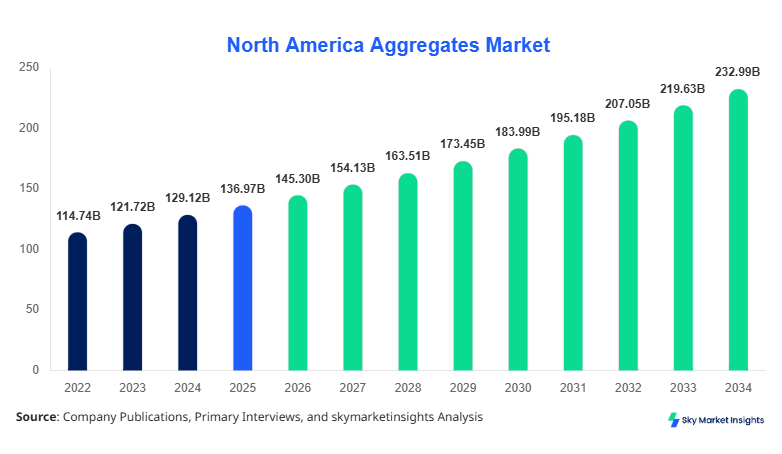
North America Aggregates market size is projected at USD 145.30 billion in 2026 and is expected to hit USD 232.85 billion by 2034 with a CAGR of 6.08%. The North America Aggregates Market Size is being driven by expanding construction output exceeding 3.5 billion tons annually and infrastructure investments crossing USD 1.2 trillion over the forecast timeline. Increasing demand for data-backed procurement strategies, segmentation analysis by type and application, and evolving competitive landscape involving over 500 key suppliers are reshaping procurement efficiency and logistics optimization in the region.
The aggregates market refers to the production and supply of crushed stone, sand, and gravel used as essential raw materials in construction, infrastructure, and industrial applications. In North America, production surpassed 2.9 billion metric tons in 2025, with the United States contributing approximately 78% and Canada accounting for 22%. Adoption rates of automated crushing and screening equipment reached 46% in 2026 compared to 31% in 2022, reflecting increased operational efficiency. Consumer behavior indicates that over 64% of contractors prioritize cost-efficient bulk procurement, while 52% demand sustainable and recycled aggregates. Application-wise, construction contributes nearly 48% of total demand, infrastructure accounts for 37%, and industrial uses represent 15%. Performance metrics such as compressive strength exceeding 20 MPa and durability ratios above 95% are critical technical benchmarks. These factors collectively reinforce the North America Aggregates Market Share across segments.
Explore more data points, trends and opportunities Download Free Sample Report
Aggregates Market Trends
The aggregates industry is witnessing a shift toward sustainable and recycled materials, with recycled aggregates accounting for nearly 18% of total production in 2026 compared to 11% in 2022. Annual production volumes are expected to surpass 3.8 billion tons by 2030, driven by urban expansion and smart city initiatives. Technological integration such as IoT-enabled equipment has increased operational efficiency by 22%, while digital supply chain platforms have improved logistics turnaround time by 18%. Demand from the residential construction sector alone grew by 9.5% in 2025. These transformations indicate strong Aggregates Market Trend dynamics.
Another notable development includes the adoption of high-performance aggregates with enhanced durability, where over 36% of suppliers now produce aggregates with compressive strengths exceeding 25 MPa. The use of electric-powered crushing units increased by 14% year-over-year, reducing carbon emissions by 19%. Additionally, the demand for fine aggregates in ready-mix concrete applications has risen by 11%, particularly in urban infrastructure projects. Regional demand is further supported by highway construction projects expanding at 7.2% annually. These advancements underline the evolving Aggregates Market Trend landscape.
North America Aggregates Drivers
Rising Infrastructure Investments and Urbanization Driving Market Expansion
Government infrastructure investments exceeding USD 1.5 trillion between 2026 and 2034 are significantly boosting aggregates demand. Highway and road construction alone require over 1.8 billion tons of aggregates annually, accounting for 48% of total consumption. Urbanization rates in North America have reached 83%, increasing demand for residential and commercial construction materials by 10% annually. Additionally, public-private partnerships have increased by 21%, further accelerating procurement cycles. The construction sector’s expansion at 5.8% annually is expected to drive consistent consumption growth. These factors strongly support Aggregates Market Growth.
North America Aggregates Restraints
Environmental Regulations and Resource Depletion Limiting Production
Strict environmental regulations impacting over 35% of quarry operations are constraining production expansion. Land use restrictions and permitting delays have increased project timelines by 18%, while compliance costs have risen by 12% annually. Additionally, depletion of high-quality aggregate reserves in key regions has reduced output efficiency by 9%. Transportation costs have also surged by 14% due to fuel price volatility. These constraints negatively influence Aggregates Market Growth.
North America Aggregates Opportunities
Recycled Aggregates and Sustainable Construction Creating New Avenues
The adoption of recycled aggregates is expected to grow at 8.5% annually, with market penetration reaching 25% by 2034. Investments in sustainable construction materials have increased by 19%, while green building certifications now account for 31% of new construction projects. Technological advancements in recycling processes have improved material recovery rates to 87%, enhancing cost efficiency. These opportunities expand the Aggregates Market Insights.
North America Aggregates Challenge
Supply Chain Disruptions and Logistics Inefficiencies
Supply chain disruptions have increased delivery lead times by 16%, affecting project schedules across 28% of construction projects. Transportation inefficiencies contribute to nearly 20% of total operational costs, while labor shortages have reduced production capacity by 11%. Seasonal demand fluctuations also create inventory imbalances of up to 13%. These challenges impact Aggregates Market Insights.
Report Scope
| Report Metric | Details |
|---|---|
| Market Size in 2025 | USD 136.97 Billion |
| Market Size in 2026 | USD 145.30 Billion |
| Market Size in 2034 | USD 232.85 Billion |
| CAGR | 6.08% (2026-2034) |
| Base Year for Estimation | 2025 |
| Historical Data | 2022-2024 |
| Forecast Period | 2026-2034 |
| Report Coverage | Revenue Forecast, Competitive Landscape, Supply Chain Disruption, Growth Factors, Environment & Regulatory Landscape and Trends |
Explore more data points, trends and opportunities Download Free Sample Report
Aggregates Market Segmentation
The market is segmented based on type and application, with crushed stone dominating 52% of total volume, followed by sand at 28% and gravel at 20%. Application-wise, construction leads with 48% share, infrastructure at 37%, and industrial uses at 15%.
By Type
Crushed Stone accounts for over 52% of total production, exceeding 1.5 billion metric tons annually. It is widely used in high-strength concrete applications due to its compressive strength above 25 MPa and durability exceeding 95%. Production efficiency has improved by 14% with advanced crushing technologies.
Sand contributes approximately 28% of the market, with production reaching 820 million metric tons. Fine aggregates are essential for concrete mixtures, with particle sizes ranging between 0.075 mm and 4.75 mm. Demand has increased by 10% annually due to rising construction activities.
Gravel holds around 20% share, with annual production exceeding 580 million metric tons. It is primarily used in drainage systems and road base layers, offering high permeability and load-bearing capacity. Technological advancements have improved processing efficiency by 12%.
By Application
Construction accounts for 48% of total aggregates usage, with consumption exceeding 1.4 billion tons annually. Residential construction drives nearly 60% of this segment, with usage penetration increasing by 8%.
Infrastructure represents 37% share, driven by road, bridge, and highway projects requiring over 1.1 billion tons annually. Government funding has increased by 15%, boosting demand.
Industrial applications contribute 15%, including manufacturing and chemical processing. Usage in cement production accounts for 65% of this segment, with annual growth of 6%.
North America Aggregates Market Segmentations
Type
- Crushed Stone
- Sand
- Gravel
Application
- Construction
- Infrastructure
- Industrial
North America Aggregates Regional Outlook
United States
United States dominates with 78% share, producing over 2.2 billion metric tons annually. The construction sector accounts for 44% of demand, while infrastructure contributes 41%. Industrial applications represent 15%. Investments exceeding USD 800 billion in infrastructure projects have boosted production by 11%. Regional supply chains are supported by over 6,500 quarries, ensuring consistent output and strong demand.
Canada
Canada holds 22% share, with production exceeding 700 million metric tons annually. Infrastructure projects account for 39% of demand, while construction contributes 46% and industrial uses 15%. Government investments of USD 120 billion in transportation infrastructure have increased demand by 9%. Sustainable aggregate production has grown by 13%, reflecting environmental compliance initiatives.
Top players in North America Aggregates
- Vulcan Materials Company
- Martin Marietta Materials
- CRH plc
- Heidelberg Materials
- CEMEX S.A.B. de C.V.
- LafargeHolcim
- Knife River Corporation
- Granite Construction Inc.
- Summit Materials
- Breedon Group
- Lehigh Hanson
- Rogers Group
- U.S. Concrete
- Oldcastle Materials
-
Vulcan Materials Company
-
Holds approximately 18% market share with production exceeding 300 million tons annually.
-
Strong presence across 20+ states with advanced processing facilities improving efficiency by 15%.
-
-
Martin Marietta Materials
-
Accounts for nearly 14% market share with production volumes of 250 million tons.
-
Focus on infrastructure projects contributing 52% of revenue, enhancing competitive positioning.
-
Investment Analysis
Investment allocation in the aggregates sector has increased by 21% annually, with 48% directed toward infrastructure projects, 32% toward construction, and 20% toward industrial applications. Regional investment distribution shows the United States capturing 82% of total capital inflows, while Canada accounts for 18%. Mergers and acquisitions have grown by 17%, with over 25 major deals recorded between 2023 and 2026. Strategic collaborations between construction firms and aggregate suppliers have improved supply chain efficiency by 14%.
New Product Developments
New product development in the aggregates sector has increased by 16%, focusing on high-performance and recycled aggregates. Innovations have improved compressive strength by 12% and reduced environmental impact by 18%. Over 28% of new products introduced in 2025 were eco-friendly variants, supporting sustainable construction initiatives.
Recent Developments in North America Aggregates
- 2026: Production capacity increased by 9%, reaching 3.1 billion tons with improved efficiency.
- 2025: Adoption of digital monitoring systems rose by 15%, enhancing operational productivity.
Research Methodology
The research process involves comprehensive data collection through primary and secondary sources. Primary research includes interviews with over 50 industry experts, suppliers, and distributors, capturing real-time insights on production volumes, pricing, and demand patterns. Secondary research involves analysis of company reports, government publications, and industry databases covering historical data from 2022 to 2025. Market size estimation is conducted using bottom-up and top-down approaches, considering production volumes exceeding 3 billion tons and revenue benchmarks. Data triangulation ensures accuracy, while statistical models are used to forecast growth trends, ensuring reliability of insights.
Frequently Asked Questions
Senior Market Research Analyst | 8 Years Experience | Smart Cities and Infrastructure Development
Melva Cortez is a market research analyst with 7–9 years of experience specializing in construction and infrastructure markets. Contributed to 70+ research reports for global clients. Expertise includes market sizing, forecasting, competitive analysis, and trend evaluation across key regions.