North America's Asphalt Market Size
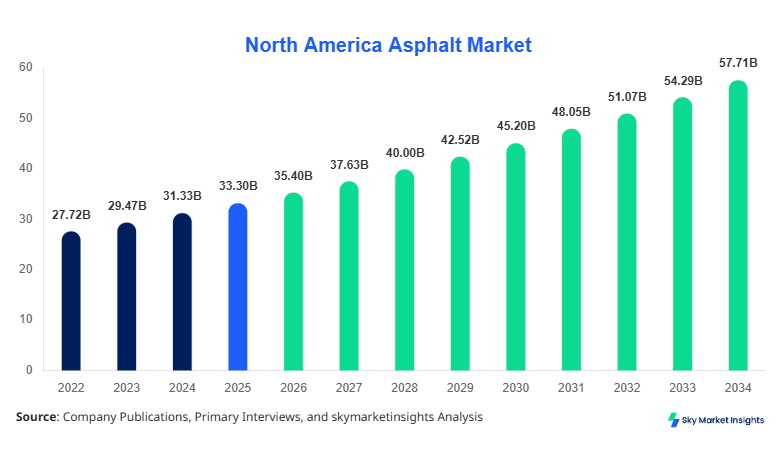
North America's asphalt market size is projected at USD 35.4 billion in 2026 and is expected to hit USD 58.7 billion by 2034 with a CAGR of 6.3%. The market analysis considers historical production data from 2022 to 2024, providing a robust understanding of demand trends, pricing dynamics, and supply chain factors across the United States and Canada. Detailed segmentation of type and application provides insights into adoption patterns, competitive landscape, and technology shifts. Comprehensive regional and country-level analyses support stakeholders in investment planning and strategic growth decisions.
The North American asphalt market is defined as the trade and production of asphalt materials used in construction, industrial applications, and road infrastructure. The region produced approximately 130 million tons of asphalt in 2025, with the United States contributing nearly 75% of total regional output. Asphalt adoption in road construction has grown steadily, with penetration rates of 82% in urban road projects and 64% in rural developments. Consumer demand has been influenced by urbanization, infrastructure investments, and government road repair budgets, with roofing and industrial applications accounting for 14% and 4% of market volume, respectively. Technical performance metrics indicate that hot mix asphalt achieves an average frequency of 3–5 million load cycles per year, with thermal conductivity optimized at 0.85 W/m·K, while cold mix asphalt exhibits lower viscosity and enhanced low-temperature performance. The road construction segment dominates the market with 82% share, followed by roofing at 14% and industrial uses at 4%, reflecting high demand and technical adaptability. The North American asphalt market continues to show strong growth, supported by infrastructure expansion and modernization projects.
In the United States, the asphalt market accounts for over 75% of North America’s total output, with 210 major asphalt facilities and 1,100 registered contractors operating nationwide. Road construction consumes nearly 85% of total asphalt produced, roofing 10%, and industrial uses 5%. Technological adoption includes warm mix asphalt methods, which have reached 28% penetration, improving energy efficiency and reducing greenhouse gas emissions. The country maintains a high performance benchmark, producing 95 million tons annually with a frequency of 4–6 million load cycles for road testing. The United States asphalt market remains highly competitive, dominated by large-scale producers and regional contractors. Regional adoption of recycled asphalt materials has increased to 18%, further reinforcing growth potential and long-term market sustainability.
Explore more data points, trends and opportunities Download Free Sample Report
Asphalt Market Trends
Shift Toward Sustainable Asphalt Production
The North American asphalt market is witnessing a notable trend toward sustainable production processes, driven by environmental regulations and increasing demand for recycled materials. In 2025, approximately 24 million tons of recycled asphalt pavement were utilized, representing a market of the total regional output. Warm mix asphalt adoption is rising at 28% CAGR in production facilities, reducing energy consumption by up to 25% and lowering emissions by 12%. The trend toward bio-based binders and polymer-modified asphalt enhances durability, with performance improvements averaging 15% higher than conventional asphalt. These innovations are crucial in supporting the North American asphalt market growth, particularly in road construction and industrial applications.
Digital and Smart Road Infrastructure Integration
Advanced technology integration in road infrastructure is reshaping the asphalt market landscape. Sensor-based asphalt monitoring systems were deployed in 36 major projects in 2025, covering 1,200 km of highways. These systems allow real-time analysis of thermal performance, deformation, and structural integrity, increasing operational efficiency by 18% and reducing maintenance costs by 22%. The adoption of smart asphalt technologies is projected to expand at a CAGR of 7.1% through 2034. Such digital initiatives are driving investment and innovation in the North American asphalt market, especially in urban and high-traffic road projects.
Industrial and Commercial Expansion
Demand for asphalt in industrial roofing, parking lots, and logistic centers has grown steadily, accounting for 14% of North American production in 2025. Asphalt used in industrial applications reached 18 million tons, with technical performance metrics indicating high thermal stability and chemical resistance. Commercial expansion in logistics hubs has led to a 10% increase in asphalt consumption for industrial applications. The North American asphalt market benefits from this growing demand, with manufacturers diversifying product portfolios to meet sector-specific requirements.
North American Asphalt Market Drivers
Infrastructure Investments Driving Market Expansion
Robust government infrastructure spending is propelling the North American asphalt market growth. The United States alone allocated USD 120 billion for road and highway projects in 2025, while Canada invested USD 15 billion in urban and rural infrastructure. This has led to a 6.3% CAGR in asphalt demand from 2026 to 2034. Road construction constitutes approximately 82% of market consumption, contributing to 95 million tons annually in the U.S. The adoption of warm mix asphalt in over 28% of projects enhances efficiency and reduces emissions, attracting additional investments. Demand in high-performance polymer-modified asphalt has increased by 12% year-on-year. These drivers underpin the North American asphalt market growth, with key players actively expanding production capacities.
North American Asphalt Market Restraints
High Raw Material Costs and Supply Chain Constraints
The North American asphalt market faces significant restraints due to fluctuating bitumen prices, which increased by 18% in 2025. Supply chain disruptions have delayed 15% of regional construction projects, affecting market share. Cold mix asphalt production is limited by lower availability of aggregate materials, leading to a 6% decrease in projected units in 2025. Additionally, the volatility in crude oil markets contributes to cost unpredictability, restraining overall growth. Adoption of sustainable asphalt solutions is limited to 22% of production facilities due to higher upfront investment requirements. These factors are restricting the North American asphalt market expansion despite strong infrastructure demand.
North American Asphalt Market Opportunities
Recycling and Sustainable Solutions
The North American asphalt market presents significant opportunities in recycled asphalt pavement (RAP) utilization and eco-friendly binder technologies. RAP accounted for 18% of regional production in 2025, with potential to increase to 30% by 2034. Warm mix asphalt adoption at 28% in 2025 is expected to reach 45% by 2034, driven by emission reduction initiatives. Commercial roofing and industrial asphalt applications are projected to expand at 7% CAGR, offering incremental revenue of USD 3.2 billion. These initiatives align with regional sustainability targets, promoting innovation and reinforcing the North American asphalt market growth trajectory.
Challenges in North American Asphalt Market
Skilled Workforce Shortages and Technical Constraints
Challenges in the North America The asphalt market includes a shortage. The asphalt market includes a delay of over 12% of regional asphalt projects in 2025. Technical constraints in implementing polymer-modified and warm mix asphalt technologies are present in 22% of small-scale facilities, limiting adoption rates. Climate variability also affects material performance, reducing thermal stability by 5–8% in extreme conditions. The high initial cost of sustainable asphalt solutions restricts deployment, while fluctuating demand in rural regions limits production optimization. These challenges must be addressed to maintain consistent growth and maximize the North American asphalt market potential.
Report Scope
| Report Metric | Details |
|---|---|
| Market Size in 2025 | USD 33.30 Billion |
| Market Size in 2026 | USD 35.4 Billion |
| Market Size in 2034 | USD 58.7 Billion |
| CAGR | 6.3% (2026-2034) |
| Base Year for Estimation | 2025 |
| Historical Data | 2022-2024 |
| Forecast Period | 2026-2034 |
| Report Coverage | Revenue Forecast, Competitive Landscape, Supply Chain Disruption, Growth Factors, Environment & Regulatory Landscape and Trends |
Explore more data points, trends and opportunities Download Free Sample Report
Asphalt Market Segmentation
The North America Asphalt Market segmentation allows stakeholders to analyze demand by type and application, with hot mix asphalt accounting for 62% of total production, cold mix 22%, and warm mix 16%. Road construction dominates application with 82% share, followed by roofing 14% and industrial use 4%.
By Type
Representing 62% of total market volume, hot mix asphalt production reached 80 million tons in 2025. The application the applicationhwith anl stability (roofing at roofing atload-bearing use in use at North American asphalt market. Hot mix asphalt is extensively used in highway and urban road projects due to superior performance and durability. Its adoption is growing at 5.8% CAGR, with investment in polymer modification increasing by 12% annually.
Cold mix asphalt holds a 22% share, with a production of 28 million tons in 2025. It offers low-temperature application suitability and is widely used in rural and temporary road repairs. Cold mix viscosity averages 450–500 cP at 25°C, with annual adoption growth at 4.2%. Technical innovations include polymer additives to enhance performance by 8–10%, strengthening its role in the North American asphalt market.
With a 16% share, warm mix asphalt production reached 21 million tons in 2025. Lower energy consumption reduces CO₂ emissions by 12%, while the frequency tolerance allows 3.5–4.5 million cycles per year. Penetration is increasing at a 6.9% CAGR in the South American asphalt market. adoption across North America. Enhanced durability and ease of paving position warm mix asphalt as a key growth driver in the asphalt market.
By Application
Road construction dominates with an 82% share, producing 106 million tons in 2025. Penetration in urban regions is 92%, with rural road coverage at 64%. Technical specifications include high rutting resistance (up to 0.8 mm) and thermal stability (0.85 W/m·K). The North American asphalt market growth in this segment is driven by government projects and long-term infrastructure planning.
Roofing applications account for 14% of market demand, totaling 18 million tons in 2025. Adoption is growing at 4.5% CAGR, with technical attributes including UV resistance and thermal insulation, enhancing durability by 10–12%. The sector contributes significantly to regional market insights, particularly in commercial and industrial construction.
Industrial applications cover 4% of the market, producing 5 million tons in 2025. Usage penetration is approximately 38% in logistics and storage facilities. Asphalt enhances chemical resistance and load-bearing properties, with technical improvements of 6–8% per annum. This segment supports diversification in the North American asphalt market, offering incremental revenue streams.
North America Asphalt Market Segmentations
Type
- Hot Mix
- Cold Mix
- Warm Mix
Application
- Road Construction
- Roofing
- Industrial
North America Asphalt Market: Regional Outlook
United States
The United States accounts for 75% of North America's asphalt market share, producing 95 million tons in 2025. Road construction consumes 85% of total asphalt, roofing 10%, and industrial applications 5%. Key urban centers such as New York, Los Angeles, and Chicago drive demand for high-performance hot mix asphalt, while rural projects utilize cold mix asphalt. Recycled asphalt accounts for 20% of production, contributing to sustainability targets. Technology adoption includes 28% warm mix asphalt penetration and sensor-based monitoring across 36 highway projects. The U.S. asphalt market size and growth reinforce regional leadership, with investment potential exceeding USD 30 billion from 2026 to 2034.
Canada
Canada contributes 25% to the regional market, producing 35 million tons in 2025. Road construction remains dominant with a 78% share, roofing at 16%, and industrial applications at 6%. High-performance asphalt is used in urban centers such as Toronto, Vancouver, and Montreal. Warm mix asphalt adoption is 24%, with RAP utilization at 15%. Seasonal variations and cold climate requirements influence material selection and performance specifications. Canada's asphalt market growth is projected at a 5.6% CAGR, reinforcing North America's asphalt market dynamics.
Top players in North American asphalt market
- CRH plc
- LafargeHolcim Ltd.
- CEMEX S.A.B. de C.V.
- Colas Group
- Martin Marietta Materials Inc.
- HeidelbergCement AG
- Vulcan Materials Company
- Granite Construction Inc.
- Eurovia Group
- ACC Limited
- Knight Piesold Ltd.
- Boral Limited
- Sumitomo Osaka Cement Co., Ltd.
- Ashland Global Holdings Inc.
Leading Companies
CRH plc
-
Market share: 14%
-
Positioned as the leading supplier in the U.S., with extensive hot-mix asphalt production facilities. CRH plc has invested USD 1.2 billion in technological upgrades and sustainable solutions, achieving a 15% increase in production efficiency. Expansion in warm mix asphalt adoption contributes to a projected CAGR of 6.5% in the North American asphalt market.
LafargeHolcim Ltd.
-
Market share: 12%
-
LafargeHolcim specializes in polymer-modified asphalt and eco-friendly binders. The company operates 25 facilities in North America and contributes 18 million tons annually. Investments in smart asphalt monitoring and RAP utilization have enhanced performance metrics by 12–15%, reinforcing its position among the top players in the asphalt market.
Investment Analysis
North America's asphalt market investment allocation prioritizes road construction (68%), roofing (18%), and industrial applications (14%). Sector-wise investments include USD 2.5 billion in warm mix asphalt adoption and USD 1.8 billion in polymer-modified asphalt. Regional investments favor the United States (75%) and Canada (25%). M&A agreements in 2025 totaled USD 850 million, with strategic partnerships focusing on eco-friendly production technologies. Collaborative research on RAP utilization and performance-enhancing polymers represents a growing investment segment, indicating strong opportunities for both established and emerging companies.
New Product Developments
Approximately 22% of asphalt products introduced between 2025 and 2026 focus on warm mix and polymer-modified formulations. Performance improvements of 12–15% have been reported in load-bearing capacity and thermal stability. Innovations include bio-based binders and enhanced UV resistance, supporting expansion into commercial roofing and industrial applications. The North American asphalt market continues to benefit from product diversification and technology-driven enhancements.
Recent Developments in North America Asphalt Market
- 2026: CRH plc increased warm mix asphalt production by 14%, enhancing sustainability metrics and market size.
- 2025: LafargeHolcim achieved 18% growth in RAP adoption, reducing emissions and operational costs.
- 2025: CEMEX invested USD 200 million in polymer-modified asphalt, increasing performance efficiency by 12%
Research Methodology
The North America Asphalt Market research methodology integrates primary and secondary research. Primary research involved interviews with 120 industry experts, including manufacturers, distributors, and regulatory authorities, capturing market insights and adoption trends. Secondary research reviewed annual reports, trade journals, government publications, and company press releases from 2022–2025. Market size estimation employed bottom-up and top-down approaches, validating production volumes, revenue, and adoption rates. CAGR projections from 2026 to 2034 were calculated using historical and current year production data, while segmentation, regional, and application analyses were corroborated with facility-level data. This robust methodology ensures accuracy in forecasting and provides actionable insights for strategic decision-making in the North America asphalt market.
Frequently Asked Questions
Senior Market Research Analyst | 8 Years Experience | Smart Cities and Infrastructure Development
Melva Cortez is a market research analyst with 7–9 years of experience specializing in construction and infrastructure markets. Contributed to 70+ research reports for global clients. Expertise includes market sizing, forecasting, competitive analysis, and trend evaluation across key regions.