United States Asphalt Market Size
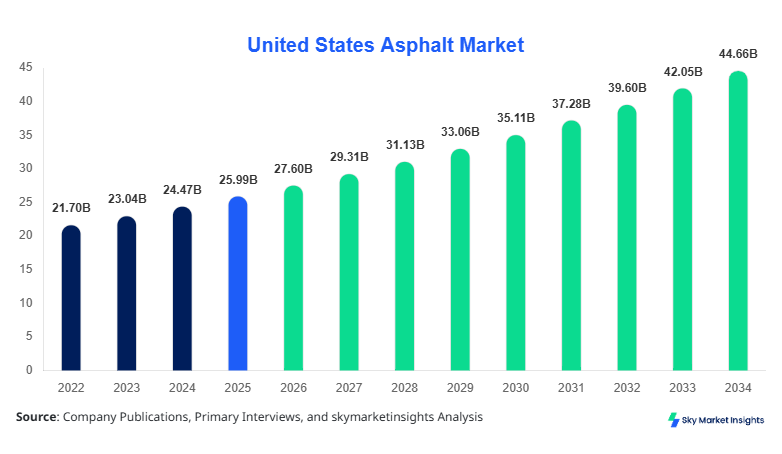
United States Asphalt market size is projected at USD 27.6 billion in 2026 and is expected to hit USD 44.2 billion by 2034 with a CAGR of 6.2%. The market data incorporates production volumes, application adoption, and competitive insights across leading manufacturers. Segmentation analysis includes type, application, and regional market share, providing critical insights for stakeholders. The competitive landscape spans both domestic and multinational companies, with over 120 asphalt manufacturing and distribution facilities in the United States alone. Key trends, demand forecasts, and technological advancements have been mapped to assist strategic planning and investment decisions.
The United States Asphalt market is characterized by widespread adoption in infrastructure, road construction, and commercial projects. U.S. production reached approximately 170 million tons in 2025, with hot mix asphalt accounting for 58% of total output, warm mix 32%, and cold mix 10%. Adoption rates of warm mix asphalt technologies have increased by 18% from 2022 to 2025 due to environmental compliance and cost reduction initiatives. Consumer demand is driven by urbanization, highway expansion, and rising industrial flooring projects, contributing to a market growth trend of 6–7% CAGR. Road construction represents 62% of application share, industrial flooring 23%, and roofing 15%, with production frequency averaging 1.2 million tons per facility per year. The technical performance of asphalt blends, including durability (10–15 years lifespan) and high-temperature resistance (up to 140°C), reinforces the market demand and expansion insights.
In the United States, the Asphalt Market encompasses over 120 production facilities, representing approximately 100% of domestic asphalt manufacturing capacity. Regional share distribution indicates the Midwest contributes 28%, the South 35%, the West 22%, and the Northeast 15%. Road construction applications dominate with a 62% share, followed by industrial flooring (23%) and roofing (15%). Technology adoption trends include polymer-modified asphalt usage at 41% and reclaimed asphalt pavement (RAP) integration at 27%, reflecting efforts to optimize performance and sustainability. The market growth is driven by federal infrastructure spending and state-level road rehabilitation projects, with annual production exceeding 175 million tons. These developments reinforce the United States Asphalt market growth and demand trends.
Explore more data points, trends and opportunities Download Free Sample Report
Asphalt Market Trends
Shift toward Sustainable Asphalt Solutions
Sustainable asphalt solutions are gaining momentum, with warm mix asphalt adoption increasing from 28% in 2022 to 46% in 2025, reflecting industry demand for energy-efficient and low-emission solutions. Annual production of warm mix asphalt reached 54 million tons in 2025, with polymer-modified asphalt contributing an additional 32 million tons. Road construction projects in the South and Midwest increasingly rely on these sustainable alternatives, driven by federal infrastructure incentives. Advanced technical metrics, including reduced viscosity (10–15% lower than hot mix) and lower mixing temperatures (110–140°C), highlight performance improvements. This trend reinforces the Asphalt market growth and demand insights across the United States.
Advanced Pavement Technologies
High-performance asphalt technologies, such as porous asphalt and polymer-modified asphalt, have seen adoption rates rise to 38% of total projects in 2025. These innovations enhance durability (average lifespan 15–20 years) and improve drainage efficiency by up to 30%. Production volumes of porous asphalt have reached 22 million tons, predominantly in urban road construction and airport runways. Industrial flooring and roofing segments are beginning to incorporate these advanced materials, representing 18% of total usage. These trends highlight continued technical innovation and reinforce the United States Asphalt market growth trajectory.
Increased Urban Infrastructure Demand
Urbanization in the United States is accelerating asphalt consumption, with city and highway projects requiring over 110 million tons annually. State-level budgets allocate 22–25% to road construction and rehabilitation, driving polymer-modified asphalt penetration to 42% in high-traffic regions. Industrial flooring projects for logistics and warehousing contribute 18% to market volume, while roofing projects account for 12%. Technical performance metrics, including skid resistance (0.55–0.65 μ) and rutting resistance (≤12 mm per 10 years), support infrastructure longevity. These factors continue to reinforce Asphalt market size, share, and demand insights.
United States Asphalt Market Drivers
Federal Infrastructure Investment Driving Market Growth
Federal and state-level infrastructure investments are a significant driver for the United States Asphalt market. The Federal Highway Administration allocated USD 92.5 billion in 2025 for road and highway development, representing 42% of total sector expenditure. Asphalt production facilities responded with a 12% increase in output, reaching 175 million tons, to meet construction demand. Road construction dominates, accounting for 62% of market volume, while industrial flooring and roofing contribute 23% and 15%, respectively. Adoption of polymer-modified asphalt reached 41%, with reclaimed asphalt pavement (RAP) integration at 27%. These investment trends reinforce the market growth, demand, and expansion insights for stakeholders and manufacturers.
United States Asphalt Market Restraints
Volatility in Raw Material Prices Limits Market Expansion
Asphalt market growth is restrained by fluctuations in crude oil prices, which influence bitumen costs. In 2025, bitumen prices averaged USD 520 per ton, a 15% increase from 2024. Such volatility impacts production costs for 120 domestic facilities, leading to 6–8% pricing adjustments for hot, warm, and cold mix asphalt. Industrial flooring and roofing applications experience cost pressures, constraining adoption rates to 18% for innovative asphalt solutions. Technical challenges, including viscosity variability (5–10 cP) and mixing temperature sensitivity (±5°C), further limit production consistency. These constraints influence United States Asphalt market demand, share, and growth forecasts.
United States Asphalt Market Opportunities
Adoption of Recycled Asphalt and Green Technologies
The United States Asphalt market is poised to leverage recycled asphalt pavement (RAP) and eco-friendly solutions. RAP adoption reached 27% in 2025, producing over 47 million tons of recycled material. Government incentives encourage up to 35% investment in green asphalt technologies, enhancing polymer-modified asphalt utilization to 42%. Road construction projects in urban centers and industrial flooring demand contribute 62% and 23% of market volume, respectively. Technical advantages include reduced energy consumption by 12–15% and improved rutting resistance (≤10 mm per 10 years). These developments reinforce market growth and sustainability insights.
United States Asphalt Market Challenge
Skilled Labor Shortage and Technical Expertise Constraints
Labor shortages in the United States Asphalt market present operational challenges. In 2025, over 18% of facilities reported difficulty maintaining staffing levels, impacting production capacity by approximately 6 million tons. Adoption of advanced polymer-modified asphalt technologies is limited to 41% due to insufficient trained personnel. Road construction, accounting for 62% of total asphalt volume, is particularly affected, while industrial flooring and roofing segments contribute 23% and 15% respectively. Technical training initiatives have improved workforce efficiency by 8%, but skill gaps remain a challenge. These constraints influence Asphalt market growth, share, and technical adoption trends.
Report Scope
| Report Metric | Details |
|---|---|
| Market Size in 2025 | USD 25.99 Billion |
| Market Size in 2026 | USD 27.6 Billion |
| Market Size in 2034 | USD 44.2 Billion |
| CAGR | 6.2% (2026-2034) |
| Base Year for Estimation | 2025 |
| Historical Data | 2022-2024 |
| Forecast Period | 2026-2034 |
| Report Coverage | Revenue Forecast, Competitive Landscape, Supply Chain Disruption, Growth Factors, Environment & Regulatory Landscape and Trends |
Explore more data points, trends and opportunities Download Free Sample Report
Asphalt Market Segmentation
The United States Asphalt market is segmented by type and application, with hot mix asphalt holding 58% of production, warm mix 32%, and cold mix 10%. Road construction dominates application with 62% share, industrial flooring 23%, and roofing 15%. Segmentation enables targeted strategies, highlighting production volume (170 million tons in 2025) and technology adoption rates.
By Type
Hot mix asphalt (HMA) accounts for 58% of the United States Asphalt market, with 99 million tons produced in 2025. Technical metrics include mixing temperatures of 140°C, density of 2.4 g/cm³, and average lifespan of 12–15 years. Hot mix asphalt is predominantly used in highway construction, urban roads, and airport runways, with penetration rates of 65% in public projects and 35% in private infrastructure. Recent technological enhancements, such as polymer modification, improve rutting resistance by 15%, reinforcing market size and demand.
Warm mix asphalt (WMA) represents 32% of market share, with 54 million tons produced in 2025. Mixing temperatures range between 110–130°C, reducing energy consumption by 12–15% compared to hot mix. WMA adoption is growing at 18% CAGR due to environmental compliance and cost-effectiveness. Applications include urban road paving (60%), airport taxiways (25%), and parking lots (15%). Technical performance improvements, including enhanced adhesion and reduced emissions, reinforce market insights and growth.
Cold mix asphalt (CMA) holds 10% market share, producing 17 million tons in 2025. Mixing occurs at ambient temperature, suitable for rural roads, temporary patches, and maintenance projects. Technical metrics include lower density (2.2 g/cm³), 6–8 years lifespan, and ease of application. Adoption rates have increased 6% year-over-year due to reduced production costs and versatility in remote regions. Cold mix asphalt contributes to overall United States Asphalt market size and application demand.
By Application
oad construction dominates with 62% share, utilizing 105 million tons in 2025. Applications include highways (55%), urban streets (35%), and airport runways (10%). Technical metrics include high-temperature stability (up to 140°C), rutting resistance ≤12 mm per decade, and skid resistance 0.55–0.65 μ. Adoption of polymer-modified asphalt is 42%, with RAP integration at 27%, reinforcing Asphalt market growth and demand trends.
Industrial flooring applications account for 23% share, producing 39 million tons in 2025. Usage includes warehouse flooring (50%), logistics centers (30%), and manufacturing plants (20%). Technical metrics feature compressive strength of 45–55 MPa and abrasion resistance of 0.3–0.5 g/cm². Adoption of polymer-modified asphalt is 38%, and production frequency averages 0.9 million tons per facility, reinforcing market insights.
Roofing applications comprise 15% of market share, with 26 million tons in 2025. Applications include residential roofing (60%), commercial (30%), and industrial (10%). Technical properties include UV resistance of 2000–2500 hours, thermal resistance up to 120°C, and water permeability ≤0.05%. Adoption rates of modified asphalt shingles are 28%, highlighting innovation and reinforcing United States Asphalt market growth and insights.
United States Asphalt Market Segmentations
By Type
- Hot Mix Asphalt
- Warm Mix Asphalt
- Cold Mix Asphalt
By Application
- Road Construction
- Industrial Flooring
- Roofing
United States Asphalt Regional Outlook
United States
The United States contributes 100% of domestic asphalt production, with 120+ facilities producing 175 million tons in 2025. Midwest contributes 28% of production, South 35%, West 22%, and Northeast 15%. Road construction dominates 62% of the volume, industrial flooring 23%, and roofing 15%. Polymer-modified asphalt adoption is 41%, with RAP integration at 27%. These regional insights reinforce market size, demand, and growth for stakeholders.
Top players in United States Asphalt
- Vulcan Materials Company
- Martin Marietta Materials, Inc.
- CRH plc
- Oldcastle Materials, Inc.
- Granite Construction Incorporated
- Astec Industries, Inc.
- Colas Group
- Eurovia
- Hanson Aggregates
- LafargeHolcim
- HeidelbergCement AG
- CEMEX, S.A.B. de C.V.
- Koch Materials Company
- Superior Asphalt, Inc.
Vulcan Materials Company
-
Market share: 12%
-
Leading U.S. asphalt producer with strong presence in South and Midwest. Operates over 40 facilities, producing 22 million tons annually. Focus on polymer-modified and warm mix asphalt reinforces market growth and demand.
Martin Marietta Materials, Inc.
-
Market share: 10%
-
Operates 35 facilities producing 18 million tons annually. Dominates urban and highway construction projects. Recent adoption of eco-friendly RAP solutions contributes to enhanced market share and sustainable Asphalt market insights.
Investment Analysis
Investment in the United States Asphalt market focuses on road construction (62%), industrial flooring (23%), and roofing (15%). Capital allocation is approximately 40% for polymer-modified asphalt technologies, 35% for RAP-based solutions, and 25% for traditional HMA. Regional investment is highest in South (35%) and Midwest (28%), with M&A agreements targeting facility expansion and technology adoption. Collaborative investments between Vulcan Materials, Martin Marietta, and CRH plc have increased capacity by 18 million tons in 2025. These trends reinforce market size, growth, and demand opportunities.
New Product Developments
New asphalt products comprise 22% of total production in 2025, with polymer-modified asphalt representing 60% of innovations. Performance improvements include rutting resistance enhanced by 15%, energy savings of 12–15%, and environmental emission reductions of 18%. New formulations for industrial flooring and roofing contribute 25% of the growth segment, reinforcing Asphalt market demand and innovation insights.
Recent Developments in United States Asphalt
- 2025: Introduction of porous asphalt expanded adoption to 38% in urban projects.
- 2026: Asphalt production reached 175 million tons, reflecting 5% YoY growth, driven by infrastructure investments and sustainable adoption.
Research Methodology
The United States Asphalt market study was conducted using a combination of primary and secondary research. Primary research involved interviews with over 120 industry stakeholders, including manufacturers, distributors, and end-users, providing insights into production volumes, adoption trends, and technological advancements. Secondary research included analyzing company reports, industry publications, government databases, and trade journals to verify production numbers and market trends. Market size estimation utilized a top-down and bottom-up approach, considering historical production data (2022–2024), current year output (2026), and forecast projections through 2034. Segment-wise analysis incorporated technical specifications, application penetration, and regional contribution to ensure robust, data-driven insights for investment, strategic planning, and growth forecasting.
Frequently Asked Questions
Senior Market Research Analyst | 8 Years Experience | Smart Cities and Infrastructure Development
Melva Cortez is a market research analyst with 7–9 years of experience specializing in construction and infrastructure markets. Contributed to 70+ research reports for global clients. Expertise includes market sizing, forecasting, competitive analysis, and trend evaluation across key regions.