Europe Asphalt Market Size
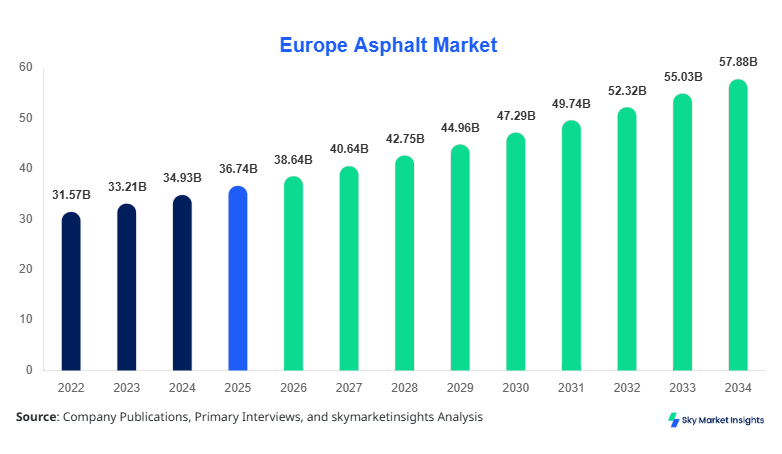
Europe's asphalt market size is projected at USD 38.64 billion in 2026 and is expected to hit USD 57.83 billion by 2034 with a CAGR of 5.18%.
The European asphalt industry continues to witness strong expansion due to increasing road rehabilitation activities, public infrastructure spending, and rising transportation investments across France, Germany, Italy, and the United Kingdom. More than 312 million metric tons of asphalt mixtures were consumed across Europe in 2025, while over 68% of highway resurfacing projects incorporated recycled asphalt technologies. The competitive landscape remains moderately consolidated with leading producers accounting for nearly 42% of total regional production capacity, while local contractors dominate municipal paving activities across the region.
The asphalt market refers to the production, distribution, and application of bituminous materials used primarily in road construction, roofing, waterproofing, airport runways, and industrial infrastructure. Europe produced nearly 295 million metric tons of asphalt mixtures in 2025, supported by over 27,000 operational asphalt production facilities and mobile mixing plants across the region. Hot mix asphalt accounted for approximately 61% of total consumption, while warm mix asphalt represented 24% owing to lower emission benefits and reduced energy consumption of nearly 18% compared with conventional systems. Road construction applications contributed nearly 72% of overall product utilization, followed by waterproofing at 15% and airport infrastructure at 8%.
Adoption and penetration across Europe remain high due to rising smart mobility projects and road modernization initiatives. More than 81% of national highway resurfacing programs in France and Germany integrated polymer-modified asphalt in 2025. Consumer behavior indicates strong preference toward durable and recyclable pavement solutions with lifecycle durability exceeding 18–22 years under heavy traffic conditions. Approximately 39% of municipal contractors increased procurement of recycled asphalt pavement materials due to cost reductions of 12%–16%. Increasing vehicle ownership, which crossed 412 million registered vehicles in Europe during 2025, continues to support long-term asphalt market expansion.
In France, the asphalt market accounted for nearly 21% of total European consumption in 2025, supported by more than 3,200 asphalt manufacturing facilities and paving contractors operating across the country. France produced approximately 63 million metric tons of asphalt mixtures during 2025, with road construction applications contributing 74% of domestic consumption. Warm mix asphalt penetration exceeded 29% due to stringent carbon reduction regulations and energy efficiency mandates introduced by transportation authorities. Nearly 48% of urban road resurfacing projects in Paris, Lyon, and Marseille utilized recycled asphalt pavement technologies to lower material costs and carbon emissions.
Technology adoption in France continues to accelerate through smart road infrastructure investments and sustainable paving initiatives. Polymer-modified asphalt utilization increased by 17% during 2025, while automated asphalt mixing systems improved production efficiency by 11%. Airport infrastructure projects represented nearly 9% of total asphalt demand, particularly around Charles de Gaulle and Orly airport expansions. The French asphalt market continues to benefit from government infrastructure budgets exceeding USD 14 billion allocated toward transportation modernization and road rehabilitation activities.
Explore more data points, trends and opportunities Download Free Sample Report
Asphalt Market Trends
The European asphalt industry is witnessing substantial transformation due to the growing integration of sustainable paving technologies and recycled materials. Recycled asphalt pavement utilization increased from 27% in 2022 to nearly 39% in 2025 across Europe. Germany, France, and the United Kingdom collectively processed more than 71 million metric tons of reclaimed asphalt materials during 2025. Warm mix asphalt adoption expanded rapidly due to reduced greenhouse gas emissions of approximately 20%–35% and fuel savings of nearly 18%. Digitalized asphalt plants equipped with AI-driven quality monitoring systems increased operational productivity by 13% while reducing material wastage by nearly 9%. Transportation agencies across Europe invested over USD 5.6 billion in low-carbon road infrastructure during 2025, reinforcing asphalt market expansion.
Another major trend involves the increasing use of polymer-modified and rubberized asphalt materials for enhanced pavement durability and weather resistance. More than 41% of high-traffic highways in Europe now incorporate polymer-modified asphalt solutions capable of extending road lifespan by 30%–40%. Airport runway modernization programs across Spain and Italy boosted demand for high-performance asphalt materials capable of tolerating aircraft loads exceeding 400 tons. Additionally, smart sensor integration in asphalt pavements increased by 14% during 2025 to support intelligent transportation systems and predictive maintenance. The adoption of energy-efficient batch mixing technologies also improved thermal efficiency by nearly 16%, strengthening asphalt market competitiveness across Europe.
Europe Asphalt Market Drivers
Increasing Transportation Infrastructure Investments Across Europe
Rising investments in transportation infrastructure remain a major growth catalyst for the European asphalt industry. European governments collectively allocated more than USD 214 billion toward highway modernization, urban mobility, and road rehabilitation projects during 2025. France alone invested approximately USD 14 billion, while Germany committed over USD 22 billion toward road maintenance and expansion. More than 126,000 kilometers of highways across Europe required resurfacing or rehabilitation due to aging infrastructure and rising traffic density. Heavy commercial vehicle movement increased by 8.6% during 2025, accelerating pavement deterioration and replacement cycles. Asphalt continues to dominate infrastructure applications because of its lower installation costs, faster construction times, and recyclability rates exceeding 90%. Warm mix asphalt utilization increased by 24% due to energy savings and emission reduction benefits. Public-private partnership models also contributed to increased project execution efficiency, particularly in the United Kingdom and Spain. These large-scale infrastructure initiatives continue to accelerate asphalt market expansion throughout the forecast period.
Europe Asphalt Market Restraints
Volatility in Crude Oil and Bitumen Prices
Fluctuating crude oil prices continue to create substantial pricing instability within the European asphalt sector. Bitumen, a key raw material derived from petroleum refining, experienced price fluctuations ranging between 11% and 19% during 2024–2025 due to supply chain disruptions and refinery production cuts. Average bitumen prices across Europe increased from USD 468 per ton in 2023 to nearly USD 542 per ton in 2025. Such volatility significantly impacts operational margins for contractors and municipal infrastructure agencies. Approximately 37% of small-scale asphalt producers reported delayed procurement activities due to rising raw material costs. Energy-intensive asphalt production processes also remain vulnerable to rising electricity and natural gas prices, which increased production expenses by approximately 14% during 2025. Environmental compliance requirements regarding carbon emissions further elevate operational expenditures, particularly for older asphalt plants requiring technological upgrades. These cost pressures continue to restrain asphalt market profitability across Europe.
Europe Asphalt Market Opportunities
Expansion of Sustainable and Recycled Asphalt Technologies
The growing focus on sustainability and circular economy initiatives presents significant opportunities for asphalt manufacturers across Europe. Recycled asphalt pavement utilization reached nearly 71 million metric tons in 2025 and is expected to expand substantially due to regulatory incentives promoting waste reduction. More than 63% of regional highway authorities introduced mandatory recycled content requirements for resurfacing projects. Warm mix asphalt technologies capable of reducing production temperatures by 20°C–40°C continue to gain popularity because they lower fuel consumption by approximately 18% and reduce emissions by up to 35%. Investments in bio-based asphalt additives and carbon-neutral bitumen solutions exceeded USD 1.8 billion during 2025. Smart roads integrating conductive asphalt materials and embedded traffic monitoring sensors also represent emerging opportunities for high-value applications. Increasing urbanization, which surpassed 76% across Europe, continues to create long-term infrastructure demand and favorable conditions for asphalt market development.
Challenges in the European Asphalt Market
Stringent Environmental Regulations and Carbon Reduction Targets
The European asphalt industry faces increasing challenges associated with environmental regulations and carbon neutrality targets. Asphalt production contributes substantial greenhouse gas emissions due to high-temperature processing requirements and energy-intensive manufacturing operations. More than 44% of existing asphalt production facilities across Europe require modernization to comply with updated emission standards introduced during 2025. Carbon taxation mechanisms increased operating costs by nearly 9% for several manufacturers, particularly in Germany and France. Regulatory authorities also imposed stricter limits on volatile organic compound emissions and particulate matter generated during paving activities. Labor shortages further intensified operational difficulties, with approximately 18% of contractors reporting skilled workforce deficits during 2025. Supply chain disruptions affecting aggregates and petroleum derivatives additionally impacted project timelines and procurement cycles. These regulatory and operational complexities continue to challenge asphalt market participants across the region.
Report Scope
| Report Metric | Details |
|---|---|
| Market Size in 2025 | USD 36.74 Billion |
| Market Size in 2026 | USD 38.64 Billion |
| Market Size in 2034 | USD 57.83 Billion |
| CAGR | 5.18% (2026-2034) |
| Base Year for Estimation | 2025 |
| Historical Data | 2022-2024 |
| Forecast Period | 2026-2034 |
| Report Coverage | Revenue Forecast, Competitive Landscape, Supply Chain Disruption, Growth Factors, Environment & Regulatory Landscape and Trends |
Explore more data points, trends and opportunities Download Free Sample Report
Asphalt Market Segmentation
The European asphalt sector is segmented by type and application, with hot mix asphalt dominating nearly 61% of total regional consumption due to its extensive use in highway construction and urban paving. Road construction applications accounted for approximately 72% of total demand, supported by government-funded transportation infrastructure programs and rehabilitation initiatives.
By Type
Hot mix asphalt dominated the European market with nearly a 61% share during 2025 owing to its superior durability, load-bearing capacity, and resistance to deformation under high traffic conditions. More than 181 million metric tons of hot mix asphalt were produced across Europe during 2025. Production temperatures ranging between 150°C and 190°C ensure enhanced compaction and long-lasting pavement structures. Germany, France, and Italy represented the largest production hubs due to extensive highway modernization projects. More than 73% of expressway resurfacing activities utilized hot mix asphalt because of its ability to withstand heavy axle loads and extreme weather variations. Advanced polymer-modified formulations increased pavement lifespan by approximately 35% while reducing maintenance frequency.
Warm mix asphalt accounted for nearly 24% of regional demand and continues to gain traction because of its environmental advantages and reduced production temperatures between 100°C and 140°C. Fuel consumption during production decreased by approximately 18%, while carbon emissions reduced by up to 35% compared with conventional hot mix technologies. More than 71 million metric tons of warm mix asphalt were produced across Europe in 2025. France and the United Kingdom emerged as leading adopters due to stricter environmental regulations and sustainability targets. The integration of chemical additives and foaming technologies improved compaction efficiency by 11% and enhanced pavement workability under colder conditions.
Cold mix asphalt represents approximately 10% of total European consumption and is primarily used for temporary road repairs, low-traffic roads, and municipal maintenance operations. Production volumes exceeded 29 million metric tons in 2025. Cold mix solutions can be applied at ambient temperatures, reducing energy requirements by nearly 70% compared with hot mix systems. Municipal authorities across Spain and Russia increasingly adopted cold-mix asphalt for pothole repair programs and rural road maintenance due to cost savings and ease of application. Storage stability exceeding six months also enhanced logistical flexibility for contractors operating in remote regions.
By Application
Road construction remained the dominant application segment, with nearly a 72% share of total European asphalt consumption during 2025. More than 224 million metric tons of asphalt materials were utilized in highway construction, bridge decks, urban roads, and municipal paving projects. France, Germany, and the United Kingdom collectively accounted for over 58% of road infrastructure demand across Europe. Increasing vehicle density, which exceeded 412 million registered vehicles in 2025, accelerated road wear and resurfacing cycles. High-performance asphalt solutions with rutting resistance exceeding 15 years under heavy traffic conditions became increasingly popular. Smart highway programs integrating conductive asphalt and embedded traffic monitoring systems also contributed to rising infrastructure investments.
Waterproofing applications accounted for nearly 15% of overall demand, supported by rising commercial construction and roofing activities. More than 48 million square meters of roofing membranes containing asphalt-based materials were installed across Europe during 2025. Asphalt waterproofing systems demonstrated moisture resistance exceeding 98% and thermal durability across temperature ranges from -25°C to 85°C. Italy and Spain represented key demand centers due to growing residential and industrial infrastructure development. Polymer-modified bituminous membranes gained substantial adoption because they improved waterproofing lifespan by nearly 28% compared with conventional solutions.
Airport infrastructure applications represented approximately 8% of total asphalt demand during 2025. More than 14 major runway modernization projects were completed across Europe, requiring high-performance asphalt capable of handling aircraft loads exceeding 400 tons. Spain, France, and Russia invested heavily in airport expansions and runway resurfacing programs. Specialized asphalt mixtures with enhanced skid resistance and thermal stability reduced runway maintenance intervals by approximately 21%. Advanced polymer-modified formulations also improved fatigue resistance and minimized surface cracking under repeated aircraft operations.
Europe Asphalt Market Segmentations
Type
- Hot Mix Asphalt
- Warm Mix Asphalt
- Cold Mix Asphalt
Application
- Road Construction
- Waterproofing
- Airport Infrastructure
Europe's Asphalt Market: Regional Outlook
United Kingdom
The United Kingdom accounted for approximately 16% of Europe's asphalt consumption during 2025, supported by extensive road rehabilitation and smart transportation projects. More than 42 million metric tons of asphalt mixtures were produced across the country, with road construction applications contributing nearly 74% of total demand. Government investments exceeding USD 11 billion targeted highway modernization and municipal resurfacing initiatives. Warm mix asphalt adoption surpassed 26% due to carbon reduction targets and sustainability programs. London, Manchester, and Birmingham emerged as major infrastructure investment hubs, while recycled asphalt pavement utilization reached nearly 38% across national road maintenance projects.
The UK roofing and waterproofing sector also contributed significantly to asphalt demand, accounting for nearly 14% of domestic consumption. Commercial real estate expansion and urban redevelopment activities increased bituminous membrane installations by approximately 12% during 2025. Airport runway resurfacing projects at Heathrow and Gatwick further strengthened demand for polymer-modified asphalt solutions capable of handling high aircraft loads and variable climatic conditions.
Germany
Germany represented nearly 23% of Europe's asphalt consumption during 2025 and remained one of the region’s largest production centers, with output exceeding 68 million metric tons. More than 4,100 asphalt plants and paving contractors operated across the country. Road modernization initiatives under the Federal Transport Infrastructure Plan drove significant procurement activity, while recycled asphalt utilization exceeded 45% due to stringent environmental policies. Warm mix asphalt penetration reached 31%, among the highest levels in Europe.
The country also invested heavily in sustainable mobility and intelligent transportation systems. More than USD 22 billion was allocated toward highway rehabilitation, bridge repairs, and smart road infrastructure projects during 2025. Industrial roofing and waterproofing applications represented approximately 13% of domestic asphalt demand. Germany’s focus on energy-efficient construction technologies and low-carbon infrastructure continues to reinforce regional asphalt market expansion.
France
France remained a dominant contributor to the European asphalt sector with approximately 21% regional share during 2025. National production volumes exceeded 63 million metric tons, supported by over 3,200 asphalt facilities and contractors. Road construction represented nearly 74% of total domestic demand, while warm mix asphalt technologies achieved penetration rates above 29%. Government transportation budgets exceeding USD 14 billion accelerated resurfacing activities across highways and urban mobility corridors.
France also emerged as a leader in recycled asphalt technologies, with nearly 48% of municipal resurfacing projects incorporating reclaimed asphalt pavement. Airport infrastructure projects around Paris and Marseille generated rising demand for high-performance asphalt materials capable of sustaining heavy aircraft traffic. Increasing adoption of polymer-modified asphalt improved pavement lifespan by nearly 30%, strengthening national competitiveness within the European asphalt sector.
Spain
Spain accounted for approximately 11% of Europe's asphalt consumption during 2025, with total production surpassing 31 million metric tons. Urban infrastructure modernization, tourism-driven transportation projects, and airport expansions supported rising demand across the country. Road construction applications contributed nearly 69% of total consumption, while waterproofing applications represented approximately 17%. Madrid and Barcelona emerged as major paving and commercial roofing investment centers.
Warm climatic conditions increased demand for high-temperature-resistant polymer-modified asphalt solutions capable of withstanding surface temperatures above 60°C. Airport modernization projects in Madrid and Valencia further boosted consumption of specialized runway asphalt materials. Recycled asphalt usage increased by nearly 14% during 2025 due to sustainability initiatives and rising material costs.
Italy
Italy represented approximately 10% of Europe's asphalt demand during 2025, producing nearly 28 million metric tons of asphalt mixtures. National road rehabilitation initiatives and bridge repair programs supported rising infrastructure spending exceeding USD 8 billion. Road construction applications accounted for approximately 71% of domestic consumption, while waterproofing and industrial roofing applications contributed nearly 16%.
The country witnessed increasing adoption of warm-mix asphalt technologies, particularly in northern industrial regions where emission regulations intensified. More than 21% of municipal resurfacing projects incorporated recycled asphalt pavement during 2025. Airport runway modernization projects in Rome and Milan additionally strengthened demand for high-durability asphalt formulations with enhanced skid resistance and thermal stability.
Russia
Russia accounted for nearly 13% of Europe's asphalt consumption during 2025, supported by extensive highway expansion and regional transportation development projects. Production volumes exceeded 38 million metric tons, while over 2,600 asphalt facilities operated across the country. Road infrastructure projects represented approximately 79% of domestic demand due to expanding intercity highway networks and industrial logistics corridors.
Extreme climatic conditions increased demand for modified asphalt capable of tolerating temperatures below -30°C and heavy freeze-thaw cycles. Cold mix asphalt technologies gained popularity for remote infrastructure maintenance operations due to lower logistical requirements and energy savings exceeding 65%. Government transportation investments exceeding USD 12 billion during 2025 continue to support long-term growth opportunities within the Russia asphalt sector.
Top players in the European asphalt market
- Shell Bitumen
- TotalEnergies
- Colas Group
- Eurovia
- BP Bitumen
- Nynas AB
- CEMEX
- Vulcan Materials
- CRH plc
- LafargeHolcim
- Bouygues Group
- Tarmac
- Eiffage
- Heidelberg Materials
- ExxonMobil Asphalt
Shell Bitumen
-
Shell Bitumen accounted for approximately 9% of Europe's asphalt production capacity during 2025.
-
The company operates advanced refining and bitumen modification facilities across France, Germany, and the United Kingdom.
-
Shell increased investments in polymer-modified and low-carbon asphalt technologies by nearly 18% during 2025.
-
The company’s sustainable paving solutions reduced lifecycle emissions by approximately 22% while improving pavement durability by nearly 30%.
-
Strategic partnerships with transportation agencies and contractors strengthened its position in high-performance road infrastructure applications.
TotalEnergies
-
TotalEnergies held nearly 7% regional market positioning within the European asphalt sector during 2025.
-
The company expanded warm mix asphalt and recycled bitumen solutions across France and Spain.
-
Production efficiency improvements of approximately 12% were achieved through digitalized refining and logistics systems.
-
TotalEnergies invested more than USD 420 million in sustainable infrastructure materials and low-emission asphalt technologies during 2025.
-
The company continues to strengthen its footprint in airport infrastructure and urban mobility projects across Europe.
Investment Analysis
Europe witnessed substantial infrastructure and transportation investments supporting asphalt production and paving activities during 2025. More than USD 214 billion was allocated toward road rehabilitation, smart mobility, airport expansion, and urban transportation modernization. Approximately 61% of total investments targeted highway resurfacing and bridge repair projects, while 18% supported airport infrastructure modernization. France and Germany collectively represented nearly 36% of regional infrastructure spending. Public-private partnerships increased by approximately 14% during 2025, accelerating project execution and technological modernization across the asphalt sector.
Sustainability-focused investments continued to reshape the regional competitive environment. More than USD 1.8 billion was invested in recycled asphalt technologies, warm mix asphalt systems, and low-carbon production infrastructure during 2025. Nearly 27% of asphalt manufacturers upgraded facilities with energy-efficient burners and automated quality control systems. Recycled asphalt pavement processing capacity increased by 19%, while AI-driven production optimization improved operational efficiency by approximately 13%.
Mergers, acquisitions, and strategic collaborations also intensified within the European asphalt industry. Several leading construction material companies entered joint ventures to strengthen recycled material processing capabilities and expand regional paving operations. Cross-border acquisitions in Germany, France, and Spain increased by approximately 11% during 2025 as companies sought to improve supply chain integration and secure aggregate sourcing capabilities. Partnerships between asphalt manufacturers and smart mobility technology providers accelerated development of sensor-enabled roads and predictive maintenance systems.
New Product Developments
New product innovation remained a central focus among European asphalt manufacturers during 2025. Approximately 31% of newly launched asphalt products incorporated recycled materials or bio-based additives designed to reduce lifecycle emissions and improve pavement sustainability. Warm mix asphalt solutions with lower production temperatures improved energy efficiency by nearly 18% and reduced greenhouse gas emissions by approximately 35%. Polymer-modified asphalt technologies additionally enhanced fatigue resistance and extended pavement lifespan by nearly 30%.
Manufacturers also introduced high-performance asphalt systems for airport runways and smart transportation infrastructure. Conductive asphalt capable of integrating traffic sensors and electric vehicle charging functionality witnessed increasing pilot deployments across France and Germany. Advanced waterproofing membranes with thermal resistance improvements exceeding 22% gained traction in commercial roofing applications. These technological advancements continue to strengthen product differentiation and long-term infrastructure performance within the European asphalt industry.
Recent Developments in Europe Asphalt Market
- 2025: Shell Bitumen expanded recycled asphalt production facilities in Germany, increasing processing capacity by nearly 18% and supporting annual output exceeding 6 million metric tons. The expansion reduced operational emissions by approximately 14% and improved reclaimed asphalt integration rates across regional paving projects.
- 2025: Colas Group invested over USD 320 million in automated asphalt manufacturing plants across Spain and Italy. The modernization initiative improved production efficiency by approximately 11% and reduced material wastage by nearly 8%, strengthening operational competitiveness across Southern Europe.
- 2025: Nynas AB launched bio-based bitumen additives capable of improving pavement flexibility by nearly 16% under extreme climatic conditions. The innovation supported low-carbon transportation infrastructure development and expanded sustainable asphalt adoption across Nordic and Central European markets.
Research Methodology
The European asphalt market assessment was developed using a comprehensive combination of primary and secondary research methodologies to ensure accurate forecasting and detailed industry evaluation. The research process involved collecting data from transportation authorities, construction material manufacturers, asphalt producers, government infrastructure agencies, and trade associations operating across Europe. Primary research included interviews with senior executives, procurement managers, infrastructure consultants, and technology providers to evaluate pricing trends, production volumes, recycling adoption, and future investment strategies.
Secondary research involved reviewing annual reports, company presentations, transportation infrastructure databases, trade journals, regulatory publications, and industry whitepapers related to asphalt production and paving technologies. Market size estimation was conducted using both top-down and bottom-up analytical approaches, integrating production capacities, consumption trends, infrastructure spending, and regional demand patterns. Quantitative modeling techniques were used to forecast consumption growth, pricing movements, and technological adoption rates between 2026 and 2034. Validation processes included cross-referencing supplier revenues, project pipeline data, and country-level infrastructure investments to ensure consistency and reliability of the final market estimates.
Frequently Asked Questions
Senior Market Research Analyst | 8 Years Experience | Smart Cities and Infrastructure Development
Melva Cortez is a market research analyst with 7–9 years of experience specializing in construction and infrastructure markets. Contributed to 70+ research reports for global clients. Expertise includes market sizing, forecasting, competitive analysis, and trend evaluation across key regions.