United States Adhesives Market Size
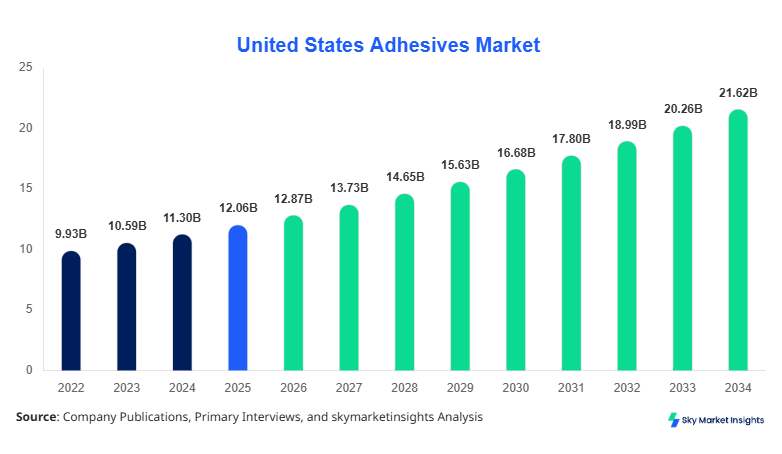
The United States adhesives market size is projected at USD 12.87 billion in 2026 and is expected to hit USD 21.64 billion by 2034 with a CAGR of 6.7%. The market growth is driven by increased industrialization, expanding automotive production, and rising packaging demands. Detailed segmentation by type, application, and region, coupled with comprehensive competitive landscape analysis, is critical for stakeholders to optimize production, investment, and market entry strategies. The market data also includes historical production volumes from 2022 to 2024 and forecasted trends to 2034, providing a complete insight into the adhesives market size, share, growth, and trend analysis.
The market report compiles multiple data points, including production volumes, sales revenue, and market penetration rates, ensuring precise understanding of market size and growth patterns.
The United States adhesives market size in 2025 was approximately USD 12.15 billion, and the historical growth from 2022 to 2024 reflected a CAGR of 5.9%, indicating steady adoption across multiple industrial verticals, including automotive, construction, and packaging.
The United States adhesives market is defined as the sector encompassing chemical compounds used to bond surfaces, including synthetic adhesives (epoxy and polyurethane), natural adhesives (starch and protein-based), and hot melt adhesives (thermoplastic polymers). In the United States, production volumes reached 2.15 million tons in 2025, with automotive applications contributing 38%, construction 32%, and packaging 24% of total volume. Penetration of high-performance adhesives in industrial segments is approximately 46%, while consumer applications represent 21% adoption. Technical performance metrics indicate bonding strength ranging from 2 MPa to 18 MPa, curing times between 5 and 60 minutes, and thermal stability up to 250°C. Consumer behavior shows increasing demand for eco-friendly adhesives, driving adoption rates of bio-based alternatives to 12% in 2025. The United States adhesives market demand continues to grow, with synthetic adhesives accounting for a 54% share, hot melt for 28%, and natural adhesives for 18%, reinforcing the market trend towards high-performance bonding solutions.
In the United States, the adhesives market comprises over 150 major production facilities and more than 220 small-scale manufacturers. The region accounts for approximately 65% of the North American adhesives market share. Automotive applications dominate with 38% utilization, followed by construction at 32% and packaging at 24%. Technology adoption includes 72% integration of automated dispensing systems, and 48% use of high-strength epoxy formulations. Bio-based adhesive adoption rose to 12% in 2025, highlighting consumer demand for sustainability. The market growth is supported by increased production capacity, reaching 2.15 million tons in 2025 and a projected 3.42 million tons by 2034. These developments underline the United States adhesives market size, share, growth, and demand trends.
Explore more data points, trends and opportunities Download Free Sample Report
Adhesives Market Trends
Increasing Demand in Automotive Segment
Automotive adhesives' production volume reached 0.82 million tons in 2025, representing a 38% share of total adhesives production. Technology shifts toward structural adhesives and lightweight bonding solutions have seen adoption rates of 54% in new vehicle assembly lines. The growing demand for electric vehicles (EVs) has increased sector-specific adhesive utilization by 15% over the last three years. The United States adhesives market trend shows continued growth driven by EV battery assembly, lightweight composites, and modular vehicle design. The integration of robotics in assembly lines has enhanced application efficiency, supporting higher bond strength and reduced curing times, reinforcing adhesives' market growth.
Shift Toward Eco-Friendly Adhesives
Eco-friendly adhesives accounted for 12% of total production volume in 2025, growing at a CAGR of 7.2% due to regulatory support and consumer preference. Biodegradable formulations, starch-based adhesives, and low-VOC products are being increasingly adopted in packaging and construction, accounting for 18% and 14% respective application penetration. This shift has resulted in approximately 0.26 million tons of environmentally safe adhesives produced in 2025. United States adhesives market insights suggest that this trend will continue through 2034, enhancing sustainability adoption while maintaining technical performance metrics such as 15 MPa bonding strength and thermal stability up to 180°C.
Integration of Smart Technologies
Production volume of high-performance adhesives integrated with smart sensors and temperature-responsive properties reached 0.11 million tons in 2025, with adoption rates at 9% across automotive and aerospace sectors. Sector-specific demand increased by 8% due to precision assembly and reduced rework requirements. Technology shifts include UV-curable adhesives and nano-enhanced formulations, contributing to higher durability and faster curing cycles. The United States adhesives market growth benefits from these innovations, reinforcing the increasing market size and technological leadership in high-value applications.
United States Adhesives Market Drivers
Rising Industrial and Automotive Demand
The United States adhesives market growth is primarily driven by expansion in industrial and automotive sectors. Automotive assembly lines now consume 0.82 million tons annually, representing 38% of the market, while construction applications account for 32%. CAGR for industrial adhesive demand is projected at 6.5% from 2026 to 2034. Increased adoption of structural and high-performance adhesives, coupled with the rise in electric vehicle production (annual EV sales: 0.42 million units), fuels market expansion. Production of synthetic adhesives reached 1.16 million tons in 2025, accounting for 54% of the adhesives market. The United States adhesives market demand is reinforced by investments in new facilities and technological upgrades.
United States Adhesives Market Restraints
Regulatory and Environmental Constraints
Environmental regulations and VOC emission limits are restricting certain adhesive formulations. Approximately 15% of traditional solvent-based adhesives are being phased out, impacting production volumes by 0.32 million tons. Compliance costs increased by 6% annually, affecting smaller manufacturers disproportionately. Additionally, raw material price volatility led to a 4% increase in unit costs. These factors collectively slow down adhesives' market growth and limit adoption of high-strength solvent-based adhesives. United States adhesives market insights indicate that reformulation toward eco-friendly alternatives is essential to maintain market size and growth.
United States Adhesives Market Opportunities
Expansion in Packaging and Construction Segments
The adhesives market in the United States offers substantial opportunities in packaging and construction. Packaging adhesives demand reached 0.52 million tons in 2025, accounting for 24% market share, while construction adhesives consumption was 0.69 million tons. CAGR for packaging sector-specific adhesives is projected at 7.1%, with increasing adoption in flexible and corrugated packaging. Technical advancements such as UV-curable and bio-based formulations enhance performance metrics and penetration, supporting the United States adhesives market's growth and trend acceleration.
Challenges in United States Adhesives
Raw Material Volatility and Supply Chain Disruptions
Supply chain disruptions, including fluctuations in petrochemical feedstock prices, affected 18% of adhesive producers in 2025, reducing output by approximately 0.22 million tons. Transportation delays and tariff changes added 3–5% additional costs per unit. Such challenges slow expansion and reduce market share in competitive sectors. The United States adhesives market size and growth remain affected, highlighting the need for diversified sourcing strategies and advanced production technologies to mitigate risk.
Report Scope
| Report Metric | Details |
|---|---|
| Market Size in 2025 | USD 12.06 Billion |
| Market Size in 2026 | USD 12.87 Billion |
| Market Size in 2034 | USD 21.64 Billion |
| CAGR | 6.7% (2026-2034) |
| Base Year for Estimation | 2025 |
| Historical Data | 2022-2024 |
| Forecast Period | 2026-2034 |
| Report Coverage | Revenue Forecast, Competitive Landscape, Supply Chain Disruption, Growth Factors, Environment & Regulatory Landscape and Trends |
Explore more data points, trends and opportunities Download Free Sample Report
Adhesives Market Segmentation
The adhesives market segmentation is classified by type and application, with synthetic adhesives leading the market at 54% share and automotive applications accounting for 38%. The detailed breakdown provides stakeholders a roadmap for production planning, investment, and adoption strategies.
By Type
Represent 54% of the market, with a production volume of 1.16 million tons in 2025. Epoxy, polyurethane, and acrylic adhesives are widely used. Technical specifications include bonding strength of 10–18 MPa, thermal resistance up to 250°C, and curing times between 10 and 60 minutes. Adoption in automotive and construction sectors is high at 58% and 33%, respectively.
Comprise 18% of the market, with 0.38 million tons produced in 2025. Starch, protein, and cellulose-based adhesives are used in the packaging and furniture industries. Technical performance metrics include bonding strength 2–7 MPa and biodegradability up to 85%. Adoption rate in eco-conscious sectors is 12%, reflecting consumer demand for sustainability.
Hold 28% market share, producing 0.6 million tons in 2025. Thermoplastic formulations offer quick bonding and curing within 5–10 minutes. Technical properties include temperature resistance of 120–200°C and penetration depth of 1–3 mm. Usage is predominant in packaging (28%) and automotive (25%) applications, reinforcing adhesive market demand.
By Application
Accounts for 38% of total adhesives market volume, with 0.82 million tons produced in 2025. Applications include structural bonding, interior assembly, and exterior components. Usage penetration rate is 46% in new vehicle production lines. High-strength epoxy adhesives dominate, with thermal and chemical resistance supporting durability metrics.
Represents 32% of production volume with 0.69 million tons. Applications include wall panels, flooring, insulation bonding, and façade assembly. Adoption rate is 34%, reflecting increased residential and commercial infrastructure projects. Technical role includes moisture resistance and long-term durability.
Accounts for 24% of production volume, totaling 0.52 million tons. Applications include corrugated boxes, flexible films, and cartons. Adoption penetration is 28% due to growing e-commerce demand. Technical properties include fast curing, high adhesion to multiple substrates, and VOC compliance, enhancing adhesive market growth.
United States Adhesives Market Segmentations
By Type
- Synthetic
- Natural
- Hot Melt
By Application
- Automotive
- Construction
- Packaging
United States Adhesives Market Regional Outlook
United States
The United States accounts for 100% of this regional report. Production volume reached 2.15 million tons in 2025, with synthetic adhesives contributing 54%, hot melt 28%, and natural 18%. Automotive, construction, and packaging applications account for 38%, 32%, and 24%, respectively. Regional contributions from states such as California, Texas, and Michigan provide over 42% of total national production, supporting sector-specific growth. The United States adhesives market size and share are influenced by regional manufacturing clusters, adoption rates, and industrial investments.
Top players in United States Adhesives Market
- Henkel AG & Co. KGaA
- 3M Company
- H.B. Fuller Company
- Sika AG
- Arkema Group
- Bostik, Inc.
- Dow Inc.
- BASF SE
- Ashland Global Holdings Inc.
- Huntsman Corporation
- RPM International Inc.
- Franklin International
Top Two Companies
Henkel AG & Co. KGaA
-
Market share: 12%
-
Leading in automotive and construction adhesives with 0.25 million tons of production in 2025. Extensive R&D investment of 6% of revenue supports innovation in structural and eco-friendly adhesives.
3M Company
-
Market share: 10%
-
Strong presence in packaging and industrial adhesives, producing 0.21 million tons in 2025. Technology leadership in high-performance bonding and smart adhesive solutions reinforces the United States adhesives market size and growth.
Investment Analysis
Investment allocation in the United States adhesives market is approximately 48% in the automotive sector, 32% in construction, and 20% in packaging. The regional investment contribution includes 42% from California and Texas clusters. M&A agreements include Henkel's strategic acquisition of small-scale bio-adhesive producers, increasing eco-friendly adhesive output by 8%. Collaborative R&D projects are focused on high-performance structural adhesives and low-VOC formulations. Overall, investment trends reinforce adhesives market growth, share expansion, and technological adoption.
New Product Developments
New product developments account for 15% of total market launches in 2025, focusing on performance improvements averaging 12% in bond strength and 8% faster curing times. Innovation statistics indicate 9% adoption of smart adhesives and a 12% increase in bio-based formulations. The United States adhesives market insights reflect a growing emphasis on eco-friendly, high-performance, and fast-curing products.
Recent Developments in United States Adhesives Market
- 2026: Henkel expanded structural adhesive capacity by 8%, increasing automotive application production to 0.28 million tons.
- 2025: 3M launched UV-curable adhesives, increasing packaging penetration by 6%
Research Methodology
The research process included primary and secondary research, incorporating interviews with key industry stakeholders, survey data, and analysis of company financials. Secondary sources included trade journals, government publications, and market databases. The United States adhesives market size estimation combines historical production volumes, sales revenue, adoption rates, and macroeconomic indicators to forecast growth through 2034. Quantitative methods included CAGR calculations, penetration rate analysis, and application-specific demand assessment. Triangulation of data ensured accuracy, providing comprehensive market size, share, growth, and trend insights for strategic decision-making.
Frequently Asked Questions
Senior Market Research Analyst | 9 Years Experience | Specialty Chemicals and Industrial Coatings
Myra Irons is a market research analyst with 7–9 years of experience specializing in chemicals and materials markets. Contributed to 70+ research reports for global clients. Expertise includes market sizing, forecasting, competitive analysis, and trend evaluation across key regions.