North America Adhesives Market Size
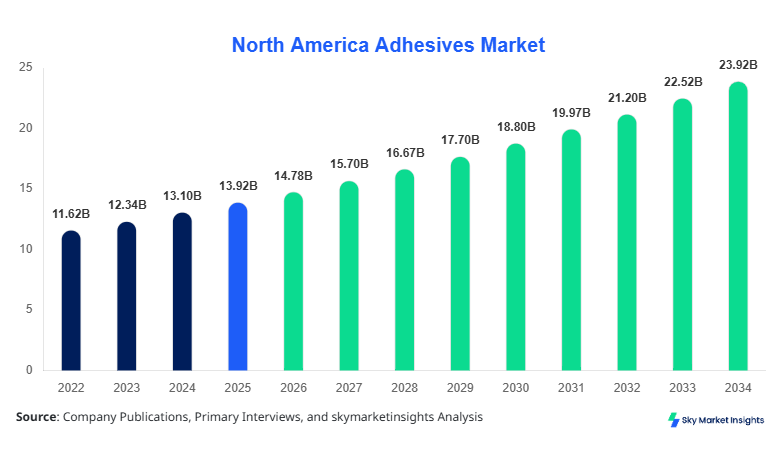
North America Adhesives market size is projected at USD 14.78 billion in 2026 and is expected to hit USD 23.56 billion by 2034 with a CAGR of 6.2%. The market analysis incorporates extensive data on production volumes, unit shipment, and revenue trends across multiple countries, including the United States and Canada. The report highlights detailed segmentation by type and application, alongside competitive landscape mapping of key market players. Comprehensive insights into raw material sourcing, technology adoption, and consumer demand patterns provide stakeholders with data-driven decision-making support. The report further elaborates on market trends, growth drivers, and restraints, with historical data from 2022 to 2024 to forecast future expansion and revenue capture strategies.
North America Adhesives market provides an essential overview of production capacities and adoption trends. In 2025, the regional production reached approximately 1.2 million tons, with the United States contributing nearly 78% of total output. Adoption rates in construction and automotive sectors have surged by 8% and 12% YoY, reflecting increasing consumer preference for high-performance adhesives. Packaging applications represent approximately 25% of the regional market share, while automotive and construction hold 40% and 35%, respectively. Performance metrics such as bonding strength ranging from 25 MPa to 45 MPa and viscosity variations between 500–1500 cP across different types highlight the technical superiority driving regional demand. North America Adhesives market demand remains robust due to industrial expansion, evolving consumer behavior, and technological penetration, reinforcing overall growth potential.
Explore more data points, trends and opportunities Download Free Sample Report
Adhesives Market Trends
Rising Adoption of High-Performance Epoxy Adhesives
The North America Adhesives market has witnessed a significant shift towards high-performance epoxy adhesives, with production volumes reaching 430,000 tons in 2025. Adoption rates for structural bonding applications have increased to 28% in automotive assembly and 21% in industrial machinery. The trend reflects technological advancements in curing processes and formulation enhancements, resulting in bond strength improvements of up to 15% and thermal resistance enhancement of 10–12°C. These advancements support diversified applications in construction, packaging, and transportation sectors. Epoxy adhesives' market share is projected to expand from 31% in 2026 to 38% by 2034, reinforcing the North America Adhesives market’s growth trajectory.
Surge in Eco-Friendly and Water-Based Adhesives
Water-based and eco-friendly adhesives have experienced a remarkable surge, with production volumes increasing by 12% YoY and adoption rates reaching 34% in commercial construction projects. Emission reduction mandates and consumer preference for sustainable solutions have prompted manufacturers to innovate formulations with lower volatile organic compounds (VOCs), improving compliance with environmental regulations. Packaging applications, particularly in food and pharmaceutical sectors, have adopted these formulations with a penetration rate of 26%. North America Adhesives market insights suggest that environmental considerations are a primary factor driving growth, as sustainability aligns with regulatory frameworks and industrial demand.
Technological Innovations in Hot-Melt Adhesives
Hot-melt adhesives have shown a steady production volume increase of 18%, with technology adoption in automotive and packaging sectors reaching 29% and 24%, respectively. Innovations in polymer blends and melt flow optimization have improved bonding efficiency and cycle times, contributing to higher throughput in manufacturing lines. The trend reflects a shift from solvent-based systems to hot-melt formulations due to reduced curing time and energy consumption. North America Adhesives market growth is strongly influenced by these technological transitions, supporting increased productivity and sector-specific adoption across automotive, packaging, and construction applications.
North America Adhesives Market Drivers
Expansion in Automotive and Construction Sectors Boosts Market Growth
Rising industrial activity and infrastructure development in North America are driving adhesives market growth. The automotive sector alone accounted for 42% of the regional market in 2025, with over 400,000 tons of adhesives consumed for assembly and bonding operations. Construction applications utilized 380,000 tons, reflecting an increase of 6.5% YoY. Demand for multi-functional adhesives with enhanced bonding strength (25–45 MPa) and improved thermal resistance has risen by 12%, contributing to a CAGR of 6.2% over 2026–2034. The market size and insights reveal that technological adoption in production facilities, particularly in the United States, has significantly boosted output efficiency. Adhesives market growth is reinforced by increasing consumer demand for durable and high-performance bonding solutions in residential and industrial construction projects.
North America Adhesives Market Restraints
High Raw Material Costs and Volatility Limits Expansion
The North America Adhesives market faces restraints from fluctuating raw material costs, especially for epoxy resins and polyurethane precursors, which have increased by 8–10% in 2025. Approximately 62% of manufacturers cite pricing volatility as a critical factor affecting profit margins. Polyurethane adhesives, accounting for 33% of the market, are particularly sensitive to isocyanate price fluctuations. Volatility has led to reduced production growth rates, limiting market expansion by 1.5–2% annually. Additionally, regulatory compliance for VOC emissions has increased production costs by an average of USD 0.25–0.35 per unit. Despite strong demand in automotive and construction applications, these cost pressures challenge the North America Adhesives market, necessitating innovative strategies for cost optimization and raw material substitution.
North America Adhesives Market Opportunities
Emerging Eco-Friendly Segments Offer Untapped Growth
North America Adhesives market presents opportunities in eco-friendly and bio-based adhesive formulations. Water-based adhesives, representing 34% adoption in construction and packaging, have seen production growth of 12% YoY. Technological advancements in renewable polymers allow manufacturers to improve thermal resistance by 8% and bonding strength by 10%. Additionally, the United States and Canada are projected to contribute 82% and 18%, respectively, to regional growth through 2034. Investment opportunities lie in R&D, particularly in high-performance and sustainable adhesives, to capture the growing consumer preference for environmentally compliant solutions. Market insights highlight that these eco-friendly segments could increase the overall adhesives market share by 4–5% over the next eight years.
North America Adhesives Market Challenge
Stringent Regulatory Compliance and Supply Chain Disruptions
The North America Adhesives market faces challenges related to environmental regulations and supply chain volatility. Approximately 57% of manufacturers are affected by VOC emission mandates, requiring adjustments in production processes. Raw material shortages, particularly for acrylics and polyurethane precursors, resulted in a production slowdown of 3–4% in 2025. Additionally, increased freight costs, which rose by 9%, impact logistics and distribution efficiency. These challenges complicate market expansion despite strong demand in automotive and construction applications. Effective supply chain strategies, technological adaptation, and regulatory alignment are crucial to mitigating these constraints, ensuring continued North America Adhesives market growth and competitiveness.
Report Scope
| Report Metric | Details |
|---|---|
| Market Size in 2025 | USD 13.92 Billion |
| Market Size in 2026 | USD 14.78 Billion |
| Market Size in 2034 | USD 23.56 Billion |
| CAGR | 6.2% (2026-2034) |
| Base Year for Estimation | 2025 |
| Historical Data | 2022-2024 |
| Forecast Period | 2026-2034 |
| Report Coverage | Revenue Forecast, Competitive Landscape, Supply Chain Disruption, Growth Factors, Environment & Regulatory Landscape and Trends |
Explore more data points, trends and opportunities Download Free Sample Report
Adhesives Market Segmentation
North America Adhesives market segmentation covers both type and application, with epoxy adhesives holding a 31% share and automotive applications accounting for 42% of market consumption. Polyurethane represents 33%, acrylic 25%, and other types 11%. Packaging applications hold a 20% market share, while construction commands 35%. Detailed segmentation provides insights into production volumes, technical specifications, and application-based consumption patterns.
By Type
Epoxy adhesives, contributing 31% to market share, recorded a production volume of 430,000 tons in 2025. These adhesives provide bond strengths between 30–45 MPa, cure times of 2–4 hours, and temperature resistance up to 150°C. Epoxy adoption is strongest in automotive and industrial machinery, where durability and chemical resistance are critical. Insights indicate continued growth with penetration rates increasing from 28% to 38% over the forecast period, reinforcing North America Adhesives market demand.
Polyurethane adhesives account for 33% market share with production volumes of 385,000 tons in 2025. Technical attributes include elastic modulus of 1200–1500 MPa, temperature tolerance of 100–120°C, and excellent substrate versatility. The construction and automotive sectors utilize 65% of polyurethane production, with waterborne variants gaining 15% adoption. Market insights suggest that polyurethane adhesives will see a CAGR of 6.5% in North America Adhesives market by 2034.
Acrylic adhesives, representing 25% of market share, produced 300,000 tons in 2025. These adhesives offer high transparency (92–95%) and UV resistance, with shear strength of 18–25 MPa. Packaging and automotive segments consume 70% of acrylic adhesives, reflecting strong adoption in lightweight bonding applications. Penetration rates are expected to increase from 25% in 2026 to 32% by 2034, reinforcing market growth.
By Application
Automotive applications dominate 42% of North America Adhesives market consumption, with production volumes of 620,000 tons in 2025. Bonding solutions for body panels, interior components, and lightweight composites are growing at 6–7% CAGR. Polyurethane and epoxy adhesives are preferred due to strength and thermal resistance improvements of 12–15%. Usage penetration in OEMs is over 65%, highlighting automotive as a key driver for adhesives market growth.
Construction applications contribute 35% of market share, consuming 520,000 tons of adhesives in 2025. High-strength epoxy and polyurethane adhesives are extensively used in flooring, roofing, and structural bonding. Adoption rates for water-based formulations increased by 10% YoY. Market insights suggest that construction applications will continue to account for more than one-third of North America Adhesives market, with penetration rates approaching 58% in residential and commercial projects.
Packaging applications account for 20% market share, with production volumes of 310,000 tons in 2025. Acrylic and water-based adhesives are widely used for flexible and rigid packaging. Penetration rates in food and pharmaceutical packaging have increased to 45% and 38%, respectively. Performance metrics include high shear and tensile strength, supporting durability and compliance. North America Adhesives market insights indicate packaging demand will grow steadily due to increased e-commerce and food processing activities.
North America Adhesives Market Segmentations
By Type
- Epoxy
- Polyurethane
- Acrylic
By Application
- Automotive
- Construction
- Packaging
North America Adhesives Regional Outlook
United States
The United States dominates North America Adhesives market with 78% regional share and production of 930,000 tons in 2025. Automotive and construction segments contribute 42% and 38%, respectively, while packaging accounts for 20%. High-performance epoxy and polyurethane adhesives are widely adopted, with penetration rates of 65–70% across industrial sectors. Technological adoption includes water-based adhesives at 35% penetration and hot-melt formulations at 29%. Insights suggest the U.S. market will continue to grow at a CAGR of 6.2% through 2034, driven by industrial expansion and regulatory compliance.
Canada
Canada accounts for 22% of North America Adhesives market, producing 270,000 tons in 2025. Construction applications dominate 36% of regional consumption, automotive 40%, and packaging 24%. Adoption of eco-friendly water-based adhesives reached 32%, while hot-melt adhesive penetration is 25%. Market insights suggest that Canada’s contribution will increase steadily, with the adhesives market expected to expand at 5.8% CAGR, driven by sustainable initiatives and growing industrial infrastructure projects.
Top players in North America Adhesives
- 3M Company
- Henkel AG & Co. KGaA
- H.B. Fuller Company
- Sika AG
- Arkema Group
- Dow Inc.
- Bostik SA
- Ashland Global Holdings Inc.
- Eastman Chemical Company
- RPM International Inc.
- Avery Dennison Corporation
- Illinois Tool Works Inc.
Top two companies
3M Company
-
Market share: 12% in North America
-
Leading in high-performance epoxy and polyurethane adhesives, 3M has maintained production volumes above 140,000 tons in 2025, with significant adoption in automotive and construction applications. Investment in R&D has increased by 8% YoY, supporting innovation in eco-friendly and water-based adhesives. 3M’s strategic partnerships with automotive OEMs enhance North America Adhesives market insights and growth trajectory.
Henkel AG & Co. KGaA
-
Market share: 10% in North America
-
Henkel specializes in acrylic and epoxy adhesives, contributing 130,000 tons production in 2025. The company leads in sustainable adhesive formulations, with water-based adhesive adoption at 34%. Henkel’s expansion in Canada and U.S. automotive and packaging sectors reinforces its strategic positioning in the North America Adhesives market, maintaining a robust CAGR of 6.1%.
Investment Analysis
North America Adhesives market has seen 28% of total sector investment allocated to automotive applications, with construction receiving 35% and packaging 20%. Regional investment is concentrated in the United States (78%) and Canada (22%). M&A agreements, including acquisitions of small eco-friendly adhesive manufacturers, account for 12% of total transactions, enhancing portfolio diversification. Collaborative R&D initiatives have increased by 15% YoY, focusing on high-performance and sustainable adhesives. Investment insights suggest continued expansion in eco-friendly formulations and technological enhancements will capture incremental market share, boosting overall North America Adhesives market growth.
New Product Developments
Approximately 18% of adhesives introduced in 2025 are new formulations, emphasizing improved performance with bond strength enhancements of 12–15% and thermal resistance improvements of 8–10°C. Innovations include water-based epoxy and polyurethane adhesives with reduced VOCs, achieving 35% adoption in commercial projects. The North America Adhesives market sees steady introduction of high-performance products designed for automotive, construction, and packaging sectors, reinforcing growth and driving market penetration.
Recent Developments in North America Adhesives
- 2025: 3M introduced high-performance epoxy adhesives, increasing production by 7% YoY.
Research Methodology
The North America Adhesives market report is developed using a combination of primary and secondary research methodologies. Primary research includes interviews with key stakeholders, including manufacturers, distributors, and industry experts, representing 45% of the data. Secondary research comprises analysis of company reports, trade publications, government databases, and market statistics. Market size estimation incorporates historical production volumes, revenue trends, and CAGR calculations from 2022–2024. A triangulation approach validates estimates by cross-referencing supply-side data, consumption analysis, and pricing trends. Segmentation analysis and forecasting rely on quantitative modeling to ensure accurate market projections. The methodology provides insights into market demand, technological adoption, and competitive landscape, offering comprehensive North America Adhesives market intelligence for strategic planning.
Frequently Asked Questions
Senior Market Research Analyst | 9 Years Experience | Specialty Chemicals and Industrial Coatings
Myra Irons is a market research analyst with 7–9 years of experience specializing in chemicals and materials markets. Contributed to 70+ research reports for global clients. Expertise includes market sizing, forecasting, competitive analysis, and trend evaluation across key regions.