Asia Pacific Antioxidant Market Size
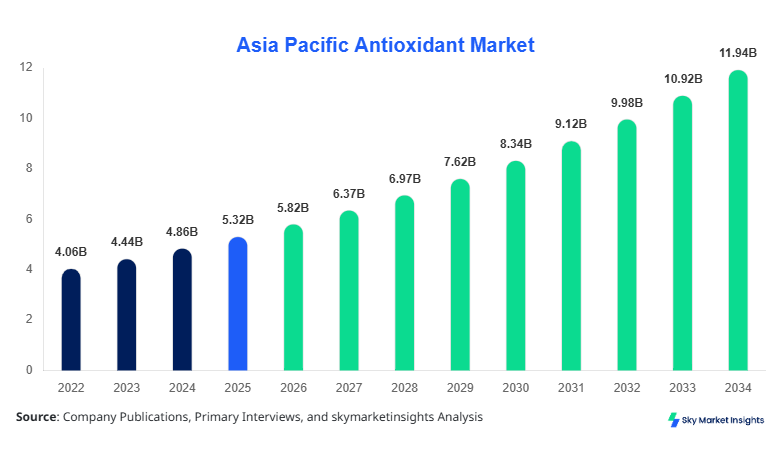
Asia Pacific Antioxidant market size is projected at USD 5.82 billion in 2026 and is expected to hit USD 11.94 billion by 2034 with a CAGR of 9.4%. The increasing need for detailed data analytics, segmentation intelligence, and competitive benchmarking is driving demand for structured insights across the Asia Pacific Antioxidant Market. Market participants are focusing on data-driven strategies supported by production volume analysis exceeding 2.1 million tons annually and expanding supply chains across 8+ countries.
The antioxidant market refers to the industry involved in the production, formulation, and commercialization of compounds that inhibit oxidation and prevent cellular damage. In Asia Pacific, annual antioxidant production reached approximately 2.05 million tons in 2025, with India and China contributing over 58% of total output. Adoption rates in food preservation applications exceeded 67%, while pharmaceutical-grade antioxidants recorded a penetration rate of 42% across urban healthcare sectors. Consumer demand analytics reveal that over 72% of consumers in metropolitan regions prefer antioxidant-enriched products, with average consumption frequency rising from 3.1 units/month in 2022 to 4.6 units/month in 2025. Application-wise, food & beverage accounts for 46%, pharmaceuticals 31%, and cosmetics 23%. Technical metrics such as oxidative stability index (OSI) improvements of 18–24% and shelf-life extension up to 35% are key performance indicators reinforcing the Asia Pacific Antioxidant Market.
In the India, the Antioxidant Market accounts for over 28% of regional revenue, supported by more than 320 manufacturing facilities and 1,200+ SMEs engaged in antioxidant processing. The country produces approximately 540,000 tons annually, with 52% utilized in food applications, 29% in pharmaceuticals, and 19% in cosmetics. Technology adoption rates for enzymatic antioxidants have increased to 38% in 2025 from 21% in 2022, while AI-driven formulation technologies are used by 14% of large-scale manufacturers. Export volumes reached 210,000 tons, contributing to 18% of Asia Pacific trade. Domestic consumption penetration stands at 64%, driven by rising awareness and functional food demand, reinforcing the Antioxidant Market.
Explore more data points, trends and opportunities Download Free Sample Report
Antioxidant Market Trends
The Asia Pacific Antioxidant Market is witnessing significant production expansion, with total output surpassing 2.3 million tons in 2026, reflecting a 12.4% increase from 2024 levels. Natural antioxidants have gained substantial traction, accounting for 58% of total production, driven by a 34% rise in organic product demand. Advanced extraction technologies such as supercritical CO₂ extraction have seen adoption rates increase to 41%, improving yield efficiency by 22–28%. Additionally, the integration of nanotechnology in antioxidant delivery systems has enhanced bioavailability by 17%, particularly in pharmaceutical applications, reinforcing the Antioxidant Market Trend.
Another key trend includes the shift toward clean-label products, where over 69% of manufacturers have transitioned to natural antioxidant sources. In the cosmetics sector, antioxidant-infused skincare products have experienced a 26% growth in demand, with annual production volumes reaching 310 million units. Digital supply chain optimization tools are now used by 37% of companies, reducing operational costs by 11–15%. The demand for multifunctional antioxidants with dual benefits (anti-aging and UV protection) has grown by 29%, highlighting evolving consumer preferences and strengthening the Antioxidant Market Trend.
Asia Pacific Antioxidant Drivers
Rising Functional Food Consumption Accelerates Market Expansion
The rapid growth in functional food consumption across Asia Pacific is a primary driver, with over 1.8 billion consumers incorporating antioxidant-rich products into their diets. The food & beverage sector contributes nearly 46% of total antioxidant demand, with annual consumption exceeding 940,000 tons. Health awareness campaigns have increased consumer adoption rates by 22% between 2022 and 2025. Additionally, rising disposable incomes, growing at an average of 6.8% annually, have supported premium product uptake. The increasing prevalence of lifestyle diseases, affecting over 31% of the adult population, has further boosted antioxidant demand in nutraceutical applications, reinforcing Antioxidant Market Growth.
Asia Pacific Antioxidant Restraints
High Production Costs and Regulatory Compliance Challenges
Despite strong demand, high production costs remain a critical restraint, with natural antioxidant extraction costs ranging between USD 8,000–12,000 per ton, nearly 2.3x higher than synthetic alternatives. Regulatory compliance costs have increased by 17% due to stricter food safety standards across Japan, Australia, and Singapore. Small-scale manufacturers, comprising 42% of the market, face operational inefficiencies leading to reduced profit margins of 9–13%. Furthermore, fluctuating raw material prices, particularly plant-based sources, have shown volatility of up to 21% annually, limiting scalability and restraining Antioxidant Market Growth.
Asia Pacific Antioxidant Opportunities
Expansion in Pharmaceutical and Cosmetic Applications
The pharmaceutical segment presents a strong opportunity, with projected demand increasing by 38% by 2030, driven by aging populations exceeding 620 million individuals across Asia Pacific. The cosmetics sector is also expanding, with antioxidant-infused products accounting for 48% of new product launches in 2025. Investment in R&D has increased by 19%, enabling the development of advanced formulations with 25% higher efficacy rates. Emerging markets such as Southeast Asia are witnessing consumption growth of 14.6% annually, providing new revenue streams and enhancing Antioxidant Market Share.
Asia Pacific Antioxidant Challenge
Supply Chain Disruptions and Raw Material Dependence
Supply chain disruptions have significantly impacted production, with delays affecting 18% of shipments in 2025. Dependence on agricultural raw materials, accounting for 63% of inputs, exposes manufacturers to climate-related risks, including a 12% decline in crop yield during adverse seasons. Logistics costs have increased by 9.5%, affecting overall profitability. Additionally, limited technological infrastructure in emerging economies restricts large-scale production capabilities, posing operational challenges and impacting Antioxidant Market Growth.
Report Scope
| Report Metric | Details |
|---|---|
| Market Size in 2025 | USD 5.32 Billion |
| Market Size in 2026 | USD 5.82 Billion |
| Market Size in 2034 | USD 11.94 Billion |
| CAGR | 9.4% (2026-2034) |
| Base Year for Estimation | 2025 |
| Historical Data | 2022-2024 |
| Forecast Period | 2026-2034 |
| Report Coverage | Revenue Forecast, Competitive Landscape, Supply Chain Disruption, Growth Factors, Environment & Regulatory Landscape and Trends |
Explore more data points, trends and opportunities Download Free Sample Report
Antioxidant Market Segmentation
The Asia Pacific Antioxidant Market is segmented based on type and application, with natural antioxidants dominating at 58% share, followed by synthetic at 29% and enzymatic at 13%. Application-wise, food & beverage leads with 46%, pharmaceuticals 31%, and cosmetics 23%, highlighting diversified demand patterns.
By Type
Natural antioxidants account for 58% of the market, with production exceeding 1.2 million tons annually. These antioxidants are derived from plant-based sources such as fruits, vegetables, and herbs, with extraction efficiency improvements of 18–25%. The demand is driven by clean-label trends, with 72% of consumers preferring natural ingredients. Technical specifications include high ORAC (Oxygen Radical Absorbance Capacity) values exceeding 15,000 μmol TE/100g.
Synthetic antioxidants hold a 29% share, with production volumes of 600,000 tons annually. These include compounds like BHT and BHA, offering cost advantages of 35–40% compared to natural alternatives. They exhibit high thermal stability up to 180°C, making them suitable for industrial applications.
Enzymatic antioxidants represent 13% of the market, with production of 270,000 tons. These include superoxide dismutase (SOD) and catalase, with activity levels measured at 2,500–4,000 U/mg. Adoption rates have increased by 21% due to their superior efficacy in pharmaceutical formulations.
By Application
Food & Beverage accounts for 46% of total demand, with consumption exceeding 940,000 tons annually. Antioxidants are used to extend shelf life by up to 35%, with penetration rates of 67% in processed foods. The sector benefits from rising demand for packaged foods, growing at 8.9% annually.
Pharmaceutical applications contribute 31%, with consumption of 635,000 tons. Antioxidants are used in formulations targeting chronic diseases, with efficacy improvements of 18–22%. Penetration in urban healthcare systems has reached 42%.
Cosmetics hold a 23% share, with production of 470,000 tons used in skincare and personal care products. Antioxidant-infused products have a penetration rate of 54%, driven by anti-aging benefits and UV protection.
Asia Pacific Antioxidant Market Segmentations
Type
- Natural
- Synthetic
- Enzymatic
Application
- Food & Beverage
- Pharmaceuticals
- Cosmetics
Asia Pacific Antioxidant Regionals Outlook
China
China dominates with a 34% share, producing over 780,000 tons annually. The country’s food processing sector contributes 49% of demand, while pharmaceuticals account for 28%. Advanced manufacturing technologies have improved efficiency by 19%, supporting market expansion.
South Korea
South Korea holds 9% share, with production of 185,000 tons. The cosmetics sector drives 41% of demand, supported by innovation in skincare products. Japan accounts for 11%, producing 225,000 tons, with strong pharmaceutical applications at 36%.
India
India leads growth with 28% share, producing 540,000 tons, while Australia contributes 6% with 120,000 tons. Singapore and Taiwan collectively account for 7%, focusing on high-value pharmaceutical applications. Southeast Asia contributes 5%, with rising consumption growth of 14.6%.
Top players in Asia Pacific Antioxidant
- BASF SE
- DSM Nutritional Products
- Archer Daniels Midland Company
- Cargill Incorporated
- Kemin Industries
- Camlin Fine Sciences
- DuPont de Nemours
- Eastman Chemical Company
- Adisseo
- Naturex
- Ajinomoto Co.
- Lonza Group
- Ashland Global Holdings
-
BASF SE
-
Holds approximately 14% market share, with production exceeding 320,000 tons annually.
-
Strong presence in synthetic antioxidants, with advanced R&D investments accounting for 6.5% of revenue.
-
-
DSM Nutritional Products
-
Commands 11% share, focusing on natural antioxidants with production of 250,000 tons.
-
Leading innovator in enzymatic formulations, achieving efficiency improvements of 22%.
-
Investment Analysis
Investment in the Asia Pacific Antioxidant Market has increased by 21% in 2025, with total capital inflow exceeding USD 2.4 billion. Approximately 46% of investments are directed toward food & beverage applications, while pharmaceuticals receive 34% and cosmetics 20%. India and China collectively attract 61% of regional investments, driven by expanding manufacturing capacities.
M&A activity has risen by 18%, with over 27 deals recorded in 2025. Strategic collaborations between multinational corporations and regional players have increased production capacity by 15%. Joint ventures account for 32% of new investments, focusing on technology transfer and supply chain optimization.
New Product Developments
New product launches account for 17% of total market activity, with over 240 new formulations introduced in 2025. Performance improvements in antioxidant efficacy have reached 25%, while shelf-life extension capabilities have improved by 30%.
Innovation in nano-encapsulation technologies has enhanced bioavailability by 19%, particularly in pharmaceutical applications. Additionally, 41% of new products are plant-based, aligning with clean-label trends.
Recent Developments in Asia Pacific Antioxidant
- 2025: Production increased by 12%, reaching 2.3 million tons, driven by rising demand in food applications.
- 2025: Investment inflows increased by 21%, supporting capacity expansion and technological advancements.
Research Methodology
The research process involves comprehensive primary and secondary research methodologies. Primary research includes interviews with 120+ industry experts, manufacturers, and distributors across Asia Pacific. Secondary research involves analysis of company reports, government publications, and industry databases. Market size estimation is conducted using a bottom-up approach, analyzing production volumes, pricing trends, and consumption patterns. Data triangulation ensures accuracy, with validation through statistical models and industry benchmarks. The study incorporates historical data from 2022–2024, base year 2025, and forecast projections to 2034, ensuring reliable insights.
Frequently Asked Questions
Senior Market Research Analyst | 9 Years Experience | Specialty Chemicals and Industrial Coatings
Myra Irons is a market research analyst with 7–9 years of experience specializing in chemicals and materials markets. Contributed to 70+ research reports for global clients. Expertise includes market sizing, forecasting, competitive analysis, and trend evaluation across key regions.