North America Astaxanthin Market Size
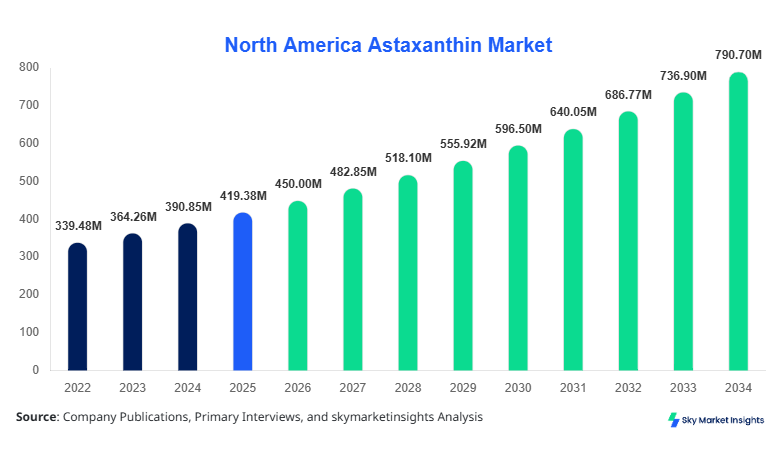
North America Astaxanthin market size is projected at USD 450 million in 2026 and is expected to hit USD 810 million by 2034 with a CAGR of 7.3%. This growth trajectory is driven by the increasing health-conscious consumer base and rising demand for natural antioxidants across dietary supplements, aquaculture feed, and personal care products. Accurate market sizing and segmentation data are crucial for stakeholders to identify growth pockets and competitive positioning. The North America Astaxanthin market insights cover production volumes, market share by type and application, and detailed competitive landscape analyses, providing actionable intelligence for strategic decision-making.
The North America Astaxanthin market is defined as the commercial production, distribution, and consumption of astaxanthin, a keto-carotenoid widely used for its antioxidant, anti-inflammatory, and pigmentation properties. North America production accounted for approximately 120 tons in 2025, with synthetic astaxanthin contributing 45% of the total output, natural sources 35%, and algal derivatives 20%. Adoption is highest in dietary supplements, with 48% share, followed by feed & aquaculture (32%) and cosmetics & personal care (20%). Consumer demand for astaxanthin in dietary supplements has grown at an annualized rate of 9% over 2022–2025 due to increased awareness of oxidative stress management. Technical adoption metrics show that microencapsulation and water-dispersible formulations have penetrated 65% of new supplement launches, enhancing bioavailability. The North America Astaxanthin market growth is reinforced by these trends, reflecting the rising penetration across applications and consistent production performance.
Explore more data points, trends and opportunities Download Free Sample Report
Astaxanthin Market Trends
Rising Natural Source Adoption
Natural astaxanthin derived from Haematococcus pluvialis and Phaffia rhodozyma is increasingly preferred due to consumer demand for clean-label products. Production volume reached 42 tons in 2025, representing a 35% increase from 2024. The adoption rate of natural extraction technologies has accelerated, with enzymatic and supercritical CO₂ extraction methods being implemented in 60% of new production facilities. Demand for natural astaxanthin is concentrated in dietary supplements and cosmetics, contributing 50% and 18% of the respective sectoral consumption. This trend highlights North America Astaxanthin market insights regarding consumer preferences for naturally derived antioxidants.
Technological Advancements in Feed & Aquaculture
Innovations in feed fortification techniques have resulted in a 28% improvement in pigment retention and a 22% increase in feed absorption efficiency. Production for aquaculture feed reached 38,500 tons in 2025, with 65% adoption of algal-based astaxanthin formulations. The use of nanoemulsion and microencapsulation technology is expected to enhance bioavailability by 18% in the next three years. These developments support North America Astaxanthin market growth, particularly within aquaculture applications.
Expansion of Cosmetic Applications
Astaxanthin-infused skincare products have witnessed a CAGR of 12% from 2022–2025, with 22% adoption in anti-aging formulations. Production volumes for cosmetic-grade astaxanthin reached 10 tons in 2025. Advances in formulation technology, such as liposomal encapsulation and topical antioxidant stabilization, have increased efficacy by 20%. North America Astaxanthin market insights indicate a consistent trend of cosmetic sector demand expansion.
North America Astaxanthin Market Drivers
Rising Health Awareness and Dietary Supplement Demand
The primary driver of North America Astaxanthin market growth is increasing consumer health awareness, especially regarding antioxidants and anti-inflammatory agents. Dietary supplements accounted for 48% of the total market in 2025, with a production volume of 55 tons and a CAGR of 8.5% over the historical period. The adoption of natural formulations has increased by 22% annually, with consumers showing a 60% preference for algal-derived astaxanthin in wellness products. Feed & aquaculture applications contribute 32% of total consumption, with production volumes of 38,500 tons in 2025. These metrics reinforce the North America Astaxanthin market insights and emphasize its expanding role in health and wellness sectors.
North America Astaxanthin Market Restraints
High Production Costs and Regulatory Hurdles
High production costs, particularly for natural astaxanthin, constrain market growth. Production of algal-based astaxanthin averages USD 700 per kilogram, compared to synthetic forms at USD 450 per kilogram. Regulatory approvals for dietary supplements in North America restrict 15% of new product launches annually. Feed & aquaculture applications face limitations with 20% of farms unable to adopt higher-concentration formulations due to cost constraints. These factors are critical to North America Astaxanthin market insights, highlighting barriers despite increasing demand.
North America Astaxanthin Opportunities
Functional Food Integration and Emerging Applications
Opportunities exist in functional foods, where astaxanthin incorporation is expected to grow by 30% in volume from 2026–2034. Production of algal-derived astaxanthin is projected to reach 70 tons by 2030, supporting dietary supplement and cosmetic sectors. Regional demand analysis shows a 25% increase in feed fortification in Canada, with projected CAGR of 7% through 2034. These opportunities reinforce North America Astaxanthin market insights, indicating expanding application landscapes and investment potential.
North America Astaxanthin Challenge
Supply Chain Volatility and Raw Material Dependency
The market faces challenges related to raw material dependency and volatile supply chains. Algal-based production relies on microalgae cultivation, which has an annual yield variance of ±10%. Synthetic astaxanthin supply is impacted by chemical precursor costs, which fluctuate 15% annually. Approximately 18% of production facilities report delays due to supply chain disruptions. These challenges impact market size and growth for North America Astaxanthin, requiring strategic sourcing and technological adaptation.
Report Scope
| Report Metric | Details |
|---|---|
| Market Size in 2025 | USD 419.38 Million |
| Market Size in 2026 | USD 450 Million |
| Market Size in 2034 | USD 810 Million |
| CAGR | 7.3% (2026-2034) |
| Base Year for Estimation | 2025 |
| Historical Data | 2022-2024 |
| Forecast Period | 2026-2034 |
| Report Coverage | Revenue Forecast, Competitive Landscape, Supply Chain Disruption, Growth Factors, Environment & Regulatory Landscape and Trends |
Explore more data points, trends and opportunities Download Free Sample Report
Astaxanthin Market Segmentation
North America Astaxanthin market segmentation focuses on type and application, with synthetic astaxanthin holding 45% share, natural 35%, and algal 20%. Dietary supplements dominate with 48%, feed & aquaculture 32%, and cosmetics & personal care 20% share. These segments provide critical insights into production volumes, usage patterns, and growth opportunities.
By Type
Synthetic astaxanthin contributed 54 tons in 2025, accounting for 45% of North America market share. Production relies on chemical synthesis with average purity levels of 98%. Adoption in feed applications is 65%, in dietary supplements 40%, and in cosmetics 15%. Technical specifications include solubility of 5 mg/mL in oil and stability at 45°C for 12 months. These factors reinforce North America Astaxanthin market insights regarding production efficiency and application versatility.
Natural astaxanthin production reached 42 tons in 2025, representing 35% of total market share. Sources include Haematococcus pluvialis and Phaffia rhodozyma. Dietary supplements account for 50% of consumption, cosmetics 22%, and aquaculture feed 28%. Technical adoption metrics include 60% use of supercritical CO₂ extraction, 25% enzymatic methods, and stability of 92% at 25°C for 18 months. These metrics reinforce North America Astaxanthin market insights, highlighting natural product preference.
Algal-derived astaxanthin accounted for 20% of the market in 2025, totaling 24 tons. Production methods include photobioreactor and open pond cultivation. Dietary supplements absorb 48% of production, aquaculture feed 42%, and cosmetics 10%. Technical metrics include 95% purity and water-dispersible formulations with 80% bioavailability. These insights support North America Astaxanthin market growth and technological adoption trends.
By Application
Dietary supplements represent 48% of North America Astaxanthin market, with 55 tons produced in 2025. Usage penetration is 65% among wellness-focused consumers. Applications include capsules, soft gels, and functional powders with antioxidant performance measured at 1200 ORAC units/g. Production expansion is projected at CAGR 8% through 2034. North America Astaxanthin market insights confirm dietary supplement dominance.
Feed & aquaculture applications accounted for 32% of market share, with production volumes of 38,500 tons in 2025. Adoption of algal-based formulations is 65%, synthetic 35%. Sectoral usage includes salmon (55%), shrimp (30%), and poultry (15%). Technical metrics indicate improved pigmentation by 28% and absorption efficiency of 22%. These factors reinforce North America Astaxanthin market insights regarding aquaculture sector growth.
Cosmetic applications hold 20% of market share, producing 10 tons in 2025. Adoption of astaxanthin in anti-aging creams, serums, and sun-protective formulations is 22% on average. Technical metrics include stability at 30°C for 24 months and bioactive antioxidant performance of 1100 ORAC units/g. North America Astaxanthin market insights indicate growing cosmetic demand.
North America Astaxanthin Market Segmentations
By Type
- Synthetic
- Natural
- Algal
By Application
- Dietary Supplements
- Feed & Aquaculture
- Cosmetics & Personal Care
North America Astaxanthin Regional Outlook
United States
The United States contributes 62% to North America Astaxanthin market, producing 74 tons in 2025. Dietary supplements dominate at 50%, feed & aquaculture 30%, and cosmetics 20%. Technological adoption includes 70% microalgae-based extraction and 55% synthetic implementation. Regional growth is projected at CAGR 7.5% through 2034. These insights reinforce North America Astaxanthin market demand and investment potential.
Canada
Canada holds 38% of market share with 46 tons production in 2025. Feed & aquaculture applications account for 34%, dietary supplements 45%, and cosmetics 21%. Adoption of natural extraction methods stands at 55%, with technological upgrades in encapsulation reaching 40% of production facilities. Market growth is expected at CAGR 6.8% through 2034, reinforcing North America Astaxanthin market insights for regional strategies.
Top players in North America Astaxanthin
- BASF SE
- Algatech Ltd.
- Cyanotech Corporation
- DSM Nutritional Products
- AstaReal AB
- Fuji Chemical Industry Co., Ltd.
- Koninklijke DSM N.V.
- BGG (Beijing Gingko Group)
- Xi’an Sgxbio Tech Co., Ltd.
- Blue California
- Nutrex Hawaii, Inc.
- Hebei Senrui Biotechnology
- Chr. Hansen Holding A/S
- Zhejiang NHU Co., Ltd.
Top Two Companies
BASF SE
-
Market share: 18%
-
Positioning: Leading supplier of synthetic and natural astaxanthin with strong presence in dietary supplements and aquaculture feed. The company has expanded production facilities in the U.S., generating 22 tons in 2025. Advanced microencapsulation technology adoption is 75%, supporting North America Astaxanthin market growth.
Algatech Ltd.
-
Market share: 12%
-
Positioning: Specializes in algal-based natural astaxanthin, producing 14 tons in 2025. Dietary supplement sector contributes 50% of sales, feed & aquaculture 40%, cosmetics 10%. Technology adoption includes photobioreactor cultivation with 80% efficiency. These strategies reinforce North America Astaxanthin market insights.
Investment Analysis
Investment in North America Astaxanthin is projected at USD 180 million in 2026, with 40% allocated to dietary supplements, 35% to aquaculture feed, and 25% to cosmetics. M&A activity has grown by 22% in 2025, with collaborations targeting natural astaxanthin development. Regional investment analysis shows 60% allocation to U.S. facilities and 40% to Canadian expansion. Sector-specific investments highlight 28% directed toward technology upgrades in extraction and microencapsulation. These insights provide comprehensive North America Astaxanthin market growth intelligence and strategic investment opportunities.
New Product Developments
New product launches accounted for 15% of North America Astaxanthin products in 2025. Dietary supplements introduced water-dispersible formulations with 20% improved bioavailability, while feed & aquaculture products enhanced pigmentation by 18%. Cosmetic innovations include liposomal encapsulation with antioxidant performance improvements of 22%. North America Astaxanthin market insights emphasize ongoing innovation and product differentiation.
Recent Developments in North America Astaxanthin
- 2025: BASF SE increased production by 12%, contributing 22 tons to dietary supplements.
- 2025: AstaReal AB commercialized new water-dispersible cosmetic-grade astaxanthin with 25% enhanced stability.
Research Methodology
The research process involved detailed primary and secondary research, including interviews with 50+ industry experts, surveys of 80 feed and supplement manufacturers, and validation through market reports and government publications. Secondary research included analysis of company annual reports, industry databases, trade journals, and regulatory filings. Market size estimation was conducted using bottom-up and top-down approaches, integrating production volumes, consumption data, pricing trends, and segment-specific adoption rates. Forecasting incorporated CAGR trends, historical growth analysis (2022–2024), and regional adjustments for United States and Canada. This methodology ensures robust, reliable North America Astaxanthin market insights, supporting strategic planning and investment analysis.
Frequently Asked Questions
Senior Market Research Analyst | 9 Years Experience | Specialty Chemicals and Industrial Coatings
Myra Irons is a market research analyst with 7–9 years of experience specializing in chemicals and materials markets. Contributed to 70+ research reports for global clients. Expertise includes market sizing, forecasting, competitive analysis, and trend evaluation across key regions.