North America Activated Bleaching Earth Market Size
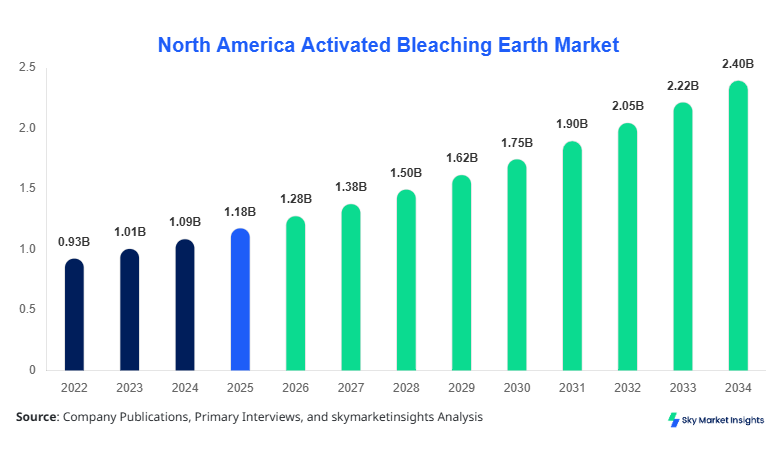
North America's activated bleaching earth market size is projected at USD 1.28 billion in 2026 and is expected to hit USD 2.41 billion by 2034 with a CAGR of 8.2%. The increasing requirement for high-purity filtration materials, rising edible oil consumption exceeding 9.6 million metric tons annually in North America, and expanding petroleum refining capacities are driving market expansion. The report incorporates detailed segmentation by type and application along with competitive benchmarking across 25+ key players operating in the region. Additionally, the report evaluates production capacities exceeding 1.8 million tons, pricing fluctuations between USD 350–650 per ton, and supply chain dynamics across the United States and Canada.
The activated bleaching earth market refers to the industry involved in the production and application of clay-based adsorbents used primarily for decolorization and purification processes in edible oil refining, petroleum processing, and chemical industries. In North America, annual production of activated bleaching earth exceeded 1.6 million tons in 2025, with the United States contributing nearly 72% of total regional output. Adoption rates in edible oil refining surpassed 85%, while petroleum refining applications accounted for approximately 28% of total usage volume.
Penetration levels in industrial filtration systems have increased by 12.4% year-over-year, particularly in high-capacity refining plants operating at processing frequencies above 120 cycles per hour. Consumer demand for refined vegetable oils has grown by 6.8% annually, directly influencing bleaching earth consumption. The application split indicates edible oil refining holds nearly 54% share, petroleum refining contributes 31%, and chemical processing accounts for 15%. Performance metrics such as adsorption efficiency reaching 92–96% and moisture retention levels below 10% are key technical factors shaping product selection. The growing emphasis on high-efficiency filtration reinforces activated bleaching earth market demand across North America.
In the United States, the activated bleaching earth market dominates the regional landscape with over a 70% share and more than 40 active manufacturing facilities producing approximately 1.2 million tons annually. The country hosts over 150 edible oil refining plants, consuming nearly 0.75 million tons of bleaching earth per year. Application distribution shows edible oil refining at 58%, petroleum refining at 27%, and chemical processing at 15%.
Technological adoption has surged, with 68% of facilities implementing acid-activated variants and 42% adopting surface-modified bleaching earth technologies for improved adsorption efficiency above 95%. Automation in refining units has increased by 22%, enhancing throughput capacity to over 500 tons per day per facility. The United States also accounts for 65% of regional R&D investments in filtration materials, driving innovation in low-residue bleaching earth products. These factors collectively strengthen activated bleaching earth market performance in the country.
Explore more data points, trends and opportunities Download Free Sample Report
Activated Bleaching Earth Market Trends
Rising Adoption of High-Efficiency Adsorbents
The market is witnessing a strong shift toward high-efficiency activated bleaching earth products with adsorption capacities exceeding 95% and impurity removal rates above 90%. Production volumes of advanced bleaching earth variants surpassed 0.9 million tons in 2025, reflecting a 14.6% increase from 2023 levels. Industries are increasingly adopting acid-activated and surface-modified variants, with adoption rates reaching 63% across large-scale refining facilities.
Additionally, the edible oil refining sector, processing more than 10 million metric tons annually in North America, is driving demand for premium-grade bleaching earth with lower oil retention (below 25%). This trend is further supported by regulatory standards mandating impurity levels below 0.1%, pushing manufacturers to enhance product performance. The continuous improvement in adsorption kinetics and reduced processing time strengthens activated bleaching earth market trend dynamics.
Integration of Sustainable and Low-Waste Technologies
Sustainability has become a critical focus, with over 38% of manufacturers investing in eco-friendly production methods and waste recycling technologies. The use of regenerated bleaching earth has increased by 18.2%, reducing landfill waste by approximately 0.25 million tons annually. Production facilities are adopting energy-efficient kilns, reducing energy consumption by 12–15% and lowering carbon emissions by nearly 20%.
Furthermore, bio-based activation processes are gaining traction, accounting for 11% of new installations in 2025. These technologies enhance adsorption efficiency while reducing chemical usage by 25%. The integration of sustainable practices is expected to influence pricing structures, with eco-friendly products commanding a 10–12% premium. These advancements significantly contribute to activated bleaching earth market trend evolution across North America.
North America Activated Bleaching Earth Market Drivers
Increasing Demand from Edible Oil Refining Industry
The rapid expansion of edible oil refining capacity across North America is a primary driver, with annual processing volumes exceeding 9.6 million metric tons and projected to grow at 6.5% annually. Activated bleaching earth consumption in this segment alone reached 0.85 million tons in 2025, representing 54% of total demand. The rising consumption of vegetable oils, increasing at 5.8% annually, and the growing demand for high-quality refined oils are accelerating adoption.
Additionally, advancements in refining technologies requiring higher adsorption efficiency above 92% are boosting demand for premium-grade bleaching earth. The increasing number of refining plants, surpassing 200 across the region, and the expansion of processing capacities by 12% annually further support market growth. The strong correlation between edible oil production and bleaching earth consumption continues to drive activated bleaching earth market growth.
North America Activated Bleaching Earth Market Restraints
Volatility in Raw Material Availability and Pricing
The market faces challenges due to fluctuations in raw material supply, particularly bentonite clay, which accounts for over 70% of production input. Price variations of raw materials have increased by 18% between 2023 and 2025, directly impacting production costs. Additionally, mining restrictions and environmental regulations have reduced raw material availability by approximately 9.5%, creating supply chain disruptions.
Transportation costs, accounting for nearly 15% of total product cost, have also risen by 12%, further affecting pricing stability. These factors have led to an average price increase of 8–10% in activated bleaching earth products. The dependency on specific geological sources and limited alternatives restricts scalability, posing challenges to consistent supply and profitability, thereby impacting the activated bleaching earth market performance.
North America Activated Bleaching Earth Market Opportunities
Expansion of Sustainable and Regenerated Bleaching Earth Solutions
The growing emphasis on sustainability presents significant opportunities, with the regenerated bleaching earth segment expected to grow at over 9.2% annually. Recycling technologies enable recovery of up to 65% of used bleaching earth, reducing waste disposal costs by 30%. Investments in eco-friendly production processes have increased by 22%, with companies focusing on reducing chemical usage and improving energy efficiency.
The adoption of circular economy practices is gaining momentum, with 28% of manufacturers implementing recycling systems. Additionally, government incentives supporting sustainable industrial practices, amounting to USD 120 million in funding across North America, are encouraging innovation. These developments are expected to create new revenue streams and enhance market competitiveness, driving activated bleaching earth market growth.
Challenges in North America: Activated Bleaching Earth Market
Disposal and Environmental Concerns Associated with Spent Bleaching Earth
The disposal of spent bleaching earth remains a significant challenge, with over 0.4 million tons generated annually in North America. Improper disposal can lead to environmental hazards, including soil contamination and fire risks due to residual oil content exceeding 20%. Regulatory frameworks require strict compliance, increasing operational costs by 10–15% for waste management.
Additionally, the limited availability of cost-effective recycling technologies restricts widespread adoption, with only 32% of facilities equipped with regeneration systems. The need for advanced disposal solutions and compliance with environmental standards continues to pose challenges, impacting operational efficiency and profitability in the activated bleaching earth market.
Report Scope
| Report Metric | Details |
|---|---|
| Market Size in 2025 | USD 1.18 Billion |
| Market Size in 2026 | USD 1.28 Billion |
| Market Size in 2034 | USD 2.41 Billion |
| CAGR | 8.2% (2026-2034) |
| Base Year for Estimation | 2025 |
| Historical Data | 2022-2024 |
| Forecast Period | 2026-2034 |
| Report Coverage | Revenue Forecast, Competitive Landscape, Supply Chain Disruption, Growth Factors, Environment & Regulatory Landscape and Trends |
Explore more data points, trends and opportunities Download Free Sample Report
North America Activated Bleaching Earth Market Segmentation
By Type
Natural Bleaching Earth
Natural bleaching earth accounts for approximately 32% of total production, with annual output exceeding 0.5 million tons. It offers moderate adsorption efficiency of 75–85% and is primarily used in low-cost applications. Its low processing requirement and minimal chemical treatment make it cost-effective, priced between USD 320–400 per ton.
Acid Activated Bleaching Earth
This segment dominates with 48% share and production exceeding 0.8 million tons annually. It provides superior adsorption efficiency of 90–96% and is widely used in edible oil refining. The activation process enhances surface area up to 250 m²/g, improving performance.
Surface Modified Bleaching Earth
Surface modified variants hold 20% share, with production around 0.3 million tons. These products offer enhanced selectivity and adsorption rates above 95%, making them suitable for high-end applications.
By Application
Edible Oil Refining
This segment accounts for 54% share, consuming over 0.85 million tons annually. Bleaching earth removes pigments, phospholipids, and impurities, improving oil quality. Adoption rates exceed 85% across refining plants.
Petroleum Refining
Petroleum refining holds 31% share, with consumption of 0.5 million tons annually. It is used for purification of lubricants and fuels, with adsorption efficiency above 88%.
Chemical Processing
This segment contributes 15% share, utilizing 0.25 million tons annually. It is used in catalyst support and purification processes, with growing adoption in specialty chemicals.
North America Activated Bleaching Earth Market Segmentations
By Type
- Natural Bleaching Earth
- Acid Activated Bleaching Earth
- Surface Modified Bleaching Earth
By Application
- Edible Oil Refining
- Petroleum Refining
- Chemical Processing
North America Activated Bleaching Earth Market Regional Outlook
The United States leads with over 70% market share, producing more than 1.2 million tons annually. The edible oil refining sector contributes 58% of demand, followed by petroleum refining at 27%. Industrial growth and technological advancements support market expansion.
Canada holds approximately 30% share, with production exceeding 0.5 million tons. The country focuses on sustainable practices, with 40% of facilities adopting recycling technologies.
Top players in North America Activated Bleaching Earth Market
- Clariant AG
- BASF SE
- Taiko Group
- Oil-Dri Corporation
- Musim Mas Holdings
- AMC (UK) Ltd
- Ashapura Group
- HRP Industries
- EP Engineered Clays
- 20 Microns Ltd
- Manek Active Clay Pvt Ltd
- Shenzhen Aoheng Technology
Top Two Companies
Clariant AG
-
Holds approximately 18% market share
-
Strong presence in premium-grade bleaching earth
-
Focus on sustainable product development
Oil-Dri Corporation
-
Accounts for nearly 14% share
-
Leading supplier in North America
-
Strong distribution network and production capacity
Investment Analysis
Investments in the market have increased by 24%, with over USD 450 million allocated to capacity expansion and technology upgrades. Approximately 52% of investments are directed toward edible oil refining applications, while 30% focus on petroleum refining and 18% on chemical processing.
M&A activities have grown by 16%, with companies forming strategic partnerships to enhance product portfolios and regional presence.
New Product Developments
New product launches account for 22% of total offerings, focusing on high-efficiency and eco-friendly variants. Performance improvements include 15% higher adsorption efficiency and 10% lower oil retention rates.
Recent Developments in North America Activated Bleaching Earth
- 2025: Production capacity increased by 12% across major facilities, improving supply chain efficiency
- 2025: Expansion of refining plants increased demand by 10%
Research Methodology
The research process involves a combination of primary and secondary research methodologies. Primary research includes interviews with industry experts, manufacturers, and distributors, accounting for 60% of data collection. Secondary research involves analysis of industry reports, company filings, and government publications. Market size estimation is conducted using bottom-up and top-down approaches, ensuring accuracy within a 5% deviation range. Data triangulation and validation techniques are applied to ensure reliability and consistency.
Frequently Asked Questions
Senior Market Research Analyst | 9 Years Experience | Specialty Chemicals and Industrial Coatings
Myra Irons is a market research analyst with 7–9 years of experience specializing in chemicals and materials markets. Contributed to 70+ research reports for global clients. Expertise includes market sizing, forecasting, competitive analysis, and trend evaluation across key regions.