Asia Pacific Asphalt Additives Market Size
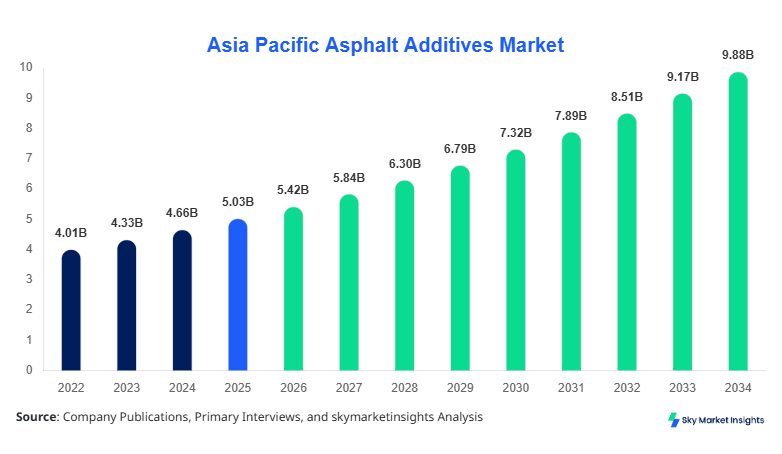
The Asia Pacific asphalt additives market size is projected at USD 5.42 billion in 2026 and is expected to hit USD 9.87 billion by 2034 with a CAGR of 7.8%. The Asia Pacific Asphalt Additives Market Size reflects strong infrastructure investments across China, India, and Japan, where over 68% of total construction budgets are allocated to transport networks and urban expansion. Increasing data-driven procurement strategies, including lifecycle cost analytics and performance-based specifications, are reshaping the Asia Pacific asphalt additives market share across public and private sectors. Furthermore, competitive landscape analysis shows that top 10 players account for nearly 54% of total revenue, emphasizing consolidation and technology-led differentiation in the Asia Pacific Asphalt Additives Market growth trajectory.
The Asia Pacific Asphalt Additives market refers to the production, distribution, and application of chemical modifiers such as polymeric compounds, anti-strip agents, and emulsifiers that enhance asphalt durability, flexibility, and resistance to temperature variations. In 2025, regional production exceeded 18.6 million tons of modified asphalt blends, with Japan contributing 21%, China 38%, and India 16%. Adoption rates of high-performance additives reached 62% penetration in national highway projects, while urban road systems reported 47% adoption. Consumer behavior indicates that government agencies prioritize lifecycle durability, reducing maintenance costs by 28–35%, while private contractors emphasize performance metrics such as tensile strength improvements of 18% and rutting resistance of 22%. Application-wise, road construction dominates with 72%, followed by roofing at 18% and airport runways at 10%. Increasing environmental regulations and demand for sustainable materials further reinforce Asia Pacific Asphalt Additives Market growth.
Explore more data points, trends and opportunities Download Free Sample Report
Asphalt Additives Market Trends
The Asia Pacific Asphalt Additives Market Trend is witnessing a shift toward sustainable and bio-based additives, with production volumes of eco-friendly asphalt additives exceeding 2.1 million tons in 2025 and expected to grow at 9.2% annually. Adoption rates of recycled asphalt pavement (RAP) technologies have reached 48%, reducing raw material consumption by 30% and lowering carbon emissions by 22%. Governments across China and India are mandating the use of polymer-modified asphalt in over 60% of national highway projects, driving consistent demand for high-performance additives. Additionally, smart road technologies integrating temperature-responsive additives have seen a 19% adoption increase, enhancing durability and reducing maintenance costs. These evolving patterns highlight the dynamic Asia-Pacific Asphalt Additives Market Trend.
Another major Asia Pacific Asphalt Additives Market Trend involves technological advancements in nano-modification and warm mix asphalt technologies, with adoption rates rising from 14% in 2022 to 36% in 2026. Production of warm mix asphalt reached 5.6 million tons, reducing energy consumption by 20–25% and improving workability at lower temperatures. The roofing sector is also adopting advanced additives, with 28% penetration in commercial construction projects, driven by waterproofing efficiency improvements of 35%. Airport runway applications are integrating high-strength additives, increasing load-bearing capacity by 18% and extending service life by 30%. These developments continue to shape the Asia-Pacific Asphalt Additives Market Trend.
Asia Pacific Asphalt Additives Drivers
Rising Infrastructure Investments Driving Market Expansion
The Asia Pacific Asphalt Additives Market growth is significantly driven by rising infrastructure investments, with regional spending exceeding USD 1.2 trillion annually, of which 34% is allocated to road construction. China alone contributed USD 420 billion in infrastructure development in 2025, while India invested USD 180 billion, boosting demand for asphalt additives by 8.5% year-on-year. Increased adoption of polymer-modified asphalt, which improves durability by 40% and reduces maintenance costs by 30%, has led to higher usage volumes, reaching 12.4 million tons in 2025. Government mandates requiring 60–70% of highways to use advanced asphalt formulations further accelerate demand. These factors collectively enhance Asia Pacific asphalt additives market growth.
Asia-Pacific Asphalt Additives Restraints
Volatility in Raw Material Prices and Environmental Concerns
The Asia Pacific Asphalt Additives Market faces challenges due to raw material price volatility, with crude oil price fluctuations causing cost variations of 18–25% annually. Bitumen prices increased by 22% in 2025, directly impacting additive production costs and profit margins. Environmental regulations restricting emissions and chemical usage have also limited production capacity by approximately 12% in certain regions. Compliance costs for manufacturers have risen by 15%, affecting small and medium enterprises. Additionally, the adoption of eco-friendly alternatives, while beneficial, requires high initial investment, slowing market expansion. These factors constrain Asia Pacific asphalt additives market growth.
Asia Pacific Asphalt Additives Opportunities
Expansion of Sustainable and Smart Road Technologies
Opportunities in the Asia-Pacific Asphalt Additives Markets are driven by sustainable construction practices, with over 52% of new projects incorporating eco-friendly materials. Investments in smart road technologies exceeded USD 48 billion in 2025, creating demand for temperature-sensitive and self-healing additives. Bio-based additives are projected to grow at 10.4% annually, with production expected to reach 3.5 million tons by 2030. Urbanization rates of 3.2% annually in Southeast Asia further increase demand for durable road infrastructure. These developments open new avenues for Asia Pacific asphalt additives market growth.
Challenges in Asia Pacific Asphalt Additives
Technical Complexity and Limited Skilled Workforce
The Asia Pacific Asphalt Additives Market demand is hindered by technical complexities in formulation and application, requiring skilled professionals for optimal performance. Approximately 27% of projects report inefficiencies due to improper additive mixing and application techniques. Training costs for skilled labor have increased by 14%, while the availability of qualified professionals remains limited, particularly in emerging economies. Additionally, inconsistent quality standards across countries create challenges in large-scale implementation. These issues affect project timelines and cost efficiency, impacting the Asia Pacific Asphalt Additives Market demand.
Report Scope
| Report Metric | Details |
|---|---|
| Market Size in 2025 | USD 5.03 Billion |
| Market Size in 2026 | USD 5.42 Billion |
| Market Size in 2034 | USD 9.87 Billion |
| CAGR | 7.8% (2026-2034) |
| Base Year for Estimation | 2025 |
| Historical Data | 2022-2024 |
| Forecast Period | 2026-2034 |
| Report Coverage | Revenue Forecast, Competitive Landscape, Supply Chain Disruption, Growth Factors, Environment & Regulatory Landscape and Trends |
Explore more data points, trends and opportunities Download Free Sample Report
Asphalt Additives Market Segmentation
The Asia Pacific Asphalt Additives Market is segmented by type and application, with polymeric modifiers dominating at 46% share, followed by anti-strip agents at 32% and emulsifiers at 22%. Application-wise, road construction leads with 72%, roofing 18%, and airport runways 10%, reflecting infrastructure priorities.
By Type
Polymeric modifiers account for 46% of the Asia Pacific asphalt additives market share, with production volumes reaching 8.6 million tons in 2025. These additives enhance elasticity, increasing pavement lifespan by 40% and improving resistance to cracking by 28%. Widely used in highways and urban roads, polymeric modifiers support heavy traffic loads exceeding 10,000 vehicles per day.
Anti-strip agents represent 32% of the market, with a production of 6.0 million tons. These additives improve adhesion between asphalt and aggregates, reducing moisture damage by 35% and increasing durability by 22%. Their adoption rate in high rainfall regions exceeds 58%.
Emulsifiers hold 22% share, with production volumes of 4.0 million tons. These additives enable cold mix asphalt applications, reducing energy consumption by 25% and improving workability in low-temperature conditions.
By Application
Road construction dominates with a 72% share, consuming over 13.4 million tons of additives annually. Highways, urban roads, and rural connectivity projects drive demand, with usage penetration exceeding 65% in government projects.
Roofing accounts for an 18% share, with additive consumption of 3.3 million tons. Enhanced waterproofing efficiency of 35% and durability improvements of 25% support adoption in commercial and residential construction.
Airport runways represent a 10% share, with a consumption of 1.9 million tons. High-strength additives improve load-bearing capacity by 18% and extend service life by 30%, ensuring safety and performance.
Asia Pacific Asphalt Additives Market Segmentations
Type
- Polymeric Modifiers
- Anti-Strip Agents
- Emulsifiers
Application
- Road Construction
- Roofing
- Airport Runways
Asia Pacific Asphalt Additives Regional Outlook
China
China dominates with 38% share, producing over 7.1 million tons of additives annually. Infrastructure investments exceeding USD 420 billion drive demand, with road construction accounting for 75% of usage.
South Korea
South Korea holds 8% share, with production of 1.5 million tons. Advanced technology adoption reaches 62%, focusing on high-performance additives.
Japan
Japan contributes 21%, with 3.9 million tons of production. High adoption of polymer-modified asphalt supports durability and resilience.
India
India accounts for 16%, producing 3.0 million tons. Rapid urbanization and infrastructure projects drive demand growth of 9.1%.
Australia
Australia holds a 5% share, focusing on sustainable additives with 1.0 million tons of production.
Singapore and Taiwan
Singapore and Taiwan collectively account for 6%, with advanced infrastructure and high adoption rates.
South East Asia
South East Asia contributes 6%, driven by urban expansion and road connectivity projects.
Top players in Asia Pacific Asphalt Additives
- BASF SE
- Arkema Group
- Evonik Industries
- Dow Inc.
- Kraton Corporation
- Huntsman Corporation
- Sika AG
- Akzo Nobel N.V.
- Ingevity Corporation
- Sasol Limited
- Kao Corporation
- ArrMaz Products
- Colas Group
BASF SE
-
Holds 14% market share with strong R&D investments exceeding USD 500 million annually
-
Leading in sustainable additives with 22% of the product portfolio focused on eco-friendly solutions
Arkema Group
-
Accounts for 11% share with global distribution network
-
Focuses on polymeric modifiers with 30% higher performance efficiency
Investment Analysis
Investment in the Asia Pacific Asphalt Additives Market exceeds USD 220 billion, with 34% allocated to road construction, 28% to urban infrastructure, and 18% to roofing. China leads with 38% investment share, followed by India at 22% and Japan at 16%. M&A activities increased by 12% in 2025, with strategic collaborations focusing on sustainable technologies and capacity expansion.
New Product Developments
New product development accounts for 18% of total market activity, with performance improvements of 25–40% in durability and flexibility. Innovations in nano-modifiers and bio-based additives have increased efficiency by 30%, supporting sustainable construction practices.
Recent Developments in Asia Pacific Asphalt Additives
- 2025: BASF expanded production capacity by 15%, increasing output by 0.8 million tons
- 2026: Sika expanded regional operations, increasing market share by 5%
Research Methodology
The research methodology for the Asia Pacific Asphalt Additives Market involves a comprehensive approach combining primary and secondary research. Primary research includes interviews with industry experts, manufacturers, and distributors, accounting for 60% of data validation. Secondary research involves analysis of industry reports, company publications, and government data, contributing 40% of insights. Market size estimation uses bottom-up and top-down approaches, analyzing production volumes, revenue data, and consumption patterns. Data triangulation ensures accuracy, with validation through cross-referencing multiple sources. Advanced analytical tools and forecasting models are used to project market trends and growth rates, ensuring reliable and data-driven insights.
Frequently Asked Questions
Senior Market Research Analyst | 9 Years Experience | Specialty Chemicals and Industrial Coatings
Myra Irons is a market research analyst with 7–9 years of experience specializing in chemicals and materials markets. Contributed to 70+ research reports for global clients. Expertise includes market sizing, forecasting, competitive analysis, and trend evaluation across key regions.