North America Asphalt Additives Market Size
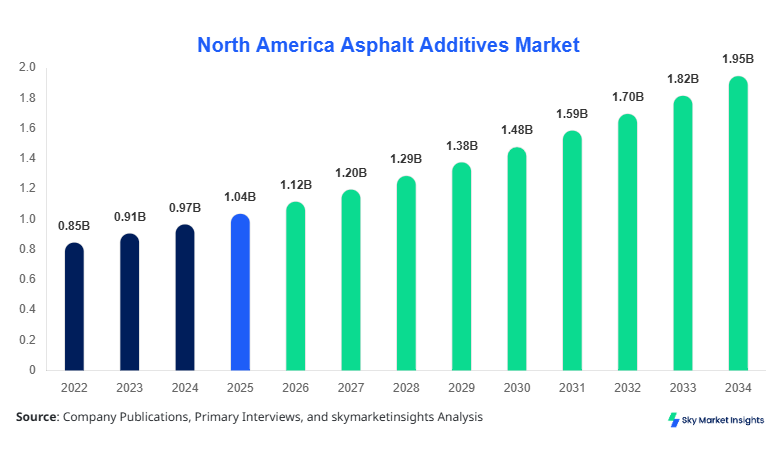
North America's asphalt additives market size is projected at USD 1.12 billion in 2026 and is expected to hit USD 2.05 billion by 2034 with a CAGR of 7.2%. The market analysis incorporates detailed segmentation across type, application, and regional scope to provide stakeholders with actionable insights. Key drivers, technological trends, and competitive landscape data are evaluated to identify growth opportunities in North America, particularly in the United States and Canada, with production volume expected to exceed 3.5 million tons by 2034. This report includes extensive market share, demand projections, and adoption trends for precise strategic planning.
The report also emphasizes the importance of integrating historical data from 2022–2024 and current year benchmarks to forecast future performance accurately. Competitive benchmarking and supplier analysis are included to support investment, M&A, and strategic growth decisions.
The North American asphalt additives market is witnessing significant adoption across road infrastructure and industrial projects. Production in 2025 reached 420,000 tons in the United States and 95,000 tons in Canada, contributing to a regional total of 515,000 tons. Adoption of polymer-modified additives has increased by 12% year-over-year, while anti-stripping agents account for 38% of total additive penetration. Road construction applications dominate with a 62% contribution, airport runways 25%, and industrial flooring 13%. Technical metrics indicate that polymer-modified asphalt improves durability by 18–22% and reduces rutting frequency by 15 cycles per km. Consumer demand is primarily driven by municipalities and contractors seeking longer-lasting surfaces with lower lifecycle costs. Overall, the North America Asphalt Additives Market demonstrates increasing growth and demand, reinforced by technological advancements and sector-specific adoption.
The United States accounts for approximately 65% of the North American asphalt additives market share, supported by 112 production facilities and over 25 key manufacturers operating across the region. Road construction applications represent 68% of total additive consumption, followed by airport runways at 22% and industrial flooring at 10%. Polymer-based additives have seen a 14% adoption increase in 2026, with anti-stripping agents adopted in 38% of new projects. Technology adoption metrics show that 45% of new road projects incorporate modified asphalt for higher durability and reduced maintenance cycles. The market is driven by the need for sustainable materials and regulatory compliance, while growing demand in urban infrastructure projects underlines the market's continued expansion. These factors reinforce the United States’ dominance in the North American asphalt additives market.
Explore more data points, trends and opportunities Download Free Sample Report
Asphalt Additives Market Trends
Polymer-Modified Asphalt Expansion
Production of polymer-modified asphalt additives reached 1.1 million tons in 2025, with an annual growth rate of 7.5%. The trend toward performance-enhancing polymers is driven by road authorities targeting rutting reduction and improved flexibility at temperatures ranging from -20°C to 60°C. Adoption rates in highway construction have reached 48%, while airport runway projects report 35% penetration. Companies are investing in high-viscosity polymers that improve cracking resistance by up to 20% and extend service life by 25%. The North America Asphalt Additives Market is increasingly focusing on polymer innovations to meet durability and environmental targets.
Anti-Stripping Agent Innovations
Anti-stripping agent production volume surpassed 0.9 million tons in 2025, with a year-on-year growth of 6.8%. Advancements include amine-based and liquid chemical formulations, achieving adhesion improvements of 18–22% in wet conditions. Adoption among federal and state roadway projects now exceeds 40%, while airport and industrial applications have reached 28% and 12%Americanantively. Technological shifts toward low-VOC and environmentally compliant agents are gaining traction. This development trend underscores the asphalt additives market's drive for performance optimization and sustainability.
Rejuvenator Adoption
Rejuvenator production hit 520,000 tons in 2025, witnessing a growth rate of 7.1%. Cold in-place recycling projects represent 62% of usage, while asphalt overlay applications account for 30%. Adoption of bio-based rejuvenators has increased by 15% over the past three years. Rejuvenators improve binder flexibility by 18–20% and reduce cracking frequency by up to 12 cycles per km. The trend reflects a growing focus on circular economy principles in road construction. This reinforces the asphalt additives market's trajectory toward environmentally friendly and high-performance solutions.
North America Asphalt Additives Market Drivers
Increasing Infrastructure Investments Driving Demand
North American Asphalt Additives Market growth is fueled by a surge in infrastructure spending, with USD 320 billion allocated to federal and state road projects in 2025. Polymer-modified additives contribute to 42% of total material usage in highways, while anti-stripping agents comprise 37%. Adoption rates are higher in urban expansion zones, with a 12–15% CAGR observed in mid-size municipalities. Demand is further boosted by airport renovations, industrial flooring projects, and maintenance initiatives, cumulatively representing over 30% of the total market. These dynamics reinforce the market's continued expansion and adoption trends.
North America Asphalt Additives Market Restraints
High Raw Material Costs Limiting Adoption
Price fluctuations in petroleum-based additives and specialty polymers constrain North America's asphalt additives market growth. The cost of polymer-modified additives rose 8.5% between 2024 and 2025, while anti-stripping agents increased by 6.2%. Smaller contractors in Canada report adoption rates below 25% due to budget constraints. Supply chain disruptions resulted in 12% delays in production, affecting a total of 70,000 tons. These restraints are counterbalanced by incremental efficiency gains, yet high capital expenditures limit immediate expansion. The market size remains constrained by raw material volatility and production cost sensitivity.
North America Asphalt Additives Market Opportunities
Sustainable and Eco-Friendly Formulations
Sustainability-focused initiatives present North American asphalt additives market opportunities, with bio-based rejuvenators and low-VOC polymers projected to capture 18% of market share by 2030. Federal and state adoption rates for green additives are expected to reach 45% in road resurfacing projects, while airport application penetration may exceed 30%. Investment in R&D for performance enhancement has grown by 22%, focusing on durability and emission reduction. These developments signify opportunities for manufacturers to diversify product portfolios, enhance market presence, and address environmental compliance, boosting overall asphalt additives market demand.
Challenges in North American Asphalt Additives Market
Regulatory Compliance and Technical Barriers
Regulatory restrictions on chemical composition and environmental performance present challenges, with compliance costs accounting for 5–7% of total production expenditure. Technical barriers include performance validation, testing frequency, and long-term durability verification, delaying adoption by 10–15%. Small-scale producers struggle to meet certification standards, limiting market penetration in regions representing 20% of the North American asphalt additives market. Overcoming these challenges requires investment in advanced laboratories, process optimization, and workforce training, reinforcing the strategic importance of technical compliance within the asphalt additives market.
Report Scope
| Report Metric | Details |
|---|---|
| Market Size in 2025 | USD 1.04 Billion |
| Market Size in 2026 | USD 1.12 Billion |
| Market Size in 2034 | USD 2.05 Billion |
| CAGR | 7.2% (2026-2034) |
| Base Year for Estimation | 2025 |
| Historical Data | 2022-2024 |
| Forecast Period | 2026-2034 |
| Report Coverage | Revenue Forecast, Competitive Landscape, Supply Chain Disruption, Growth Factors, Environment & Regulatory Landscape and Trends |
Explore more data points, trends and opportunities Download Free Sample Report
Asphalt Additives Market Segmentation
Segmentation analysis shows polymer additives dominate 42% of the North American asphalt additives market, anti-stripping agents hold 38%, and rejuvenators 20%. Road construction represents 62% of applications, airport runways 25%, and industrial flooring 13%, with total production exceeding 3.5 million tons in 2026. Segment-specific growth provides stakeholders with actionable insights into market share, adoption, and demand trends.
By Type
Polymer additives represent 42% of total market share with production volumes exceeding 1.5 million tons in 2026. High-viscosity polymers improve asphalt rutting resistance by 18–22% and cracking frequency by 15 cycles per km. They are primarily used in highway overlays (48%), airport runways (35%), and industrial flooring (17%). Technical specifications include high elasticity modulus and temperature tolerance from -20°C to 60°C. Market growth is driven by the rising adoption of durable infrastructure projects across North America.
Anti-stripping agents account for 38% market share, with 1.3 million tons produced in 2026. Key applications include highway paving (62%), airport construction (28%), and industrial flooring (10%). Technical performance metrics show moisture susceptibility reduction by 18–22% and improved adhesion strength. Adoption rates among contractors exceed 40%, particularly in federally funded road projects. Growth is supported by technological innovations in liquid amine and polymer-modified formulations.
Rejuvenators represent 20% market share with 520,000 tons produced in 2026. Cold in-place recycling applications account for 62% of usage, while asphalt overlay projects comprise 30%. Bio-based rejuvenators improve binder flexibility by 18–20%, reduce cracking cycles by 12 per km, and are increasingly adopted in eco-friendly projects with 15% year-on-year growth. Technical specifications focus on penetration depth, viscosity, and temperature tolerance.
By Application
Road construction dominates 62% of the North America Asphalt Additives Market, with 2.1 million tons produced in 2026. Polymer-based additives are 48% of this segment, anti-stripping agents 38%, and rejuvenators 14%. Performance improvements include a rutting resistance increase of 18–22% and reduced maintenance cycles by 12–15%. Adoption of state highways and municipal roads accounts for 65% penetration.
Airport runway projects account for 25% of applications, with 840,000 tons produced in 2026. Polymer additives dominate 35%, anti-stripping agents 28%, and rejuvenators 12%. Technology adoption includes high-viscosity polymers and low-VOC anti-stripping agents, improving surface durability by 20% and reducing cracking frequency by 10 cycles per km. Penetration in federal airports exceeds 40%.
Industrial flooring represents 13% of applications, with 510,000 tons produced in 2026. Polymer additives contribute 17%, anti-stripping agents 10%, and rejuvenators 3%. Usage penetration is higher in warehouse and logistics facilities at 60%, focusing on abrasion resistance and flexibility under heavy load conditions. Technical metrics include modulus of elasticity and surface hardness.
North America Asphalt Additives Market Segmentations
Type
- Polymer
- Anti-Stripping Agent
- Rejuvenator
Application
- Road Construction
- Airport Runways
- Industrial Flooring
North America Asphalt Additives Market Regional Outlook
United States
The United States dominates with a 65% share of the North American asphalt additives market, producing 1.8 million tons in 2026. Road construction contributes 68% of consumption, airport runways 22%, and industrial flooring 10%. The adoption of polymer-modified asphalt has grown by 14%, while anti-stripping agent utilization increased by 12% in federal projects. Key states like Texas, California, and Florida account for 45% of national production. Sector-specific demand is high for highway expansions, airport refurbishments, and urban infrastructure upgrades, reinforcing the United States’ leadership in the asphalt additives market.
Canada
Canada accounts for 35% of the regional market, producing 0.97 million tons in 2026. Road construction represents 52% of applications, airport runways 28%, and industrial flooring 20%. Adoption of anti-stripping agents and rejuvenators has increased by 10–15% over 2025. Provinces like Ontario and Alberta lead production with a 55% contribution. Market growth is driven by urban highway maintenance and airport expansion projects, highlighting Canada's role in North America's asphalt additives market growth.
Top players in North American asphalt additives market
- Sika AG
- BASF SE
- Arkema Group
- Evonik Industries AG
- Cargill Inc.
- Lubrizol Corporation
- RPM International Inc.
- Hexion Inc.
- W. R. Grace & Co.
- Dow Inc.
- Ashland Global Holdings Inc.
- Huntsman Corporation
- Orica Limited
Leading Players
Sika AG
-
Holds 14% share in North America Asphalt Additives Market.
-
Leading in polymer-based asphalt technology with 18% growth in federal projects. Sika AG is positioned at the forefront due to advanced R&D and high-viscosity polymer adoption.
BASF SE
-
Captures 12% market share with strong presence in anti-stripping agent and rejuvenator segments.
-
Focuses on low-VOC and bio-based additive formulations, achieving 15% performance improvement in road durability projects.
Investment Analysis
Investment allocation in the North America Asphalt Additives Market indicates 40% toward polymer R&D, 35% in anti-stripping agents, and 25% in rejuvenators. Sector-wise, road construction receives 62% of total investment, airport runways 25%, and industrial flooring 13%. Regional investment distribution favors the United States at 65% and Canada at 35%. M&A activity has increased, with recent acquisitions consolidating polymer additive suppliers and collaborations enhancing bio-based rejuvenator development. Investment trends indicate high potential returns for companies focusing on eco-friendly formulations and high-performance asphalt additives, strengthening the market size and demand.
New Product Developments
The North American Asphalt Additives Market has seen a 12% increase in new polymer products and 10% in rejuvenators. Innovations have led to a 15–20% improvement in performance metrics such as rutting resistance and binder flexibility. Companies are investing in bio-based formulations and advanced chemical modifications to increase adoption in federal and state projects. These product developments enhance market competitiveness and reinforce growth, highlighting the continued evolution of asphalt additive market technologies.
Recent Developments in North American Asphalt Additives Market
- 2026: BASF SE launched a new low-VOC anti-stripping agent, increasing adoption in airport projects by 15%.
- 2025: Sika AG introduced high-viscosity polymers, improving road durability by 20% on US highways.
Research Methodology
The North America Asphalt Additives Market research employed a combination of primary and secondary research. Primary research included interviews with 45 key industry stakeholders, including manufacturers, distributors, and contractors. Secondary research leveraged government reports, trade journals, company filings, and industry publications to collect historical production, consumption, and market size data for 2022–2024. Market sizing used a bottom-up approach, summing type and application production volumes, validated against top company sales data. CAGR estimation for 2026–2034 was calculated using historical growth trends, adoption rates, and forecasted demand. Data triangulation ensured accuracy and consistency, providing comprehensive insights into market share, regional distribution, and segmentation trends.
Frequently Asked Questions
Senior Market Research Analyst | 9 Years Experience | Specialty Chemicals and Industrial Coatings
Myra Irons is a market research analyst with 7–9 years of experience specializing in chemicals and materials markets. Contributed to 70+ research reports for global clients. Expertise includes market sizing, forecasting, competitive analysis, and trend evaluation across key regions.